Tag Archives: ministry

Remember the ‘Why?’ of Church – Pastor Thoughts

As you may have read last time, I spent last week in the mountains at the Alberta Study Conference. It is an annual event in Canmore (a beautiful little mountain town just outside of Banff), which is always a treat to visit. 

Study conferences are a chance to hear keynote speakers, spend time with friends and colleagues, and have the chance to get away for a bit. All important parts of finding some rest and rejuvenation in ministry, or really any vocation. 

But the other piece is having the change to step back and look at things with perspective. It is easy to get mired in the details and day-to-day of things, so taking intentional time to step back and ask some of the bigger questions is vital. Plus being surrounded by mountains has a natural way of granting some helpful perspective. 

Church life can be a race from Advent to Easter, a marathon and a sprint combined, that you are always feeling like you need to catch up. I was fortunate last week to have some good conversations with colleagues about ministry and to take the chance to sit with my thoughts. 

A lot of the conversation was centered on the fact that the church has a lot on our plate these days, change management chief among them. But along with navigating all the change that we facing, it is easy for us to forget why we are doing all this in the first place. 

This notion was confirmed again at our local clergy meeting here in Winnipeg this week. The Bishop remarked that 2023 will be a big year for the church, with several congregations facing big challenges and decisions. Change is happening already. But, along with the challenges due to pandemic, general decline, an aging population that isn’t replacing itself (our birthrate is only 1.4 in Canada!), climate change, political unrest, economic inequality and so on, the church seems to have difficulty articulating the purpose at our core. We can get so fixated on making sure we can keep the lights on, pay the insurance, fill council spots, print bulletins, find Sunday School teachers, etc., that we forget that all of those things actually have very little to do with our core mission. We aren’t communities whose core purpose is having money in offering plates, well maintained buildings and full council/committee rosters. 

Rather, all of those things are secondary or tertiary to why we exist. Offering and committees and buildings are simply the means to the end of “Church.” Our central purpose is to proclaim the Gospel, to tell the world of the Good News of Christ’s death and resurrection. 

Still, it can be hard to really know what that means. How do we proclaim that? Why is this 2000-year-old story important? It feels more concrete to focus on cleaning carpets, making sure the snow is shovelled and filling volunteer roles. 

I am someone who believes that we cannot talk enough about those big picture pieces that sit at the core of our being. Why Church? Why Jesus? Why the Bible? Why is all of that so important?

This Lent, we will be having Soup+Bread Studies after worship and we will talk about these questions. We will take the time to articulate – to say out loud again in conversation – why being a community of faith in this time and place is important, and why budgets, buildings and volunteers are needed to keep the church going. Not because we need budgets, buildings and volunteers, but because we are human beings living in a messy world in need of hope and light. Hope and Light that is found in the Gospel message heard in communities of faith just like ours. 

As we approach Annual Meeting Season, Transfiguration Sunday and Lent, I encourage you to take the time to get some perspective, to ponder ‘Why Church?’ and to be reminded of what the central things of faith are for us. 

Maybe that will be at our Soup+Bread study, maybe that will be by taking some time in prayer and scripture, maybe that is what we will be experiencing the entire Ash Wednesday-Lent-Holy Week cycle of worship or maybe it will be in another individual way. However you find that perspective, know that it will help you and us in following God’s call to whatever the church is going to go next, wherever God is calling us to follow in 2023 and beyond. 

Do we still feel called to this? – Pastor Thoughts

I have been thinking a lot about call lately. 

As in, you know, being “Called” to ministry. 

For most pastors, deacons and bishops, the sense of call to ministry isn’t a one-and-done kind of thing. It isn’t like turning on a light switch, but more a constant state of wrestling and wondering. Asking oneself “Am I still called to do this?” is always part of the gig. 

In recent years more than ever, I have watched clergy do a lot of wondering. From friends and colleagues, to clergy bloggers and writers… a lot of us are wondering if our sense of calling is sustainable through all the challenges facing the church. A lot of people are deciding it isn’t, and they are leaving ordained ministry for other work. 

Certainly, in the past number of years I have had my own moments of wondering how my calling to serve continues to fit in with where the church is at. 

That being said, I might be one of the worst examples of Pastors to talk to about wrestling with being called. I used to joke in seminary that I was born into the “Norwegian Lutheran Pastors Breeding Program.”

My grandfather was a pastor. So was his brother. And his brother-in-law. His closest friends were also pastors. Growing up, “church” was something that my immediate and extended family was always involved in. And wherever we traveled there were usually some church or pastor or church folks that we knew.  

For me, going to seminary and becoming a pastor was a possibility that was known from an early age. From when I played pastor dressup as a two -year-old, to career shadowing my pastor in grade 9,  to serving on council when I was 18, to working at camp throughout my university years, and to attending campus ministry, I always knew that being a pastor was an option and one that I wanted to pursue. 

But my story is uncommon. Lots of those called to ministry take very different routes. Some need the right encouragement at the right time, or need to get connected and involved in a church community at the right moment to be opened up to the idea of ordained ministry. Some go to seminary just to learn more and end up pursuing ordination. Some only experience that call later in life after establishing a first career or other vocation. 

This week, Jesus calls Peter and Andrew from their fishing boats, and they immediately drop their nets and follow. If only it were so simple. 

Though we tend to talk about calling as it relates to pastors, we are NOT the only ones called by God to serve. The call to follow, the call to minister is a calling given to all the baptized. We are ALL called to follow Jesus into the service of the Kingdom of God. We are ALL called to do our part in making sure the Gospel is preached to the world around us. 

In many ways it is this sense of call that I wrestle with the most. Are there enough of us who feel this baptismal call to be church together? Do churches today have enough motivation to pursue this ministry of the Kingdom of God?

“Being Church” is harder than it has been in a long time. For a while now, we have been finding ways to keep doing what we have been doing with fewer resources, smaller budgets and fewer people. But we are getting to the point where that is almost too exhausting to continue. The time has come for us now to be creative in finding new ways to organize ourselves. We need to be willing to change and adapt, to work with others around us in ways we didn’t have to consider before. The alternative is that keeping on as we are or trying to bring back what we used to be will overwhelm our diminishing resources. The models of church that we are used to – a church on every street corner doing all the same things that the church on the next street corner is doing – don’t serve us well anymore. 

Do we hear God’s call to adapt and change to the new thing? Or are we more committed to holding on to what we once had? The answers to these questions are complicated. 

What does it mean for us to be called these days? And what does “following” look like? I have been circling around these questions since I was two years old… and my sense of the answers are as unclear to me as ever.

And yet in the strangest way, I think I might be as intrigued and excited to explore their answers as I have ever been. In all my time wrestling with being called and what it means to be called, the potential of what the future could be is as great as ever. People and congregations are open to new things in ways that felt unimaginable just a few years ago. God is calling us and we are being invited to explore what that means for us and how we might follow, even as where we are going and how we will get there is still being revealed to us. 

The time it takes to figure church out – Pastor Thoughts

“Come and See”

This last week’s Gospel lesson from John contains this phrase. While maybe it doesn’t jump out a first, there are some preachers and scholars out there who say that John is the Gospel of “Come and See.”

Other scholars have described it as “Word and Sign.” 

Both are shorthand ways of saying that in John’s Gospel there is a repeating pattern of Jesus inviting people (the disciples, crowds, the religious authorities) to believe that he is the Messiah (Word) and when they hesitate, Jesus reveals who he is with a miracle or other divine act (Sign). 

This dynamic plays out most clearly in the story of Lazarus. Jesus comes late to heal Lazarus and so Lazarus’ sister Mary meets Jesus on the road. When she points out that Jesus could have done something to prevent Lazarus’ death, Jesus reminds her that HE is the resurrection and the life (Word). But then when they get to the tomb, Mary objects to the stone being rolled away because there will be a smell (hesitation). But Jesus commands it anyway, and out walks Lazarus (Sign). 

“Come and See” is the phrase that describes that invitation between the Word and the Sign, the invitation given just at the moment when we might be hesitating to believe that Jesus is who he says he is. 

This pattern that John lifts up is a way to make the Gospel all the more compelling. John recognizes that most of the people who come after him won’t be able to watch Jesus in action the way the disciples and crowds did. But if we can see ourselves in their hesitation then maybe we will see that the only necessary part is the Word. We will hear the Good News and come to faith. John basically says this at the end of his Gospel. 

While I think one of the challenges to faith in a world confident that science and technology will save us, is precisely the lack of “signs.” I also think that this dynamic of “Come and See” is a part of our lives and communities as Christians and as people of faith. 

It is just that the signs might not be what we expect. We are probably not going to head over to the local cemetery and see someone hop out of a casket.

But in our communities of faith we DO see people who are healed and brought to new life all the time. People who are dead in loneliness or isolation, people who are broken by fractured family relationships, people who have suffered illness and disease, who, by being a part of church communities, find hope and life and peace. 

We see people who hear the “Gospel Word” and are transformed into new creations. Who are so captured by the good news of Jesus’ love for them that it changes them to the core. 

In the past few months, I have been watching one such transformation in my own family. My son, who is 8, has been attending church almost weekly his whole life (pandemic lockdowns not withstanding). And of course he was a baby, a toddler, or little kid for a lot of that time. This past fall, he has begun telling me that he likes my sermons, not every week, but once in a while. I have asked him what he likes, and he has been able to tell me very accurately what my sermon for a particular Sunday was about. And over the Christmas season, I had the opportunity to sit with him in the pew for a few services. Together we found the hymns in hymnbooks and I taught him how to follow the verses of hymns. We followed the litany and psalm together, learning which lines were for us to say. We talked about the different parts of worship, as in when to stand (when we sing, pray and hear the Gospel) and when we sit (all other times). He often will sing liturgical songs at home (“This is feast!”) or repeat other liturgical responses at home. 

It only took him eight and a half years of attending church for it to take (especially since learning to read in the last two years). And, all of a sudden, worship and church and being together with all the people he knows at church (two churches!) have imparted to him that faith is important, that what God has to say to him and about his world and life is important, and that worshipping in community is important. 

“Come and See” is an invitation to witness how the Word of God is doing incredible things in our world and in our lives. Maybe as we start this New Year together, 2023 will be a year to “Come and See.’

The extravagance of a baptism – Pastor Thoughts

Baptisms are one of my favourite things to do as a pastor. I have been privileged to preside at many over the years.

For most families coming for baptism, I have made the point of meeting with the family ahead of time to talk about the meaning, reasons, symbols and images of the rite. Baptisms present shameless opportunities to invite myself into the home of all kinds of folks for an hour, often people who might only be connected to church through grandparents, and talk about Jesus, faith and what it means to be a Christian.

(As an aside, if anyone thinks that pastors have a magical power to convince people to come to church, we don’t. Of all these pre-baptismal meetings I have done, the families who were actively engaged before remained so. And the families who weren’t active or who were even unchurched, also remained so. But I have seen many church members invite family, friends and neighbours to church who then became active members themselves.)

Pre-baptismal meetings have been great conversations about faith, about how we see God active in our lives and how families hope to see God active in the lives of their children. We also unpack the subtle but rich symbols of baptism: Water, Word, Oil and Candle. (Ask about an adult study if you want to know more!)

Equally as exciting is the baptismal rite in worship itself. Baptisms, though seemingly brief, are packed with liturgical action. There is the litany of questions and promises, the “flood prayer” declaring God’s actions and promises made in water, the “washing” of the candidate, the laying on of hands, the anointing with oil and the candle lit from the light of the Paschal candle. That being said, the way that Lutherans tend to do baptism is often understated and to the point. We often get uncomfortable being too much on display and so we keep things somewhat restrained. 

There is one baptism, however, that I will never forget. For all the baptisms that I had seen growing up in my home congregation or the ones that I had assisted with on internship, it was a baptism that took place during my final year of seminary that sticks out in my mind the most. 

It was a baptism for the newborn child of a classmate and my best friend, presided over by our seminary liturgy professor in my final year. During one of our chapel services, we all gathered around the font. There, the deep and notoriously large bowl at the seminary was filled with water. 

As the parents answered the questions, our professor held the child who was wrapped up in a warm blanket. As she prayed the “flood prayers”, her hands played in the water, splashing to remind us that water moves and has life. She then took green boughs, dipped them in the water and sprinkled the entire congregation, reminding us we were also baptized children of God. 

Then the baby was unwrapped from the blanket, wearing nothing, and just like so many parents have done in kitchen sinks, our professor put the baby right into the water, sitting the child down as if she were having a bath. The baby was washed from head to toe in the warm water as the baptismal formula was proclaimed: I baptize you in the name of the Father, and of the Son and of the Holy Spirit. 

Then back into the warm towel the baby went. Laying her hands on the baby’s head, the pastor prayed the prayer of confirmation. Then she took some sweet smelling baby oil and carefully anointed the baby on the head, behind the ears, the chest and back, on each arm and hand, leg and foot. Our professor carefully made the sign of the Cross first on the child’s head, then over the baby’s mouth, on the heart, and then on each hand and each foot, each and every part of the baby, marking the child as belonging to Christ.

Finally, the baby was dressed in a baptismal gown: The white robes of the great multitude that gathers before the throne of God in the book of Revelation, the symbol of the baptized who belong to the Body of Christ. Robes that we could all wear when we gather for worship, but that at least the pastors wears to remind us that we are baptized.

Some part of me felt as if I had finally seen a baptism for the first time. Not that our normally restrained versions weren’t baptisms, but that they often only hinted at rich images and symbols of the rite. 

There was something to the slow and careful ritual of preparing the whole body of the baby, of being unwrapped, fully washed, anointed (chrismated, as it is called in the Orthodox Church) with oil and dressed in the baptismal garment that made it clear that this little baby was now forever changed in the presence of the community. Something had happened to this baby – they now belonged to the church, to the Body of Christ in a way that they hadn’t before. It wasn’t that a box had been checked, or a certificate provided; it was that a journey and a transformation had taken place.

Of course all the ritual action doesn’t make the baptism more valid; all we need (as the small catechism reminds us) is Water and the Word. 

But I do know that we can forget just what has happened to us in Baptism, just how we have been changed and transformed. As we hear the story of Jesus’ baptism this Sunday, we will be reminded of what God is doing with us and with the water. And we are reminded that this action of God is life changing. 

Maybe some day we will build up to taking our time with liturgical action like my seminary professor did; but today we know that the work of God is the same in us, washing us from head to toe, anointing us fully and completely in Christ, naming and claiming each and every part of us for the sake of the Kingdom of God. 

The End of Advent and the Beginning of Christmas – A Christmas Day Sermon

John 1:1-14
In the beginning was the Word, and the Word was with God, and the Word was God. He was in the beginning with God. All things came into being through him, and without him not one thing came into being. What has come into being in him was life, and the life was the light of all people. The light shines in the darkness, and the darkness did not overcome it…

*Note: Sermons are posted in the manuscript draft that they were preached in, and may contain typos or other errors that were resolved in my delivery. See the Sherwood Park Lutheran Facebook Page for video

And the Word became flesh. 

This morning, on this feast of the nativity, we have made a long journey to be here. 

Through the dark places, searching for the light. We have journeyed through Advent. We draped our sanctuary and our selves in the deep and rich blues of Advent, we let our eyes adjust to the dark until the distant starlight began to peek through the darkness. Our Advent waiting and wondering led to this moment of celebration at the birth of Christ. 

We began 5 Sundays ago with Jesus announcing the end of time, imploring us to Keep Awake. To open our eyes to the world around us. 

We continued on with John the Baptist, who was preaching in the dark wilderness to “Prepare the way of the Lord,” the Lord who will come to straighten our crooked paths.

We then followed John to prison, to the dark night of the soul, wondering if all these promises of the Messiah were in fact true. 

And finally, last week, we heard the announcement. Mary would bear a child named Jesus. And our darkness, the darkness of the entire cosmos was placed in contrast to the tiny baby growing in one young woman’s womb… and we wondered if this indeed was God’s plan to push the darkness back and keep it at bay. To bring light, THE LIGHT of GOD, into the world through a tiny baby born to insignificant people in a forgotten corner of the world.

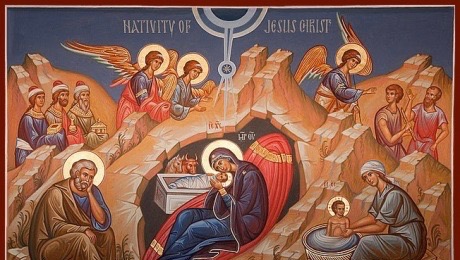
And then last night, we walked with Joseph and Mary across country, to the town of David called Bethlehem. We submitted to the Emporer’s decree to be registered, we were denied place to rest our heads, we squatted like refugees in animal barns, we heard the angels with the outcasts and we found out that God was indeed born into our dark world, bringing real light. 

We also discovered, that this 2000 year old story is a story for 2022. That if Jesus was born into a world full of darkness back then, one where tyrants ruled, soldiers killed, people lived in fear, that certainly the darkness of our world is not too much for God. That Jesus does come into our darkness too. Messiah is born today, just as 2000 years ago.

But today, the Gospel of John pulls us back from the details of the story. John gives us the Christmas story again, but without shepherds and angels, barns and journeys, without even Mary or Jospeh. 

John takes us to the heart, to the meat of the story. 

And the word became flesh. 

John’s story of incarnation is hardly one we could reproduce with a Sunday School pageant. John expects that we can separate the details of the story from the meaning of the story. What does it mean that the God of all creation has chosen to become incarnate?

Incarnation is one of those churchy words that pastors tend use, but that actually has a very earthy meaning. 

The flower with a similar name, carnation, gets its name from its fleshy colour.

Carnivale, the South American Mardi Gras festival is related to incarnation too. The great festival where you eat all the meat in the house before fasting during lent.

And carnivore, the scientific word for meat eater. 

Carne means meat. 

So that church word incarnation literally means”to take on meat.”

And the Word became flesh. 

The birth of Christ is the moment when God puts on the meat of humanity, the flesh of our bodies. If you want to know what God looks like, look at the people around you, look at their skin and eyes and hair. When Mary and Joseph and those Shepherds looked into the eyes, of the christ child, they would have seen there all of humanity contained in flesh.

When the disciples and the crowds heard his voice, they would have heard the voice of the God. 

When the lepers and the lame and blind were touched and healed by Jesus, they would have felt the touch of God. 

When the soldiers nailed feet and hands to a cross, they would have pierced the Body of Christ. 

But putting on our meat isn’t just about our physical bodies. 

The incarnation is also how God puts on the flesh of our humanity. The darkness of sin and suffering and death. The flesh of the human condition, of limited, fragile creation. God takes on what it means to be human, to be created, to be us.  

John’s Christmas story omits all the details that we tend to think the story is all about in order to bring us to heart or the meat of the matter. God has taken on our flesh in order to bridge the unbridgeable gap between God and a fallen, broken creation. God has become one of us in order to come near to all of us. 

Sure, John’s version of the Christmas story might be missing a few of the familiar parts of the story, but fleshiness of the story, of the incarnation reminds us that of all the Christmas traditions we hold this time of year, the most true of them all is the one carry on with week after week. In the Eucharist as we share in bread and wine, we partake in God’s fleshiness. And we are reminded again and again that God takes on our flesh AND we take on God’s. That God’s light and life comes near to us again and again. Given and shed for us. 

And as God comes near, as God becomes incarnate, God begins to reveal the light that has been missing from our world. We begin to see just how pervasive the darkness was. We begin to see that even the smallest bit of real light coming into life through a young woman giving birth in a barn is more light than we can handle. We begin to see that God comes and comes in small space, because even the smallest light pushes the darkness away, but the darkness can never diminish even the smallest amount of light. 

The light shines in the darkness, and the darkness did not overcome it. 

As we began in Advent seeing the dark places of the world, making our way from the end of the world backwards to the beginning, to the announcement of the coming Messiah, to going with Mary and Joseph to Bethlehem and with angels to shepherds, John tells us that our destination was here. Here with the Word in the beginning. Christmas is where God begins creation anew. 

Christmas begins all things new, because the darkness of sin and death will no longer have hold over us. Because the old order of things has ended, and now the Christ born into flesh has come today. 

Christmas according to John might not have all the details we think are normally part of the story, but John does take us to the heart, to the meat of the matter. John strips the details back to open ears to hear, our eyes to see, our hearts to know that this story of a babe being born to virgin in a stable in Bethlehem, is the story of God coming into our world, coming in order to be near to us again. 

Hear John’s final line in the Christmas story again:

Today, the Word becomes flesh and lives among us, and we have seen his glory, the glory as of a father’s only son, full of grace and truth.