Tag Archives: Luther

The inner call and outer call

The season of Easter was understood by the Early Church as one long day of celebration. Seven weeks of focusing on the good news of resurrection. 

The Gospel readings appointed for the season of Easter often tell the stories of resurrection appearances for the first three weeks. But in the second half of the season, the readings and focus of Easter turn toward what this new community of followers of Jesus will need to become. 

In this fifth week of Easter, we hear a Gospel lesson where Jesus encourages his disciples to love one another. In fact, Jesus commands it in a reading that should be familiar from Maundy Thursday. 

The commandment has one meaning given to the disciples about to witness the events of Good Friday.  It has another meaning given to the disciples and followers of Jesus, sorting out how to be this new community called the Body of Christ. 

To a post-resurrection community, the New Commandment from Jesus becomes an important lens to understanding our baptismal calling⎯our vocation as Christians. 

It is often the case that when we, as 21st-Century people of faith, talk about “call” or “vocation”, we conjure up modern imagery of following our passion or inner call. We imagine that inner drive or intrinsic passion to live out our dreams, to find that place where our personal passions can be pursued in the world. 

You might be surprised to discover that Martin Luther was highly suspicious of the notion of inner call. The idea of inner call was one that had been around since the Fourth Century and was very popular among monks. However, Luther felt that monasticism was trying to pull itself and the practice of faith away from the world. In Luther’s mind, the Gospel was for the sake of community, the Gospel reconciled us with God in order that we could love our neighbour. 

Thus, our baptismal call or vocation does not come from within us, but rather from our neighbour. Through our neighbours, the Holy Spirit calls us to service for the sake of our neighbours’ needs. The teacher is called to teach because the neighbour needs to learn. The farmer is called to grow food so the neighbour can eat. The carpenter is called to build so that the neighbour has shelter, etc. We are called to work to meet the needs of our neighbours, and this is the basis for our vocation or call. 

As the post-resurrection Easter community tries to determine what comes next, we hear the New Commandment from Jesus to love one another. Our calling, our vocation, comes from this commandment. Loving our neighbour, meeting our neighbours’ needs, becomes the place where our faith meets the world, where the Gospel’s community-building activity is lived out. The Holy Spirit calls us to take the Gospel into the world by loving our neighbour as Christ has first loved us. 

A home I didn’t know I had – Pastor Thoughts

It has been almost 3 weeks since I returned from the Reformation Study Tour to Germany that I was on in the first half of May. 

While I have told a few stories of my trip here and there and many photos of the trip were posted to Facebook, I am still processing and unpacking all that I had the chance to see and experience.  I had a busy few weeks immediately after my return, and it has only been the past few days that have had some time to reflect and ponder. 

I have been fortunate enough to travel some in my life. I have been lucky to be able to explore a fair bit of western Canada, to travel to the US for school, family holidays and work conferences. But it is my two high school band trips to Europe and my seminary cross-cultural trip to Peru that stand out. They were chances to be immersed in rich cultures, languages and histories different than my own (to a degree). 

There was something different about this trip to Germany, particularly to many of the important sites of the Reformation and to Martin Luther’s life. Even though I don’t have an ounce of German heritage, there was something familiar, something known that felt like I was connected to these places. 

After three connecting flights and three connecting trains, as we walked from the train station into the town of old Wittenberg, our tour leader and professor kept exclaiming, “I feel like I am home!”

Wittenberg is just a small town of 44,000 people, smaller than Brandon, Manitoba. Other than in 2017, it certainly isn’t the most sought-after tourist destination. Like so much of Europe, when you walk into the town, the buildings and architecture span the centuries in ways that we usually don’t see as Canadians. Buildings that are five, six or seven hundred years old might be right next to other structures built only in recent decades. 

But Old Wittenberg is much more of a time warp. Within five minutes of leaving the very modern train station, it feels like you step into the 16th century. Within moments our tour leader was pointing out various sites: Luther’s house, the University of Wittenberg where Luther was a professor, St. Marien’s Church where Luther was the pastor, etc…

We finally wound up at the Colleg Wittenberg, a dorm-style residence across the alley from the Lutheran World Federation office in Wittenberg. Two fairly unassuming buildings just around the corner from St. Marien’s and across the street from a donair shop.

It all felt so surreal. 

The history and origin story that is so central to my Lutheran identity, yet for me that had always been one found in books, lecture halls, church basements and in my imagination, was now real. The history and theology that have been so central to my academic, vocational and professional life for the past 20 years came alive in a way I did not anticipate. I was standing where Luther had lived. I was walking the streets where he walked, looking in on the church he served, just like he was an old seminary friend that I had come to visit. 

I couldn’t help but feel, just like the professor leading the trip, that this place was home too. A home that I didn’t know that I had until now. 

PS Here are photos from Germany: Some of the paintings of Lucas Cranach the Elder, who was the court painter of Fredrich the Elector of Saxony and a good friend of Luther’s. He was the most prolific artist of his day, credited with doing much to promote the Reformation through his art and art house which mass-produced his work.

Cranach’s art

Reformation 504 – God is still God, We are Still God’s People

Jeremiah, the 31st chapter (31-34)
31The days are surely coming, says the Lord, when I will make a new covenant with the house of Israel and the house of Judah. 32It will not be like the covenant that I made with their ancestors when I took them by the hand to bring them out of the land of Egypt—a covenant that they broke, though I was their husband, says the Lord. 33But this is the covenant that I will make with the house of Israel after those days, says the Lord: I will put my law within them, and I will write it on their hearts; and I will be their God, and they shall be my people. 34No longer shall they teach one another, or say to each other, “Know the Lord,” for they shall all know me, from the least of them to the greatest, says the Lord; for I will forgive their iniquity, and remember their sin no more.

Today is Reformation 504.

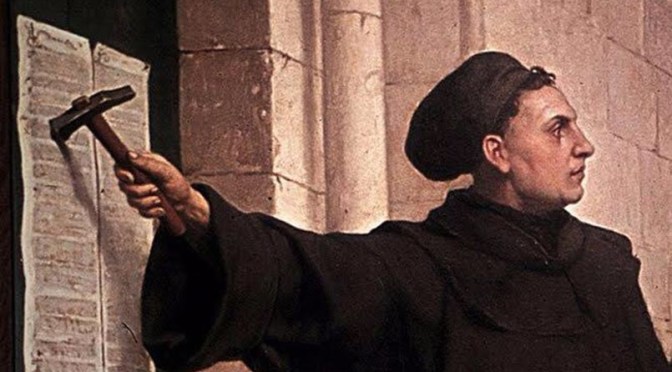
504 years since Martin Luther nailed his 95 theses to the church door in Wittenberg, on October 31st, the eve of All Saints Day or All Hallows Eve. This simple act sparked a transformation of christians and the church that still reverberates to this day. 

As we consider the Reformation today, we must also admit that the past 20 months have been another reformation of a kind for us, with everything we are used to doing and being together as a church being upended and changed. 

There is a theory among some scholars of religion, particularly Christians, that there is a major transformation or reformation every 500 to 700 years. Five hundred years ago it was Martin Luther. Seven hundred years before that is was the split between East and West, creating the Roman Catholic and Eastern Orthodox Churches. 400 or so years before that it was the codification of Christian belief at council of Nicea – out of which came the Nicene Creed. 

And each of these moments were, in some way or another, about re-imagining the ways in which Christians understand and proclaim the gospel. The Reformation was precisely about this issue, about the right proclamation of the gospel in community. Martin Luther’s reasons for speaking up and speaking out as he did were pastoral, he was concerned for the well-being of the people he served. He wanted to make sure they clearly heard the good news of God’s free gift of grace given for them, rather than the exploitative message of the church, using fear to get people to pay their way into heaven. 

Luther always wanted to turn us back to the gospel, to turn us back to the good news of Christ’s death and resurrection that saves us from sin and death. 

20 months into this 21st century pandemic, we need to hear that gospel promise from the 16th century. Though the world is more normal than last year, we are only slowly passing through this pandemic. It is hard to know whether we are nearing the end or still at the beginning. Good news is hard to come by and normal seems like an ancient dream. 

And so in the midst of darkness, in order to do our best to follow Luther’s desire for gospel clarity, we hear again the same foundational texts of the Reformation. Romans 3, the part of St. Paul’s writings that sparked Luther’s imagination towards God’s radical gift of grace. And John’s declaration that the Son sets us free, the promise of freedom in the gospel. And of course, Psalm 46, the basis for the most famous of Luther’s hymns – A Mighty Fortress. 

But what about Jeremiah, the somewhat familiar but often overlooked reading of the bunch?

Jeremiah’s prophetic words were written for the people of Israel during the violent times of the Babylonian exile. Words about the covenant with Abraham and Sarah… the covenant that goes all the way back to the beginning: the promise of land, descendants and a relationship with God. And while usually a covenant is an agreement that places conditions on both parities, all the people of Israel had to do was not refuse. All the promises were coming from God, none from Abraham and Sarah and their descendants. 

Still, the people consistently turned away. It’s not surprising that they turned away as it is hard to believe in God in the midst of violence and oppression. 

Most of what comes before this passage in Jeremiah is a lot of God’s ranting and raving about the failings of the people. Eventually God decides that a new course is needed for God’s people. And so God makes a promise. A promise that rang true in the Reformation and a promise that rings true for us today. 

So no, Jeremiah is the least famous of the Reformation readings, but it is none-the-less foundational. There is no radical gift of grace in Romans, no freedom in the Son of God in John, no A Mighty Fortress without Jeremiah. 

The problem and struggle of the people of Israel and in Martin Luther’s day is the same as it ever was. A problem that stemmed back to the garden of Eden, and problem that we too bear. 

As God tries and tries to draw us back to God, we continue to turn away. For the people of Israel, God’s promise of land, descendants and relationship first given to Sarah and Abraham was always too unbelievable and also never enough. Whether it was Abraham’s own fear that God’s promises wouldn’t come true, or the people of Israel longing for Egypt and slavery as they wandered in desert, or the Israelites losing faith during the Babylonian exile. 

During the Reformation it was a church that wanted to control God’s promises, to make mercy a commodity rather than a promised gift. 

And today? We too struggle with covenant. It is too hard to trust, even in the midst of chaos and change, in the lonely and fearful world of the pandemic, in this world it is hard to accept that God’s promises are indeed for us too. The promised land seems to unreal, descendants to follow us in faith and carry the torch feels laughable. A God who loves sinners like us? Preposterous. A God who is relevant in a world that has mostly forgotten or doesn’t care anymore? Unimaginable.

It’s no wonder that God might be frustrated with us. We just don’t want to get it.  

And so God does a different thing. 

God starts all over again. 

God brings us to the foundation. 

God decides that a new covenant is needed. A simpler covenant. A simple relationship. 

When in scripture, a prophet – such as Jeremiah – utters the words “Thus says the Lord” biblical scholars call it an oracle. A message of the divine, a direct speech from God. And so it behooves us to listen, to open our ears and hear what God is about say:

But this is the covenant that I will make with the house of Israel after those days, says the Lord: I will put my law within them, and I will write it on their hearts; and I will be their God, and they shall be my people. 

I will be their God, and they shall be my people. 

And with that, a new covenant comes into being. One that even the fickle Israelites cannot break. Or the people of 16th century Europe, or 21st century pandemic peoples.

A covenant made manifest in incarnation. In the God who becomes flesh, the God in Christ who comes to bring the Kingdom near to us. The God whom we try to put to death, and the God who rises again on the third day. 

This new covenant, this new promise is now unbreakable. It is the promise of mercy, the promise of radical grace and forgiveness, the promise that sin, suffering and death will no longer control us. 

Because God is our God… we cannot be God in God’s place. 

And we are God’s people, we have no other identity, nothing else lays claim to who we are, not  the world, not ourselves, criss or tribulation, not sin… not even death. 

We are God’s people, we belong to the one who has chosen mercy and love for us. 

And God reminds us of this truth each and every day, week after week, season after season. 

God reminds us that we are God’s in the mercy and forgiveness that we hear proclaimed. 

We are God’s in the Word announced in this assembly and in places of worship all over the world. 

We are God’s in the Baptism that washes and renews us for life as God’s children. 

We are God’s in the bread and wine, given so that we become the Body of Christ for the world.

Thus says the Lord, I will be your God, and you will be my people. 

This is the foundation of the truth proclaimed anew in the Reformation, just as it became the new covenant with the people of the Israel. 

And this is the precisely what God intends for us to hear on the 504th anniversary of the Reformation, during our pandemic exile and our zoom reformation, that we 21st people of faith still belong to the God of Abraham and Sarah and Martin Luther. 

That even when we try to turn away, that God’s promise is unbreakable. 

Thus says the Lord, I will be your God, and you will be my people. 

Reformation 501: Don’t forget about Jeremiah

John 8:31-36

31Jesus said to the Jews who had believed in him, “If you continue in my word, you are truly my disciples; 32and you will know the truth, and the truth will make you free.” 33They answered him, “We are descendants of Abraham and have never been slaves to anyone. What do you mean by saying, ‘You will be made free’?”

34Jesus answered them, “Very truly, I tell you, everyone who commits sin is a slave to sin. 35The slave does not have a permanent place in the household; the son has a place there forever. 36So if the Son makes you free, you will be free indeed.”

A Reading from Jeremiah, the 31st chapter (31-34)

31The days are surely coming, says the Lord, when I will make a new covenant with the house of Israel and the house of Judah. 32It will not be like the covenant that I made with their ancestors when I took them by the hand to bring them out of the land of Egypt—a covenant that they broke, though I was their husband, says the Lord. 33But this is the covenant that I will make with the house of Israel after those days, says the Lord: I will put my law within them, and I will write it on their hearts; and I will be their God, and they shall be my people. 34No longer shall they teach one another, or say to each other, “Know the Lord,” for they shall all know me, from the least of them to the greatest, says the Lord; for I will forgive their iniquity, and remember their sin no more.

Today is Reformation 501… not as dramatic as Reformation 500 last year. We haven’t be preparing for this day like we did for Reformation last year. In fact, it has been a pretty quiet year for Reformation after we spent much of 2017 talking about it.

And in some ways, I think that Martin Luther would have mostly hated all the hoopla last year if he was alive to see it. A quiet Reformation might have been more his style, not because he was a quiet and subdued person, but because he wouldn’t want something about him or about our history as Lutherans to get in the way of preaching the gospel.

And in many ways, I think Luther would have been much more excited to celebrate with us here in the Interlake, the thing we are celebrating next week on All Saints. Congregations and people coming together in order ensure that the ministry of gospel goes on in our shared ministry congregations and communities would have been the kind of thing that Luther would have probably been in favour of.

Luther always wanted to defer to the gospel, to turn us back to the good news of Christ’s death and resurrection that saves us from sin and death.

And on this 501st anniversary of the Reformation do we ever need good news. North America is reeling once again from stories of terrorism and violence. Bombs in the mail being sent to the leaders of the Democratic Party and then another mass shooting… and another in a place of worship – this time in a synagogue in Pittsburg with 11 people dead and more wounded. Like the Reformation 501 years, this day does not come without violence.

And so in the midst of darkness, in order to do our best to follow Luther’s desire for gospel clarity, we hear again the same foundational texts of the Reformation. Romans 3, the part of St. Paul’s writings that sparked Luther’s imagination towards God’s radical gift of grace. And John’s declaration that the Son sets us free, the promise of freedom in the gospel. And of course, Psalm 46, the basis for the most famous of Luther’s hymns – A Mighty Fortress.

But what about Jeremiah, the somewhat familiar, but often overlooked reading of the bunch? If is perhaps appropriate to focus on these words from the Old Testament, words read in synagogues all over world that speak about the history of the people of Israel…

Jeremiah’s prophetic words written for the people of Israel during the violent times of Babylonian exile. Words about the covenant… the covenant that goes all the way back to the beginning. To Abraham and Sarah, to the promise of land, descendants and a relationship with God. And while usually a covenant is an agreement that places conditions on both parities, all the people of Israel had to do was not refuse. All the promises were coming from God, none from Abraham and Sarah and their descendants.

And yet the people consistently turned away. It’s not surprising that did turn away, it is hard to believe in God in the midst of violence and oppression.

Yet, most of what comes before this passage in Jeremiah is a lot of God’s ranting and raving about the failings of the people. And eventually God decides that a new course is needed for God’s people. And so God’s makes a promise. A promise that rang true in the Reformation and a promise that rings true for us today.

So no, Jeremiah is the least famous of the Reformation readings, but it is none the less foundational. There is no radical gift of grace in Romans, no freedom in the Son of God in John, no A Mighty Fortress without Jeremiah.

The problem and struggle of the people of Israel and in Martin Luther’s day is the same as it ever was. A problem that stemmed back to the garden of Eden, and problem that we too bear.

As much as God tries and tries with us to draw us back to God, we continue to turn away. For the people of Israel, God promise of land, descendants and relationship first given to Abraham was always too unbelievable and also never enough. Whether it was Abraham’s own fear that God’s promises wouldn’t come true, or the people of Israel longing for Egypt and slavery as they wandered in desert, or the Israelites losing faith during the Babylonian exile.

During the Reformation it was a church that wanted to control God’s promises, to make mercy a commodity rather than a promised gift.

And today? We too struggle with covenant. It is too hard to trust, even in the midst of chaos and change, seeming decline and dying, that God’s promise are indeed for us too. The promised land seems to unreal, descendants to follow us in faith and carry the torch feels laughable. A God who loves sinners like us? Preposterous. A God who is relevant in a world that has mostly forgotten or doesn’t care anymore? Unimaginable.

It’s no wonder that God might be frustrated with us. We just don’t want to get it.

And so God does a different thing.

God starts all over again.

God brings us to the foundation.

God decides that a new covenant is needed. A simpler covenant. A simple relationship.

When in scripture, a prophet – such as Jeremiah – utters the words “Thus says the Lord” biblical scholars call it an oracle. A message of the divine, a direct speech from God. And so it behooves us to listen, to open our ears and hear what God is about say:

But this is the covenant that I will make with the house of Israel after those days, says the Lord: I will put my law within them, and I will write it on their hearts; and I will be their God, and they shall be my people.

I will be their God, and they shall be my people.

And with that, a new covenant comes into being. One that even the fickle Israelites cannot break. Or the people of 16th century Europe, or 21st century Pittsburg, or in Manitoba on Reformation Sunday in 2018.

A covenant made manifest in incarnation. In the God who becomes flesh, the God in Christ who comes to bring the Kingdom near to us. The God whom we try to put to death, and the God who rises again on the third day.

This new covenant, this new promise is now unbreakable. It is the promise of mercy, the promise of radical grace and forgiveness, the promise of that sin, suffering and death will no longer control us.

Because God is our God… we cannot be God in God’s place.

And we are God’s people, we have no other identity, nothing else lays claim to who we are, not the world, not ourselves, not guns or violence, not sin… not even death.

We are God’s people, we belong to the one who has chosen mercy and love for us.

And God reminds us of this truth each and every day, week after week, season after season.

God reminds us that we are God’s in the mercy and forgiveness that we hear proclaimed.

We are God’s in the Word announced in this assembly and in places of worship all over the world.

We are God’s in the Baptism that washes and renews us for life as God’s children.

We are God’s in the bread and wine, given so that we become the Body of Christ for the world.

Thus says the Lord, I will be your God, and you will be my people.

This is the foundation of the truth proclaimed anew in the Reformation, just as it is became the new covenant with the people of the Israel.

And this is the precisely what God intends for us to hear on the 501st anniversary of the Reformation and on the day after yet another mass shooting, that we 21st Century Jews and Christians, Lutherans (and Anglicans) still belong to the God of Abraham and Sarah and Martin Luther.

That even when we try to turn away, that God’s promise is unbreakable.

Thus says the Lord, I will be your God, and you will be my people.