Tag Archives: liturgy

How we screw up prayer and how social media teaches us to do it right.

We have a problem with prayer. So many Christians seem to think prayer can only happen in one way. One dimensional prayer I call it.  Let me elaborate…

As a pastor, one would think that I spend most of my time in my own congregation. However, one might be surprised just how often I worship in other churches, and it is always interesting to watch how my fellow colleagues have planned and then preside at (lead) worship. I try to bring a sense of curiosity when I worship at a church other than my own. Often there are little things to learn and borrow.

prayer11However, over the years, maybe even for decades I have noticed many churches operate with an understanding of prayer that I just cannot get behind.

In Lutheran liturgy, our worship contains many different kinds of prayer. There are prayers said in silence like confession, prayers said by the presider (worship leader) like the collect/prayer of the day and eucharistic prayer, prayers said by an assistant minister like the prayers of intercession and offering prayer, and there are prayers said by the whole assembly, like the Lord’s Prayer.

Prayer is used in a variety of ways, with the understanding that there are a variety of ways to pray. This has been the way the church has done liturgy and understood prayer for hundreds, almost thousands of years.

Yet, even as a child I remember prayer being taught and spoken of largely with one understanding, and so often this one understanding is how many christians understand prayer today.

Prayer is talking to God. Specifically, it is us talking to God. More specifically, it is us saying words with our mouths to God. And there are all kinds of teaching and theories and styles to saying these words with our mouths to God.

As teen and young adult in church, I remember being sent on occasion to different workshops on prayer, and I remember all the courses that were offered that I didn’t go to. I recall thinking it was strange that learning how to pray was all about becoming more open and vulnerable in my prayers, learning how to “open my heart” to God. As if prayer was some kind of divine therapy session, and I had to learn how to say the words just right.

As a pastor, one of the chief concerns of our church, and of many of my friends and colleagues is that we aren’t spiritual enough as leaders. Specifically, that our prayer life isn’t up to snuff. When I ask more about this, it seems that many pastors worry that they don’t pray enough (translation: not enough time saying things to God). We worry that we are not spending enough time in silent meditative prayer (saying things to God in our head), or enough in morning devotions (telling God our daily plans), or enough in small group prayer (taking turns saying words to God in front of others).

So many Christians and Christian leaders seem to have the notion that prayer is saying words to God, and the better we get at saying these words, the better our faith will get, the better our “relationship with God” will be. Prayer becomes exceedingly one-dimensional in this view.  Whether praying is done alone, in a group, or in church, we seem to believe that only the one speaking is the one praying.

What this translates into is a lot of pressure to be pray in this one way. Pressure to pray at home, and pressure to pray at church. For Lutherans this has translated into a poor understanding of the worship and liturgy. We treat liturgy like vegetables. You have to eat them, but nobody likes them.

imagesPrayers that were once prayed on behalf of the assembly by one voice are now prayed by all. And pastors have this awful, awful habit of saying little phrases that betray our one-dimensional understanding of prayer:

“Let us pray the offering/collect/post-communion prayer together”

“Pray with me this prayer…”

“Let us all pray out loud.”

These phrases reinforce the idea that praying only happens when we say words with our mouths.

Liturgy is not to be understood this way. Prayer is not only prayer when we say words with our mouths.

(As a tangent: I think it interesting that we are increasingly leaving our music making to a group of experts like a band, while we are all praying out loud which has been normally done by one voice).

Before I say what I think is a healthier understanding of prayer, I think there is an example we all use regularly that would help us into a deeper and broader understanding of what prayer looks like.
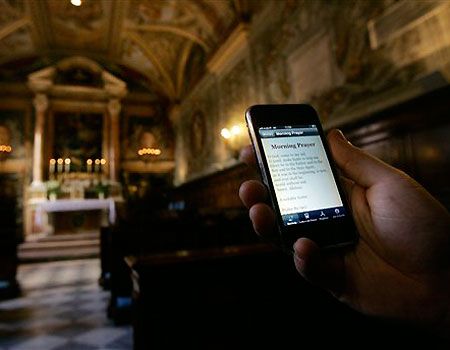
0_23_ibreviary_churchSocial Media.

Yes, Facebook, Twitter, Instagram, Youtube, Pintrest etc…

Okay, so I know that Social media at its worst is a lot of people cyber “yelling” at each other.

But social media at it is best is conversational. It involves speaking AND listening.

In fact, most of social media is not speaking at all, it is mostly hearing. Social media wouldn’t work if most of us weren’t listening, reading, hearing, receiving.

But social media takes it a step further. With social media you can like, favourite, share, retweet and more. You can read or hear what others have said and add your approval or endorsement without adding your own words.

Likes, favourites, shares, retweets are nothing new. We have been doing them in church for 1000s of years. They are the equivalent of “Amen.”

Social media teaches us that it isn’t always about saying words with our mouths. Sometimes it is important not to say anything at all but to let the words of others speak as if they were our own. You can probably see where I am going.

As a pastor, my voice is often the one that speaks for the assembly in worship. It is my voice that voices the prayers of the whole group. And so when I worship in other churches where I get to be in the pew and the presider or worship leader says, “let’s all pray together this prayer…” I say nothing. I sometimes wonder if the people around me think I am not participating.

When we see prayer only as saying words with my mouth, we all have to mumble the unfamiliar texts of liturgical prayers in an unpracticed and monotone way. Have you ever paid attention to how a congregation prayers the Lord’s prayer versus the prayer of the day? The Lord’s Prayer is the same every week, and we learn how to pray it together. But the Prayer of the Day/Collect changes every week and so we stumble through if we try to say it out loud together.

C1010109prayerYet, when we understand that when the presider or worship leader says a prayer with one voice, and still we are all praying together (one by speaking, the rest by listening) with one voice as a group, prayer becomes deeper and broader.

When we understand that the deep breaths and moments of silence before a prayer is spoken are the moments when we can, in fact, all truly pray together (instead of all reading monotonously at the same time), prayer becomes deeper and broader.

When we understand that in the “Amens”, the “and also with yous”, the “Lord’s Prayer” that we not just praying individually at the same time with our voices, but with the voice of the whole church, with every Christian who has ever said “Amen”, with every Christian who will ever say, “Our Father in heaven”, prayer becomes deeper and broader.

When we understand that prayer is more than one dimensional, more than saying words with my mouth, prayer becomes deeper and broader. Prayer becomes something we really do together, not something that we do individually at the same time which is really what we are doing when we say those phrases like, “Pray out loud with me.”

I think a deeper and broader understanding of prayer would help us realize that sometimes saying nothing, or just “Amen” at the end is prayer just as much as saying words with our mouth. Just like we know that a like, favourite, share or retweet is using social media the same as updating a status.

So let’s start praying with our ears, likes, retweets, with our Amens, in the silences and, when it is appropriate, together with many voices.

For more on social media and liturgy read this: Social Network Liturgy: Putting down the iPhone


So, how do you see prayer? Can we learn about prayer from social media? Share in comments, on the Facebook Page: The Millennial Pastor or on Twitter: @ParkerErik 

PS I recently read that one fewer hour of sleep a night for a week gives you the equivalent mental capacity of someone with the blood alcohol level of 0.10. With a new baby in the house, that would make my mental capacity the equivalent of 0.40, I think. This has been the reason for few posts lately, but I hope to pick up the pace again soon.

PPS Twitter has been flagging my blog as spam lately. If you would like to help get it unflagged (because according to wordpress and google it is fine), file a ticket with a link to my blog here


I wish Mumford & Sons Would Play at My Church

So last week I wrote a post about how Praise Bands are the New Medieval Priests. Over the past few days, that particular post has been generating discussion in the comments section, on my Facebook page and on Twitter. Worship is such an emotionally loaded topic, especially when it comes to music. Music is a powerful art form and so important in Christian worship. I think somewhere along the way, readers got the sense that I was advocating one style over another – that I was saying ‘Contemporary’ worship is not as good as, or as holy as, or as faithful as ‘Traditional’ worship.

Let me be clear, I was not advocating one style over another.

Image source - blog.ncbaptist.org
Image source – blog.ncbaptist.org

This is not about Contemporary vs. Traditional.

In fact, I didn’t use the word ‘contemporary’ or the word ‘traditional’ in that post. I am no classical music / organ snob, or someone who listens only to music newer than 5 years old. If you look at my iTunes library or the presets on my satellite radio in the car, you will see that my preference is eclectic. There is bluegrass, rock, folk, pop, classical, jazz, organ, soundtrack etc… But my heart music is some kind of bluegrass, folk, pop, rock mix or in other words Mumford & Sons. If Mumford & Sons decided to become a Praise Band, I would have resumes delivered daily to the church they play at. If Mumford & Sons decided to write a liturgy… I would be running down the streets looking for Jesus, because I would be convinced of the end of the world.

So let me say it again, this is not about Contemporary vs. Traditional.

I think I failed to connect the dots in my Praise Band Medieval Priests post. I think I failed to make clear I was talking about the medium of worship. I was talking about the ‘how’ of worship, not the ‘what’.

Yes, I have a strong bias to liturgy, but not because I am a traditionalist. I am biased towards liturgy because it is the agreed-to practice of the community of the Church. It is the vehicle that, for hundreds of years, Christians have agreed says what we believe about God, and liturgy allows us to worship God in an agreed-upon way. Liturgy is strongly rooted in the bible, in the early church, and in good theology.

Now I admit, I do think lots of contemporary music has bad theology in it, and I have done my fair share of ranting about Jesus-is-my-boyfriend songs. But I am also the first to admit that a lot of traditional hymns have equally bad theology. There are Jesus-is-my-boyfriend hymns out there too, they just escape our notice because they sound a little more Pride and Prejudice than Sixteen Candles. Contemporary music doesn’t have inherently bad theology, but like hymns, the theology covers a wide spectrum.

That being said, for my evangelical readers, I think I need to explain liturgy as medium.

Liturgy is not synonymous with organ music. The word Liturgy means “work of the people.” ‘The Liturgy’ is the order of worship, the texts that are used for the songs,  the assigned bible readings for each Sunday, the prayers and responses said by the pastor and congregation, the sacraments of baptism and holy communion. Liturgy is the skeleton of worship that Christians have agreed upon for hundreds of years.

But Liturgy can be done with organs, or guitars, or string instruments, or brass instruments, or piano, or drums or a cappella. In fact, I have done liturgy with all those kinds of instruments and their styles.

The style of music in liturgy can be any style, played by all manner of instruments and ensembles. There is some great liturgical music written and played in the contemporary style out there (eg. Steve Bell’s Holy Lord).

So, when I say Praise Bands are the New Medieval Priests, I am talking about Praise Bands. And no, of course not all Praise Bands. But the medium of ‘Praise Band’.

It is not way they play, but how they play it.

221313230_640Like with Medieval Priests , the Praise Band medium has become the message.

When Medieval Priests led worship, the language, the secret prayers, the division between the laity and priesthood, the transformation of bread and wine into Christ’s body and blood became the message. Those things were supposed to be the medium, the means of sharing God’s grace with the people. Instead, the Priests became the message, that only special people were required for worship, that only holy people had access to God. The liturgy of the medieval church had strayed far from the worship habits of the early church. The early church which gathered for prayer and song, to hear the Word of God, to share in the holy meal, to be sent into mission (that’s liturgy by the way).

Now this is completely anecdotal and very well my opinion, but for me the medium of the Praise Band can make the worshipper unnecessary. Just like the medieval priest who said mass by himself, often a Praise Band playing a song would sound just the same whether the congregation was present or not.

I think my objection comes from my experience over the past few years with Praise Bands. It seems like if I stopped singing, if the whole congregation stopped singing, almost nothing would change in the experience of music in worship. Praise Bands are a medium that has everything going against them when it comes to worship. They exist in an entertainment, consumer culture. They are a born of a genre of music that is performative. They even sound the best when played in concert style rather than worship style. They sound really good when the band interprets a song using the band’s own particular style, gifts and blend.

Here is where the rubber hits the road for me; despite all my best efforts to sing along, to songs that I know and that I played when I was in a Praise Band, I feel I like the music is more conducive to me listening than singing along. I am starting to enjoy listening over singing along, and I think I am not alone. I think this has become ‘worship’ for a good many people. Listening to the Praise Band, just like watching the Medieval Priest.

Does this mean I think we should give up on contemporary music in worship? Not at all. But I think, that like the liturgy of the Medieval Priests, Praise Bands will need a Reformation of sorts. I don’t know what that looks like, but some of the comments on my last post are the beginning of the discussion. Read them, see what people who have devoted their lives to music and worship are thinking. It is good stuff, it is smart, intentional and thoughtful.

Meanwhile, I am still thinking about how (maybe even if) Praise Bands are the New Medieval Priests. And wondering if Mumford & Sons will come play at my church.

So are Praise Bands a doomed medium? What needs to be done to reform them? Share in the comments, on The Millennial Pastor Facebook Page or on Twitter: @ParkerErik

_____________________________________________

PS. Just in case I wasn’t clear that I am aware of my own hypocrisy about this stuff, here is a video of a Praise Band playing a song that I co-wrote for the National Youth Gathering of my denomination…

Praise Bands are the New Medieval Priests

You don’t have to spend much time in a mainline congregation to overhear someone bemoaning our traditional worship and pointing to those huge evangelical churches that get all the kids to come because of their hip and cool worship. When we see Praise Bands, a lot of us get a little church envy. Over the past few months, I have had the opportunity to be around Praise Bands and Evangelical style worship, which leads me to a secret about Mainliners: we all get a little envious of mega church praise and worship.

That being said, my experience with Praise Bands has become increasingly one of alienation. I just can’t access Praise music anymore, I don’t hear Praise songs as the music of worship. I find myself wondering why I am just standing there, in the midst of a group of people who are also not singing. As the Praise band performs song after song, I am consistently lost as to how the music goes, what verses will come next, how to follow the melody, when to start and stop singing, or when a random guitar solo will be thrown in right when I thought I had figured out when the next verse starts. Even some Praise Bands folks recognize themselves just how alienating their shtick can be:

My alienation with Praise music isn’t because I am not musical or don’t know what is going on in worship. I am a pastor after all, I have been in worship LOTS. I play a number of instruments. I had played in music ensembles, secular and church, I have even played in Praise Bands. I can sing well enough to chant, most melodies are easy enough to pick up and I prefer singing parts from sheet music.

So if I am standing there feeling alienated by Praise music because I can’t follow along, what about most other people? What about those who didn’t spend a significant portion of their childhood being musically educated and playing music in church?

Lots of Praise Bands are full of talented musicians. They often perform very well, better than some professional artists who mostly lip sync. Some of the Praise Bands I have heard could easily be found in local bars or pubs playing for young adult hipsters and no one would bat an eyelash.

Most recently, as I stood listening to a Praise band overwhelm my senses with their loud music (crap… I sound old), the lead singer’s beautiful interpretations of song melodies, and the random guitar solos, I looked around at the people in the pews with me. Most were just standing there too, not singing, not really being a part of the music at all. We are all just bystanders to the moment, we were being played at, rather than played with.

As a Lutheran, I am rooted in a tradition that advocates for the role of folks in the pews. In Medieval worship, the people had become unnecessary for worship. The priests spoke Latin, and the people didn’t. The priests had stuff to say and pray, the people just stood there. The priests often faced away from the people to the altar, ignoring the people. The priests even whispered secret prayers to themselves, and only served themselves the wine at communion, because the people might spill the blood of Christ. Sometimes priests said mass all by themselves, people weren’t even necessary for worship to happen. The priests had all special knowledge and privilege, they basically performed worship at the people.

Martin Luther, the key dude of the Reformation didn’t like this at all. He translated the bible into the language of the people. AND he also translated worship into the language of the people. Liturgy (which means ‘work of the people’, but also refers to those rote prayers, litanies, responses, music etc…) was changed so that the people could be included. No more secret prayers, no more facing away from the people, priests spoke in the language that most people understood, and worship was about participation and designed to be for the people. Worship was so that the people could hear the Gospel, instead of be bystanders to the hocus-pocus magic. The assembly, all the people gathered for worship, were now considered necessary.

Now 500 years later, despite all lessons of the Reformation that Protestants –  Mainliners and even Evangelicals – have been teaching, we are going back to non-participatory, secret language, performance worship. Just like priests who lead worship in a language that few spoke, Praise Bands are incompatible with a worship that is done by the community. Rock Bands are by design meant to overwhelm the audience with sound. They are a performative medium, not a participatory one.

Worship Bands have become new ‘Medieval Priests’. It is becoming more and more clear to me that we are unnecessary bystanders to most of what Praise Bands do. They play so loud that our singing is unnecessary, so we don’t sing. They sing in such highly interpretative ways, that we can’t follow melodies. They use screens with words intended to be easy to read, but that mean we can’t see what is coming and half the time, the screens are wrong, even in the most mega of mega churches.

What happened? When did we forget the lessons that our forebearers fought to teach us? 

I suspect it has something to do with over-emphasis on the individual in North American Christianity, particularly Evangelicalism. We don’t often worship as communities any more, we worship as a group of individuals. More like the folks in a movie theatre, than the folks playing a team sport. I also think it has something to do with our suspicion of history, of tradition, or anything old or ancient, we are obsessed by what is new.

Praise Bands have lost the worship plot. They are more about performance and than facilitation of worship. Praise Bands at their best completely exclude the Body gathered to worship.

OLYMPUS DIGITAL CAMERAFull disclosure: I am fully aware that when I lead worship in my ancient vestments and with ancient liturgies, many can feel alienated. But Liturgy as its best is meant to include and to reconcile. Liturgy is a team sport, where each is given a role, and where no individual can go it alone. Just like any team sport, it takes learning and practice to know what is going on and to play well.

Liturgical worship has stood the test of time, it has been around for 2000 years. You can see our liturgical roots in the writings of the early Christian church. Liturgical worship will remain as long as Christ’s church does. I don’t know if the same can be said for Praise Bands. Praise Bands just may go the way of the Medieval priest saying mass to himself in the dusty corner of a cathedral. Praise Bands are likely to become an obscure historical footnote, remembered only by those wishing to take up the ancient priestly performance.

So, are Praise Bands excluding people from worship? What is our way forward? Share in the comments, on Facebook: The Millennial Pastor Page or on Twitter: @ParkerErik

UPDATE: There has been a lot of thoughtful conversation here in the comments , on Facebook and on Twitter. I written a followup post that hopefully addresses some of the comments which you can find here: I want Mumford & Sons to Play at My Church

Social Network Liturgy: Putting down the iPhone

I will be the first to admit it. I am addicted to my iPhone.

Most days I am much more willing to risk leaving my wallet or keys unprotected than my phone. I will leave my computer bag and my wallet  in the car in bad areas of town, but I won’t leave my phone on my desk in an empty church when I go to the water cooler in the adjacent room.

Electronic devices now dominate our time and attention. It is hard for many of us to be away from the constant stream of information. I am often glancing at facebook and Twitter, reading (writing) blogs, searching for something new to read, to learn, to laugh at, to be offended by, to think about, to distract.

This morning, in his opening essay, CBC Q’s Jian Ghomeshi talked about unplugging and being present. He gave two examples of experiences, a wedding and a concert, where attendees were asked to not use, and even surrender their devices, in order to be present and fully experience the event.

This is really hard to do.

This Easter I had the chance to simply sit in the pew because I was in between calls. During the sermon, the teenager in front of me was playing games on his iPod Touch. And his dad was watching over his shoulder, and his grandma was annoyed.

I think our default reaction is to be angry at a situation like this, to feel disrespected as pastors or long time church members. But here is the thing… I don’t think that teen had a choice. I don’t think his brain and body would have let him just sit and listen. He would have probably started “iWithdrawal” 30 seconds into the sermon.

This is sad.

A few posts back I wrote about Old and New Thinking, saying that the church really doesn’t know why people have drifted away. I also said that people might start drifting back, and we won’t know why either. But I think, without really doing it on purpose, the church has become a place to unplug, to fully experience the here and now. A rarity in our world these days.

Jian Ghomeshi mentioned a wedding and concert, occasional events that most of us might experience a handful of times a year. Yet, each week as I write my sermon, study scripture, prepare worship I have to slow down and be present. Each Sunday, as our congregation gathers, I get to put down the phone entirely. I get to fully engage and be present, to experience the here and now. The church, without being any different than it is now, provides a space to do that, week after week.

Liturgical worship is at one time a fully engaged experience of the present, and at the same time, the first and oldest form of social media. As I have heard it said, liturgy is like the stream of the faithful, of ritual and tradition, of history and community, of interconnectedness with people of all times and places. We get to wade, splash and swim in it, but the stream has been here long before us and will remain long after us. In liturgy we are bound together more powerfully than Facebook or Twitter, we see more deeply than Instagram, we weave stories and threads more powerfully than Pinterest, we proclaim wider scandal than Reddit, we experience something older and more forgotten than MySpace, we seek the lost and forgotten more thoroughly than Google+.

When many in our world begin to discover our devices are really satisfying that part of our brain that drives us to eat too much, drink too much, smoke too much, use too much… places where we can put down the devices will become sought after. In fact, Jesus says something to Martha about that this week.

And a place where we can put down the device but find an incredible social experience of community deeper than any network?

Well, the church will always be that place.