Tag Archives: Jesus

Wrapping up the year on Christ the King – Pastor Thoughts

The church is rarely accused of being ahead of the times. But every year around the end of November, with a little celebration, the church marks Christ the King Sunday and the end of the liturgical year. And so even ahead of the rest of the world, the church is still out of step. 

Still, I cannot help but ponder beginnings and endings around Christ the King. I look forward to this Sunday mostly because of what comes after, my favourite season Advent. 

But Christ the King requires the conclusion of all the stuff that came before it. To finish the story-telling arc of the previous year, to end with the Christ taking his place on the throne. Of course, on Sunday we will hear a very different understanding of where that throne is.

Stepping back to take stock of where we have been is an important process for us as people of faith and just as human beings. We can get so focused on where we are headed to next, that we get tunnel vision for the present and immediate future. It is difficult to take the long view, to step back and account for all the places we have been before now and how that has affected us. 

Christ the King reminds us that endings are not usually what they seem with God. Rather than a vision of the final dwelling place of God, we go to the cross, to the moment when death had seemingly won… and we discover that this was the moment of God’s new beginning. 

And so it is with the end of one church year and the beginning of another. On Christ the King we go back to the cross, and to begin Advent we talk about the end. God has a way of turning endings into beginnings, into new and second chances. 

As we see the myriad of seeming endings about us, the struggles of our world to maintain itself, our ending on the horizon as a church, we might wonder, what God has in store for us. We might wonder what new beginnings are around the corner this day, and how we might be changed forever by the new thing that God is about to do. 

Pastor Erik+

Don’t pray like either the tax collector or pharisee

Luke 18:9-14
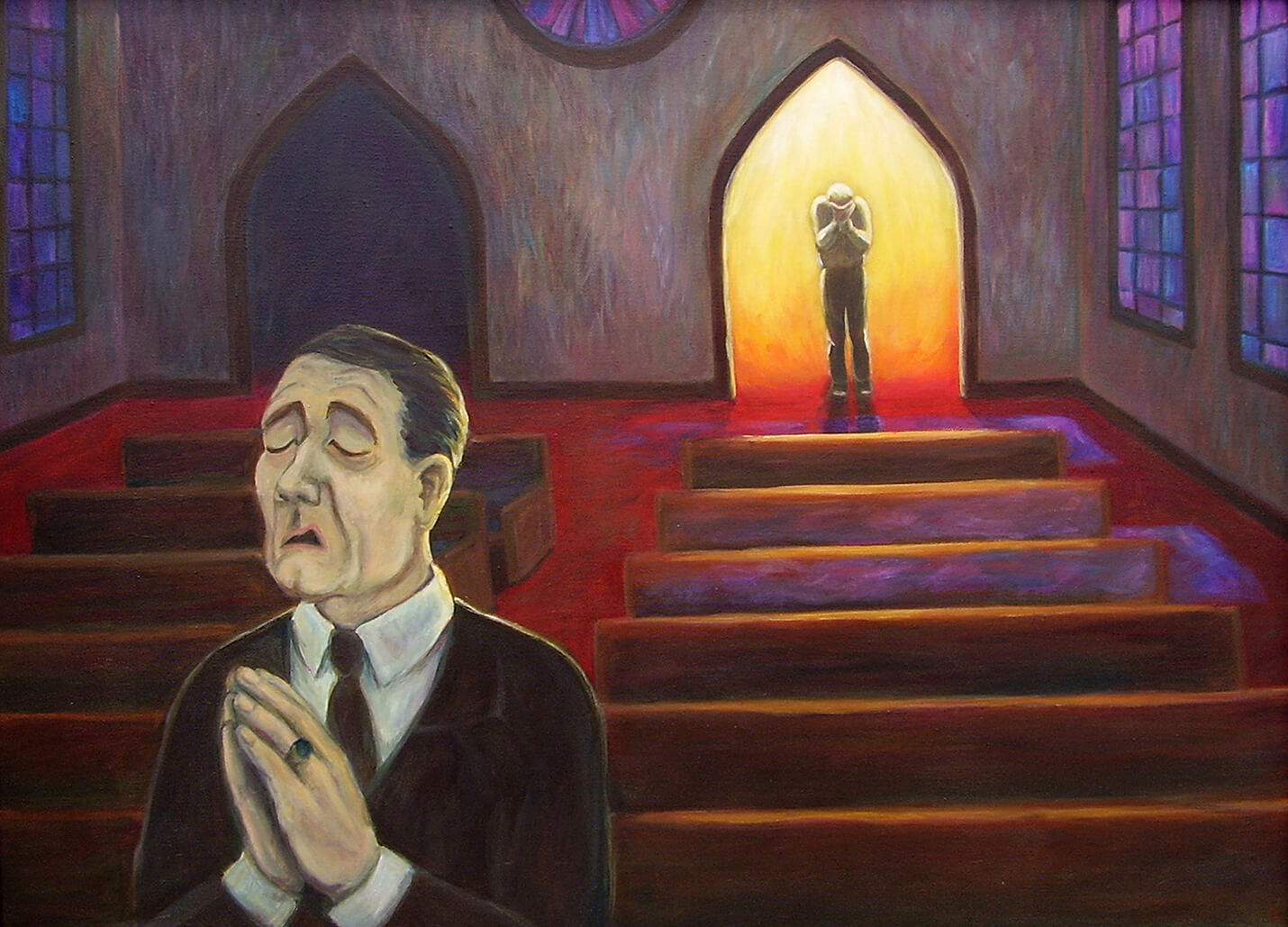
Jesus told this parable to some who trusted in themselves that they were righteous and regarded others with contempt: “Two men went up to the temple to pray, one a Pharisee and the other a tax collector. The Pharisee, standing by himself, was praying thus, `God, I thank you that I am not like other people: thieves, rogues, adulterers, or even like this tax collector. I fast twice a week; I give a tenth of all my income.’ But the tax collector, standing far off, would not even look up to heaven, but was beating his breast and saying, `God, be merciful to me, a sinner!’ I tell you, this man went down to his home justified rather than the other; for all who exalt themselves will be humbled, but all who humble themselves will be exalted.”

*Note: Sermons are posted in the manuscript draft that they were preached in, and may contain typos or other errors that were resolved in my delivery. See the Sherwood Park Lutheran Facebook Page for video

For the past several months, we have been hearing Jesus’ thoughts about discipleship. We have heard parables and stories that Jesus has been telling his followers about what it means to serve, about what it means to trust and about what God is up in the world. As we round the corner toward the final few weeks of this liturgical year, Jesus provides a parable seemingly about humility. About two very different people and their prayers to God. Prayers that maybe sounded a bit like this:

“God, I thank you that I am not like other people: proud, haughty, self-righteous, or even like that on-fire-for-Jesus Christian. I bow my head when I pray silently, and I cover the amount on my envelope with my thumb when I slip it into the offering plate”.   

Have you ever prayed that prayer? Or had those thoughts? 

“God, how could you love someone like me. I am not like those other people who have it all together, who give more than I do, who volunteer more than I do, who are better people than I am. Have mercy on me, because that’s all I have”

What about this prayer and these thoughts?

It is easy to hear this parable and think that it is a lesson about the value of humility. There is the Pharisee, incorrectly dividing the world into categories. Thankfully we are not like him. And there is the tax collector. He knows what this is about, he is a good Lutheran. All sin. The only hope he has is for God’s mercy.

To our ears listening centuries after this story was first told, the details of this parable can just fly over our heads. We don’t know what it was like to stand in the temple of Jerusalem, the grand centre of Hebrew religion and power. The term Pharisee in our world is a derogatory, not a position of honour and importance. Imagining a haughty religious type praying this prayer in an opulent setting can make it seem easy to identify the villain. Yet there is so much we don’t know, images and symbols we miss, we have not heard the standard prayers of the Hebrew faith.

Understanding the context, as always, is very important. The temple of Jerusalem would have been grand sight to behold. It was big and it had rules. The people believed that it was where God lived – in the inner sanctum, the holy of holies. The temple was the place where you had to earn every inch of God’s favour. Whether you were a Pharisee or tax collector, you knew where you stood in the eyes of God when you were inside the temple. 

The Pharisee knows that he is righteous. He prays a Benediction that every Jewish man was to pray each day. Thank you God that I am not a Gentile, a sinner, or a woman. The Pharisee modifies the prayer, but the point is still the same. He is genuinely thankful for who he is. The pharisees sees those around him and looks down on them because they are truly less righteous than he. 

The tax collector, on the other hand, knows that he cannot expect anything from God. His job requires him to break the rules of Judaism. To charge interest, to handle money with graven images on it, even to steal or assault. He is not righteous and his only hope is God’s mercy. The tax collector is so wrapped up in himself, that he doesn’t see the world around him. 

But both the Pharisee and the tax collector are quick to divide people into categories. It doesn’t matter if one places himself in the good category and the other in the bad 0 the effect is the same. Both are acting as judge on God’s behalf. The Pharisees judges himself righteous, the tax collector judges himself unrighteous. 

And when slow down and look at ourselves honestly, we are often guilty of the same.

Whether we are thanking God for not being thieves, rogues, adulterers or tax collectors, or whether we are thanking God because we are not arrogant, self-righteous, or prideful, the issue is the same. We divide humanity into categories, justified or unjustified, saved or unsaved, loved or unloved. 

In fact, being divided into tribes and factions has become so pervasive over the past few years that we argue about everything, politics, culture, science and more. 

Human beings are constantly looking for the ways that we can identify who is in and who is out. We might not be standing on the street corner, boldly thanking God in prayer for our certain salvation. But have we looked down on others, the homeless, those in financial trouble, those hold differing views about the pandemic, about the war in Ukraine, about climate change and even those who are sick, and we thank God that we are not them. “Therefore by the grace of God, go I”. 

But we are also often the ones thinking that we are worthless compared to those around us. That we unworthy, while everyone else seems so perfect. We are certain that no one has it as bad us, or that others have their act together while we are struggling to get by. 

Whether we are intentional about it, or whether we do not know that we are doing it, we too place ourselves in the same categories that the Pharisees and the Tax Collector do. 

Now, here is the problem with that kind of thinking. It is a trap of our own making. 

One that the parable today gets us to fall for again. 

We so easily identify ourselves with either the Pharisee or the tax collector, or both. But this parable is not about pride or humility, and it is just as much not about pharisees or tax collectors. 

The parable is about the storyteller. 

The parable is about Jesus.  

While we are busy trying to make things about us, God is reminding us that it is God alone who justifies. God alone decides who is good enough for the Kingdom.

According to the law, the Pharisee came into the temple righteous, and left the temple righteous. But Jesus says something about the tax collector that should grab our attention, 

“I… tell… you,  this man went down to his home justified”. 

There is nothing that the tax collector did that earned his justification. His prayer did not make him righteous. 

Rather, it is Jesus who says that the man is justified. It is Jesus who decides. 

In the world of the Jerusalem temple, there were those were in and those were out. But everything changes with Jesus. 

Through birth, life, death and resurrection, Jesus comes to tear down the categories we try to build. Whenever we try to make categories, God will stand on the other side, because God wants all to be included, all to receive grace, all to be loved. God has only one category – the Kingdom to which we all belong. We are God’s beloved children. 

The parable that Jesus tells is not a parable on how to act, or who to be like or how to pray. This is a parable about God. A parable that shows us God’s motives and shows us the way that God chooses to act in the world. That shows us that God wants to be with and care for the least, the lost, the sinners and the alone. God wants to care for us… because we are the least, the lost, the sinners and the alone.

Neither the Pharisee, nor the tax collector, nor us, want to see or admit, that being justified, that being saved is something that God does for us. Yet, that is what is told to us today.  The trap is laid that we try to divide humanity into saved and not saved. And it is God who alone who knows the way out. Through love and mercy God chooses humanity. God who chooses those who truly cannot be righteous on our own, God comes to us as Christ who lives and dies, with us, with imperfect and flawed human beings, God sends us the Holy Spirit to bring us into the resurrection and into new life. 

Perhaps our prayer today should be:

“God, we thank you that we ARE like other people: Pharisees and tax collectors, sinners and saints.  We are justified by your righteousness; we are saved by your love.”

Image source: https://canadianmennonite.org/sites/default/files/article_photos/07-01A-pic-4-the_parable_of_the_pharisee_and_the_tax_collector_2017.jpg

What the church can learn from extra curricular activities – Pastor Thoughts

With a second week of school nearly complete, many extra-curriculars are starting up. I had the privilege of sitting around a table in the atrium at the Royal Winnipeg Ballet (RWB) with some other dance parents for a couple hours. 

Dance parents are like hockey parents, many spend hours sitting outside of dance studios like hockey parents sit in cold arenas. 

I couldn’t help but wonder what was so compelling about dance that these families would bring their kids one to seven (SEVEN!!!) days a week for dance classes for 10 months of the year. Few kids will become professional dancers, maybe some will become dance teachers, but most will dance for as long as they can and eventually move on with life.  

The next morning as I met with clergy colleagues over zoom, the discussion landed on declining volunteer capacity in congregations. Many were lamenting that most churches cannot find committee members, folks for worship roles, coffee makers, and so on.

As my colleagues talked about church, I couldn’t help but wonder what kept people coming back to the RWB week after week (day after day!) and what the church could learn from it. To be clear, the RWB recreational division has suffered a massive decline in enrolment during the pandemic and they have been very open about that. The other dance parents remarked that none of their kids’ classes were full, which was a rare occurrence pre-pandemic. It isn’t just churches that are seeing fewer folks being involved, it is allcommunity institutions: sports, arts, service clubs, etc.…

On top of that Canadians are getting older. 50% of us are over the age of 50. That means that for every family of four like mine, there are two empty-nest couples out there. 

But still, I couldn’t help but wonder what kept folks coming back to dance. I don’t know the answer (if I did, I would get rich selling books!). 

I do have thoughts though:

  • Is it the relative ease in ascertaining the benefit of dance and hockey and piano? Sure; but most kids won’t dance on Broadway, play in the NHL or perform at Carnegie.
  • Is it that there is a value associated with these activities? Should churches have annual fees? (Just kidding of course!)
  • Is it that church has no aging-out process and that adults participate as much as the kids? Most dance, hockey and piano parents don’t actually do the thing they are dragging their kids to. Or did all the kids who attended Sunday School over the past decades “age out” of church, like they did sports, music, dance and scouts?
  • Could it be that Christians have behaved badly lately: cozying up to power, condemning more than offering love, cutting people off more than reaching out? Almost certainly this is a big piece.
  • But also could it be that the free gift of God’s grace, the regular pondering of meaning and purpose in life, and the radical welcome given to imperfect sinners is a little deeper than most folks want to go on a regular basis? I also think this is something significant.
  • Lastly, might it be that churches and church leaders have for a long time assumed that people inherently understood why being part of a church is a good thing? Dance, hockey and all the other extra curriculars regularly “evangelize,” promote and recruit, while citing the benefits of participating. Have we forgotten how to do that? I suspect this might be the biggest piece. 

No doubt, when people aren’t working and taking care of families and households, how people spend their precious leisure time has dramatically changed what people are willing to participate in. And we have not even begun to sort out this pandemic world and its realities. 

Still, in the days, weeks, months and years to come, a lot of what we will be called to do is to let go of the idea that people *should* come to church (because they should know better), and begin to articulate again why following Jesus is a life changing thing for us. 

The whole world is still in the midst of this pandemic reset. As we all slowly rebuild and refashion our lives and what we invest our precious time and energy in, God is calling the church to proclaim again the Good News AND why it matters to us and why it should matter to our neighbour. 

As difficult and scary as this task sounds, it is also exciting. God has big things in mind for us.  

Lost Sheep, Lost Coins and Lost in 2022

GOSPEL: Luke 15:1-10
Now all the tax collectors and sinners were coming near to listen to [Jesus.] 2And the Pharisees and the scribes were grumbling and saying, “This fellow welcomes sinners and eats with them.”

3So he told them this parable: 4“Which one of you, having a hundred sheep and losing one of them, does not leave the ninety-nine in the wilderness and go after the one that is lost until he finds it? 5When he has found it, he lays it on his shoulders and rejoices. 6And when he comes home, he calls together his friends and neighbors, saying to them, ‘Rejoice with me, for I have found my sheep that was lost.’ 7Just so, I tell you, there will be more joy in heaven over one sinner who repents than over ninety-nine righteous persons who need no repentance.

8“Or what woman having ten silver coins, if she loses one of them, does not light a lamp, sweep the house, and search carefully until she finds it? 9When she has found it, she calls together her friends and neighbors, saying, ‘Rejoice with me, for I have found the coin that I had lost.’ 10Just so, I tell you, there is joy in the presence of the angels of God over one sinner who repents.”

*Note: Sermons are posted in the manuscript draft that they were preached in, and may contain typos or other errors that were resolved in my delivery. See the Sherwood Park Lutheran Facebook Page for video

Today we get to hear some familiar parables about the Lost – the Lost Coin and Lost Sheep. There is something deeply familiar about the shepherd who leaves the 99 to find the one lost sheep, about the woman who tears apart her house to find her one lost coin. And if we were to continue after this, to hear the story of prodigal son. 

But just maybe this year, there is something different in the way we hear these parables. Something helps us identify different and see our selves differently in the story. 

If I am honest, I should confess my own bias in preaching these stories before. The previous four times I have preached on these parables, I have always found myself identifying with the 99 sheep, the 9 coins or more importantly the grumbling Pharisees. I have found it hard to see myself in the lost thing. Before, I tried to redefine what I meant to be lost or just preached about grumblers. In my sermon from 3 years ago, at the time a father of a 5 year old and 3 year whose whose whole life was chasing after lost people and things, I gave lost things and people a bum rap. 

But this year in 2022, as I read this story of Jesus and these two parables again, and it was almost like hearing them for first time. Since the last time this gospel lesson was read in church, our whole world and lives have been turned upside down.  We have known an experience of being lost and alone, all experiencing it at the same time, that probably many of us had never before endured. We all know today, in new ways what is means to be alone, to feel lost, to be surrounded by danger, and to long to be found and rescued in new and profound ways. And if you don’t, what were you doing during the past two years?

In the old world of 2019 where feeling lost and alone, abandoned and forgotten was a foreign, or at least private experience… this new world that we are now living in has plenty of loneliness to go around. It doesn’t take much to remember how recently the walls of our homes kept us in and others out, or that the streets and walkways were emptier than we have every seen. We have felt the danger of simply being with others, we have seen the rage of protest and frustration, we have welcomed the refugee fleeing a war that feels too close for comfort.

Just this week, we have born witness to tragedy in James Smith Scree Nation and Weldon. We got the alerts on our phones, TVs and radios. We grieve the violence and loss of life. And we are reminded of the complicated history that Canada bears with indigenous peoples and communities. 

And if that wasn’t enough to endure, the news came on Thursday that Queen Elizabeth died. After 70 years on throne, she is the only monarch that most of us have known or remember well. Her death is not only the loss of a wife, mother, grandmother and great grandmother whose life was dedicated to service in an role that was not of her own choosing, but she represents in many ways the end of era that spans the time from the Great Depression and World War II all the way to our 21st century pandemic world. We have known that that time late 20th century world was ending, but now it feels even more like we have transitioned fully to a new 21st century existence.

Now with all of that on our plates this week, we know understand now that feeling lost and abandoned, alone and in danger, has been a common experience for human beings through the ages. Being lost seemed like it was just a thing for those on the margins, those who fell into lives of abuse, addiction, and crime. But certainly as Jesus preaches to the Scribes and Pharisees, tax collectors and debtors, we can now understand the ancient world was full hardship and struggle. Feeling lost, hoping for salvation was common place. The people who hear Jesus preach would have known what it was to be lost, at least most of them. 

Their world was not one where there was much mercy and grace to be found. Sinners, debtors and the unclean rarely found help and care, rarely were they able to escape their circumstances. Once in debt it was nearly impossible to get out, once unclean it was a whole process to become clean again, once a sinner the whole community turned its back to you. 

So these crowds following Jesus, listening to his preaching about discipleship would have heard these parables of lost things as radical and unexpected, as stark contrasts to the image of a judgemental God that they were so often warned of. 

When the sinners and debt collectors hear the pharisees and scribes grumbling about Jesus caring for the lost, the expected response would be for Jesus to shape up and start following the rules. It simply wouldn’t track that a shepherd might risk the 99 for the sake of the 1. It is a waste of time and energy to tear apart one’s house just to find a single coin, when you still have 9.

So imagine the crowds hearing Jesus tell the story of the shepherd that leaves the 99 behind to go and find the one lost sheep. The story of the woman who takes apart her whole house in order to find a lost coin and then throws a party to celebrate. And finally the story of the prodigal son, the child who has lost to the world seemingly for good, returns home to the joy of his father and of course the jealous older brother. 

These stories of the lost things would have been radical to the ears of the crowds because they revealed a God far different than the one they had been taught to fear. They tell the story of a God who loves so deeply that God will search and find the lost and forgotten, God will go out to meet those who are alone and abandoned, God cares not just for the whole, the community, the herd, but just as much for the one, the individual, the personal. God who knows us as the family of faith called the Body of Christ, and who knows us that the beloved baptized child in whom God is well pleased. 

And this Shepherding God who goes out for the 1 sheep this finding God who searches frantically for the 1 coin, this loving God who runs out to meet the lost son on the road and goes out to me the resentful son in the field… this God is the One whom finds and gathers us up. Gathers us up from our scattered and separated lonely places, who brings us together in to one Body, one congregation, one family, who rejoices that we have been found, that we have been retuned home, that we are reunited in Christ. 

This same finding God continues to meet us in our world this week. As God weeps and mourns with the communities of James Smith Cree Nation and Weldon, God promises that death is not the end and that there is New Life found in the Shepherd who search for the lost. As a commonwealth grieve’s the death of a beloved Queen and matriarch, while wrestling with the legacy of colonialism, God joins us again and again to a community, a Body and Kingdom in Christ that spans all time and space. As we contend with change that do not know how to manage, God reminds us that God has walked this journey with God’s people before, and God will show us the way now. 

This week, this year, more than ever before in our lives, we may have needed to hear these parables of the Lost as a church. We needed to be reminded of the loving finding God who doesn’t just look for those others that we consider lost, but loves and finds us, all of us. Because God knows knows that we are just as much the one lost sheep as we are the 99. God knows we are just as much the one lost coin as we are the 10 found ones. 

And the God who seeks, finds, knows and loves us is exactly who we need. 

The challenge to Discipleship in 2022 – Pastor Thoughts

This week Jesus is talking with the crowds about Discipleship. He gives a couple of cheeky examples that overturn our expectations and remind us that Discipleship requires sacrifice. You will have to hear my sermon on Sunday to find out more, but suffice to say the point is that Discipleship, or being a follower of Jesus is a journey for which we don’t know what the end destination will look like.  

And of course, Fall has often been a time when Discipleship and related programs are promoted by many churches. Discipleship is a big church word that we have a very strange relationship with in 2022. What does following Jesus actually look like and mean for our lives today? If you have the answer, I think there is a lot of money to be made as an author and guest speaker!

Discipleship evokes a sense of doing. Disciples sound like people who are out in the world doing things related to following and having faith in Jesus. Identifying where Discipleship is happening in our own lives might be a bit of a challenge. 

I suspect that for many folks, Discipleship is what a lot of people think pastors or other clergy are out doing in the world: praying, reading the Bible, helping the poor, visiting the sick, teaching the young, comforting the grieving, etc. And if we are honest about our history as Lutherans in Canada, a lot of congregations have wanted pastors to do “Discipleship” on their behalf. Not the way that a person of means might have a maid clean the house on their behalf, but more like how a student would rather the teacher finish the math problem on the blackboard than be called forward to write it out themselves.

Of course we know that there are many ways to be a disciple. The super volunteer who makes the coffee, hands out the bulletin, has served on council for 25 years, teaches Sunday school, mows the church lawn and generally is out there making the church keep running is someone who comes to mind. Or maybe the prayerful person who prays for the whole congregation every week. Or maybe the faithful student of the Bible who keeps to a regular reading plan. 

But sometimes Discipleship can also be the overwhelmed family who manages to pull things together enough to show up at church once a month or even every six weeks. Sometimes discipleship is that faithful senior who sings alto in the choir, shows up at church most weeks, puts what they can in the plate even if it is not very much and is simply there even though they are not leading the charge on council or handing out bulletins or mowing the lawn. 

Discipleship looks like different things for different people. For some it is service, for others leadership, for others study, for others caring and compassion, still for others it is presence and consistency.  

But most of all, at this moment in 2022, it is also something that we haven’t been good at for the most part as North American Lutherans for the past 75 years or so. Discipleship today is about asking good questions. Questions like:


Who are we? What is our identity?
What does it mean to be people of faith?
What does it mean to do faith in community?
What does it look like for us to serve the world today?
What is God calling us to be now?
Why is the church important for us today?
Why is it important for the world?

For a long time, it was assumed that we knew all the answers to these questions and that we all had the same answers. Church was simply a matter of providing the space for people who mostly understood collectively that Discipleship meant to follow Jesus and to be good Christians together. 

But I am pretty sure we don’t know the answers to those questions today, or if we ever did. I am pretty sure that if there is one thing above all else that has allowed folks to drift away from faith communities, it is not knowing the answers to why all this church stuff is important and often getting reprimanded for asking. 

While some might disagree with me, I think one of the most important jobs for pastors and church leaders today is to be asking these questions, to be talking about Discipleship and what it means, to be admitting that we don’t know where following Jesus will take us or how it will change us. 

Just like the crowds who will interrogate Jesus about Discipleship on Sunday, we are in between places, on the road and uncertain of where we are headed.

But Jesus knows the way. And Jesus is calling us to follow, even if it means giving up things we never imagined that we would have to leave behind. Because who God turns us into on the other side, will make all the difference.