Tag Archives: Jesus

Emmaus and Hockey Night in Canada – Pastor Thoughts

Hello Canada and Hockey fans in the United States and Newfoundland.

I am not anywhere close to old enough to have heard Forster Hewitt utter that iconic phrase live, but I have heard the recordings. As many of us turn our attention to the NHL playoffs this week, (to watch the Jets, Oilers and Maple Leafs), it is easy to think back and remember stories of hockey games past and the Canadian cultural ritual that is watching hockey together on Hockey Night in Canada (HNIC).

I remember the old HNIC Theme Song – the one written by Delores Claman that ran from 1968 to 2008. (TSN owns it now, maybe you still hear it if you watch the Jets regularly). Click here to listen: Hockey Night In Canada Theme Song Original – YouTube. Those first few notes of the low brass fanfare that swells into the full band always remind me of watching Oilers’ playoff games in the 90s. (I am a little too young to remember the Gretzky dynasty years very well.) 

When I was going to the University of Alberta, I played in the Cosmopolitan Community Band. One year for a Christmas concert we played the HNIC Theme Song. It was so cool to play that iconic song and for it to sound almost exactly like it did on TV. 

Whenever I hear that song, it immediately stops me from whatever I am doing. I am transported back to Saturday nights watching hockey with family and friends. It feels like Canada’s second national anthem, or at least it did. It has the power of connecting you to all the other people humming along from wherever they are watching the game.

For a whole host of reasons, that song will always hold a special place in my heart and mind. And whenever I hear it, it will immediately bring back cherished memories and feelings. Maybe you aren’t a big hockey fan, but we all have songs or sounds, foods or smells, books or movies that, whenever we see them or hear them or taste them or smell them, transport us back to another place and another time. Memories that hold on to us as much as we hold onto them. 

This week, we hear one of my favourite stories from all Scripture, The Road to Emmaus story. The climactic moment of the story is kind of like my HNIC Theme Song moment. The disciples are pre-occupied with all that has gone on, trying to understand their new world. And then Jesus takes some bread and begins to bless it. 

For the disciples, it was as if the HNIC Theme Song started playing. A memory that held them as much as they held it. A memory that woke them up from all their preoccupations. And they were transported back to that moment when their teacher and friend was sitting with them, reminding them of who they were – who God had declared them to be. 

For us as people of faith, each time we gather for worship, we are surrounded by the sights and sounds, smells and tastes, words, songs and actions that break us free from all those pre-occupations that take up our focus. Memories, symbols and images that hold us. And in those things, God reminds us who we are and who God has declared us to be. 

So as we sit down to watch hockey this week or hear the story of the Road to Emmaus, remember that God is there, finding ways to cut through the noise of our lives and break through into our hearts and minds. Breaking through and transforming us into Easter people.  

Christ is Risen Indeed! Alleluia!
The Church is Beginning – A Maundy Thursday Sermon

GOSPEL: John 13:1-17, 31b-35
And during supper 3Jesus, knowing that the Father had given all things into his hands, and that he had come from God and was going to God, 4got up from the table, took off his outer robe, and tied a towel around himself. 5Then he poured water into a basin and began to wash the disciples’ feet and to wipe them with the towel that was tied around him.

*Note: Sermons are posted in the manuscript draft that they were preached in, and may contain typos or other errors that were resolved in my delivery. See the Sherwood Park Lutheran Facebook Page for video

Tonight is the beginning. Tonight the church begins the 3 days. Tonight the church begins. 

“You will never wash my feet.”

As Jesus kneels  before Peter, towel in hand, the moment between Teacher and follower feels like a moments that we have been rehearsing in our own ways over the past few years. 

There is a part of us that wants to just tell Peter, “Stop being so stubborn, brother! If Jesus wants to wash your feet, let him do it!” 

It is the part of us that knows better, that knows that if Jesus is offering, the best we can do is open our hands, our hearts, our ears and eyes to receive. 

But there is the other part of us that has lived versions of this moment before. 

“You will never get me to do that again.” Has been a refrain during this pandemic. 

Peter’s visceral reaction is one we have felt in so many different ways. Things that we once never thought about we now have strong feelings over. 

So when Peter arrives for dinner and sees Jesus kneeling on the floor washing feet, his reaction isn’t so foreign anymore. 

4 Maundy Thursdays into the pandemic, and we are finally back around the table of the Last Supper… and how changed we are. The experiences we bring to this table maybe help us to understand Peter a little better… they maybe help to us to understand all the disciples a little better. 

We now get what it feels like to wander with uncertainty for years, following and trying to trust that Jesus will show us the way. Amazed by the miracles, but confused by where this journey might take us. 

Tonight is the first night of the Triduum, the Three Days, of Jesus Passover from death to life. The stage and setting starts small tonight, or at least it feels that way.

A small group gathered for dinner and worship, Peter and his strong feelings about having his feet washed by his teacher, and lessons on community, advice on how to live with one another given by a teacher to his followers. 

Maundy Thursday, this first night of the 3 Days is meant to draw us in. To pick us up from the Hosannas of Palm Sunday and remind us that the shouts of crucify are coming. 

And yet, we also know this table from our Sunday gatherings. We know that this table isn’t just a dinner party hidden away from the world, but something more. 

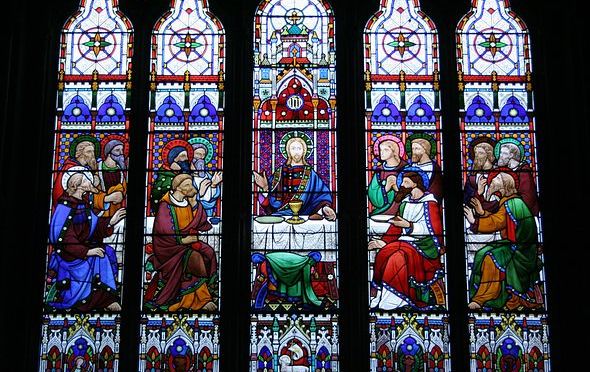
The foot washing, and the new commandment bookend the beginning of something that will grow beyond our imagination. The Lord’s table is revealed tonight, table where bread and wine are shared, the table where Body and Blood is given, the table where the Body of Christ gathers – gathers across time and space. The table that brings the Church into being. 

Because it is to the Lord’s Table, to this table tonight, to this table from the first Maundy Thursday, that the Church will continually return to, week after week after week. 

Because it is at the Lord’s table, where the assembly, where believers in faith, gathers to hear the word and to receive God’s promise given in bread and wine. 

Because it is tonight that God’s promises are given for the sake of the world, where the promises that death on Friday and life on Sunday are forever interwoven. 

Even as Peter protests having his feet washed, even as we have own strong feelings. Even as Jesus proclaims a new commandment, that we ought to love one another… and we fail to uphold and keep that commandment…

This night is still the moment that church continually returns to. The moment just before the chaos erupts into the world, a moment of respite and reprieve… the where faithful and flawed and opinionated followers find themselves at the table with Jesus… and there Jesus passes on the things of God, food that transforms us for life, a body of Christ that turns us into the Body of Christ. 

Tonight we begin these three days at the Lord’s table, and here God begins the church. The church that will go to cross tomorrow and the empty tomb on Sunday. The church that proclaims the mystery of faith each time it gathers at the table again – Christ has died, Christ has risen, Christ will come again. 

Tonight is the beginning. Tonight the church begins the 3 days. Tonight the church begins.

Do we still feel called to this? – Pastor Thoughts

I have been thinking a lot about call lately. 

As in, you know, being “Called” to ministry. 

For most pastors, deacons and bishops, the sense of call to ministry isn’t a one-and-done kind of thing. It isn’t like turning on a light switch, but more a constant state of wrestling and wondering. Asking oneself “Am I still called to do this?” is always part of the gig. 

In recent years more than ever, I have watched clergy do a lot of wondering. From friends and colleagues, to clergy bloggers and writers… a lot of us are wondering if our sense of calling is sustainable through all the challenges facing the church. A lot of people are deciding it isn’t, and they are leaving ordained ministry for other work. 

Certainly, in the past number of years I have had my own moments of wondering how my calling to serve continues to fit in with where the church is at. 

That being said, I might be one of the worst examples of Pastors to talk to about wrestling with being called. I used to joke in seminary that I was born into the “Norwegian Lutheran Pastors Breeding Program.”

My grandfather was a pastor. So was his brother. And his brother-in-law. His closest friends were also pastors. Growing up, “church” was something that my immediate and extended family was always involved in. And wherever we traveled there were usually some church or pastor or church folks that we knew.  

For me, going to seminary and becoming a pastor was a possibility that was known from an early age. From when I played pastor dressup as a two -year-old, to career shadowing my pastor in grade 9,  to serving on council when I was 18, to working at camp throughout my university years, and to attending campus ministry, I always knew that being a pastor was an option and one that I wanted to pursue. 

But my story is uncommon. Lots of those called to ministry take very different routes. Some need the right encouragement at the right time, or need to get connected and involved in a church community at the right moment to be opened up to the idea of ordained ministry. Some go to seminary just to learn more and end up pursuing ordination. Some only experience that call later in life after establishing a first career or other vocation. 

This week, Jesus calls Peter and Andrew from their fishing boats, and they immediately drop their nets and follow. If only it were so simple. 

Though we tend to talk about calling as it relates to pastors, we are NOT the only ones called by God to serve. The call to follow, the call to minister is a calling given to all the baptized. We are ALL called to follow Jesus into the service of the Kingdom of God. We are ALL called to do our part in making sure the Gospel is preached to the world around us. 

In many ways it is this sense of call that I wrestle with the most. Are there enough of us who feel this baptismal call to be church together? Do churches today have enough motivation to pursue this ministry of the Kingdom of God?

“Being Church” is harder than it has been in a long time. For a while now, we have been finding ways to keep doing what we have been doing with fewer resources, smaller budgets and fewer people. But we are getting to the point where that is almost too exhausting to continue. The time has come for us now to be creative in finding new ways to organize ourselves. We need to be willing to change and adapt, to work with others around us in ways we didn’t have to consider before. The alternative is that keeping on as we are or trying to bring back what we used to be will overwhelm our diminishing resources. The models of church that we are used to – a church on every street corner doing all the same things that the church on the next street corner is doing – don’t serve us well anymore. 

Do we hear God’s call to adapt and change to the new thing? Or are we more committed to holding on to what we once had? The answers to these questions are complicated. 

What does it mean for us to be called these days? And what does “following” look like? I have been circling around these questions since I was two years old… and my sense of the answers are as unclear to me as ever.

And yet in the strangest way, I think I might be as intrigued and excited to explore their answers as I have ever been. In all my time wrestling with being called and what it means to be called, the potential of what the future could be is as great as ever. People and congregations are open to new things in ways that felt unimaginable just a few years ago. God is calling us and we are being invited to explore what that means for us and how we might follow, even as where we are going and how we will get there is still being revealed to us. 

The time it takes to figure church out – Pastor Thoughts

“Come and See”

This last week’s Gospel lesson from John contains this phrase. While maybe it doesn’t jump out a first, there are some preachers and scholars out there who say that John is the Gospel of “Come and See.”

Other scholars have described it as “Word and Sign.” 

Both are shorthand ways of saying that in John’s Gospel there is a repeating pattern of Jesus inviting people (the disciples, crowds, the religious authorities) to believe that he is the Messiah (Word) and when they hesitate, Jesus reveals who he is with a miracle or other divine act (Sign). 

This dynamic plays out most clearly in the story of Lazarus. Jesus comes late to heal Lazarus and so Lazarus’ sister Mary meets Jesus on the road. When she points out that Jesus could have done something to prevent Lazarus’ death, Jesus reminds her that HE is the resurrection and the life (Word). But then when they get to the tomb, Mary objects to the stone being rolled away because there will be a smell (hesitation). But Jesus commands it anyway, and out walks Lazarus (Sign). 

“Come and See” is the phrase that describes that invitation between the Word and the Sign, the invitation given just at the moment when we might be hesitating to believe that Jesus is who he says he is. 

This pattern that John lifts up is a way to make the Gospel all the more compelling. John recognizes that most of the people who come after him won’t be able to watch Jesus in action the way the disciples and crowds did. But if we can see ourselves in their hesitation then maybe we will see that the only necessary part is the Word. We will hear the Good News and come to faith. John basically says this at the end of his Gospel. 

While I think one of the challenges to faith in a world confident that science and technology will save us, is precisely the lack of “signs.” I also think that this dynamic of “Come and See” is a part of our lives and communities as Christians and as people of faith. 

It is just that the signs might not be what we expect. We are probably not going to head over to the local cemetery and see someone hop out of a casket.

But in our communities of faith we DO see people who are healed and brought to new life all the time. People who are dead in loneliness or isolation, people who are broken by fractured family relationships, people who have suffered illness and disease, who, by being a part of church communities, find hope and life and peace. 

We see people who hear the “Gospel Word” and are transformed into new creations. Who are so captured by the good news of Jesus’ love for them that it changes them to the core. 

In the past few months, I have been watching one such transformation in my own family. My son, who is 8, has been attending church almost weekly his whole life (pandemic lockdowns not withstanding). And of course he was a baby, a toddler, or little kid for a lot of that time. This past fall, he has begun telling me that he likes my sermons, not every week, but once in a while. I have asked him what he likes, and he has been able to tell me very accurately what my sermon for a particular Sunday was about. And over the Christmas season, I had the opportunity to sit with him in the pew for a few services. Together we found the hymns in hymnbooks and I taught him how to follow the verses of hymns. We followed the litany and psalm together, learning which lines were for us to say. We talked about the different parts of worship, as in when to stand (when we sing, pray and hear the Gospel) and when we sit (all other times). He often will sing liturgical songs at home (“This is feast!”) or repeat other liturgical responses at home. 

It only took him eight and a half years of attending church for it to take (especially since learning to read in the last two years). And, all of a sudden, worship and church and being together with all the people he knows at church (two churches!) have imparted to him that faith is important, that what God has to say to him and about his world and life is important, and that worshipping in community is important. 

“Come and See” is an invitation to witness how the Word of God is doing incredible things in our world and in our lives. Maybe as we start this New Year together, 2023 will be a year to “Come and See.’

Christmas not as we expect – Pastor Thoughts

The great day of anticipation is soon here. 

In no time at all, we will gather together for the first fully in-person Christmas Eve and Christmas Day services since 2019. Though Christmas and worship wasn’t cancelled in 2020 and 2021, these past two years Christmas Eve and Day worship has not been the same. The sound of one another’s voices as we sing carols, the visitors from afar and familiar folks that we know well all together, the glowing candles as we sing Silent Night. 

2022 with all its ups and downs is bearing a lot of expectation about what this Christmas should be. There are many people who are trying to get back what we didn’t have in the last two years, trying to have the gatherings, visits, trips that we missed the past two years. The parties and concerts that were cancelled. Trying to recreate with nostalgia the memories of Christmases gone before. 

And still once again this year, those things are under threat. Not from a virus but from continent-wide weather events. 

In our family, our planned Christmas company has been unable to fly out of Kamloops since Monday and might have arrived a week late, if at all. Another friend and colleague has been stuck in Victoria for days with no help from the airline in terms of a booking another flight home to Regina. Pastors in Eastern Canada and the United States are wondering on Facebook if in-person services will be cancelled for the third year in a row. Luckily, all the means to be online are already in place. 

In a twist of fate, Manitoba might be one of the best places to be for winter weather this Christmas. We are going to have just the regular cold and snow that we can handle with no problem. 

But of course, all the expectations about what this time of year is supposed to be are still there. And as a good friend says, “Expectations are pre-meditated resentment.” 

Wanting Christmas to be a certain way with certain people following certain traditions is pretty normal. But as our world changes and there seem to be more things outside of our control that affect us in bigger and bigger ways, we might do well to remember that Christmas is a story rooted in unmet expectations and in people navigating circumstances beyond their control. 

And still in a world that buffets us back and forth with challenges and struggles, God comes. God becomes incarnate. God is born into human life so they we might share in the divine. 

So as we bring all the things we want Christmas to be this year, God is already at work bringing the hope and promise that we need in our troubled world. 

May this Christmas Season be a time to celebrate the joy of Christ’s coming with those that you love, in whatever way is possible. 

Blessings to you this season. 

Pastor Erik+