Tag Archives: Jesus

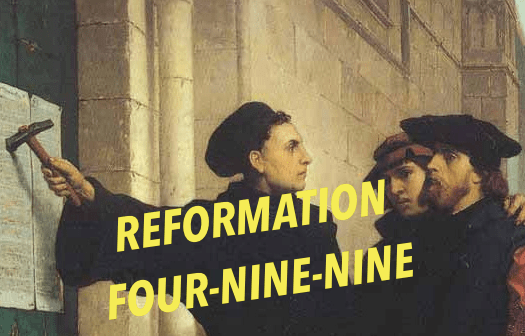
Reformation Four Nine-Nine

John 8:31–36

Then Jesus said to the Jews who had believed in him, “If you continue in my word, you are truly my disciples; 32and you will know the truth, and the truth will make you free.” 33They answered him, “We are descendants of Abraham and have never been slaves to anyone. What do you mean by saying, ‘You will be made free’?”

34Jesus answered them, “Very truly, I tell you, everyone who commits sin is a slave to sin. 35The slave does not have a permanent place in the household; the son has a place there forever. 36So if the Son makes you free, you will be free indeed.

Sermon

So confirmands, today you are lucky enough to share this day with the 499th anniversary of the reformation. Now don’t worry if you aren’t entirely sure what “The Reformation” is all about, your parents and families probably aren’t entirely sure either. But today, as you affirm your faith in front the congregation you are standing on the shoulders of a community of people that have gone before you for almost 500 years – The Lutheran community (and Anglican one for some). And Lutherans and Anglicans are just one part of a larger Christian family that has been around for 200 years.

Now the words and promises that you will hear today have already been spoken and made to you in your baptism. But you probably don’t remember your baptism, so we remind you of those promises again today, when you are at an age when you will remember. So you can hear and remember the promises that God has made just to you.

And those promises are the same ones that the reformation was all about.

Reform. Change. Reformation. Change for the better.

Our world talks about change and reform a lot. Political reform, economic reform, environmental reform, social reform – you name it, we are talking about changing it. When we listen to the message around us and to what we as individuals want, change and reform are common themes.

The call for reform and change is not just for change’s sake. The desire for reform comes from a deep need within ourselves. A need to make things better, to make things right. We desire a better life, better circumstances. And at the same time the scariest thing about reform and change, is the fear of loss.

As Lutherans we stand on change, we try to embrace ongoing reform. There are 87 million of us in the world, nearly 3 times the population of Canada. And today, the Lutherans around the world remember that big Reformation from where we began and started.

Four hundred and ninety-nine years ago on October 31st, 1517. A young monk, priest and university lecturer, published 95 theses about change, about religious reform. Martin Luther hoped that his ideas could be discussed by friends and colleagues in a civil manner. Instead, Luther’s writing expressed the growing dissent among the people and pushed into the light issues that had been simmering for decades, which hit Christianity in Europe like a hurricane.

For you see, Luther hit a chord. He connected to that deep desire for change. He identified the issues of oppression in the church and of abuse by the clergy. People were tired of being exploited by the church who made them fear death, hell and purgatory nor did they not want to be continually controlled by the nobility who made them fear soldiers and prisons. As Luther identified these issues, he diagnosed the illness that existed in medieval church.

Figuring out he problem is the easy part though. We are good at diagnosing our problems and knowing that we need and want something different. Luther looked around and saw the suffering of the people and he saw the need for reform.

When we look around at ourselves, we see problems too. We long for change. Here we see a shrinking church membership and at the same time an aging membership. We have heard about financial short comings. And many of us are tired as we give more of ourselves to the church, of our time our money, and of our energy.

And so while Identifying the problem is the easy part, actual Reformation is hard.

When the followers of the Jesus are faced with the prospect of freedom, they balk at the idea. They know their problems too. They struggle under the government of the Romans. And they struggle under the religious rule by the temple priests. But when change and freedom stares them in the face, they would rather stick to what they know. They would rather be oppressed by the Romans and the Jerusalem Temple.

When Luther began proposing reforms to the Church of his day, they were rejected. Even though the Vatican was in debt because of never ending wars and had been bankrupted by the enormous building project of St. Peter’s Basilica, they wanted to stay on the same path rather than actually change.

And the difficulties that christianity faces today in North America are so frightening to some, that congregations are deciding simply to slowly die. To make sure all the surviving members are cared for in the last years of their lives. It is easier and safer to stay the same, even when we can clearly see the problems around us.

And so here we stand. On this Reformation Sunday, on this Sunday of change, we know that we have a problem, we know that we need to reform too.

As Jesus talks to his followers today he reminds them of two simple realities. The truth will make you free. The Son will make you free.

It is the same truth that Luther discovered, the truth that prompted him to begin writing about change in the church.

And it is the same truth that will carry our congregation and our larger Christian family through our problems.

Jesus will set us free.

The reality of our need for change, our desire for reform, is that we cannot do it on our own and and we cannot get it right. As St. Paul writes in Romans, “For all have sinned and fall short of the glory of God”.  We know that things could be different, we know that life could be better, but we also know that no matter how hard we try, we cannot keep from hurting others or being hurt, or from causing others to suffer or suffering ourselves, from causing grief or being grieved, or from killing or dying.

And while most people would give up in the face of this news. Luther heard something different. Luther heard the promise that Jesus makes:

So if the Son makes you free, you will be free indeed

We are all sinners, and we all fall short. Yet, God’s promise is in Christ. As Jesus comes  into our world, as Jesus joins us in falling short and being unable to make things better, Jesus offers freedom.

The Reformation started with this idea, that we cannot really change things, but instead, God is doing the changing. Even though we sin, and fall short, even though we cannot change our world to be the place we know it could be, God is there loving and caring for us. Christ is there, living with, dying and rising again with us.

And God’s grand plan for changing the world, began in the smallest way. A baby born in a stable. A baby like no other. A baby that was divine and human. But God wasn’t done there. God’s next reform was to the idea God loved some and not others, and that God’s love was for those who could earn it. As Jesus preached and taught, he told people, he tells us, that God’s love is for all people. And finally God’s biggest change was in the shape of the cross. On Good Friday, Jesus endured death, yet the surprise of Easter morning was God’s undoing of death’s power over life, God had made a new promise that new life will go on.

It is on these changes and reforms, these promises by God that the Reformation began. And it is on the shoulders of the Reformation that we stand. As Lutherans, we have been given a gift. A gift that came at great cost, a gift that came out of division, conflict and strife. A gift that reminds us that the most important thing the church can do is tell people of God’s love.

And by God’s love, we are set free. We are set free from sin and death. We are set free from our own failures and fears.

Reformation Sunday is about remembering what happened 499 years ago, about remembering and commemorating where we came from. But it also about the reformation that is happening now. The Reformation and transformation that God has been up to this whole time – God has been changing the world, changing us by setting us free.

Amen. 
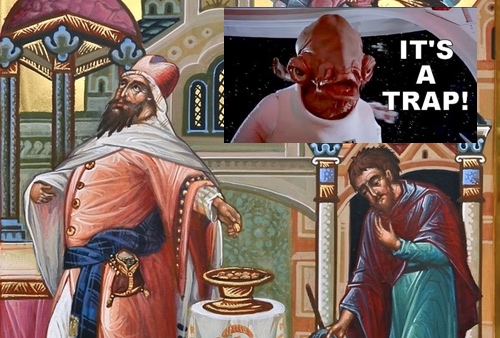
The parable of the Pharisee and Tax Collector – It’s a Trap

Luke 18:9-14

The Pharisee, standing by himself, was praying thus, `God, I thank you that I am not like other people: thieves, rogues, adulterers, or even like this tax collector. I fast twice a week; I give a tenth of all my income.’ But the tax collector, standing far off, would not even look up to heaven, but was beating his breast and saying, `God, be merciful to me, a sinner!’

“God, I thank you that I am not like other people: proud, haughty, self-righteous, or even like that on-fire-for-Jesus Christian. I bow my head when I pray silently, and I cover the amount on my envelope with my thumb when I slip it into the offering plate”.

Have you ever prayed that prayer? Or had those thoughts?

“God, how could you love someone like me. I am not like those other people who have it all together, who give more than I do, who volunteer more than I do, who are better people than I am. Have mercy on me, because that’s all I have”

What about this prayer and these thoughts?

It is easy to hear this parable and think that it is a lesson about the value of humility. There is the Pharisee, incorrectly dividing the world into categories. Thankfully we are not like him. And there is the tax collector. He knows what this is about, he is a good Lutheran. All sin. The only hope he has is for God’s mercy.

To modern listeners, the details of this parable go by so quickly. We don’t know what it was like to stand in the temple of Jerusalem. The term Pharisee is derogatory today. It can seem easy to identify the villain here because we have not heard the standard prayers of the Hebrew faith.

But understanding the context, as always, is very important. The temple of Jerusalem would have been grand sight to behold. It was big and it had rules. The people believed that it was where God lived – in the inner sanctum, the holy of holies. The temple was the place where you had to earn every inch of God’s favour. Whether you were a Pharisee or tax collector, you knew where you stood in the eyes of God when you were inside the temple.

The Pharisee knows that he is righteous. He prays a Benediction that every Jewish man was to pray each day. Thank you God that I am not a Gentile, a sinner, or a woman. The Pharisee modifies the prayer, but the point is still the same. He is genuinely thankful for who he is. The pharisees see those around him and looks down on them.

The tax collector, on the other hand, knows that he cannot expect anything from God. His job requires him to break the rules of Judaism. To charge interest, to handle money with graven images on it, even to steal or assault. He is not righteous and his only hope is God’s mercy. The tax collector is so wrapped up in himself, that he doesn’t see the world around him.

The Pharisee and the Tax Collector are both quick to divide people into categories and be judge on God’s behalf. The Pharisees judges himself righteous, the tax collector judges himself unrighteous. And we are often guilty of the same.

Whether we are thanking God for not being thieves, rogues, adulterers or tax collectors, or whether we are thanking God because we are not arrogant, self-righteous, or prideful, the issue is the same. We divide humanity into categories, justified or unjustified, saved or unsaved, loved or unloved.

Human beings are constantly looking for the ways that we can identify who is in and who is out. We might not be standing on the street corner, boldly thanking God in prayer for our certain salvation. But have we looked down on others, the homeless, those in financial trouble, those who struggle with addiction, those who come from broken families, even those who are sick, and we thank God that we are not them. “Therefore by the grace of God, go I”. Or how often have we been the ones thinking that we are worthless compared to those around us. That we unworthy, while everyone else seems so perfect. Whether we are intentional about it, or whether we do not know that we are doing it, we too place ourselves in the same categories that the Pharisees and the Tax Collector do.

Now, here is the thing about that kind of thinking. It is a trap.

And so it the parable today.

The parable that Jesus tells today is a trap that makes us identify ourselves with either the Pharisee or the tax collector. But this parable is not about pride or humility, and it is just as much not about pharisees or tax collectors.

The parable is about the storyteller.

The parable is about Jesus.

While we are busy trying to make things about us, God is reminding us that it is God alone who justifies. God alone decides who is good enough for the Kingdom.

According to the law, the Pharisee came into the temple righteous, and left the temple righteous. But Jesus says something about the tax collector that should grab our attention,

“I… tell… you,  this man went down to his home justified”.

There is nothing that the tax collector did, rather it is Jesus who says that the man is justified. It is Jesus who decides.

In the world of the Jerusalem temple, there were those were in and those were out. But everything changes with Jesus.

Through birth, life, death and resurrection, Jesus comes to tear down the categories we try to build. Whenever we try to make categories, God will stand on the other side, because God wants all to be included, all to receive grace, all to be loved. God has only one category for all of us. We belong to God and God alone.

Now, to the confirmands who shared their faith statements. If there was one thing I hope you take away from the past two years, it this. That we are not good enough to save ourselves, and nor are we too bad to be loved by God. God is the one who decides who is in and who is out, and God says, you are in.

The parable that Jesus tells is not a parable on how to act, or who to be like or how to pray. This is a parable about God. A parable that shows us God’s motives and shows us the way that God chooses to act in the world. That shows us that God wants to be with and care for the least, the lost, the sinners and the alone. God wants to care for us… because  we are the least, the lost, the sinners and the alone.

Neither the Pharisee, nor the tax collector, nor us, want to see or admit, that being justified, that being saved is something that God does for us. Yet, that is what is told to us today.  The trap is laid that we try to divide humanity into saved and not saved. And it is God who alone who knows the way out. Through love and mercy God chooses humanity. God who chooses those who truly cannot be righteous on our own, God comes to us as Christ who lives and dies, with us, with imperfect and flawed human beings, God sends us the Holy Spirit to bring us into the resurrection and into new life.

Perhaps our prayer today should be:

“God, we thank you that we ARE like other people: Pharisees and tax collectors, sinners and saints.  We are justified by your righteousness; we are saved by your love.”

Amen. 

It was not Moses who gave us Thanksgiving

John 6:25-35

Then Jesus said to them, “Very truly, I tell you, it was not Moses who gave you the bread from heaven, but it is my Father who gives you the true bread from heaven. For the bread of God is that which comes down from heaven and gives life to the world.” (read the whole passage)

Earlier this week, a New York Times food columnist wrote about “Canadian Thanksgiving.” His article was about the surprising but little known holiday of Canadian Thanksgiving on the second Monday in October. He wrote about  the quieter nature of Canadian Thanksgiving that sadly and unimaginatively mirrors the American one in menu and traditions. He thought that there could be something uniquely Canadian that would make Canadian Thanksgiving our own.

The Canadian Thanksgiving for most of us sounds funny, because for us there is just Thanksgiving, and then American Thanksgiving, which seems to be an excuse to have a shopping holiday on Black Friday.

And so this weekend, as we gather with family and friends around mashed potatoes, turkey and football to celebrate “Canadian Thanksgiving,” it may be worth considering where this holiday came from.

While the legends are that the roots of Thanksgiving takes its roots from the pilgrims landing on Plymouth Rock and sharing a feast with the indigenous people that they met in the new world… the reality is that people have been giving thanks around the time of harvest for hundreds of years before the discovery of the new world.

And so for us in Canada, Thanksgiving has been a time to give thanks for all the things that we have been blessed with. To give thanks for the harvest after a long summer of plowing, planting, growing and harvesting.

But let’s be honest, most of us aren’t celebrating thanksgiving for those reasons. Its not like this is the one time of year when we have enough extra food to have a feast. We could probably afford a turkey dinner most days if we really wanted one.

Thanksgiving for us is much more about the time spent with loved ones. We might be able to have turkey whenever we want, but finding the time to be with family and friends… well, that is something we are often desperate for. In fact, unlike the pilgrims of Plymouth Rock, or the extended families working on prairie farms 100 years ago who lived, worked and spent most time together, family time and rest time is very scarce for us. And thanksgiving might one of 2 or 3 times a year when families get to spend quality time together.

We might even get desperate to make this weekend special, with stressing over food and decorations, fighting and bickering because we already sad to say goodbye to loved ones before they arrive, trying to bring back the memories and feelings of the past that we forget to let new memories be made in the now.

As much as Thanksgiving is a chance to be with family and have that moment to pause and relax and just be… it can just as much be that painful reminder of the deep void that we all carry within us. The emptiness that never seems to be filled. The pain of loss and suffering that is never quite healed. The longing for something more than ourselves that we try to fill with things and stuff. That need for meaning in our lives that we push aside with mindless tv or endless internet surfing. That search for happiness that too often ends in substance abuse and addiction, that the next hit never fulfills.

Thanksgiving, like any holiday or time that we try to fill with nostalgia and sentimentalism, can all too often be a reminder of the great void at centre of beings, that we just don’t know how to fill.

Wow… This is a depressing thanksgiving sermon.

Maybe the bible can help? or that Jesus fellow we like talking about in church?

Well, today, when the crowds are following Jesus around the lake, they are clearly looking for something. While they pretend to be surprised to have come upon Jesus, he knows that they are out searching for something to fill their voids. They are doing the same thing that we are often trying to do on Thanksgiving weekend and Jesus calls them on it. These crowds have just experienced the miracles of the feeding of the 5000.  Jesus turned 5 barley loaves and two small fish into enough to feed thousands. And the crowds having experienced this miracles from heaven want more.

More food that is.

The crowds that are following Jesus are probably serial messiah followers. You see, in Jesus’ day, messiahs were a dime a dozen. There were leaders of small religious groups around every corner. Charismatic people who convinced people that they had the solutions to all their problems. The Messiahs promised that they would show people the path to righteousness, or that they would raise an army to oust the Roman occupiers, of that they would make their followers rich… or that they would make the nation great again. And the crowds would follow each would be messiah like the flavour of the week. The messiah they were following last week would different than the one followed now, and the one they would be following next.

And Jesus knows this. “You just want more bread” he scolds the crowds with.

“So show us a sign, that you are real deal” they respond.

The crowds don’t realize they are just following a cycle of disappointment, going from one messiah to the next. They are desperate people, looking for hope anywhere. And each time, they want this messiah to be the one who will fill their voids, who will give them something to hold on to.

But Jesus doesn’t give them a sign. All the other messiahs had signs and miracles too.

Instead, Jesus reminds them of the truths that they have been taught for generations. The manna, the bread from heaven that their ancestors were given did not come from Moses. Or in other words, Jesus reminds the desperate crowds that falling just another messiah in the hopes that this will be the one is not who they are.

Jesus reminds them that is is not Messiahs with big promises, it is not Thanksgiving dinners, it is not seeking after the next hit, is not trying to fill our empty voids with junk that satisfies.

Jesus reminds the crowds that is was God who provided the manna, the bread from heaven.

And then the crowds see.

It wasn’t signs that they needed. It wasn’t more bread. It wasn’t more stuff. It wasn’t more distraction. It wasn’t more escape. It wasn’t more of what they once had.

Jesus reminds them WHO it is that gives true bread from heaven.

Jesus reminds us WHO it is that can fill that void centre of our being, WHO it is that will give us that bread of life. Only God can relieve the our hungry void. Only God can fill our thirsty emptiness.

This weekend, as we sit at Thanksgiving tables desperate for the thing that will fill our empty voids, to satisfy the longing that we carry for something or someone to finally give us what we need… it won’t be the turkey, or the memories, or the stuff in our lives, or the escapes we seek out that will fill us. It will be those moments when we reach out across the table with open and empty hands and say, “pass the potatoes.”

It will be when we look into the eyes of those that we love, and recognize that we are loved, that we will be filled.

Because, those moments of recognizing love in others begins here first. It begins with the open hands and open hearts that we bring to God’s table.

As we come with our voids held out and open, God says to us “the Body of Christ given for you. You are now a part of me and I am a part of you.”

As we come with the emptiness deep inside of us ready to be filled, God says to us, “the Blood of Christ, shed for you. I will fill you with my love, and you will not thirst”

Here, in this Body that is the church, in this family of Christ, we are reminded of what we have been taught for generations. That true bread from heaven, bread that leaves us full inside, that fills our voids and our longing… that God gives us this bread.

That here, at the Lord’s table of Thanksgiving,  God gives us the true Thanksgiving meal.

Jesus said to them, “I am the bread of life. Whoever comes to me will never be hungry, and whoever believes in me will never be thirsty.”

The Dishonest Manager and the Wasteful God

Luke 16:1-13

Jesus said to the disciples, “There was a rich man who had a manager, and charges were brought to him that this man was squandering his property….And his master commended the dishonest manager because he had acted shrewdly;… (Read the whole passage)

As we continue down this rabbit hole of Jesus’ teaching and ministry, we have heard with Jesus doing odd things, dealing with odd people, and telling odd parables. Jesus healed the salve of a conquering centurion earlier this summer, Jesus gave a very Donald Trump-esque speech about a month go about divided family and neighbours against each other, and few weeks ago, was giving dinner party advice. But today, he talks about something that rubs against our North American sense of pragmatism. Wastefulness.

The manger in today’s parable is a squanderer. To squander is to waste. Wastefulness for us is a sin. In our 21st century society we worry very much about wasting anything. Wasting time, money, the environment, and resources. If there is anything we can imagine wasting, we worry about wasting it. To squander is to misuse, to mismanage, to fritter away. But even more so in our go-getter society, it is considered squandering when we fail to seize any opportunity set before us, when we fail to be in control. We worry about all of this. What if we don’t collect what we are owed? What if what we put our time and energy towards something that isn’t full value in return? We worry so much that it bothers us when wastefulness and squandering isn’t punished.

And that’s the trouble of Jesus’ parable today. A lot of the time, it’s hard to make sense of what exactly Jesus is saying, but today he has said something that is just plain crazy.

Jesus’ story starts out a little rocky. It is about a rich man whose property manager is accused of squandering. And of course the manager gets fired. While there is no evidence given of the squandering, the dishonest manager does not dispute the charges. Instead he concocts a scheme to protect himself for when he is tossed out onto the street. He reduces the debt of some of his clients in the hopes they will return the favour of mercy for when he is in need very shortly. And manager gambles on a clever idea because he has nothing to lose. He cannot lose more than his job and he has no other prospects that seem appealing.

Yet when the manager is brought before his master, the Master commends the dishonest manager for his shrewd actions of forgiving the debts. He restores and entrusts the scheming servant once again. The dishonest man is forgiven, all because he acts shrewdly, according to the Master.

This is where everything falls apart for us. This is where we cannot figure out what this parable means. Luke tries his hand at offering an explanation. Try #1, maybe we need to be more like the children of the world, sly and clever. Try #2, maybe this is about making friends at any cost, even dishonest ones. Try #3, this is about trust and servitude. We must be trustworthy to enter the kingdom of God, we must serve only one master. Luke seems just as confused as we are. Be clever, but trustworthy. Be dishonest, but honest.

The confusion is not only Luke’s. The manager himself seems to have no idea that his Master will respond the way he does. This parable defies our notions of right and wrong to the core. Why would the Master commend the selfish and dishonest manager?

The setting of this parable beings to provide a clue. Land was owned by families and clans. Communities relied on each other, by doing business with each other. If one family had to sell their land, a cousin was obligated to buy it. If one family couldn’t make ends meet, relatives were expected to help out. Maintaining relationships with neighbours and friends was not just polite, it was a necessity of life.

Sounds familiar doesn’t it? Like any small town or rural community or even church community around here.

Things haven’t changed much in two thousand years. Still today, family and land often go hand in hand. Small towns and rural communities have long memories, you can be the new person for decades. The importance of knowing your neighbours goes without saying. You might buy groceries from your next-door neighbour, have a relative as your nurse, vote for your best friend for town council. Everyone is interconnected.

The only way to keep from wasting or squandering your resources is to work together and to help each other out.

And that is the real problem of the parable. Our confusion is about the Master’s response to commend a dishonest manager. To commend selfishness and to restore a squanderer to his job.

We assume that the manager is wasting his Master’s property, that he isn’t putting it to its full potential. Let’s put it this way, the manager is not a friendly corner store owner who lets his customers pay what they can. Instead, he is a squeeze-blood-from-a-stone kind of guy. If you owe 100 barrels, you are going to pay 100. The idea of reducing debt doesn’t come until after the selfish servant is fired from his job.

According to our definition of squandering, by generously forgiving debts and not collecting full value, the manager doesn’t actually waste his master’s property until after he is fired. 

Now, let us step back for a moment. This parable comes along in the Gospel of Luke, right after the parables of the Lost Coin, the Lost Sheep, and the Prodigal Son. It comes right after three parables where God squanders his time, attention and care for the sake of the lost.

God turns the idea of squandering on its head. To God, land, resources and money are squandered when they are hoarded. Holding onto to what you own, collecting full value at any cost… now that is wastefulness to God.

The master doesn’t fire the manager for not producing enough, but for holding on too tight. How opposite of the way we think.

When we first heard this parable today, there was an easily missed cue at the beginning. The first words that are spoken are “There was a rich man”. WE often think that this parable is about the dishonest manager, but it is truly about the generous and self-giving rich man. The rich man who lavishly gives away his time and resources, and his forgiveness.

And the rich man does not commend shrewdness. We are so stuck thinking about what this parable means for us, and what it tells us what we must do and how we must act, that we cannot really see what is happening so simply — forgiveness. We cannot see who it is about — God. God does not praise the servant’s dishonest and shrewd motives but the action of forgiveness. God praises the manager for wise action. God is the rich and forgiving master.

And because God chooses grace and mercy above all, forgiveness abounds. For the servant, the debtors, for us. God squanderingly gives forgiveness away for free.

It is hardwired in our brains, in our bodies, in our very beings that we should take what we can get, that we should make sure we receive 100% value. In our world, a debt of 100 jugs of olive oil would not be reduced to 50, rather we would make sure that when the debt is finally paid it would be 150 in return. A debt of 100 containers of wheat would not be reduced to 80, rather 120 would be paid in return. We are so quick to assume that selfish motivations are being commended, that we cannot see that the rich man praises the shrewd actions of forgiveness, grace and mercy.

This parable, like the ones before about the Lost Sheep, the Lost Coin and the Lost Son, is really about a radical, backwards, upside down God who believes in rejoicing with the found and who believes in the bad business practice of giving away God’s most precious resources for free, of giving away forgiveness, grace and mercy.

While we are busy getting 100% value, God is spending lavishly to save us when all seems lost. And this is the radical business practice of God. God who calls hoarding squandering. God who gathers us all in, by giving God-self away. God who is about forgiveness existing in the world no matter the reason.

And we thought this parable was about waste, but instead it is about the upside economy of the Kingdom of God.

Amen

The Lost Sheep & Lost Coin vs Caring Shepherd & Joyful Woman

Luke 15:1-10

So he told them this parable: “Which one of you, having a hundred sheep and losing one of them, does not leave the ninety-nine in the wilderness and go after the one that is lost until he finds it?…

“Or what woman having ten silver coins, if she loses one of them, does not light a lamp, sweep the house, and search carefully until she finds it?…

Finally, Jesus seems to be laying off the guilt trip this week. For the past couples weeks, Jesus has been giving us a hard time. Two weeks ago he was criticizing our sense of self-importance. Last week it was our holding on to possessions, and how they hold on to us.

Today, we hear two familiar parables. The Lost Sheep and the Lost Coin. They are connected to a third, the parable of the Prodigal Son, which we heard in Lent. And it is nice to hear something that sounds a little more Jesus-y. A little less Jesus the critic and little more of the feel good Jesus, the hopeful Jesus.

The experience of being lost and being found is something we can all identify with. We have all been lost or have lost something. We have been found or have found something or someone. Being found is a joyful feeling, finding that lost thing is a relief. And as that familiar song says, “I once was lost, but now am found. Was blind, but now I see.” We are deeply connected in faith to the idea of the lost being found. When Jesus talks about finding lost things, it is something that we feel down in our souls, in the very core of our being.

Jesus is talking to a varied group of listeners. Tax collectors and sinners, or more appropriately, debtors. The people who collected the money and the people who owed the money, along with the Pharisees and scribes, religious authorities. Upon hearing their grumbling about the company that he keeps, Jesus offers these first two of three parables.

A shepherd loses a sheep. One lost from the flock of 100. So he leaves the 99 in order to the find the one. Some might call it dedication, others might say irresponsible. But he finds the sheep and celebrates.

A woman loses one of her coins. A silver coin or day’s wage. She tears apart the house to find it and then throws a party. A lot of effort for just one coin, but she finds it and celebrates.

The point is made. The pharisees and the scribes might be grumbling about the presence of tax collectors and sinners, but lost things, lost people are kind of God’s thing. And yet, the grumbling of the Pharisees and scribes does point us to a problem that we often seem to share. No matter how hopeful and feel good Jesus gets, we find reasons to grumble.

The Pharisees and scribes show us our own complicated relationship with the idea and experience of being lost.

I can remember those moments that stick in my memory from childhood. Wandering the aisles of the grocery store or the clothing racks of the department store, when my mother disappeared from sight. I was never lost for more than a few seconds or minutes, but the fear that so quickly sets in can be paralysing. It is the same for being lost in an unfamiliar city, or hiking through the mountains and leaving the trail only being unable to make your way back.

But perhaps, it isn’t just being physically lost. It is losing that job, losing that relationship, losing that sense of freedom because of illness or disability. Or maybe it is just feeling lost in life, unable to gather your sense of self enough to feel grounded and secure.

Being lost is terrifying, unsettling, debilitating. And when we are lost, or when we feel like we have lost out, we are quick to blame those around us. The map maker, or GPS company or city planners. The company we used to work for, the government, the economy, our ex, the disease or accident. Or maybe just the whole world seems to be at fault.

Yet, there has been a strange attitude that our world has been exposed to lately. The attitude that brings us Trump or Brexit or Canadian Values Screening. When others are lost, we are quick to blame the lost for their problems. Those people don’t need to come here and take our jobs. That person should have had the will-power to resist addiction. If he just tried a little harder at work. If she just gave him another chance. If they had taken better care of themselves, maybe they wouldn’t have gotten sick.

When we are lost, it is someone else’s fault. When someone else is lost, it is their own fault.

Being lost is a complicated experience indeed.

Some of your may remember all the way back to Lent and the story of the Prodigal Son. You may remember that the titles of parables are not what Jesus’ named them. The titles are what we, the church over the centuries, have named Jesus’ stories.

And the parable that we call The Prodigal Son is called by another name by the Eastern Orthodox. They call it the parable of the Loving Father.

And how we name the parable shows us which part we think is most important.

The parable of The Prodigal Son is about a spoiled brat of a son who spends his inheritance on partying, only to have to return home, hand in hand. It almost sounds like a cautionary tale!

But the parable of The Loving Father, well that is about a father who welcomes his lost son home with open arms.

Hear the difference?

When these three parables are placed side by side by side, the Lost Sheep, Lost Coin and Prodigal Son, we see that that the lost things have little to do with each other. It is hard to see the common thread between a sheep, a coin and a son.

Yet, when we compare the Shepherd, the Woman and the Father… each goes and seeks out the lost. The Shepherd leaves the 99 to find the 1. The woman turns her house inside out to find the coin. And the Father runs to greet his son while his son is still far off.

Each goes and seeks the lost. And then when the lost has been found, each celebrates. The Shepherd rejoices with his friends. The Woman throws a party for a coin. The Father slays the fatted calf for his son that was lost and now is found.

We name the parables after the lost things because we think the lost things are the most important parts of the story.

But just maybe Jesus isn’t making a point about what is lost, but instead who does the finding.

Maybe the parables should be named the Caring Shepherd, the Joyful Woman, the Loving Father.

Maybe Jesus is trying to make a point about just who is finding us.

The Pharisees and scribes want to blame the lost for being lost. We have a complicated relationship with the idea of being lost. We would blame everyone and anyone else when we feel lost, but anyone else who is lost has only themselves to blame.

Yet in the midst of misread maps and failing GPS, in the midst of lost jobs, lost loves and lost health… in the midst of all the things and people that are lost in our world.

Jesus is talking about being found.

Jesus is talking about who is doing the finding.

Jesus is talking about how God goes to extraordinary lengths to find lost things and people.

Jesus is talking about all those people that we are quick to label as lost,

tax collectors and sinners,

those who owe debts and those who collect,

those whose maps have led them astray in life,

those who know the loss of brokenness and suffering,

those who have no other place where they belong,

Jesus is talking about how all those people are the ones who God finds.

Jesus is talking about how all those people are us.

And in fact, when Jesus tells these parables again here today, Jesus tell us that no matter how lost we may feel in life, no matter much we focus on the lost things and the lost people, that the point of this story is being found. Jesus tells these parables about God who finds.

Jesus says today, that here, where lost sinners gather together to repent… that here we are the most found we can be.

Because our finding God has found us, in the forgiving words of grace, in the finding waters of baptism, in celebrating feast of bread and wine.

Jesus is telling feel good, hopeful parables today. Parables that we may think are about lost things and lost people. But parables that are really about Caring Shepherds, Joyful Women and Finding Gods.