Tag Archives: Jesus

Easter is not an answer but a promise

We are coming to the final days of Easter: nearly seven weeks of celebrating the Resurrection. We began with the disciples experiencing the death and resurrection of Christ—this apocalyptic moment, this instance of God breaking into our history⎯the moment that changed our trajectory. We lingered with the disciples as they met the Risen Christ in the upper room, on the road to Damascus, on the beach eating fish. Then we turned with the disciples to make sense of it all. What has this moment changed in us? What has it changed in the world?

On this final Sunday of Easter, if this were the kind of narrative we like to read or watch in novels or on TV, we would come to some kind of resolution. An answer would be provided, and the journey of transformation would have a beginning, a middle and an end. 

Except in reality, on this 7th Sunday in Easter, we don’t get that. Rather, we eavesdrop in on a prayer. A prayer from Jesus to God the Father. A prayer that entrusts us into God’s care. A prayer asking that we would be remembered and blessed by the Father. A prayer that we listen in on, and yet one that is precisely for our ears to hear. 

There is no tidy ending to this process of transformation. The Cross and Resurrection event break into the world, but they don’t break out. The Cross and the Resurrection enter into our world and remain, changing all things from the Easter moment onward. But they do not give us answers. We don’t get to neatly figure out what Jesus has done to us, how Jesus has changed us. 

Rather, we get to live with unanswered questions. What do we do with this death and resurrection business? How are we going to live lives of faith? That is still being determined; that is still playing out. 

These are questions of the early Church and questions for Sherwood Park Lutheran Church. Where we go from here? is not an easily answered question. Our journey is not the plot of a TV series. It is still going to take some time to find the fulfillment of our calling to serve the world with the Gospel.  Living a life of faith isn’t a set of steps to follow, but it is a way of life spent following the Holy Spirit’s call and serving our neighbours. It is hearing the Gospel of God’s mercy and forgiveness for sinners.

Answers are not what we need on the last Sunday of Easter. What we need is a reminder that God will not forget or abandon us in this life of faith, a testament that Jesus still has disciples and followers top of mind, even in an Easter world. That is the Easter message that God gives us, just when we need it most.

A Pastor Like Luther

The Fourth Sunday in the season of Easter is the middle Sunday. It is usually called “Good Shepherd Sunday” because we hear a lot of shepherd-related readings on this Sunday. They serve as a means to turn us from the immediate stories of resurrection that we have been hearing for three Sundays to the next question that the church has to answer: What comes next?

Often, Good Shepherd Sunday is used as an opportunity for pastors (from the word ‘pastoral’ related to the word ‘shepherd’) to tell our stories of call. 

My own story is fairly undramatic. No lightning storms like Martin Luther, no voices from heaven or burning bushes. Simply a lot of time spent in and among church folk who gently and subtly encouraged me to explore the calling that was clearly bouncing around my heart and mind at a young age. 

Now, as I come up to my 16th anniversary of ordination, I realize that being called isn’t so much a one-time event like the legendary lightning storm where Luther promised to become a monk, or the literal calling of Jesus to his disciples. Rather, being called is something that happens over and over again. We heard this last Sunday when Peter and the other disciples, after being given the Holy Spirit by Jesus in the upper room, decided to go back to being fishermen. They needed to be called again!

Our calling begins in baptism, and we are called into ministry over and over by the Holy Spirit. Some of us are called to a ministry that extends out into the world from our secular work and vocations. Some are called to be set apart, to attend to the baptized and called community. These ones held back in the church are pastors – our focus is on feeding and equipping the baptized. 

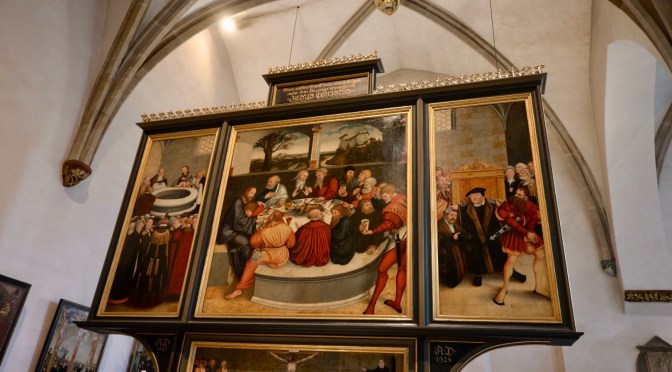
A year ago, on May 7th, 2024, I found myself standing in St. Mary’s town church in Wittenberg. When you first walk in, the narthex serves as a gift shop and admission desk. It is a little dark, and the ceiling is low, as you are underneath the balcony. Past that, you step into the sanctuary with its distinct green pews, high late-gothic pillars and ceiling. The Lucas Cranach Altar piece stands out in the chancel. 

St. Mary’s is where Martin Luther served as the pastor. I will admit that prior to about a month before that moment, I hadn’t really imagined that being a pastor was a significant part of Luther’s life. I had always imagined him primarily as a professor and debater, writing and speaking out against the abuses of the church. But in preparation for travelling to Wittenberg, I researched some of Luther’s most important sermons and was starting to see how influential his pastoral ministry was to his writing and speaking. 

It was in the context of congregational community and life where I began to feel the call to ordained ministry. Being active and included in all the things that our congregation had going on: Sunday school, children’s choir, confirmation, youth, youth orchestra, praise band, college and careers, serving on council when I was 18, career shadowing my pastor in grade nine, regular potlucks, Christmas pageants, family Bible studies, curling bonspiels, church picnics and campouts, adult studies, ushering, reading lessons, serving communion, etc. 

Being a part of a church was different than any other community that I was a part of. Not quite family, not quite friends and peers, not like a school or workplace, not like a neighbourhood. Church was like church, and I could sense a call to serve that unique community. 

It wasn’t until I was standing in St. Mary’s Church, thinking of Luther preaching his sermons on how to be a community that goes about changing and reforming, that I could see this was probably where his sense of call came from too. After 40 years of being a Lutheran and fifteen years of ordained ministry, I felt connected to Luther in a new way that I did not expect. I could see how, in all the things that he wrote about reforming the Church, he was looking through the lens of his ministry to the people of St. Mary’s and Wittenberg. His call came from the same place as mine, from the Holy Spirit through the congregation he served. A call repeated and reaffirmed regularly by being a part of the life of congregations and faith communities, where he could see the lives of his people sharing in their joys and sorrows. Luther’s community was often the motivation behind his calls for reform. He wanted to create a world where the people he served and cared for could hear the Good News of God’s forgiveness, life and salvation given for them. Luther wasn’t an academic tucked away in an ivory tower (or the Wartburg Castle!) thinking abstractly, but a pastor seeking the best for the people entrusted to his care. 

This is a Luther I can identify with: A Shepherd called to tend to his sheep and live his life in community. 

The ministry we are all called to

This week, the disciples have gone fishing. It feels like an interesting choice following the events of Good Friday and Easter. Yet, even in their attempt to go back to what they know, to the lives they lived before Jesus came and called them from their fishing boats, Jesus comes strolling down the shoreline again. There, he cooks them a meal of fish for breakfast. 

Following the meal, Jesus shares a conversation with Peter. He asks Peter if he loves him. Three times. This well-known story from the Gospel of John is a gospel reading often used at ordinations, the services where deacons, pastors and bishops are set apart for the ministries to which they are called. 

As I have shared before, the topic of my doctoral research thesis is the Lutheran Office of Ministry. Or in other words, the understanding that Lutherans share of how clergy or ordained ministers go about their work. As I hear this gospel lesson about Jesus’ meeting with confused disciples, uncertain of what to do next, I cannot help but think about the work of pastors and other clergy. 

Often, it can seem like pastors are the only ones “called” to ministry in the church. Or at least we talk and act like that is the case. But as you know, I am fond of repeating, our calling is firstly a baptismal calling⎯one we all share. 

Still, it’s easy to think that the only person doing ministry is the pastor. I believe this perspective on ministry stems from an unavoidable reality that pastors and clergy are often working at the heart of the ministry of a congregation or faith community. Pastors are tasked with preaching the Word and administering the Sacraments. Pastors bear responsibility for the care of the community of faith. 

When Jesus looks at Peter and asks, “Peter, do you love me?”,

Peter responds, “Yes, Lord, you know that I love you.”

Then Jesus says, “Feed my sheep.”

Jesus is calling Peter to ministry. Yet, it doesn’t mean that this is a task just for clergy. 

Ministry happens in congregations and faith communities. Ministry happens relationally. Ministry doesn’t take place with one person or another, but rather happens in the space in between. The space in between the pastor and the congregation is the place of ministry. We physically represent this in worship with Word and Sacrament. The Word becomes Gospel as it is announced from the pulpit and into waiting ears in the pews. The Holy Spirit meets the newly baptized as the waters fall from the hands of the presider onto the head of the baptized. The Body of Christ joins us to itself and each other as bread and wine are passed from communion server to communicant. 

Ministry, the work of the gospel, happens between us. And I think that is why Jesus tells Peter to feed his sheep three times. Jesus is reminding us that it isn’t about Peter and it isn’t about the sheep. It is about the Bread of New Life that feeds us with the Gospel. 

The Happy Exchange

Doubtless, you will have heard me talk about Martin Luther’s concept of the Happy or Joyful Exchange at one time or another in the past few months. 

The Happy Exchange is the metaphor that Luther uses to describe how our sins are forgiven. In the exchange, we give to Jesus our sins. But what does that mean? Do we heap them on him like some kind of scapegoat who is then sent away? Do we mark him with them like bruises and wounds like the famous camp skit ‘The Ragman’?

Not exactly. In giving our sins to Christ, it is that he takes responsibility for what was our responsibility. Jesus takes our sins from us by claiming them as his own. In return, Jesus gives us his righteousness, blessing and life. 

You might call it an exchange of goods for bads. 

For the past few years, we have been using a Good Friday tradition of tying black strips of cloth to our rough-hewn cross on Good Friday. I will admit, the first year we did it, it felt a bit hokey. However, as we have come back to this tradition, it has taken on a more profound and deeper meaning. This year, while I watched as worshippers tied their black strips of cloth to the cross, I couldn’t help but think of the Happy Exchange. 

Here, we were putting our sins, suffering and death onto the cross⎯onto Christ. It didn’t matter if they were big or small, known or unknown. The moment that truly caught me, though, was the letting go. I noted that more than a few folks held onto their strips for a moment, and even more lingered after tying their cloth strip to the cross. It was an emotional act to make tangible our connection to Christ on the cross. 

Here is the thing about the Happy Exchange: it is not an easy trade. Giving up our sins is not easy. Our sins are not just rule infractions on a report card. Our sins make up a significant part of who we are; our failures, our hurts, and our sufferings, all contribute to shaping us as people. It is not easy to just hand big parts of ourselves over to God. 

There is a reason we confess our sins each week in worship. We need to practice the act of handing over our sins to Christ. Because once we do manage to let go, our sins are gone from us forever⎯we can no longer hold onto them!

On Easter Sunday morning, the image that we began on Good Friday was completed. The strips of black cloth were gone from the cross. In their place, were beautiful and colourful flowers⎯signifying the righteousness, the blessing and the life of Christ. 

It struck me this year more than it has before that, together in worship, we rehearsed and lived out the Happy or Joyful Exchange this Holy Week. A beautiful image of how our sins are forgiven and our lives are transformed by the Good News of Christ’s death and resurrection. 

Alleluia! Christ is Risen!

The In-Between of Easter Still to Come

Palm Sunday, Maundy Thursday, and Good Friday are behind us, yet Easter morning is still to come. This in-between moment is one where two realities exist at the same time. Christ has died and Christ has risen, but neither is fully here. 

While uncomfortable, this is the place where we live as the Church, as people of faith. We are always in-between realities. We are always becoming and on our way to something new. 

As we approach the Easter morning scene, the Resurrection moment, we are like the women who are the first on their way to the tomb. Everything they know, everything they have witnessed, every possibility they can imagine tells them that what they are about to find is going to be one sure thing⎯death. 

They had no concept of what was possible with God, of what they were actually on their way to see and witness. Their minds and hearts could not fathom it. 

Easter is like that. Our crucified and risen God is like that. Everything we see and understand around us says that one thing is true, when a totally different thing is about to happen. 

Resurrection and New Life are always surprising and unexpected. God has a way of surprising us with empty tombs and new realities that change everything. Easter has a way of showing up when there is no way we could have predicted it. 

That’s why we proclaim and emphasize the mystery part of the mystery of faith⎯Christ has died, Christ is risen, Christ will come again.