

We are on the doorstep of Holy Week.
Clergy types will soon be setting out to write and preach sermons that somehow make sense of the passion story, from Triumphant Entry, to Last Supper, to Trial and Crucifixion and finally Resurrection.
Along the way, it will be important to say something about how the death of a wandering preacher, teacher and healer on a cross is the means of our salvation… and what exactly we are being saved from.
This is a tricky endeavour because the story of the passion doesn’t explain the reasons. Instead we are left to fill in the gaps, and Christians have been trying to make sense of Christ’s death since St. Paul was writing letters.
And so often on Good Friday, a strange and convoluted theory of the reasons for Christ’s death is presented… one that makes God seem merciless, if not plain incoherent.
Often, God is presented as the ultimate source of Christ’s condemnation, the one who kills Jesus on Good Friday.
And this is absurd.
It is my contention that Good Friday is the day of the most important facet of the Good News and it is not because God killed Jesus.
Satisfaction Atonement
One of the most common ways that Christians tend to explain the atonement is with Bishop Anselm’s satisfaction atonement theory. The cole’s notes version is that the punishment for human sin is our death. And the satisfaction, the making things right is Christ’s death (since he was without sin).
What is rarely stated is that Anselm used medieval legal practice to formulate his theory. In medieval law, a fine was the punishment for most crimes. Anselm saw then that death was the fine for sin. But that wasn’t the end of the matter. In order to compensate the victim, satisfaction was paid. An additional amount that would make things right.
Anselm figured that since death was the most human beings could pay, an additional payment to make satisfaction with God was needed. Christ’s death becomes the satisfaction for our sin.
Now, beyond the fact that his medieval legal system is flawed and very human like any other system, there are a number of problems with Anselm’s theory:
God requires blood in order to show mercy… which is not mercy.
God is bound by human laws… which means God isn’t free.
And finally God and Jesus split apart by the cross… which is trinitarian heresy.
Anselm’s atonement theory is certainly not the only one out there (Christus Victor/ Ransom theory, Moral influence theory, scapegoat theory etc…). But it shows a common problem that most explanations of what was going on on the cross seem to have – they undo the trinity.
The Cross and Trinity
For some reason preachers tend to get uncomfortable with God being too close to the cross of Good Friday. When I was a neophyte theology student, still two years from starting seminary I was asked to give a short reflection on Good Friday on one of the 7 last words of the cross. My words were “I thirst.” And I pontificated eloquently on how Jesus experienced the human condition fully on the cross. Sounds lovely. And I then expounded on how Jesus was fully separated from God, just like we were. Almost sounds legitimate… except for that whole trinity thing.
The doctrine of the trinity reminds us that the persons of the trinity are never separate because they are one God. They are distinct, but one. So the experiences of one are shared by all. The Father and the Son could not be separated, even on the cross.
And this the heart of the problem. We don’t like the idea of God suffering, the Father suffering. We would rather make God the killer than the sufferer.
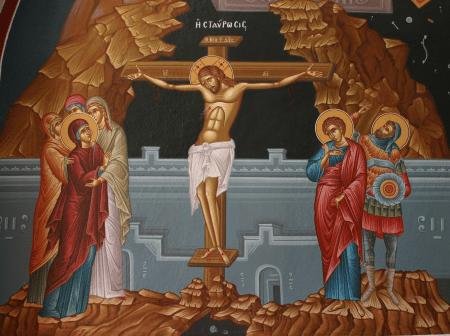
But the Trinity necessitates that God the Father experienced the cross just as much the Son did. God was crucified and died on that cross.
So who killed God?
We did.
Humanity. Our religion. Our government. Our authorities. Our mobs.
Yes, I do think that God knew the cross was in store of Jesus even before that angel visited Mary to tell her she was pregnant.
But it was not because God was perversely and cruelly looking to punish someone for our sin. It is not because God needed blood to be merciful.
God knew the the cross was in store because God knew us. God knew that humanity couldn’t let God come close in the incarnation. God’s coming close threatened our godship. We cannot be god if God is God. We could not be god if Jesus is God.
And here is where the Good News of Good Friday meets us.
Even though God knew the consequence of incarnation – of coming close to creation, of coming in flesh – God followed through to the end. God was born, God lived, God died. God did all the human things. Good Friday was the completion. God declared that God is going to a part of all of created life. There is no part of human existence that would be apart from God.
So why did Jesus have to die? Because we said so.
And why do we get to live? Because God said so.
So this Holy Week, whether you are preaching or hearing the preaching, listen… listen for the good news of Good Friday.
Listen and know that it is not that God killed God’s son in order to show us mercy. The good news is never a demand for blood. That is sin.
The good news is that God chooses life. God chose to live. Chose to live all of created life, including death.
And because God lived it all, that whole resurrection thing that happens on Sunday becomes part of our story. Because God chose to live and die with us, we get to die and live with God.
What good news do you hear on Good Friday? Share in the comments, or on the Facebook Page: The Millennial Pastor or on Twitter: @ParkerErik
 The Millennial Pastor