Tag Archives: easter

Not Easter as we are used to anyways

*This sermon is a collaboration with my partner in life and ministry, the Rev. Courtenay Reedman Parker. You can find her on twitter @ReedmanParker*

GOSPEL: Matthew 28:1-10

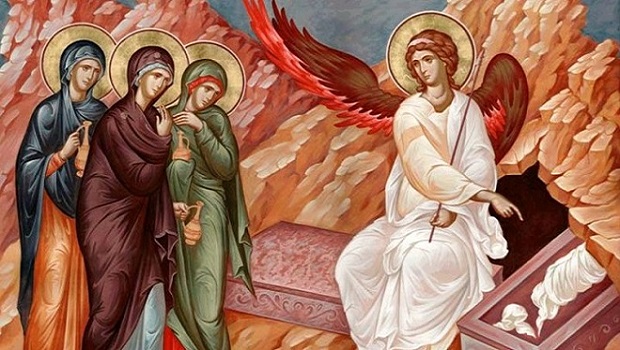
1After the sabbath, as the first day of the week was dawning, Mary Magdalene and the other Mary went to see the tomb.(Read the whole passage)

While it was still dark.
While it was still night.
While she could not see.
While she thought death held sway.
While she grieved.
While she wept.
While it was still dark, resurrection began


While It Was Still Dark by Jan Richardson

I imagine Mary Magdalene, and the other Mary, walking together to the tomb where Jesus had been placed just days earlier. These were not mere acquaintances of Jesus. These were not even his disciples. These were his friends, his family. 

And they were leaving their homes, leaving their loved ones. Leaving in spite of a lockdown to go to the tomb. To complete the burial rite. 

Many of us have walked that walk. To the resting places of our loved ones: public visitations at funeral homes or in the intimacy of someone’s home. It wasn’t that long ago that it was commonplace to hold a wake, a time to offer prayers, to gather in community to mourn our collective loss, and to offer support to one another in our grief. 

For those of us who have walked that walk know the precarious nature of grief. We know that a loved one has died. We know that life will never be the same. That our day-to-day existence, our relationships have all changed. There is an emptiness in the space between where our loved one was, and is no longer. In the liminal time when when we’ve become aware that death has happened, but before the wave of emotion hits us like a tsunami.

This is how I imagine Mary Magdalene and the other Mary leaving their physically isolated homes to go to the tomb where Jesus lay. 

We know that life has changed. We know that life will never be the same again. But we don’t know how… we don’t know the specifics. All we know is that there was then… and there is now… and somehow, someway, there will be a future we can’t yet see or imagine.

This is not how we usually do this.” 

A phrase that we have been repeating over and over again in the past days and weeks. A month into physical distancing measures and the Coronavirus has taken over our lives, even if we are not infected. 

And yet, we have been practicing for this moment as the church, practicing being disrupted by change, practicing muddling along with unfamiliar technology, unwanted changes, disruptions to our tried and true ways to going about our life as a community. 

But today acceptance of these changes has been forced and accelerated.

Because we are forced to stay home, forced to use the 21st century technology that we have been resisting, forced to re-imagine what it means to be community. 

And so there is also something familiar, or maybe original and authentic about this Easter morning. 

The family gatherings and traditions, the easter egg hunts, and roast hams, the colourful spring dresses and ties, the long weekend outdoors… they weren’t part of the first Easter. 

Hiding out in homes, behind locked doors and fearful of the outside world. That is original Easter. 

On the morning of that third day, the disciples were in hiding. After Good Friday, after the crucifixion of their teacher and friend at the hands of empire and religion, they went into lockdown. 

But it isn’t the disciples, the male disciples that we usually think of who at the heart of the easter story. 

It is the women. 

Mary Magdalene and the other Mary. 

The disciples are hiding away, but the women go out into the early morning darkness. They go out because they must. Their friend has died and there is no one but them to tend to his body.

They are essential workers. 

The orderlies and respiratory therapists and radiologists who make their way to hospitals in the early morning darkness because they must. 

They are the childcare providers and animal rescue workers and tow truck drivers who are still on the job every day to keep just enough of the world functioning to fight pandemic. 

They are the researchers and epidemiologists and hockey equipment turned PPE manufacturers working round the clock to save lives, flatten curves and keep us safe. 

They are the grocery store mangers, and civic water filtration engineers and steel distributers making sure the systems that need to function keep functioning so as not to add any other crisis to our collective plates in this moment. 

They are the caretakers of ritual and dignity, the ones who make sure that Jesus doesn’t become just another number on a Roman crucifixion accounting ledger, but is still treated as a person, a human being, even in death. 

The women go because they must. 

And so unsure and afraid, they come to the tomb.

I imagine that if there was anything that they knew from Good Friday, if there was anything they could be sure of, it was the expectation of finding Jesus’ body, even if they didn’t quite know how they Ould gain access into the tomb.

These women, like us, didn’t know what the peak crisis moment would be, they didn’t know that you needed to be on the other side to understand. 

They didn’t know what we already know, they found that Good Friday had something new and unexpected to declare. 

Instead of the body of their dear and beloved friend, they find something, someone else entirely. 

A messenger.
A divine messenger.
“Do not be afraid,” the Angel says. 

How is fear not possible in this moment? When nothing is as it should be? When nothing and no one is the same.

“He has been raise from the dead,” The divine messenger declares.

How can this still be the same world that women live in?

“Go quickly and tell his disciples… you will see him.”

How can this be where Good Friday has taken them? Where the cross has taken them?

Where this empty tomb has taken them?

This divine messenger, this angel has changed their world, changed their understanding of everything that came before. 

But still the old world remains.

There is still empire and oppression.
There are still paranoid Kings and cruel imperial governors.
There are still soldiers in the streets and police at the ready.
There is still danger and persecution
There are still locked doors.
There are still incredulous disciples hardly willing to believe the word of a woman. 

Empty tombs, and Angels from heaven and shocking news of resurrection don’t make those things go away. 

Not then.
And not today.

On this Easter morning:
There are still news conferences with case numbers and death tolls.
There are still politicians playing games with our lives.
There are still deniers in the streets and anxious shoppers waiting in line.
There is still fear and anxiety and uncertainty.
There are still our locked doors, and lonely easter meals coupled with seemingly empty hearts.
There are still the empty feelings of our lives, the emotional and spiritual cost that physical distance demands.
There is still the thought of when things go back to normal… back to the before time.

Empty tombs, and Angels from heaven and shocking news of resurrection don’t make those things go away either. 

Sin and suffering and death don’t just go away. 

“Do not be afraid” the Angel said, even in the midst of all these things. 

And if empty tombs, and Angels streaming down from heaven were not enough, 

Jesus greets the women too. 

“Do not be afraid,” Jesus says. 

Because the things of this old world that remain, do not have the final say.
Because the empty tomb changes our world.
Because resurrection transforms all things.
Because new life found is where should only be death
Because the risen Christ has the final say.

Empires and oppression, news conferences and death tolls; cannot put down the Risen One.
Paranoid kings, cruel imperial governors, game playing politicians cannot control New Life
Soldiers and pandemic deniers in the streets cannot keep Jesus from us.
Danger and fear, persecution and anxiety are not more powerful than empty tombs.
Locked doors and lonely meals do not limit Christ’s access.
Unbelieving disciples and the emptiness within are not the story that Christ writes for us.

Today is still Easter, even if the women weren’t expecting it, even if we don’t feel like it.

Not Easter as we are used to anyways. 

Yet, today is the day of Resurrection, the day of New Life, the day of New Beginnings that we need. 

The Easter that the Risen Christ brings to us today. 

Amen. 
A Pentecost Moment for an Easter Community

Acts 2:1-21

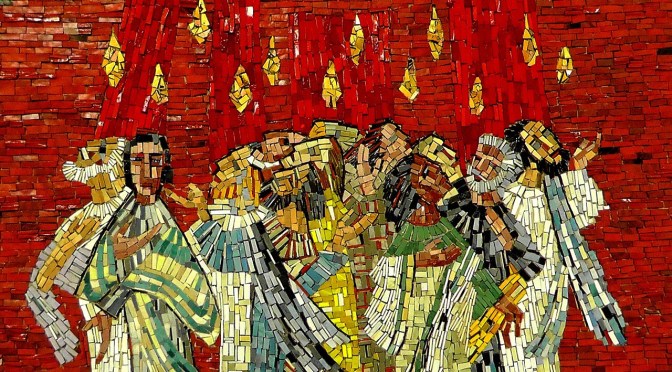
When the day of Pentecost had come, the disciples were all together in one place. And suddenly from heaven there came a sound like the rush of a violent wind, and it filled the entire house where they were sitting. Divided tongues, as of fire, appeared among them, and a tongue rested on each of them. All of them were filled with the Holy Spirit and began to speak in other languages, as the Spirit gave them ability. (Read the whole passage)

After seven weeks of celebrating the season of Resurrection, seven weeks since we gathered with the women at the empty tomb on Easter morning, we have come to the next climactic moment of the church year – Pentecost Sunday. Today, the spirit comes unexpectedly and surprisingly into the gathering of disciples, and sets them on fire with the gospel in dramatic fashion. Tongues of fire, impromptu sermons, intrigued crowds and many baptisms. The Pentecost story is one that we would love to see and experience more often in our congregations and worship services.

Yet, Pentecost is a day to which we have an odd relationship as modern Christians – as Lutherans gathering together for a Barbecue on the plains of Manitoba in 2019.

Pentecost comes from Greek meaning the 50th. The 50th day from Passover, seven weeks after Easter. Pentecost is one of the major church festivals, along with Christmas, Epiphany, Easter and All Saints.

However, Pentecost usually comes and goes without the same in of fanfare are Christmas or Easter, instead it is maybe a convenient day for confirmations or recognitions of graduates… a Sunday that moves us from Easter in spring to green summer Sundays.

There is something about the Pentecost story though, something that resonates deep within us. There is something about the excitement and drama that also makes us want to look back with feelings of nostalgia, with feelings of loss and grief even.

This small little group of disciples that are one day thrust out into the public square, out of hiding into plain sight. And all of sudden the wind of the spirit blows through, igniting the interest of the entire city of Jerusalem. And the crowds just come – effortlessly. Residents of Jerusalem from all over the world. Peter begins preaching, catching the attention of all. The becomes an unplanned worship service. 3000 people are baptized. It is chaotic, but it is exciting. The crowds have come to church. Our shared ministry service here is almost like a recreation of that Pentecost story, a way for us come together with worship and some BBQ fire to recreate the drama.

But here is the rub, if we are honest, the crowds aren’t showing up most Sundays no matter what we do to recapture the moment… it isn’t easy and normal for people to just show up to church anymore. And it is a lot of work to keep the folks we have, a lot of work to keep coming ourselves. Church today is not effortless like it seemed to be on Pentecost.

But it feels like church once that effortless, or our memories of it are. We can look around most Sundays and remember the faces that once sat in empty spots. We can remember the days when many hands made for light work, when it was easy to put on a potluck or Sunday School picnic or congregational event. We can remember the hoards of kid running around church basements or playing outside during congregational meetings.

And maybe most of all we remember the Pentecost energy. We long for that energy, that Pentecost fire to come and wake our communities up. If only we could find that again.

Because we can see still that the world can get caught up in Pentecost-like moments. We can see it in Jets or Raptors playoff games. We saw it in the spontaneous crowds gathering to sing and pray even as Notre Dame cathedral was burning. We see it in the youth walking out of school and striking for climate change. We can see it in the parades for Pride month, in the crowds that will descend on Birds Hill Park for folk fest, in the spontaneous vigil crowds that seem to come with each new mass shooting, in the crowds protesting politicians and greeting royal babies. We can glimpse what seems like Pentecost energy and drama in the news, on social media, in our communities… often seemingly out of the reach of faith communities and churches.

And we also see how fleeting it all is, how interest and drama comes and goes in the blink of an eye.

And so we wonder how to find it again… if we will ever experience it again in our congregations, in our communities of faith. Will church ever have that effortless energy again?

Of course, as usual, there is more to the story.

It easy to think of the crowds and excitement.

But Pentecost was scary and confusing. It was dangerous and momentary.

It easy to forget just how terrifying those 50 days leading up to Pentecost were for the followers of Jesus. The women had come back from the empty tomb on Easter. Jesus had appeared in the locked room twice. And Jesus served breakfast on the beach only to point that Peter was unable to answer Jesus’ questions with the self-giving love that Jesus hoped for. The disciples were hiding, and fearful and confused about what came next for them. Nothing seemed to be in their control.

But then all of a sudden they were thrust into the streets, out from hiding into public view, from the closed circle of Jesus’ friends to being revealed to Jews and Gentiles alike. And even though it was chaotic, they somehow managed to gab hold of some control. Some how they managed to get organized enough to baptize 3000 people.

It is easy for us to forget how fleeting it was. St. Paul wrote to small churches. To communities of 15 or 25 people. To small groups of disciples wondering how to become the church of Jesus’ followers, waiting for Jesus to return and save them from the struggle.

And in fact, the church over the course of the past 2000 years has more often than not looked like those first disciples hiding away not sure of what to do next after the resurrection. The church has been those small communities of the faithful navigating the day to day of minisry and life in amongst the strange and chaotic world around them.

The drama and excitement, the crowds of Pentecost did not become the norm. It was only momentary. Pentecost is not the model for being church in the world.

The model has always been Easter.

The spirit’s coming was for an Easter community. The tongues of fire and the crowds and baptisms were all for the sake of the gospel, all to help the disciples tell again the Easter story. To tell the world around them the good news of resurrection, of New Life coming into the world of sin and death.

And yes, Easter is confusing. It is about empty tombs, and unbelievable stories, and Jesus showing up where we least expect him and messing with us in ways we cannot comprehend. Easter is about recognizing that we have no control over what God is up to in the world, that Jesus is ushering in new life and we are along for the ride.

The disciples, the faithful, the Church is an Easter church given a Pentecost moment. We are not a Pentecost community given an Easter moment.

Easter defines us, Easter claims us, death and resurrection creates us anew.

It is the Easter story that we tell every week, every time we gather, every time we confess our faith, we hear the Word, we gather at font and table.

And Pentecost is the Spirit’s way of pointing us back there again, of reminding us that new life comes in surprising and unexpected ways.

Pentecost is God’s way of breathing life into the Church and giving us glimpse of the new life the Gospel brings.

And yet, we remain Easter people. Even as most of the time it isn’t Pentecost, and life and ministry isn’t full of the dramatic and unexpected. Even if the crowds and energy are fleeting. Even if we feel more like those little churches of 15 or 25 that Paul was writing to instead of the 3000 that Peter was preaching to.

Even when it isn’t Pentecost, it is still Easter.

Because with Easter there is always forgiveness of sins, healing and hope for the suffering, life for the dying, resurrection for the dead. There is always the Word and Water, Bread and Wine that tie us again to the mystery of faith that Christ has died, Christ has Risen, Christ will come again.

And so this Pentecost Sunday is not the destination of we have been headed to for the past 50 days, but a reminder of who God has made us to be – Easter People brought to New Life in Christ.

Doing ministry when the plan doesn’t come together

GOSPEL: John 17:20-26

Jesus prayed:] 20“I ask not only on behalf of these, but also on behalf of those who will believe in me through their word, 21that they may all be one. …

25“Righteous Father, the world does not know you, but I know you; and these know that you have sent me. 26I made your name known to them, and I will make it known, so that the love with which you have loved me may be in them, and I in them.” (Read the whole passage)

Today is the last Sunday in the season of Easter. Seven weeks of celebrating and hearing of the Alleluias of the Resurrection. Yet, we do not leave Easter behind today. Rather, each Sunday is like a new mini-Easter, a new extension of God’s future given to us in the resurrection of Christ.

Therefore, as we prepare to move on to Pentecost next week, and into the long season of green after that, we go with our forebears in faith as a community shaped and formed by the seven week long, great day of the resurrection.

Throughout this season of Easter, we have been moved from the immediacy of the resurrection to the shaping and forming of the disciples into the early christian community. We have heard again how they were and we are being prepared to the body of Christ in the world. And with all of it coming to a head on Pentecost next week, as we mark the birth of the church.

But before we get there, we are left with two seemingly contrasting stories about where the early followers of Jesus were headed.

In one, we are silent eavesdroppers on a conversation, a prayer between God the Father and Christ the Son. In it Jesus commends this little band of misfits, outsiders and the least likely leaders to his father. And what comes from this handing over is a promise that this community of Christ’s followers are not left alone, and that those who belong to Christ are brought into the life of the Trinity, into the mission and activity of the Father, Son and Holy Spirit.

And then in the other story, we see the unfolding and surprising ministry of Paul and Silas as they go about the Greek world. As the two make their way to Phillipi with the intention of ministering to the fledging community there, they are interrupted by a slave girl who has been given the gift of divination.

The slave girl and her interruptions soon become an annoyance to Paul… and so he decides to cast out the spirit possessing her. This gets Paul into trouble, and the slave girl’s owners set to Paul and Silas to beat them and have them thrown in prison because they have just lost their lucrative source of income.

Once in prison Paul and Silas set about a new ministry to the prisoners only to have that interrupted by an earthquake and then a fearful guard contemplating taking his own life, whom Paul must again change course and do something about.

While maybe not obvious at first, the contrast between the two stories is striking. In one Jesus promises divine providence for the community of his followers. In the other, every plan for ministry that Paul has goes off the rails because of interruptions rooted in tragedy and suffering.

Somewhere between the promise that God will always go with us as the Church, as God’s hands and feet for mission, and the reality of how ministry is experienced in practice seem to diverge quite a bit.

On some level we know what Paul and Silas were experiencing. We too tend to have certain visions for ministry. We bear expectations for what church, for what our community faith, should look like. And yet, we also know what it is like when those expectations and visions aren’t realized. We know what it is to have our visions for church interrupted by the wrong kind of people, to have suffering and tragedy interrupt our plans.

It may be forest fires or the new of another mass shooting or governments unable to make trade deals that affect the daily lives of citizens or the crisis of murdered and missing indigenous women happening right on our door steps being labeled a genocide that keep us from being focused on the particular mission and formation of our community of the faithful.

It may be the struggles of balancing work, family life, young children, aging parents, retirement planning, declining health or other things of life that keep us from putting the time, energy and effort into practicing our faith that thought we would.

It might be the realities of tight budgets, tired volunteers, and a past that seems better than the future, expenses that keep going up and dollars that didn’t go as far as they used to that keep us from looking forward with hope and believing that God has good things in mind for us.

It might be a world that changes and moves on from one thing to the next so fast that our heads keep spinning, societal values and norms that seem to shift every day, new people with new identities that we aren’t sure how to navigate showing up and being part of the world in ways we struggle to understand.

Our visions and expectations for ministry are so easily interrupted these days, and along with brothers and sisters in faith here in the pews, across Winnipeg and Manitoba, across Canada and North America we don’t know what to do about it.

Paul didn’t know what do either… and maybe that is the point.

There is of course an interesting thing about the story of Paul and Silas: while they were being interrupted by the slave girl, she was telling everyone that these two men knew about salvation. And while Paul acted out of annoyance, he freed a suffering girl from possession. And while Paul was busy trying to minister to the other prisoners while in prison, it was the jailer who needed to hear the good news.

Even in the midst of some of the worst things imaginable, some of the worst suffering – slavery, exploitation, violence and false imprisonment – the gospel found a way through. Even though it was not what Paul was expecting, even though it wasn’t even according to plan B or C or D… the gospel broke into the world precisely in the midst of the interruptions of human suffering.

It is not say that the good news only comes when there is bad stuff happening, but rather than in the midst of the mess and chaos of human life, the gospel has no problem breaking in. And the gospel doesn’t need our plans to be realized to be preached and to be heard.

In fact, our plans seem to have relatively little to do with where the good news of Jesus who died and rose again for us is made known.

Paul had one idea for Philippi, but God had another.

And just maybe that is the promise that Jesus is talking about with the Father. Not a promise that our visions and expectations will be realized, but a promise that in the midst of the real messiness and chaos of the world, the gospel will break through and break in.

It all fits of course, with a God who chose to be born in a manger in forgotten Bethlehem in order come into human life. With a god who chose to wander around the backwoods of the Roman Empire with a bunch of fishermen and tax collector in order preach the news of God’s love and mercy for all people. With a God who made execution on a cross at the hands of the best religious and political leaders that humanity had to offer the moment of our redemption along all creation.

The good news of this upside down, unexpected God found in Jesus wouldn’t make sense if it could only be preached when all the plans come together, when all the visions are realized, when all the expectations are met. The good news of this Jesus makes perfect sense preached in the midst of our plans gone wrong addressing the realty of our suffering world.

Jesus’s promise that suffering and death isn’t the end makes sense when it comes to us in the midst of fires and shootings and community crisis and economic struggle.

God’s naming and claiming as God’s own in the waters of baptism reminds us of who we are as we navigate the struggles of daily life, of family, work, community, health, retirement and on and on.

Christ’s presence among us in the Body of Christ remains the same even as congregations struggle to keep up with this shifting and changing world.

The forgiveness and mercy of God help us to change and grow, even as we don’t always understand the people and things around us and how to adapt to them.

The good news of this Jesus makes perfect sense preached in the midst of this community of misfits and outsiders called the body of Christ, it makes prefect sense that it comes to us in Word, Water, Bread and Wine shared here in our imperfect, messy, and chaotic community of faith.

And so, on this last Sunday of Easter, we hear two seemingly contradictory stories that fit perfectly together. That remind us that God always comes in our imperfections and plan Fs and struggling messy moments of suffering and surprise… because that is where we are.

Because where we are is where God in Christ breaks through in order to find us, in order to tell us again of God’s promise of New life for us.

The future we cannot imagine

GOSPEL: John 5:1-9

6When Jesus saw him lying there and knew that he had been there a long time, he said to him, “Do you want to be made well?” 7The sick man answered him, “Sir, I have no one to put me into the pool when the water is stirred up;… (Read the whole passage)

Six Sundays into Easter we are coming to the end of the great party of the resurrection. Sure, things have been winding down for a few weeks already, but now is the time when the hosts are letting everyone know that the kitchen is only open a few more minutes, its last call before hitting the road. We are close to being ejected from this celebratory season into the next thing. But the coming end of Easter isn’t just about moving to the next thing. Easter wraps up the first half of the church year where we tell the story of Jesus’ life, from birth to death to resurrection. On Pentecost Sunday we mark the beginning of the Church, the Body of Christ, of Jesus’ presence in the world in a new way and we follow that with about 25 Sundays of green where we hear the teachings of Jesus.

And so it is curious, that coming to the end of the portion of the church year where we tell the story of Jesus’ life we skip back to a moment earlier on. A scene from early on in Jesus’ ministry not long after his baptism and early miracles. In the light of Easter, this moment takes on different connotations than it might have before.

Jesus is making his way through Jerusalem and comes near the Sheep Gate and the pool of Bethzatha. It was believed that this particular pool was periodically visited by an angel who would stir up the waters, after it would heal those who bathed in it – the sick, blind and lame.

Laying there is a sick man who had been there for 38 years. Jesus sees this man and asks him a question, “Do you want to be made well?”

The man tells Jesus that there is no one to bring him to the waters when they are stirred up, and he cannot make it in time on his own.

At this point, the conversation should be feeling a little off. It is like when someone responds to a question that isn’t actually an answer to the question. We have all had these kinds conversations. “What time is it?” “Oh, well we haven’t had lunch yet.” Or “How do you get to the grocery store from here.?” “That’s a long ways, you will need to drive.”

Jesus asks a fairly straight forward question and the man answers a completely different one. And in fact, there are a lot of different answers that the man could have given that would have been closer to answering Jesus’ question. He could have said ‘yes’ or ‘no,’ he could have told the story of how he lost the use of his legs or became sick, he could have asked for mercy and help. But the man doesn’t respond in any of those ways…

Instead the man begins, “Sir, I have no one…”

The man begins with relationships or his lack there of. He has no one, no one in his community has been willing to help him for 38 years. But the man also claims no agency, he believes that his problem is that he has no one, and no one will make way for him.

And maybe after 38 years that makes sense in the man’s mind. He neither sees nor imagines any kind of alternate future. This is his life, the sheep gate with all the others in his community like him, just a few steps from healing, yet completely unattainable.

The man has also completely avoided Jesus’ initial question. “Do you want to be made well?” And that is significant.

It’s significant because it is the same kind of thing we do as well. The conversation that Jesus and the man have could have just as easily been one in our homes or work places, churches or neighbourhoods. It feels unimaginable that no one would have helped this many in nearly 40 years. Yet, how many of us live with pain and discomfort, frustrations or grudges for years upon years? How often when faced with the prospect of doing something about the problems we bear, we look around and say, “There is no one here to do the work needed to do.” As a community and society, how often do we simply accept or even encourage the suffering of an unfortunate few? “If only they could help themselves, if they did’t make the choices they did, what could I do about a problem so big and so hard?”

Our problem is that we find it so hard to imagine any kind of different future than our present. The man has become his story. He has no one to take him to the pool and when he tries to make it on his own, someone steps in his way.

And so too we become our stories…

I am too old to start over,

too set in my ways to learn,

too far gone to be be saved.

We are dying because there is no one to step up and do the work,

we are declining because sports and shopping on Sunday morning,

people just don’t care enough to give of their time and resources like folks did in the past.

Climate change is too big a problem.

Sexism, racism, and inequality are other people’s problems.

I didn’t do those awful things, why should I have to pay for the sins of my ancestors.

We too cannot imagine a future different than our present. It isn’t that we don’t want to be made well or not… its that we don’t know what being well even looks like. We believe that we are what we are.

Yet, Jesus shows up and asks anyways. “Do you want to be made well?”

And you see, before the man even answers, Jesus has invalidated the man’s story of himself. “Sir, I have no one…”

Except the One who has seen him and reached out to him and asked him if he want to be made well.

And even when the man cannot see it, even when he still does not realize that Jesus has broken through his isolation and solitude, and that Jesus has seen him not for his problems but for his humanity…. even when the man cannot see all that… Jesus stays present.

“Stand up, take your mat and walk.”

It isn’t that Jesus has fixed the man’s legs, or taken away his sickness. It’s that even when the man cannot recognize Jesus’ breaking through with a new future and a new story… Jesus hears the man.

It is as if Jesus is saying, “So you think your problem is that you cannot make it to the pool and no one will help you there?… Okay, how about now?” And the man has help, the man can get to the pool.

Jesus meets this man, see him for who he is, and hears who the man believes himself to be…. and Jesus breaks through it all. Jesus makes the man well with a future that only God could have imagined.

And for all the ways in which we cannot imagine any other future, in which we believe that our present is our future… God has a new future and new story in mind for us.

Each time we gather as the assembly, God greets us with a new story about us.

Forgiveness for sinners,

Healing for suffering,

Reconciliation for the conflicted,

Intimacy for the isolated,

Welcome for the marginalized,

Community for outsider,

Hope for the despairing,

Peace for the tormented,

Life for the dying,

Resurrection for the dead.

God greets us and this world with a Word that changes our present, and opens us up to a future we cannot conceive of or imagine.

And even when we cannot see what Jesus is doing, Jesus sees who we truly are in the waters of baptism, the new identity that we are washed and cleansed with in the waters.

And even when we cannot imagine what being well looks for us, when we cannot answer Jesus’ question for us, Jesus greets us at the table, welcomes us into God’s future, into healing relationship and community found in the Body of Christ.

It is as if Jesus hears all the stories about ourselves that we bring here, that we bring to this assembly, and Jesus says to us, “Okay, so you think that that is your story, that this is your future? Okay, how about now?” And we are forgiven and healed and reconciled and brought to new life.

Jesus meets us over and over again, from Christmas, to Lent, to Good Friday, to Easter and beyond. And Jesus keeps on asking,

“Do you want to be made well?”

And thankfully, our answer to this question doesn’t matter… because Jesus has already seen us, already sought us out and already has set us into God’s future.

And Jesus’ answer to us is, “Stand up, take your mats and walk.”

The Complications of Belonging to a Church

GOSPEL: John 13:31-35

31When he had gone out, Jesus said, “Now the Son of Man has been glorified, and God has been glorified in him. 32If God has been glorified in him, God will also glorify him in himself and will glorify him at once. 33Little children, I am with you only a little longer. You will look for me; and as I said to the Jews so now I say to you, ‘Where I am going, you cannot come.’ 34I give you a new commandment, that you love one another. Just as I have loved you, you also should love one another. 35By this everyone will know that you are my disciples, if you have love for one another.” (Read the Acts text)

We are now into the latter half of the season of Easter. The Alleluias from Easter Sunday, or as it is formally called The feast of the Resurrection of our Lord, are not ringing as loudly as they were a month ago. Yes, it is still Easter but with 4 weeks of resurrection stories behind us we are coming into the questions that the early church community faced. Questions about what it means to be a community, what does it mean to belong, who exactly are we and where do we go from here? Sound familiar?

Even as we consider this new Easter world, John jumps us back to Maundy Thursday… to hours before betrayal, arrested, trial, and execution. Jesus is eating the Last Supper with his disciples, and he gives them a New Commandment – to love one another. On the night before Good Friday, these are the last instructions of a teacher to his followers. Yet, here a month into Easter, they speak of a different reality to a fledgling Easter community being birthed before our eyes.

In some ways we should have read story of Peter from the book of Acts after the gospel reading, because Peter’s dilemma is precisely how to live into the New Commandment that his teacher and master had given him.

In the days, months and years after the resurrection, the community of Jesus’ followers that continued on to become the church, had to begin dealing with a lot of questions. Questions about who belonged and what it took to become a member of the community. As Peter became the leader of the Christian community in Jerusalem, the question of who could be a part of the community quickly arose. Particularly, as small Christian communities began to sprout up beyond Jerusalem and into the Greek world, the early church had to contend with what new converts needed to do in order to join.

When Peter meets the community in Jerusalem, they are a Jewish group… all are circumcised. And they have been keeping to the tradition of Judaism not necessarily seeing following Jesus as a departure from the faith of their ancestors. Yet, Peter has been meeting with uncircumcised followers – gentiles. But not just meeting with them, eating with them. Of course, observant Judeans kept Kosher, so eating with gentiles would certainly mean breaking Hebrew purity laws. The circumcised believers question Peter’s actions… so Peter tells them a story. Peter was given a vision, a voice from heaven telling him to eat non-kosher meat. Yet when he dismissed the dream, it kept coming back.

Even then, Peter is not swayed… so the spirit sends him to the home of a gentile, Cornelius. And there Peter’s mind is changed.

Now some twenty centuries later, we don’t generally feel the same way about circumcision and eating non-kosher meat that the early christian community in Jerusalem did… yet there is still something extremely familiar about this debate.

Of course, we know on a technical level that the first step of becoming a Christian is to be baptized. In fact, the Greek word Cristos means anointed one, Messiah is the equivalent in Hebrew. And after being washed in the waters of baptism, we are a marked with cross in oil… we are anointed, we are named as Christians.

And yet, knowing what it means to become a Christian through baptism and anointing compared to belonging to a particular community… well those could very well mean different things.

In the first congregation that I served, an open country church on the corner of a quarter section of farmland, what it meant to belong had a complicated meaning. Belonging happened in a variety of ways: If your family had been farming the land for a few generations, you belonged whether you wanted to or not, whether you were in church every Sunday or once a year. And yet, if you were new to the community, meaning being the first generation to the land, you were always new. Some who had been faithfully attending for decades, were still considered “new members.”

In my second congregation, a very large congregation in a small city, belonging was very much tied to involvement and connections. You could quickly belong within months by joining one of the many groups active in the congregation, like knitters, musical groups, prayer groups, people interested in global mission and so on. Yet, you could remain a new person for years if you kept to yourself and just showed up for worship.

And at my last congregation, belonging was tied to one’s place in the community surrounding the church. Where you worked in town, what street you lived on and who your neighbours were, and how connected you were in town determined your status of belonging.

Of course, here at Sherwood Park, we have unspoken rules about what it means to belong too… they are apart of every church from Peter’s day to ours.

Circumcision and eating non-kosher meats, or having generations to stand on the shoulders of, or sharing a common interest like quilting or music or missionary work, or meeting by chance at the grocery store and again at the PTA meeting and again while shovelling snow… all of these things and so many more make up the complicated definition of belonging to a community, belonging to a church, of a church belonging to a denomination, of a denomination belonging to a religion and so on.

Yet, all of these complications of belonging are about more than checking off boxes and fulfilling requirements. They are ways that we deal with the same fear living within each of us. The circumcised ask Peter about his fraternizing with the uncircumcised because they are worried if they themselves are worthy, if they are acceptable, if they actually belong. All of our ways to defining who is in and out, who checks the right boxes and who doesn’t… they all have to do with our own fear of being good enough, of being worthy and acceptable.

Last week, we heard from Revelation giving good news to Christian communities living on margins of society and how the great multitude worshipping before the throne was God’s way of breaking down walls that divide and separate.

Today, is about God breaking down the same walls within our communities, within ourselves.

Even after being given the same vision three times Peter is not convinced… that is until he comes to the home of Cornelius.

It is when Peter must look Cornelius in the eye, in the flesh, and decide whether the good news of God’s forgiveness and love is also for this Gentile… The Holy Spirit breaks the walls Peter’s heart. The Spirit makes Peter realize something new…

All the complications of belonging… that is our baggage, that is our stuff.

But for God, there are no complications… there is simply belonging.

In Christ, we all belong. We all belong to Christ.

We all belong because of the one who crossed the chasm, who bridged the divide of Creator and creation, who joined what was separated in sin and death together in forgiveness and resurrection. In Christ, the one who is both our flesh and the divine, we are joined to the Trinue God of all.

And this same Christ, likes to keep reminding us of that. Not in the complications, but by meeting us in the flesh. Christ meets in human voices and bodies that read and proclaim God’s word, in prayer and song, in peace shared and praises given.

Christ reminds us that we all belong in the water that washes us and the oil that anoints us, and we are washed and forgiven by God, we are anointed and clothed by God, and we given the same family name – Christian.

And Christ reminds us that we are all one in the same body. As Jesus gathers at the table, as we share in Body and Blood of Christ, God makes us what we eat and drink – Christ’s body given for the sake of the world.

And all those complications, all those other things, all those reasons we find to say someone whether belongs or doesn’t… those things are pushed aside.

And instead Christ proclaims us that belonging isn’t up to us, not based on our worth or the worthiness of the generations that came before, not based on our ability to participate or contribute, not determined by our integration into the fabric of community, the number of connections to others we carry….

But belonging is determined by the One to whom we belong.

Today, Christ declares to Peter, to the early church, and to us… that we no matter who we are, we belong to God.