Tag Archives: Doctor of Ministry

The Forefront of the Kingdom of God – Part 2

Last week, in the light of the Sermon on the Plain or the Beatitudes, I talked about how the Kingdom of God is local and near to us. 

One of the things that Christianity has struggled with in the last 70 years or so is correctly identifying where the primary work of the Kingdom of God is happening. All too often, we have associated the Kingdom of God with other kingdoms and powers. Christians have looked for political influence, economic influence and cultural influence. Every time we do this, the powers of the world have taken the opportunity to exploit and use Christianity for their own benefit. You don’t have to scroll through many news headlines to find Christian Nationalism being used by political authorities right now. 

As Jesus keeps preaching the sermon on the plain this week, he speaks of loving our enemies. He preaches forgiveness and mercy in the face of violence and persecution. A message to those in power that sounds like rolling over and being a doormat for abuse, it sounds like an encouragement to weakness. 

In some ways, there is a tiny bit of justification for their skepticism. Jesus isn’t advocating simply suffering and enduring great injustice. Rather, the issue is one of location and scale. To understand what Jesus is getting at requires us to consider again where the primary work of the Kingdom of God is. 

We hear the word ‘Kingdom,’ and it conjures visions of feeding the hungry of the entire world, ending poverty on a national scale, or standing up and protesting injustice with great crowds of support. Kingdoms loom large in our minds. Yet, the Kingdom of God, or perhaps more accurately the Reign of God is best seen elsewhere; the work of Kingdom happens on a more personal and intimate scale. 

As Jesus talks about loving one’s enemies this week, he isn’t talking about far away foreign nations (though we ought to love even our far-away foreign neighbours), but more likely the enemies in front of us. The people in the community, the friends, family and neighbours with whom we may be in conflict with are the ones we ought to love.

Martin Luther’s revolutionary understanding of God’s forgiveness of sins wasn’t just about our individual and personal relationship with God. Forgiveness of sins is also about our neighbour. What is forgiveness of sins for, if it isn’t for building community? 

Where do things most clearly and regularly happen? In the local, small communities where we actually live our lives. For example, in the congregation of the faithful. It is here that we practice loving our enemies, as we confess our sin, ask for forgiveness, listen to the Word of God, and share bread and wine at the table. Local churches are at the forefront of the Kingdom of God. The place where we can see most clearly the work of the Kingdom. 

It might feel too obvious or plain, too easy and mundane. But the Kingdom of God is where the Gospel is preached and the sacraments are administered. The place where we are constantly practicing loving our enemies, practicing asking forgiveness and giving mercy. Churches are the little outposts of the Kingdom of God, bringing the new reality of God’s mercy and love to bear for the world.

A Reformed Reformation Sunday?

With October coming to an end, we prepare for that big occasion on October 31st… no, not the one with kids in costumes, candy and scary decorations in many front yards. That other occasion that is important to Lutherans and those who study 16th-century history – Reformation Day. 

This Reformation Day, it is hard to believe that we have been talking about Luther and thinking about his life for months now. Yes, I know it has been me coming back to his story and sharing photos from my trip to Reformation sites this year. When I started looking at and considering doctoral programs a few years ago, I looked at studying history with a focus on the Reformation. When I settled on the Doctor of Ministry program at Lutheran Theological Seminary in Saskatoon, I didn’t do so thinking that Luther would be central to my program of study. My research topic wondering what Lutherans think and believe about the role of clergy has morphed into what Martin Luther thought and wrote about the role of clergy in congregations and communities. 

Yet, here we are. I have travelled to Germany, walked where Luther lived and worked. I have read many, many books, written papers, lectured to a variety of groups and discovered a richness in knowing Luther’s life and work more now than I ever expected to. I was teased often in Seminary for caring about Luther too much; but now I remember the teasing from my classmates with pride. The place that Martin Luther occupies in our history as Lutherans, and among all Protestants, is hard to describe at times. 

With Martin Luther now a central part of my doctoral studies, and considering my research, Reformation Day arrives with a very different air about it. Even as someone who loved history, loved Lutheran history in particular and got teased for loving it too much, I always wanted to make sure that Reformation Sunday wasn’t a time to just celebrate Luther and forget about the Gospel. So I have been cautious on past Reformation Sundays not to talk about Luther too much. 

This year, I am less worried about that. Not because Luther should overshadow the Gospel we usually proclaim on Sunday mornings, but because when you dive into Luther’s life, his ideas and thoughts, his writing and story, it becomes clear that nearly everything he did was with the intention of focusing people on the Gospel. He was obsessed with making sure that the people around him would hear the Gospel. He spoke out when he saw the abuses of the church. He sought to encourage the people he served to live lives of faith, caring for one another rather than trying to earn salvation. And, he was pretty certain of his own flawed and infallible nature. 

As Lutherans, we do not worship Luther. We don’t believe that the things he did would save us from sin and death. But in hearing about the things that Luther did, the things he wrote, and his witness to the gospel, we can hear the Gospel of Christ in a new way and hope that we, too, can live lives of faith and service as Luther did.

15 years – Pastor Thoughts

This week we observed those two beginning of summer milestones: Canada Day and American Independence Day. While both days have muted observations in Canada (the 4th of July for obvious reasons and July 1st for colonial ones), these two statutory holidays are signs of the beginning of summer.

The 4th of July is of particular significance to me for personal reasons – I was ordained to the ministry of Word and Sacrament on a hot and muggy day in Edmonton, Alberta in 2009. I was 26 years old, having just completed my Master of Divinity from Lutheran Theological Seminary in Saskatoon, and my Bachelor of Arts in History and Theology prior to that. It had been eight years of post-secondary schooling and I was ready to join the working world full-time. 

It was hard to believe that I was about to go from years as a long-time student to being given charge of the care of a congregation all by myself. As a student, my biggest responsibilities were getting assigned readings done, writing papers on time, and trying not to spend all of my student loans before the end of the term. In those first years of ministry, I certainly wasn’t the only person who was taken aback by someone so “young” serving as a pastor. I didn’t fit the usual stereotype of a grey-haired near retirement-age man that many expect pastors to be.

Now, I am fifteen years into this life of ordained ministry. While I know the joke is often that congregations think the ideal pastor is 30 years old with twenty-nine years of experience, at 41 years old and 15 years of experience, I have seen my fair share of things. I have served open country, small town, and urban/suburban congregations, big and small churches, across two different Synods in the ELCIC. Still, along with Pastor Courtenay, we are the youngest actively serving pastors in the MNO Synod. 

When I think back to that time before being ordained, I had begun my theological education at a Roman Catholic faculty at the University of Alberta. Studying theology in a non-Lutheran environment forced me to consistently research the Lutheran perspective – my perspective. Shifting to the seminary environment meant that my wondering evolved into what it means to be a Lutheran Pastor. 

That question has remained with me since. Many of you know that the heart of my Doctor of Ministry research is asking the same question. 

A few weeks ago, I wrote about how travelling to the places where Martin Luther lived and served brought a new perspective. Understanding what Luther did and wrote takes on a fresh new meaning when you go and walk the streets of Wittenberg, imagining Luther walking the same streets, dropping in on friends for a talk, gathering guests around his dining room table, preaching in the Town Church of St. Mary’s. 

Similarly, 15 years on the frontlines of ministry offers a perspective that you cannot get elsewhere. So much of what I learned prior to ordination has new meaning now when I imagine the communities, people and relationships that I have encountered serving. For some, this might feel like seminary doesn’t provide the right kind of learning for parish ministry, that it isn’t practical enough.  I think I see things differently. Just because things make better sense with some experience under your belt doesn’t mean you throw out the theoretical knowledge that you learn beforehand, rather it provides a deeper and richer understanding. 

At this 15-year mark, my hope is to keep learning from all that I experience AND from further studies. Just as understanding Luther by being where he lived AND reading what he wrote goes hand in hand, so does experience and study, 

We will see where this takes me and us, in 5,10 and 15 years from now.

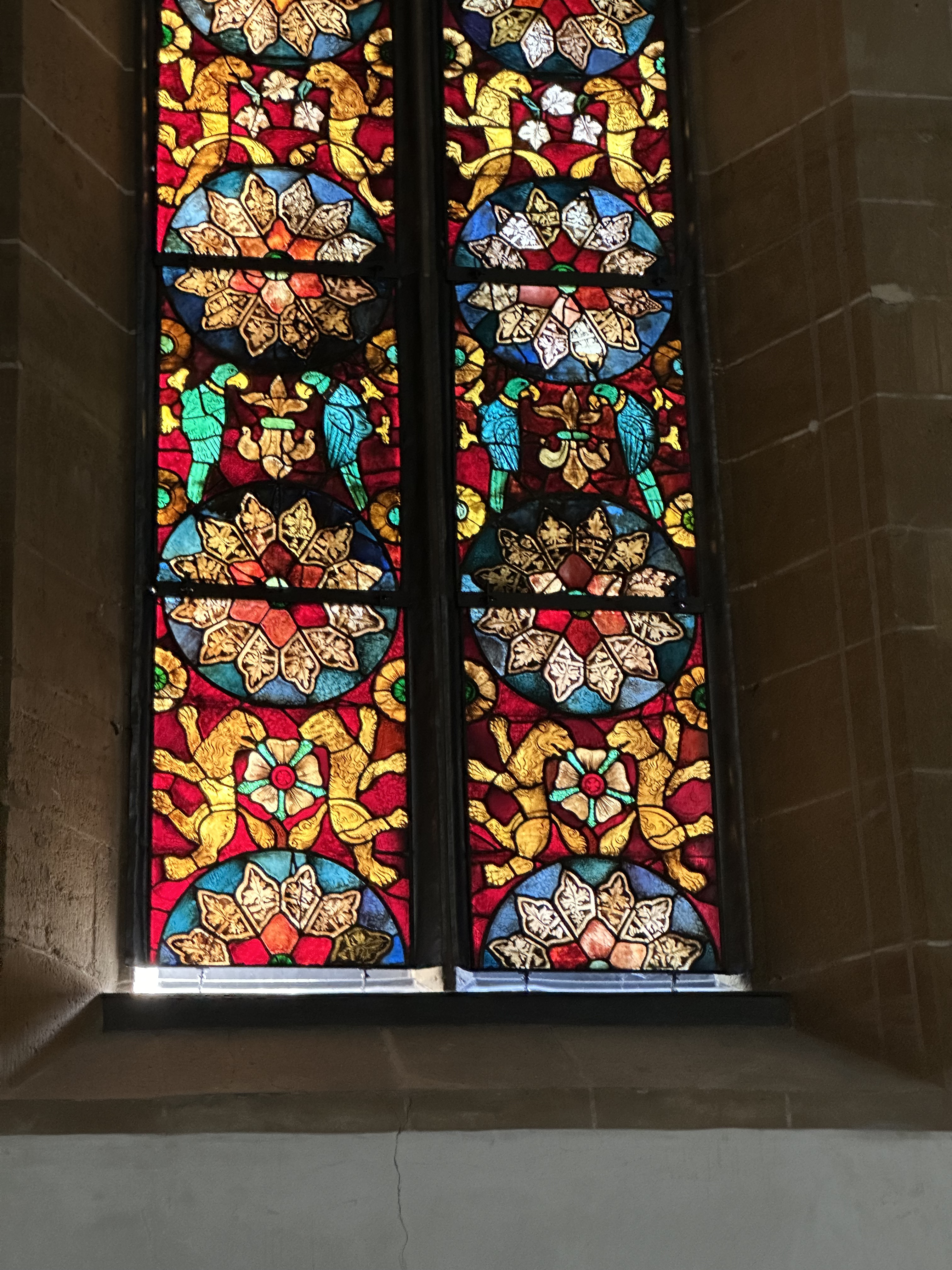
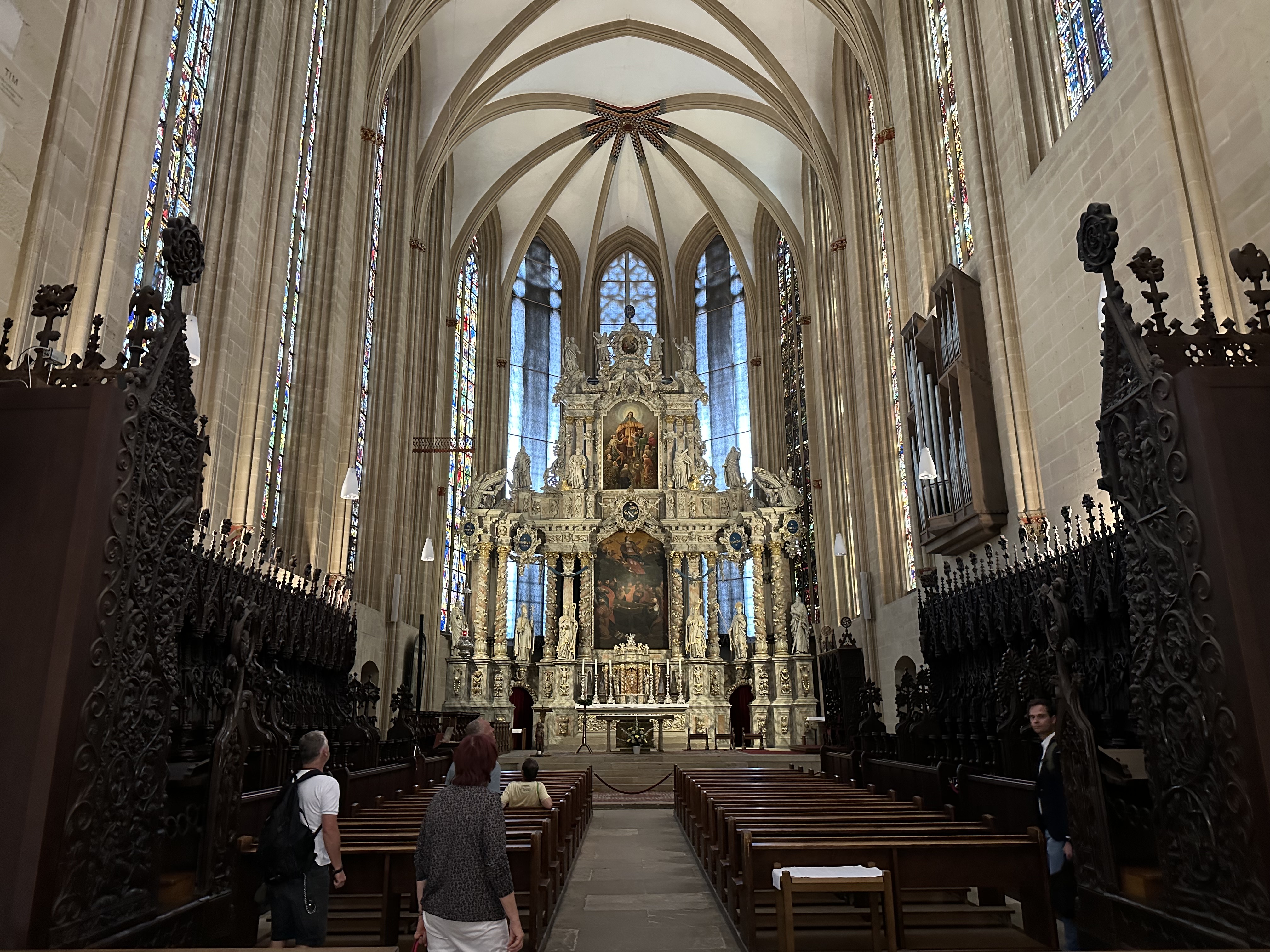
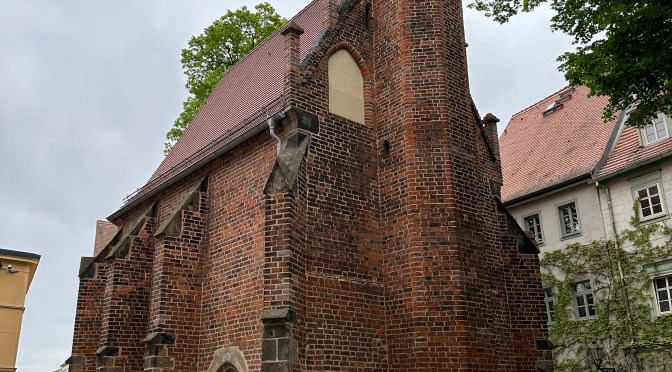
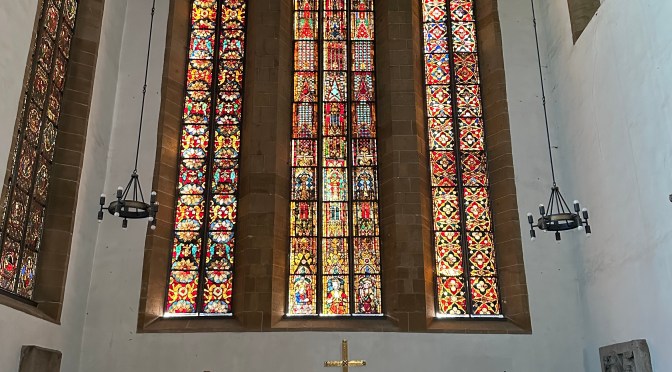
PS Photo(s) from my trip to Germany: [Above] The monastery chapel at Erfurt where Luther would have worshipped as a Monk. [Below] The stained glass was his inspiration for the Luther rose. The Cathedral in Erfurt where Luther would have been ordained a priest. My own ordination in 2009 and posing in a Luther cutout in Wittenberg.

Standing on History Unawares – Pastor Thoughts

This week the school year ended for school kids across the land. The crew of parents that typically meets at the bus stop for our street each morning for 8:08 AM pick-up has been counting the days until no more school lunches need to be made, no more rousing sleepy kids for breakfast and no more needing to climb the rest of the getting-ready-for-school mountain each day. I joked that we would all regret wanting an end to the school year in about 10 days when we start counting the days until school starts again! 

Of course, for now, it is nice to have a break in routine and some down time. 

Yet, with my mind still swimming between the 16th Century and today, I couldn’t help but remind myself that the real reason we are all trudging to this bus stop each day is… you guessed it… Martin Luther.

One of the things that we were reminded of frequently in Germany is Martin Luther’s influence on public life, not just on the Church. His translation of the Bible from Hebrew and Greek into German became the foundation of a lot of present-day written German or High German. Luther also introduced the concept of the public chest, as a means for communities to care for those in need. In addition, Luther advocated for public education funded by the State for all, including girls, which was radical at the time. He believed it was the state’s responsibility to provide education for all, as Luther scholar Franklin Painter describes it:

 1. In his writings he laid the foundation of an educational system which begins with the popular school and ends with the university.

2. He exhibited the necessity of schools both for the Church and the State, and emphasized the dignity and worth of the teacher’s vocation.

3. He set up as the noble ideal of education a Christian [person], fitted through instruction and discipline to discharge the duties of every relation of life.

4. He impressed on parents, ministers, and civil officers their obligation to educate the young.

5. He brought about a reorganization of schools, introducing graded instruction, an improved course of study and rational methods.

6. In his appreciation of nature and child-life, he laid the foundation for education science.

7. He made great improvements in method; he sought to adapt instruction to the capacity of children, to make learning pleasant, to awaken mind through skillful questioning, to study things as well as words, and to temper discipline with love.

8. He advocated compulsory education on the part of the State.

It is astounding to consider that many of the ways we simply organize ourselves in our common life, including sending our kids to grade school, were imagined first by Luther. 

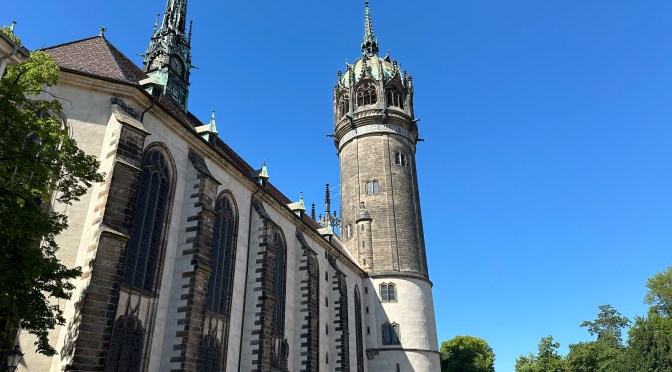
On the day that we went to the Castle Church (Schlosskirche) in Wittenberg, there were also several school groups on field trips (similar to how school groups here might go to The Forks or the Museum for Human Rights). The Castle Church is also where Luther is buried. As we stood around Luther’s grave plaque, some of the students approached us to ask us a question. They were doing a scavenger hunt of sorts, looking for the answers to a set of questions. They were trying to figure out when the Castle Church had been built. They, of course, didn’t really understand that they were asking a group of Canadian pastors and students, including a world-renowned Luther scholar this question, as we all stood around the grave of the man who essentially invented public school! Our professor, Gordon Jensen, answered at the top of his head, and we all had a good chuckle. 

All of this to say that, as the school year comes to an end or as communities of faith like the one in Wittenberg or like ours here in Winnipeg, Canada, North America or wherever we are strive to live faithfully in the world, we seldom fully grasp all that it took to bring us to where we are today, or how the decisions we make today will impact generations to come. 

Somewhere in all of that is the working of the Spirit, sometimes hardly noticed or seen, but walking with us, nudging us in the directions of God’s call to live lives of faith, caring for our neighbour. 

Pastor Erik+

P.S. Photos from my trip to Germany: The outside of the Castle Church in Wittenberg and Martin Luther’s grave plaque, just under the pulpit in the Castle Church. 


1 Franklin V.N. Painter, Luther on Education (Philadelphia: Lutheran Publication Society, 1889, no copyright) 166-168.

It takes a community to raise a church – Pastor Thoughts

This week I am able to gratefully breathe a huge sigh of relief. Only a few hours ago, I hit send on an email with my finished research paper for the course associated with my trip to Germany in May. 

After 8000 words and 30 pages of delving into the deeper reaches of Martin Luther’s thinking about the gospel, the church and ordained ministry in the church, my brain is swimming back and forth between the 16th and 21st centuries. 

Considering that I often speak about the church moving out of the 20th century and into the 21st century, and yet I am spending so much time going back to the 1500s to look at what was happening in the church during that time. 

It isn’t that I have anything, in particular, against the 20th century.  Rather our circumstances today might have more in common than with the world 500 years ago than the world 50 years ago. 

At the time of the Reformation, most of Europe had been in the medieval era for 700 years. However, an important new invention called the printing press was making the spread of information possible in ways that people only a few decades prior could not imagine. 

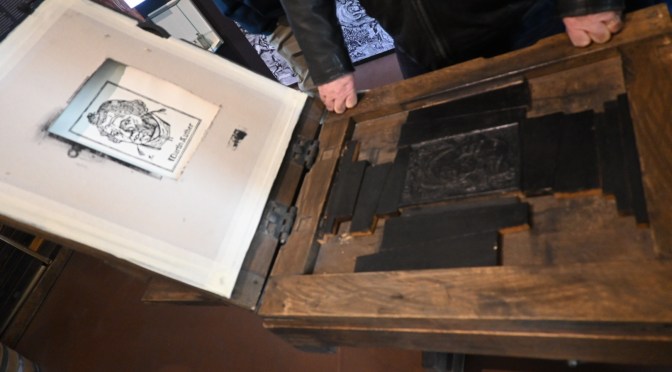
I have seen printing presses before, but while in Wittenberg, we visited the museum of Lucas Cranach’s print shop. Lucas Cranach was the court artist for Prince Frederick the Elector (Frederick was one of seven German princes who together elected the Emperor). Cranach was a good friend of Luther. His print shop was just down the street from Luther’s house, and Cranach was often responsible for spreading Luther’s writings by re-printing them along with being the most prolific art house of its time. 

The striking thing about this is when you walk the streets of  Wittenberg, the print shop, Luther’s house, the town church, the prince’s castle, the university all within a few blocks of each other. These people doing these things all lived together. They were deeply intertwined in the community. 

Now, we are living in a time when communities are growing more fragmented in some ways, and while our capacity to be connected in other ways has grown leaps and bounds. 

I suspect that Wittenberg felt less like the slower-paced, deep-connection communities of 50 years ago and more like the fast-paced but fragmented community that we are today. 

In that world, Luther spent a lot of his time and energy thinking and writing about the importance of community. Something that I didn’t really even know until I began this research because Luther wrote so much!

It is a strong reminder in a time when there are realities in the world that pull us apart more than bring us together, that community needs to happen on purpose because it rarely happens by accident. Being connected and able to share information more freely doesn’t necessarily mean naturally created bonds that allow us to care more deeply. 

Rather, Luther saw that care for the neighbour in and through the gospel, the good of forgiveness, life and salvation allows us to love our neighbour freely. And those things happen on purpose. 

PS Photo(s) from my trip to Germany: A replica of Cranach’s printing press, with a picture of Luther ready to be printed. And two photos of his logo, a serpent with wings. The serpent was thought to be a symbol common to printers at the time.