Tag Archives: discipleship

Discipleship as Power?

We are in the final weeks of hearing from Mark’s Gospel. Way back in Advent through Easter, we heard all the dramatic stories of Jesus’ life and ministry. Since June, we have been wrestling with the middle chapters of the gospel book, working out with the disciples what Discipleship means. What it means to follow Jesus as he goes about bringing the Kingdom of God near. It sounds relatively simple if we don’t think about it much and stick to a Sunday-school-surface reading. 

Of course, Mark, Jesus and the Disciples don’t give us much of a chance to make that choice. This week, James and John ask Jesus to sit at his right and at his left. (It almost sounds like my children, who are often very keen to manage whom they sit next to at mealtime.) Yet, this is not just about children trying to get seated next to the teacher, or popular kid, or favourite grandparents at dinnertime. 

James and John are opening up a complicated and layered issue that Christians continue to deal with today. What does it mean to be associated with Jesus and what do we get out of it? We don’t have to look much further than the various elections going on around us to see the ways in which politicians use proximity or distance from Jesus, Christianity, the Church and Faith to gain votes and power. We also don’t have to think very far back to the ways that the Church has used Jesus as a means to wield power over other Christians, over our neighbours, and over Creation. 

On Sunday morning, we will discover that James and John don’t really understand what they are asking. They don’t yet see that Discipleship, as Power, is not what Jesus is offering. Discipleship as Service or Sacrifice might be more like it. Jesus also has some harsh words about the problems of trying to gain individual power on offer. 

Before we get to unpack what reversal and work of transformation Jesus is up to with us, we might have to sit and stew over these hard questions. What does it mean to belong to a religion that has had such a complicated relationship with power? How do we each fit within the relationship and experience of power?

By now you might be able to guess that some of these questions are part of what I am currently working on in my doctoral courses. As we try to understand just where we sit as people of faith in 2024, there is work to be done to understand how Christianity arrived here. 

However, I won’t dig too deep into issues of power, colonialism, white-euro-centric Christian supremacy and more right now. 

Instead, as we go back to Jesus and the disciples in the Gospel of Mark, we are reminded that even in the mess of power that they and we find ourselves in, Jesus has come to flip and overturn the established orders. Christ’s power is to serve, sacrifice and give. Christ gives Godself fully and completely to power-seeking people like James, John and the rest of us. And in that giving of Godself, somehow Jesus shows us the way to new life. 

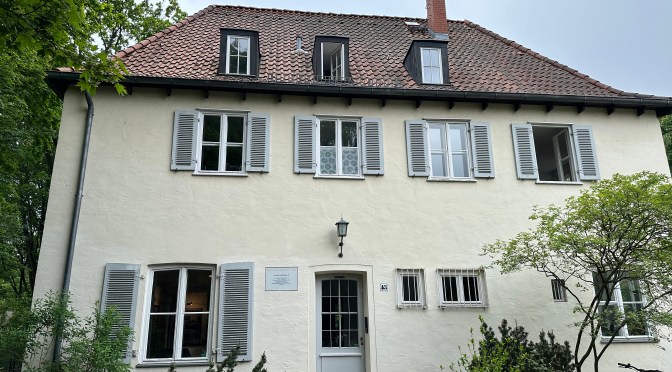
Photo: Dietrich Bonhoeffer’s House… and we know his ideas on the cost of discipleship.

Discipleship through the Seasons of Life – Pastor Thoughts

As many of you know, we moved into our new home last November. 

Since then, we have been settling into the interior of the home. Throughout the winter we were attending to building some shelves, patching up a few places, and lots of other general maintenance. We moved in the day after the first permanent snowfall of winter. Once the snow started piling up on the back deck and in the back yard, the outdoor spaces became largely unusable. 

The most significant yard upkeep that I learned after 10 years of renting was a bit of good and timely snow clearing. Our shared driveway with our neighbour meant that clearing our snow was a courtesy to her (and a good life choice!). 

Now, I will confess my spring/summer/fall yard upkeep habits were not as stellar.

The few flower beds around the house often got overrun with weeds and the spider plant(?) bushes got out of control. There were certainly rabbits living in one of the flowers beds for several years. The fall leaves only got fully raked up some years. 

But the one thing I kind of tried to keep up with was mowing the lawn – which I suppose is required by city bylaw. The lawn mower provided by the landlords was an old smelly two-stroke with the wheels almost coming off and handle bars that flopped all over. After almost losing a toe one-too-many times, I bought a battery operated mower to be an environmentally responsible adult (and to have a virtually maintenance-free tool). 

Still, I did everything wrong in terms of lawn care and the lawn was in really rough shape by the end of our time in that house. 

There is something about being a homeowner rather than a legally-obligated renter that quickly changes one’s attitude towards yard maintenance. This spring, I have spent more time and money on yard upkeep than ever previously. I have watched Youtube videos and read gardening advice online. I have talked to my neighbour about how to keep up our shared lawn space. I have been to Canadian Tire so many times that one of the cashiers told me that I should get a rewards card if I was going to be there every day. I may have been a little snarky when I said I wouldn’t keep coming there every day forever. 

Apparently, lawns need more than just occasional mowing to be healthy. I also learned that hand tools for detaching and aerating add up to quite the workout! Our garage shelves now have things like grass over-seed, fertilizer, weed killer, a weed-pulling tool, a trimmer/edger, leaf blower, different kinds of rakes and, of course, the hose and sprinkler are getting lots of use these days. Also, who knew that mowing once every two to three weeks is bad for your lawn? 

Okay… so what am I getting at here with this long description of tedious yard work? Well, I think there is some kind of metaphor here. 

In different times or seasons of life, our ability to invest time and energy into the various parts of our lives changes. It could be lawn care, but it also just as likely could be things like work, family relationships (marriage and parenting), community involvement, hobbies, and church and faith. 

Sometimes it is all we can muster to just do enough not to get fired at work. To volunteer to bring a couple of bags of Doritos to the family potluck. To write a cheque for the kids’ or grandkids’ school fundraiser. To drag ourselves out of bed on Sunday to make it to church half a dozen times a year. 

And at other times, we have energy to invest: In important projects or growing our skills at work. We are the family members with a home, time and energy for hosting family and friends on a regular basis. There is a passion within us to serve in the community with service clubs or time to get into a hobby that brings us joy. We are able to serve at church on council or read the lessons or help with confirmation or mow the church lawn (in addition to our own!), and so on. 

We all move in and out of seasons of life when we are able to do more or to do less. And when we want to have a healthy well-manicured lawn and yard, or when we want to grow a rich and vibrant faith, it takes time and energy to invest in the tools and resources that we need – connecting with a community of others doing the same, as well as with teachers or guides who can help us along the way. 

And if our lawn looks great but our neighbour’s is half dead and full of weeds (one can substitute similar situations in other areas of life), begrudging them their lack of capacity doesn’t help. Rather, we need to extend our neighbours grace and time to survive their seasons of low capacity, knowing that we ourselves have almost certainly been there at times or will be in the future. 

Our most powerful witness is when we are able to do more. A well manicured and vibrant faith practice shows more clearly the transforming work of the Holy Spirit. 

Discipleship, in all its forms, doesn’t usually happen in a straight line. Yet, in whatever space we find ourselves, Jesus is walking with us and calls us to walk with each other – in both the high and low times, whether the grass is green or brown. 

There is no greatest nor least

Mark 9:30-37

Jesus and his disciples passed through Galilee. He did not want anyone to know it; for he was teaching his disciples, saying to them, “The Son of Man is to be betrayed into human hands, and they will kill him, and three days after being killed, he will rise again.” But they did not understand what he was saying and were afraid to ask him.

Then they came to Capernaum; and when he was in the house he asked them, “What were you arguing about on the way?” But they were silent, for on the way they had argued with one another who was the greatest. He sat down, called the twelve, and said to them, “Whoever wants to be first must be last of all and servant of all.” Then he took a little child and put it among them; and taking it in his arms, he said to them, “Whoever welcomes one such child in my name welcomes me, and whoever welcomes me welcomes not me but the one who sent me.” (Read the whole passage)

We are well into this second part of the the long season of green… We have been winding our way through Mark’s gospel since May and the deeper we get, the more frustrating the disciples become. Today, they come off looking rather petty, like kids in the school yard at recess fighting over who is the king of the playground castle.

Of course we know that this isn’t just a play ground debate, we also recognize this debate about who is the greatest from the nightly news… especially as election season is upon us and one particular unavoidable politician who cannot help but tell us how tremendously great he is, unbelievably great.

But for people of faith, the scene between Jesus and the disciples today is about deeper things than self-aggrandizement and we know it. We know that this uncomfortable exchange between the disciples and Jesus has something to say about us too and about what it means for us to follow Jesus… or at least we are going to find that out.

The debate over who is the greatest is the memorable moment of the story today, but it is something that is repeated from last week which sets everything off. Jesus is talking about dying again. Last week Peter couldn’t abide it and took Jesus aside to rebuke him. This angered Jesus who the called Peter ‘Satan.’ This week, Jesus is talking about dying again but the disciples do not understand and are afraid to ask.

This point is important to keep in mind during the rest of the story. Because the disciples cannot understand what Jesus means when he says he will die and be raised three days later, they begin to focus on something trivial and manageable… they start arguing over who is the greatest. They are arguing over something they feel can control, something that seems to be quantifiable, a topic they think they can contribute to… all to distract from the fact that they didn’t understand what Jesus was talking about before and they were afraid to ask – remember what happened to Peter last week when he spoke up.

The question of who is the greatest among them is an idea they can manage… unlike the notion that Jesus has come into this world to be betrayed and die, only to rise again in 3 days. The little trivial matter is easier to talk about when the big issue, the big question makes them feel scared and powerless and insignificant.

And so they argue, they debate, they make passionate cases for who among them is the greatest… and probably they feel like they are achieving something as they travelled down the road to Capernaum. That is until Jesus hears them and sits them down for a talking to.

The disciples are doing something that we know well as human beings and especially as church folk. We know how to focus on the small trivial matters in order to avoid the big questions and bigger issues just like the disciples do.

Many of us have been to that church council meeting where the minute details of fixing a leaky sink or buying hot dog buns for the church barbecue or haggling over $10 item lines in a budget of 10s of thousands take up the bulk of time and energy….while questions of what it means to be disciples or how to follow Jesus in our community or how to encourage members growing in faith are met with silence and blank stares.

We naturally grab onto the small things, the things that feel manageable, the things that we can argue and debate and discuss… because the big questions of faith and mission and life… they sit like weights on our chests making our heats beat with anxiety when we think about them too much, let alone when we talk about them.

And so we end up sounding like the disciples, we end up arguing about who is the greatest because we are too afraid to ask about what it means for us that Jesus is betrayed, killed and raised three days later.

And we end up debating the little things like the annoyance of Sunday sports and shopping, grumbling about those who have drifted away and left us with the work, arguing over who is the blame for the decline of congregational resources and attendance… because we are too afraid to ask what it means for us that we are in this state, and what is God saying to us about being the church in this time of struggle.

So as we grumble along the way, on the road from where we were to where we are going… Jesus finally overhears us, stops us and sits us down – just as he did with the disciples.

To the disciples he says, whoever wants to be first must be last. Or in other words, all this stuff you are arguing about doesn’t mean a thing…it doesn’t mean a thing in the Kingdom of God.

And then as Jesus picks up a child and sets them in his lap, he says, “whoever welcomes one such child in my name welcomes me.”

But it isn’t some kind of moral lesson to the disciples… Jesus is in fact making a point about all that stuff he first said about dying and rising.

Because who is doing the welcoming? Who is holding the child in his lap? And who is it in baptism that declares to be children of God.

We aren’t the welcomers. We are the children.

God is the one welcoming us.

Jesus is reminding the disciples that they don’t need to be the greatest to understand what Jesus is up to in the world. Because in the Kingdom of God there is no first and last, no greatest and no least. We are all God’s children, and for us Jesus has come into the world. Jesus has come to die with us, to die with a dying creation. Yet, three days later Jesus shows us that death is not the end. And because Jesus rises from the tomb, we rise with the God of New Life on the third day.

The disciples don’t need to understand what it all means for Jesus to be betrayed, to die and to rise again… that isn’t their job. Rather Jesus tells them that he has come to bring them into the Kingdom, he comes to walk along side them, to let them see, hear and feel the Word of God among them… the Word made flesh.

And for all the things that we grab hold of to distract from the bigger issues of faith and life… they don’t matter in the Kingdom either. Because God will continue doing what God has always done for us. Whether it be when we thought we knew what God was up to with full churches and strong attendance and budgets we could meet or whether it is now when none of those things seem to be the case.

God continues to give us the Word of forgiveness and mercy week after week.

God continues to welcome us as God’s own as we are washed and renamed beloved.

God continues to gives us bread to eat and fill our hearts, so that we might become the bread that God uses to feed the world.

It has never been up to us to understand how the Kingdom works, or to have all the answers or to be saviours.

It is up to God.

And God is coming to us, coming to little ones such as these,

in the person of Jesus who dies and rises again,

coming to us again and again in Word and Sacrament,

signs of God welcome for us, signs that remind us that we are neither the greatest nor the least in the Kingdom, we are God’s beloved children.

Rebuking Peter – Giving Up Humanity

Mark 8:27-38

…Peter answered him, “You are the Messiah.” And he sternly ordered them not to tell anyone about him.

Then he began to teach them that the Son of Man must undergo great suffering, and be rejected by the elders, the chief priests, and the scribes, and be killed, and after three days rise again. He said all this quite openly. And Peter took him aside and began to rebuke him. But turning and looking at his disciples, he rebuked Peter and said, “Get behind me, Satan!… (read the whole passage)


This is the halfway point of Mark’s gospel. The end of chapter 8 with 8 more chapters to go… and Jesus is taking a moment to see what his disciples have actually learned so far. And as we continue through Mark’s Gospel it won’t get any easier. Not that Mark is ever really easy on us during this long season of Green… yet as we head into the home stretch of the season, the challenge to what it means to be disciple will only get more pointed with Mark as he asks what it means to give up our lives for the sake of the gospel.

Jesus ask his disciples a question that is both normal and odd. Normal because we all want to know what others think of us. Odd because it should be obvious given what we have heard about Jesus so far. What are people saying about me? Who do they say that I am?

And Peter steps up, as usual, to speak for the group. He knows what people have been saying, “Elijah, John the Baptist or a prophet.”

Then the real question comes, who do you say that I am?

“You are the Messiah” Peter says, sounding like he passes the test. 

But within moments, Jesus is calling Peter “Satan”, and telling Peter to leave the circle of disciples.

What happened?

Peter doesn’t actually get it, even though it seems he passed the test just moments before.

Peter is living in a crisis… a crisis of identity and purpose. He didn’t really pass the test and he doesn’t really know who Jesus really is or what Jesus is doing in the world. You see, when Jesus asks the question, Peter knows all the answers, he knows what all the people out there are saying, which means he has been listening and trying to figure out Jesus is for himself. And when Peter says that Jesus is the Messiah, it is hardly a specific answer. The people of Israel have many different and varied understandings of who the Messiah actually was. The judges who were the first protestors of Israel followed by Kings. But then also foreign conquering kings had been called Messiahs, and prophets like Elijah, but also the suffering servant of Isaiah’s prophecy, and of course recently John the Baptist. Peter doesn’t give a conclusive answer to Jesus’ question. 

Yet, the fact that Peter (and the other disciples) don’t have a specific answer really points to the fact that they don’t really know what is coming next for Jesus and them. So when Jesus tells them what comes next – that Jesus is going to suffer and die at the hands of the chief priests and elders – Peter doesn’t like that idea at all. He might not have a specific idea about who the Messiah is, but knows Jesus’ idea isn’t his vision of following the Messiah. 

And so when Peter rebukes Jesus for his silly ideas about dying, Jesus turns his back on Peter… sends him out of the group, away from the community. Now, Peter is back and part of the group only two verses later… so what is Jesus really banishing from the circle? Peter’s self-concern and vision of discipleship. Peter doesn’t want Jesus to talk about dying… Peter is thinking about himself, how he can continue up the mountain towards the goal as Jesus’ disciple. 

In fact, it is up a real mountain, the mountain of Transfiguration, that Jesus and Peter are about to go, where Peter will want to build an altar and stay believing he has finally arrived at the pinnacle of discipleship. And again Peter will miss the point and not fully understanding what comes next. 

As readers of Mark’s gospel today, we share in common a few things with the first readers of his gospel nearly 2000 years ago. Mark was writing to a community of Christians for whom their visions and hopes for what they would become were not realized. It had been about 30 years since the crucifixion and resurrection. The early church community eagerly awaited the return of Jesus, yet the first witnesses were beginning to die off. The ones who remembered Jesus first hand were getting to be fewer and fewer. The community was beginning to wonder, what comes next? If Jesus wasn’t going to return any day now, what were they to do?

We might not be waiting for return of Jesus any day, but we too are at a moment for Christians where we don’t know what to do next. Our hopes and dreams for the future have not been realized, and if this is where Jesus is taking us… we might want to rebuke him too. 

We surely don’t like the idea of giving up our lives for the sake of the gospel… we have been waiting for a return to the mountain top, for a seat back at the table of power, to be important and respected in the world again… taking up a cross and giving up our lives does not sound like what we have been waiting for as Christians in North America, Lutherans in Manitoba, a Shared Ministry in the Interlake. 

We are as confused and frustrated as Peter is about who Jesus is and what is means to be followers of his. And we just want know what comes next for us. 

Yet as Jesus banished Peter’s self-concern… Jesus is also stripping us of all the things we think are part of the vision of discipleship, numbers and power, in order to get us to see what is really coming next. 

Peter wants to hold on to vision of grandeur, discipleship that comes with perks… but Jesus is giving things up, giving everything up, giving up his very life for the mission. 

Because the thing is, Jesus has come to offer Peter so much more than a home on the mountain top or a place of power and influence or the adoration of the crowds. Jesus is coming to give Peter, the disciples, the people of Israel and all of creation new life. 

If only Peter could get over himself and his vision to see it. But he doesn’t. Peter gets rebuked by Jesus today, only to be rebuked again on the mountain of transfiguration and then again at the Last Supper and then even again after the resurrection. 

But it isn’t just Peter, no one gets it for the rest of the gospel of Mark. The Gospel ends with the women fleeing the empty tomb and telling no one because they were afraid. 

No one gets what Jesus is doing… and just maybe that is what Jesus is coming to understand. We aren’t able to let go of our visions for ourselves, we aren’t able to stop dreaming of the numbers and the power and then importance. We aren’t able to get out of our own way. We hold on to that stuff at all costs. 

And so Jesus gives it all up for us… Jesus gives up all power and importance for the sake of love, in order to come near to creation, in order to come close to us. And Jesus gives us up too. 

Jesus comes down to us in order to give us up. 

To give up our sin and suffering and death because we cannot. 

To give us up to new life. 

To give us up to God. 

To give up on our old sinful selves, in order to make us the new creations that God intended. 

For those who lose their lives for my sake… will save it. 

Jesus tries to send away Peter and his self-concern, his holding on to the wrong things. But Jesus can’t… because that is not who Jesus is… Jesus is THE Messiah, the one who has come to save… to save us by giving us up to God. 

And so when Peter doesn’t know what is coming next and doesn’t like what Jesus has in mind, and when we don’t know and don’t like what Jesus has in mind for us either…

Jesus goes ahead with us anyways. And Jesus  goes to the cross for us anyways… and Jesus transforms us anyways, from sinners into forgiven, and from dead into alive. 

Jesus doesn’t Peter twisting in the wind, even if Peter doesn’t like what is coming. And nor does Jesus leave us twisting in the wind, even if we don’t like where we are these days.

Because Jesus does know who he is and Jesus knows who we are. 

And Jesus does know what comes next for us…  New Life in the Kingdom of God. 

Church Membership vs. Carrying the Cross

Luke 14:25-33

“…So therefore, none of you can become my disciple if you do not give up all your possessions.” (Read the whole passage)

I remember when I was little and our family visited my grandparents. My grandparents living-room was always in perfect, pristine condition. Everything look new and unused, despite being dated with styles from decades before. Whenever we were in the living room, we had to be exceptionally careful not disrupt anything. No throw pillows could be moved, no dirt could be tracked, no signs of anyone actually being in the living room were allowed. Even as young child, I didn’t understand what the fuss was about – why was it called a living room, if there was no living allowed in it.

Now, as an adult, I understand only a slight bit more the desire to keep one’s possessions in good condition. And I also understand that nice things and children don’t really mix.

Yet, Jesus’s conditions on discipleship today, certainly poke at our materialism. We like our stuff, and Jesus knows it.

For a few weeks now, Jesus has been giving us the gears. Last week Jesus reminded us that we like to sit in the places of honour and send others down the table. Jesus continues the theme of pointing our faults, with his words on discipleship and possessions.

Today’s Gospel lesson has an unusual setting. Normally we pick up with Jesus in the gospels after he has traveled to a new place. But today, Jesus is still on the road. He is somewhere between destinations, with a crowd of people following him. You can almost picture it… Jesus and the disciples, on to their next village or town to preach in. And a large crowd following a short distance behind. From Jesus’s words to the crowds, we can guess that they were complaining. Kind of like the Israelites following Moses through the desert, the crowd is complaining about the journey. “Where are we going?” “When we will get there?” “What can we expect?” “What will we get out of it?” It sounds like the crowds are wondering whether following Jesus was a good idea, they are looking for something out of the deal. They want the benefits of being followers, but so far all they have found is a walk through the desert.

And so after hearing enough complaining, Jesus stops, turns and lays into the whiny followers behind him,

“Look, I didn’t say this would be easy. In fact, I told you that you would have to give up everything. Your homes, your families, your jobs, everything about your lives. If you are going to follow me, that means carrying MY cross.

You say you want to know what the plan is?!?! Yet, how many builders sit down and plan a whole project before beginning to build a tower? None.

You say you want assurances that we are going somewhere worth going to? Yet, how many Kings sit down with an enemy army across the field and say, “Well, looks like we won’t win. Let’s send out the white flag.” None.

If you want to be my followers, you are going to have to give up all the things tying you to your life before now.”

Jesus lays it out plainly for the crowds. They cannot hold on to their lives before and follow Jesus. Jesus knows that no builder can plan a whole project before its started. Think of all those contractors on HGTV who say things like, “Well, you don’t know how much the reno will cost before you open up the walls.” And yet the walls come down in search of show home living rooms and chef’s kitchens and dream master bedrooms. Jesus is calling out those who are grasping for the next new and shiny thing.

Think of all the wars being fought around the world for the sake of money and power. For the soldiers and civilians dying at the hands of kings and rulers who are trying to get or hold on to power. Jesus is calling out those who are clutching with all their might, and at any cost, on to power and control.

And now think of the church, and how we are like those crowds, looking for the things, the possessions that we can hold onto as well. Things like membership, with benefits like a reserved pew, or a key to the building, or eternal salvation.

But here is the thing about possessions. About the stuff we hold on to. The more we try to hold on, the more the stuff holds on to us. The more people want the next new and shiny thing, the more they become slaves to keeping up with the jones, to standing in line for that new iPhone coming out next week, or getting that new car, or having that kitchen renovated again. The more people try to hold on to power, to be in control, to call the shots,the more they must descend into darkness in order to keep power.

And here in the church, the more we see membership, faith and even God as something we have have, that we can own, that we can hold on to… the more it demands. The more weeks we have to keep making appearances to be in good standing. The more time we have to devote to keeping everything going, the traditions and duties and tasks. The more money we have to shovel into a hole that never seems to fill up. When membership and faith and God become possessions, they soon begin to own us, trapping us in a never ending cycle of keep it all afloat.

Jesus says, if you want to be a disciple, you need to give up your possession, give up all the things you are holding on to, because they will ultimately hold on to you and drag you under.

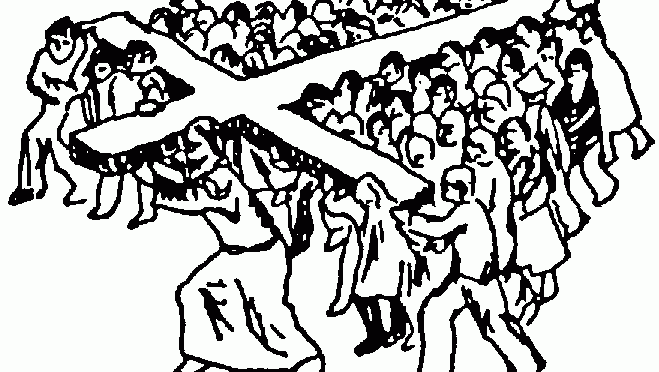
Jesus says, the thing you need to hold on to is the cross. Not your own cross, but his cross.

THE. CROSS.

And again, here is the thing about the cross.

We know that story. We know that Jesus carried the cross to Golgatha. We know that he hauled it up that mountain on Good Friday. But we also know that he stopped carrying the cross, because once he was on the mountain, the cross carried him. The cross held on to him. The cross trapped Jesus, just like all the things that we hold on to eventually do to us.

That is until Easter morning.

And all of sudden the cross that held Jesus on Good Friday, became the cross that holds all of us on Easter morning.

Jesus calls the crowds and calls us to carry the cross, because Jesus knows that we can’t carry the cross, because the cross carries us.

In world full of possessions that will hold on to us and drag us down – power, control, membership, status, new kitchens, pristine living rooms, things.

In our world full of all that, the cross is the only thing that lifts us up.

The cross is the place where the human need to hold on is met by God’s need to give up.

To give up wrath for love.

To give up judgement for mercy.

To give up sin for grace.

To give up death for life.

Jesus calls the crowds and us to give up our possessions, and not to literally empty our bank account and give away all our stuff. But to recognize that the things we hold on, keep us from seeing just what, or just who, is truly carrying us.

Our world will may never give up the quest for what is new and shiny. Our rulers may always be willing to sacrifice people for power.

Yet, God just may be calling the church to give up holding onto membership as something we own, to let faith be something that carries us. To see that the church is not a bottomless trap for energy, time and money.

But rather a community of the faithful.

A community of people who are being carried by Jesus, whose identities are being transformed by being together, who are called to work together to let the world know about this good news of giving up and letting go.

As Jesus calls out these crowds today, Jesus is reminding us of just who is doing carrying. Jesus is reminding us that the cross carries us. That Jesus’ love for the world, Jesus’ grace for sinners, Jesus triumph over death, all found on the cross, are what can truly carry us and lift us up.

Jesus tells the crowds and us today, that it is God, who was the first to give up everything. And that being a disciple, is not about what we carry, but about God who carries us.