Tag Archives: Church

Why Christians have lost the argument for faith before it started.

This week, a blogger I respect, Tony Jones, wrote a post “Why Are You Still a Christian?” It was an open and honest piece about his personal struggles with doubt and faith. His basic assertion could be characterized as saying that he is a Christian because most people believe in God. Not the best argument in my mind.

He was also unfavourable towards Atheists. A prominent Atheist blogger then shared the post and the comments started filling on Tony Jones blog with arguments against faith.

Tony Jones tweeted that he was feeling a little beat up after it all.

A post like that, trying to give his reasons for his faith, was destined to fail in the face of “rational” scrutiny. But the point of the post wasn’t to give THE argument for God, it was to share what he is clinging to at the moment. However, the responses in the comment section cannot really be faulted either.

The problem is ‘Christendom’  and how Christendom’s argument for faith and for God has been playing out over the last several decades. Now, bear with me for a moment as I try to explain.

I heard Nadia Bolz-Weber last fall in Winnipeg, and one of my favourite “Nadiaisms” that she uses to describe her church, House for All Sinners and Saints is:

“We are high commitment, low obligation.”

Theirs is a culture that allows people to participate in planning and leading as they are able, people can come and go as their interest and availability changes.

Sounds like great system, if you can work with change and chaos.

But the issue of obligation vs. commitment is one that has been rumbling about my brain for months, and I am starting to realize it is much more than a quaint idea for a little mission congregation.

Obligation vs. Commitment is at the heart of Christendom’s argument for faith.

Or more precisely, Christians have been trying to obligate society to observe, defend, practice, uphold, and respect Christianity. Then while society pushes back against being obligated in such a way. As a pastor, I get to hear the lament of failed obligation attempts pretty regularly. The lament is for a loss of privilege:

“They used to say the Lord’s prayer in schools, pastor!”

“Stores used to be closed on Sundays so people could come to church.”

“Kid’s play sports on Sunday mornings, and that is why our Sunday School is so small. It never used to be like that.”

“The cashier at (insert name) store said “Happy Holidays” instead of “Merry Christmas.””

“People need to start coming to church to fill our pews and give offering! People should be here.”

“This is a Christian nation founded on Christian values.”

“They took the 10 Commandments down from the courthouse, what is the world coming to?”

I cringe when I hear these statements. I would be willing to bet they bother me as much any non-Christian. But they bother me for a different reason.

We have lost of the plot when we think that we can obligate belief or faith.

This is why Tony Jones, who did not set out for a debate, lost before he even began. Christendom got in the way of his point. Christendom has been trying to obligate faith for decades, and people who don’t want to be obligated anymore are rightfully protesting. It is pretty hard to make an argument for faith and for people not to hear the Christian attempt to obligate everyone to follow our religion.

But the bigger issue is for those of us who are Christians.

Is forcing everyone to say a Christian prayer in school or to say ‘Merry Christmas’ or to come to church because the rest of the world is closed on Sundays really a valid evangelism or discipleship method?

I think it is time for Christians to give up trying to reclaim the obligations of Christendom past.

I think it is time for Christians to say sorry to the world for trying to legislate our faith into their lives.

I think it is time for Christians to stop trying to argue people into believing in God. 

Even if there was some argument that could once and for all prove that God is real, and the Trinity is that God, and that everyone should believe… it would be the worst idea in the world to use it. What good is a Christian who has been forced to faith?

I actually don’t like it when people who think they should be there, come to my church. I don’t want people to come to church or be Christian for the sake of filling pews and saving souls.

I want people to want to come to church. To want to become Christians. To want to have a relationship with the Body of Christ.

I want people to feel like church is something they need, not something forced upon them. 

You know who makes my heart leap for joy at church? People who can’t imagine being anywhere else on Sunday mornings. People who choose church over the other options.

But we can’t all feel that way every week. Even the most devout Christian cannot want faith enough sufficiently every day, every week, every month.

And that is where I come back to Tony Jones’ post.

“Because everyone else is doing it,” is simply not a good reason for faith. Yet, I didn’t hear that in his post.

“Because on the days when I don’t have enough faith on my own, my brothers and sisters in Christ will have enough faith for me” is what I did hear. This is one of the most important theological, ecclesiological, liturgical reasons that I can imagine for why most of us are still Christians.

Because we are committed to each other, because we commit to share our faith and to share our doubt as a community, because everyone is else is doing faith WITH me. This is one of the most important reasons in the world.

Our desire to obligate people to faith is a desire to preserve Empire, but Christians, the Body of Christ, cannot be about Empire anymore.

The Body of Christ does not obligate you, me or anyone to faith. The Body of Christ commits you, me and all creation to God.

This idea changes everything. Wanting people to believe in God is one thing, but what if Christians strived to help people to want to have faith? We would be a different Church if we tried that.

Have Christians lost the argument for faith?  Is there a defense for faith that will help? Share in the comments or on twitter @ParkerErik or on Facebook: https://www.facebook.com/millennialpastor

Want more drama? Check out the high school drama of Evangelicalism.

Evangelical drama needs Mainline experience

high-schoolThese days, Evangelicalism makes me feel old. And tired.

The week that Phil Robertson was suspended, I was preparing for the funeral of a 16-month old girl killed in a car crash. The week he was re-instated, I was preparing for a funeral of man who took his own life, leaving 3 young children behind.

Throughout the last few months as a famous pastor was accused of plagiarism, as the Pope was called a marxist, as the issue of the role of women in Evangelicalism continued to rage, as the war on Christmas rolled into full force, it just made me tired.

I watched as progressive Evangelicals bemoaned the state of their tribe. As some called for schism, as others resolved to quit fighting about it, even others thought about leaving altogether,  and still others spoke thoughtfully into the cacophony that is Christian twitter, blogs, and media.

All Christians in North America, if they are paying attention, are forced to watch the Evangelical tribe as it rumbles and quakes about whatever is the issue of the day is. And I cannot help but see it all as some grandiose high school drama.

________

There is the usual cast of characters:

The Football Team (Mark Driscoll, John Piper, John Eldredge). The crowds love them, but most cannot see that they are also the bullies. They are pretty sure the football is only for boys, and the only sport for girls is cheerleading.

The Rich Kids (Joel Osteen and Joyce Meyer). They are generally oblivious to the fact that there are other students at the high school. No one really likes them, but many want to be like them.

The Valedictorian (Rachel Held Evans). She is bright and well-liked, but constantly at odds with the football team for pointing out girls can play sports and the football team is getting too much money.

The Hipster School Newspaper Reporter (Micah J. Murray). He is interested in the truth and real stories. The football team can’t stand that he keeps writing about girls and the glee club.

The Debate Team (Zach Hoag, Tony Jones, Fred Clark, Benjamin Corey and others). They are passionate and articulate, and even agree about almost everything. But they often sound like they are fighting.

The Misunderstood Artist (David Hayward/Naked Pastor). Everyone loves his work, even if they don’t quite get it.

The Foreign Exchange Student (Sarah Bessey). Many love her, but the football team is suspicious because she has introduced this thing called “Jesus Feminism.” This new idea is causing quite the stir.

The Activist Club (The Junia Project). They are a group of passionate students, working to get their message out, and the football team is ignoring it at all costs.

(There are certainly more characters and roles than I have named here).

And there are us non-students. Those of us who are part of the story, non-Evangelical Christians, but not central figures.

There is Grandma (Roman Catholicism) and she has long been loved by the football team. Grandma used to knit scarves as Christmas presents for the team, but this year she decided that instead she was going to give goats and wells to poor people in their name and they didn’t like that at all. But the valedictorian, newspaper, activist club and debate team loved it.

And there is the star Substitute Teacher (Nadia Bolz-Weber), and the students think she is cool and hip, even members of the football team think she is badass. The students hear what she has to say as if it is fresh and new, but the same stuff the rest of the teachers have been saying for years.

(Again there are more characters than I can name.)

___________

So yes, I watch this drama and it is tiring, but there is no choice. As a young Lutheran pastor and a Mainline Christian, I know that many in my tribe feel the same, Evangelicals tire us out. They tire us out because we are the frazzled teachers and haggard parents to these high schoolers. We brought them into the world, and so we bear some responsibility for their drama. Yes, we can seem remarkably like their Grandma, but she and us had a big fight long before the high school students can remember, and we haven’t totally got past it yet. But as their parents and teachers, most of them find us uncool, irrelevant, wishy washy, out of fashion, and boring. There are a few who are starting to find us interesting and worth hearing out.

Still, Evangelicals need us. They need our experience, our wisdom, our calmness. They need our depth, our ability to see the grey areas of faith, our comfort with the tensions. They need us because we have been where they are going as they grow up. After our big fight with Grandma, we started fighting with each other, armies got involved, and people died. We have had our drama too.

And we need Evangelicals. We need their drama. We need their drama to remind us of how important this faith business, how important Jesus, is. Their drama reminds us of the passion we once had 500 years ago, of our own willingness to fight for every inch of the gospel. The high school might rumble and quake, and we will get tired of how loudly each mole hill gets argued over. But they keep us from getting apathetic, from getting too comfortable, and too familiar.

Hopefully, they will eventually come to see how they need us. Maybe they can stop looking for our flash when we offer rootedness. Maybe they will stop hoping for our strong declarations when we offer complex responses. Maybe they will stop seeking our innovation when we offer submission to the traditions of the faith community over time. Maybe they can stop wishing for big personalities from our pastors, when we offer professionalism and education.

Evangelicals, with their drama AND passion, need the Mainline.

Hopefully, we will accept that we need them. Maybe we can stop looking for their traditionalism, when they offer creativity. Maybe we can stop hoping for institutional cohesiveness for them, when they offer a grass roots touch. Maybe we can stop seeking them to honour what has “always been”, when they offer excitement for what is new. Maybe we can stop wishing their pastors will fit the mold, when they offer dynamic leadership. Mainliners, despite being tired AND experienced, need Evangelicalism.

In the meantime, despite myself, I will continue watching the high school, being exasperated by the drama and walking with my Evangelical brothers and sisters… because the Mainline needs them.

What do you think? Is Evangelicalism high school drama? Share in the comments or on twitter: @parkererik or on Facebook

Want more drama? Read: 12 Reasons Why Being a Male Pastor is Better

The Magic of Christmas is Gone – when a child dies

*Note: On December 16th, a 16th month old girl was killed in a car accident in our community. On December 21st, our congregation held the funeral. 

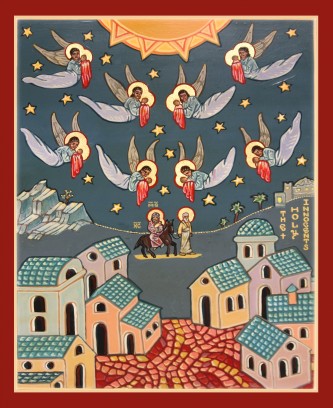
HolyInnocents-Atlanta-monkimage.php_Matthew 2:13–23

Today the magic is over. The real Holiday began on Boxing Day as thousands, even millions of people across Canada spent their time worshiping at the altars of Wal-Mart, Zellers, The Bay, Sears and more.

All that magic at Christmas, is as easily returned as a faulty watch or an unwanted pair of socks. Boxing Day, or Week, or whatever the tag line is, is a sobering reminder about how quickly the world forgets Christmas and moves on to more important things.

And the reality is, being out shopping seems a lot more normal than what we are doing here. In fact, we haven’t done anything in step with the rest of the world for quite a few weeks now.

All throughout December we decorated with blue instead of reds and green. We sang Advent hymns instead of Christmas carols. And on The Eve of the Nativity of Our Lord, we listened and watched as Christ was born in hotel room and visited by rejoicing Shepherds in the middle of the night. On Christmas morning, we sat down at a different meal, not turkey and mashed potatoes, but bread and wine, body and blood.

And this past week, when all the newspaper flyers and radio stations were telling us that we should be at the stores to get the big deals, we are here. We are here, listening and watching as the Holy Family escapes from real danger, and as all the other children in Bethlehem are massacred. The magic of Christmas is gone indeed.

The story of the massacre of the Holy Innocents does not seem like an appropriate Christmas story. Or at least is isn’t a story that you can buy, wrap up and then return on boxing day. However, it does follow the real Christmas story right in step. Last Sunday, Joseph saved Mary by choosing not to stone her when he found out she was pregnant. During the week, the two traveled a long and rocky road to Bethlehem full of thieves and other perils only to then give birth in the place where animals are kept. And now, as the paranoid King Herod orders the murder of babies under the age of 2, Jesus, Mary and Joseph escape to Egypt. The drummer boy, and the reindeer, and a tree adorned with lights and tinsel are not, and never have been, a part of this story.

Side by side, Boxing week, and this scene in Jesus’ life show us a darker side of the holiday. They show us the side of greed and fear, sides of cruelty and despair. They suck all the Christmas magic out of us, and leave us empty once more. The Joy of Christmas was supposed to last a year, but it has barely stayed with us a few days.

The story of the massacre of the Holy Innocents, of all the toddlers and babies in Bethlehem,  is not an easy story to hear. It is especially poignant this year as we had to burry an infant in our community. Our hearts ache hearing about the death of children, we know, somewhere deep inside of us, that this is unbearably sad. There is no need to compare it to the tragedies of human history that have followed since King Herod gave the order. We know what the slaughter of children was like for that town of Bethlehem, because it has not stopped. Children die each day, all over the world, of hunger, war, disease and poverty. This is not just Bethlehem or Selkirk in grief and mourning, it is a whole world. A world now even more desperate for a Messiah. Jeremiah speaks of grief for us all:

A voice was heard in Ramah,

wailing and loud lamentation,

Rachel weeping for her children;

she refused to be consoled, because they are no more.

Jeremiah’s words first expressed the grief of his people, the mothers of Israel, as they wept for their children who had been taken away to exile in Babylon. Then people of Bethlehem would have know the book of Jeremiah, and the story of the exile. But now they carry new meaning as they are stamped again to the hearts of the mothers of Bethlehem. And we know the stories of exile and the story of the Holy Innocents, but this year they carry new meaning as they are stamped upon our hearts. Tragedy upon tragedy. Heartbreak upon Heartbreak.

The darkness, that the Messiah was supposed to shine light into, appears to have returned.

Yet….

Yet….

Yet… Jeremiah’s words do not go unheard. The weeping of Rachel and of all the mothers of Israel is not ignored. God speaks to this suffering. God speaks to the people that Jeremiah first wrote to, God speaks to the mothers of Bethlehem and God speaks to us, to all who know tragedy, pain and loss. We hear the words of Jeremiah applied to massacre of the Holy Innocents, and applied to our tragedy. But Jeremiah doesn’t end with tragedy. Matthew only quotes tragedy, but the mothers and fathers of Bethlehem would have know what follows in the book of Jeremiah. And today, we hear this promise again:

Thus says the Lord:

Keep your voice from weeping,

and your eyes from tears;

for there is a reward for your work,

says the Lord:

they shall come back from the land of the enemy;

17 there is hope for your future,

says the Lord:

your children shall come back to their own country.

17 there is hope for your future,

says the Lord:

   your children shall come back to their own country.

God has not forgotten the cries of his people, and God’s messiah, Christ has come into the world for a purpose.

The newborn Messiah does not “escape” to Egypt. Instead, the Messiah travels the path of his people. The Messiah goes down the roads that the Israelites have traveled, so that God knows their suffering.

Just as the nation of Israel fled from Pharaoh in the Exodus, so too will the Messiah follow their path to Egypt and then back to the promised land.

And just as the exiles of Jeremiah’s day returned from Babylon to Jerusalem, to the holy city, the Messiah is also on his way to Jerusalem.  Egypt and Babylon are just the beginning of the Messiah’s journey. Jesus the Messiah is preparing to take on all the suffering of his people.

As the Messiah escapes to Egypt it is really only a delay of King Herod’s order for death.  Make no mistake, the destination of Messiah, from the moment he was laid in the manger, and was worshipped by shepherds and magi, is the cross. Christ the Messiah has been on his to the land of the dead this whole time.

And surprisingly, this is the hope, this is the promise that the Lord speaks to the people of Israel. This is the promise that is beneath the star, that is born into the stable, that is a little baby in Mary’s arms. The promise that is not just a baby, but a baby who will die. But not just die, but who will rise again. But who will not just rise again, but who will bring us back from the land of the enemy, who will call us to rise from our graves too…

There will be a lot of Christmas promises that are returned and exchanged for something else this week. There will be a lot of greed and darkness, that quickly returns into the world after what is supposed to be the most wonderful time of the year. And beyond our shopping malls and box stores, there will still be guns fired, hungry children, disaster, epidemic and suffering.

And it is in to this troubled world that God come to us… God comes to us as a baby shining light into our darkness and bringing the one Christmas promise that cannot be returned or exchanged.

17 there is hope for your future, 

says the Lord:

   your children shall come back to their own country.

Christ, the Baby Messiah, born in stable, sleeping in a stable manger, has come into our world, to bring us out of the land of the enemy. To pull us from the chaos of the shopping malls, from the despair of grief and loss, from tombs where we do not belong. And Christ shall bring us back to our home, back to the love God.

This is is the promise of Christ’s coming. This is the hope that the angels proclaimed. This is the Good News of great joy that was given to the Shepherds, and that has been passed on to us this day.

Amen


A Story for Christmas – Part 1

Luke 2:1-14(15-20)

snowed-inMarlena heard shouts from behind her. She looked in her rearview mirror to asses the situation. Her oldest, David, was reaching across the back seat to his sister Lizzie, threatening to wipe his snot in her hair. David was grinning devilishly while Lizzie screamed in terror. Marlena’s husband Jim was playing with the radio. It was Christmas Eve, and the family was on their was across provinces to Marlena’s parents for Christmas. Marlena had been prepping for weeks, wanting to bring the perfect Christmas to her parents, who could no longer come to them.

“Jim, can you get them to stop it?” snapped Marlena.

“Stop fighting you guys” said a disinterested Jim without looking up.

“Whatever” sighed Marlena to Jim.

“David, Lizzie if you don’t stop fighting right now, there will be no presents for Christmas”.

Marlena hated making that threat, but lately it seemed to be the only thing that got her kids to stop.

“But mom!!!! David…”

“Enough!” shouted Marlena. “If I hear another word, I will turn this car around and we will go back home with NO CHRISTMAS!”.

The kids were instantly silent.

Jim muttered under his breath, “Sounds good to me”.

All this work for the perfect Christmas, had made the family irritable, Marlena most of all. She wanted so much to have a good time with family, but December had been full of fights and stress. As the family continued to drive in silence, the storm came upon Marlena’s family very suddenly. The dull morning sky had all of a sudden turned white with falling snow. Marlena’s anxiety shifted from being about her fighting children, to simply making it to the next town.

At noon, they pulled in at a roadside hotel, there were already many cars there and the minivan barely made it through the snow to one of few remaining parking spots. They trudged into the lobby and waited to get a room. Jim did the booking while Marlena phoned her parents.

“We won’t make it for Christmas” Marlena nearly sobbed into the phone.

But her parents didn’t seem too upset. They had been invited to the neighbours and they wouldn’t be alone on Christmas Eve. Marlena was devastated… she had worked so hard and now none of that work mattered, Christmas was ruined for everyone.

Jim had managed to book the final room in the hotel… actually it was the executive suite, but he had gotten it for the same price as the other rooms. The hotel clerk was feeling in the Christmas spirit.

When they got to their room, the kids squealed with delight as they leapt onto the beds and started jumping. Jim and Marlena dropped their bags and went to unpack the rest of the van. As they made their way through the hotel lobby, their could hear the clerk telling someone that there were no more rooms. It was a young couple and they looked defeated… “Maybe you can make it to the next town” the clerk offered, trying to be helpful. Marlena knew they wouldn’t make it out of the parking lot. She approached the couple and offered to share their room. There were two beds and a pullout couch in the executive suite, it would be crowded but they could all fit. Jim was looking skeptical, but eventually he shrugged and went back out to the minivan. Marlena showed the couple to the room, and offered them a bed. They introduced themselves as Jesse and Miriam, They were so grateful and polite, while Marlena was embarrassed by her kids who hadn’t stopped jumping on the bed. The couple offered to pay for half the room, but Marlena refused their money.

“The hotel gave us the room for the price of a regular one”, she said. “Let this be our present to you”.

As Marlena, helped them with their things, Miriam took off her heavy parka to reveal that she was pregnant. Very pregnant.

“How far along are you?” Marlena asked.

“I am due next week,” Miriam answered.

The two families spent the afternoon settling into their room.

As the group scrounged for supper at the vending machines, since the hotel kitchen was closed, they sat in the lobby and chatted about their lives, while the kids bounced off the walls. Jesse was a contractor building houses, they had been living away from home, but they were on their way back to have the baby.

The snow had not let up, and the cars in the lot were covered in snow. Afternoon turned into Christmas Evening. Marlena was staring out the window thinking about the Christmas they should be having, when Miriam grabbed her large belly. Jesse looked over and said, “Must be those false labour contractions, no need to worry”.

But the contractions were real.

A few hours later, Miriam was in bed and in full labour, with Jesse at her side. Jim was on the phone with Emergency services who said they couldn’t get an ambulance out in the storm. Marlena was helping the couple as best she could. Eventually it became clear that the ambulance was not coming, and Miriam was going to have a baby in this hotel. They readied themselves as much as they could, then it was time.

“The Baby is going to come now”. Marlena said “One more push.”

Miriam gritted her teeth and Marlena got into position. With the last push, into Malena’s hands slithered a slimy and wailing bundle of legs and arms, hands and feet. Marlena gave the baby to Miriam, who was exhausted but so happy. Jesse looked stunned. Marlena brought some water and towels to clean and then swaddle the newborn.

“Christopher” Miriam said. “His name is Christopher”. Soon mother and baby were sleeping quietly in the bed.

Jim and Jesse waited in the lobby late into the night, David and Lizzie slept on the couches. Jesse couldn’t believe he was now a father. It was Jim who spied the headlights appearing in the white out. Three big 4x4s rolled up to the front door, trucks with skulls, and flames and hunting gear. Several men poured out of the trucks, they were loud and boisterous. They looked like bikers or hunters, wearing balaclavas and carrying tools. They came to streaming into lobby, they looked like a gang out for mischief.

Jesse moved to the door, Jim could see his body tense. Jim followed, worried there would be a brawl. But the group of men quieted down. One stepped froward,

“I am an EMT the volunteer fire department, we are here for the pregnant woman. My name is John Shepherd.”

Miriam was waiting at the door of her room with the baby, she was grateful for the EMTs and firefighters to check her and the baby over. When John Shepherd and his team did their work and left, Jesse came to Jim and Marlena,

“You have been like guardian angels to us. Thank you, you saved us”. He went to sit with Miriam, the two gazed at their Christmas baby.

Jim and Marlena stood nearby watching the young couple. Jim looked at his wife,

“A full motor inn, a baby born on Christmas, an EMT named Shepherd… this has been and incredible night. This is a special baby.”

Marlena looked at her husband, and she couldn’t help but think of Mary and Joseph. And angel who announced a pregnancy to an unmarried virgin and her fiancee. The promise of a baby who would change the world. A baby just like this one, who could not lift his own head, who could not survive unless his mother kept him warm with her body heat, who could not be fed unless it was his parents who gave him food, who could not be alive unless this unlikely couple worked to keep him so. The story of angels and shepherds had never seemed so real as it did tonight.

“Look at that beautiful child” Marlena whispered as she wrapped her arms around Jim.

And together as they looked at this little child, so new to world, wiggling and gurgling like newborns do, they saw skin and hair, ears, eyes and a nose. And yet as they looked longer, they saw something more, something so much more. As they looked into this child’s eyes they could see themselves, they could see everyone that they loved, they could see the whole world. In this little helpless child, they could see the divine, they could see a great passion for all creation, they could see God in flesh — Emmanuel. Looking at Jesse and Miriam, they could see Mary and Joseph, looking at Christopher, they could see Jesus. They saw the whole world differently than it was just a moment before. A world with God in it.

As the first wisps of light began to breach the horizon with the sunrise, the two families  watched this new light come into the world. As starlight and sunlight danced across the sky, they could almost hear voices singing in the sky,

“”Glory to God in the highest heaven, and on earth peace among those whom God favours!”

Amen. 

For Part 2, see here: A Story for Christmas – Part 2

Pope Francis is a Marxist, and all Christians should be too.

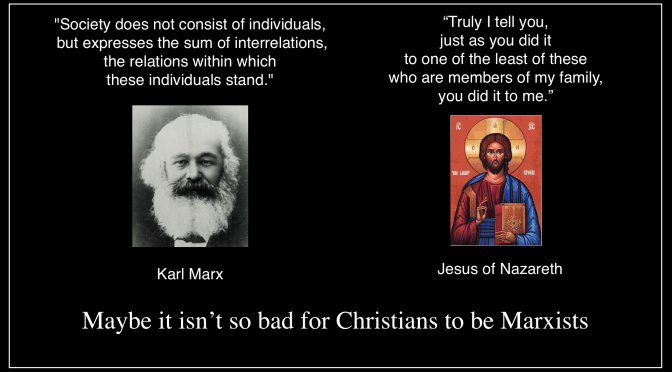
“Is it my job to feed my neighbour’s child? I don’t think so.”Jesus and Karl Marx

Just a couple of days ago in Canada, Federal Industry Minister James Moore made this statement. And of course, once the public and social media outrage (primarily on twitter) got to be too loud, Moore apologized (for being so foolish as to let his repugnant values show in public).

Also, recently the conservative right in the US (Rush Limbaugh, in particular) have called pope Francis a Marxist for advocating for the poor and speaking out against capitalism. Pope Francis responded by saying he is not a Marxist and Marxist ideology is wrong, instead he is a Christian. 

These two media storms highlight a bigger issue that we are facing and that is economic inequality. And I think Christians could benefit from a little Marxism.

Movements like Occupy Wall Street or the recent fast food workers strike show that the economic inequality created by capitalist policies is not really helping most people get ahead, but instead the majority (the middle class) is falling further and further behind the rich few.

Even here in Canada, I hear intelligent, well-meaning people tell me that capitalism is the best economic system for us. I am only 31 years old, but even I remember a time when the ‘capitalists fat cats’ were more joke than revered social leaders.

So here is the thing about Capitalism –  The majority of us are not capitalists in this economic system. Capitalists have the capital (money) to invest in stock markets, to own means of production, to run the economy.  We are workers, the proletariat, the ones off whom the capitalists earn their riches. Capitalism necessitates that the investors and owners take in the profit margins from the production of their workers. In other words, we must be paid less than we make, produce or earn for our employers. That is who capital is made. That is how capitalist invest in and own things. This is system is unequal from the get go, and most of have drunk the cool-aid thinking that capitalism is fair and balanced system.

Our blind support for capitalism is something that capitalists have convinced us is good for us… Christians included.

Karl Marx, on the other hand, said that the Capitalist promise, that what is good for the Capitalist (increased profits, lower taxes etc…) is also good for the average worker, is a big lie. Sounds like the lie of trickle down economics. The one that Pope Francis is naming.

Pope Francis, you are a Marxist.

Christians should be Marxists too.

Here is something else Karl Marx said:

“Society does not consist of individuals, but expresses the sum of interrelations, the relations within which these individuals stand.”

— Karl Marx, Grundrisse, 1858

Sounds a lot like another Marxist:

“for I was hungry and you gave me food, I was thirsty and you gave me something to drink, I was a stranger and you welcomed me, I was naked and you gave me clothing, I was sick and you took care of me, I was in prison and you visited me.” Then the righteous will answer him, “Lord, when was it that we saw you hungry and gave you food, or thirsty and gave you something to drink? And when was it that we saw you a stranger and welcomed you, or naked and gave you clothing? And when was it that we saw you sick or in prison and visited you?” And the king will answer them, “Truly I tell you, just as you did it to one of the least of these who are members of my family, you did it to me.”

– Jesus, Matthew 25:35-40

We have all been told that Marxism is unequivocally bad.  And the examples of Marxism or communism that our world has put into practice haven’t been any better than capitalism for making people’s lives better. They have been pretty awful actually.  And I am not saying that we should switch to communism.

But unlike Capitalism, which is a system that is designed to be concerned with and favour those on the top, Marxist thought turns towards the poor and marginalized. Marx’s concern for society or community, was above his concern for the individual. That concern for the poor sounds a lot like that Jesus guy.  Marxism suggests an alternative to capitalism: socialism, perhaps leading to communism.

But this where Marxism and Jesus diverge.

Jesus points out that there is no system that will work perfectly.

“For you always have the poor with you, but you will not always have me.”

– Jesus, Matthew 26:11

Jesus didn’t say you will have the poor until you institute a capitalist, mixed-market, socialist, or communist economic system. He said always.

And this is where Pope Francis is calling us to turn our concern. Christians should not be about one system or another, we shouldn’t be advocating one political or economic system over others. But like Marx, our concern should be for the least of these, for the poor, the disadvantaged, the marginalized and the weak of the world. Those who are on the bottom and those who are losing ground. Not only is it our government’s job to feed our neighbour’s children, it is our duty and moral obligation.

And as Christians whose attention is turned to the poor, who like Jesus, like Pope Francis, even like Karl Marx,  we who strive for a better world need to balance our concern and work with a confession.

We aren’t going to solve the problem. Our systems, our economies, our politics will not find the solution to starving children. Marxists, nor Capitalists, will find the solution. Human beings will not and cannot find the solution. Every system we create results in someone ending up at the bottom, ending up in the margins.

And that is why as people of faith we turn the One who redeems our failures, who welcomed children when the disciples would not, who promises a new creation, a new system – not of our making, but of God’s.

And in Pope Francis, in food for our neighbour’s children, in small acts of kindness and mercy that go unnoticed each day, we see a glimpse of that New Creation breaking in here all around us – and still yet to come.

What do you think? Are you a closet Marxist? Share in comments or on Twitter: @ParkerErik

Similar Posts:

Two Reluctant Prophets: John the Baptist and Nelson Mandela

Is Jesus the Messiah?