Tag Archives: Church

Greenhouse Churches, Scattering Seeds and the Kingdom of God

Mark 4:26-34

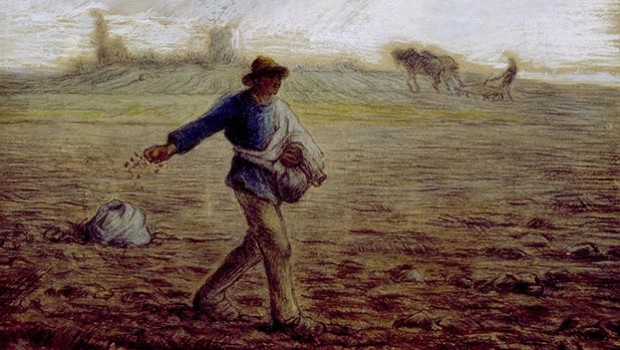
Jesus said, “The kingdom of God is as if someone would scatter seed on the ground, and would sleep and rise night and day, and the seed would sprout and grow, he does not know how. (Read the whole passage)

Sermon

Today, we delve again into Mark’s gospel. Last week, we started this long season of green, by hearing how Jesus’ family thought he was crazy. But we also heard that God’s house is the divided house, the one with room for differences and diversity, the one broken open for the sake of the world.

Today, we hear parables. Parable of the Kingdom. And while this teaching may be familiar for us, it wasn’t for those that Jesus was teaching and preaching to. As Jesus tells parables of the Kingdom, lessons that often begin, “The Kingdom of God is like…” we hear them with 2000 years of Christian tradition that has made us ready to hear them. But to the people of 1st century Israel, their understanding of the Kingdom of God was very different than ours. Before unpacking what Jesus said, it is important to know what the people would have expected.

The Kingdom of God for the people of ancient Israel had a very specific form. As we are reminded each Advent, the Israelites were waiting for the Messiah, the Saviour King who would free them from foreign oppressors like the Egyptians, Babylonians, Persians, and Romans. And this Messiah King would establish an earthly Kingdom with divine approval. A powerful kingdom with powerful armies – maybe even powerful enough to do some oppressing itself. A wealthy kingdom with abundance – maybe with enough abundance that other nations would come begging to it. This Kingdom would keep Israel from ever being ruled over by foreigners ever again. This Kingdom would find favour with God, and would therefore be a holy and righteous Kingdom. This Kingdom would be centred in Jerusalem, with the temple, God’s dwelling place as its symbol of power. The Kingdom of God was long hoped for but also had to live up to very specific criteria.

Then Jesus showed up. And he started telling parables about the Kingdom of God being like unknown seeds scattered in a field, with the sower having no clue how it would grow. Jesus told parables of how the Kingdom of God was like the humble mustard seed, the smallest of seeds that would grow into the most unruly of bushes / garden weeds.

These parables would not have described a Kingdom like the crowds would have expected. This is not the Kingdom of God they were looking for.

Even though we have heard all the Kingdom parables, we too can have a pretty narrow definition of what the Kingdom of God should look like. We too often want a Kingdom of power, security and predictability. We expect that God will fit into our narrow vision of what Kingdom will look like.

Now, it would be easy to describe the often narrow expectations that churches and ministries so often operated under, expectations of increasing attendance and finances… but I suspect we “get” that by now.

So perhaps it is more interesting to consider the effects of our narrow view of the Kingdom of God.

So let me ask a question. A question that the Bishop of the Diocese of Rupertsland asked Lutheran and Anglican clergy this week. And it is for the gardners among us, in particular.

Does anyone know of a seed that looks like the plant it produces?

I can’t think of any.

You might never guess what plant a seed turns into until you plant it. In fact, many seeds also look similar to each other and it can be hard to tell them apart without labels. Planting seeds is a bit of a guessing game. And churches, like all human beings, don’t like facing the unknown.

Churches often prefer to know that the things they do, the ministries, outreaches, projects or programs that they start will be predictable, identifiable, manageable.

And to stay with the garden image, this is more like greenhouse gardening. In the controlled environment of a greenhouse, small seedlings are grown, produced and sold. Seedlings are smaller versions of the plants they will become. And churches often like the things we invest ourselves into to look a little more like greenhouse gardening than scattering seeds in fields. We like to grow small known seedlings into larger yet similar plants.

In fact, churches are a lot like greenhouses. They are safe, stable environments. They are good at producing life. They are good growing plants that wouldn’t grow out in fields. They are good are growing with intention and purpose. They are places where life is nurtured. They are places with an an abundance of water – communities born in the waters of baptism. They are places with an abundance of fertilizer or food – bread and wine to be precise. Churches and greenhouses produce predictable, purposeful, rich life.

But Greenhouses are not the only place where plants grow. In fact, Greenhouses prepare plants for life on the outside. And churches prepare the people within them for life on the outside. To grow out in the world.

But even still, greenhouses are not the only place where life grows. In fact, most life grows out in the fields.

And like any good greenhouse, churches are in the seed scattering business too.

But scattering seeds is not predictable, or safe. Scattering seeds is not easily managed. Scattering seeds is a bit of a guessing game. And sometimes we end up planting mustard seeds in the middle of the field. A mustard seed which grows into a wild, weed-like over-powering bush.

And yet, this is what Jesus says the Kingdom of God is like. A sower who scatters seeds, but who isn’t sure just what will grow or how it turns from seed into living plant.

And yet again, this is what Jesus says the Kingdom of God is like. A small unassuming mustard seed, planted in a garden and treating to take over.

As people of faith, as workers and tenders of God’s garden, we declare that the Kingdom of God is near to us. That it is here. But sometimes we imagine that it is only here. That the Kingdom is contained only within the church. Within these four walls. Within communities who clearly and purposely identify themselves as Christian. We imagine that we allow the Kingdom into our world when we read our bibles, or pray, or attend church or gather as community.

We forget that the Kingdom of God is not contained within us. The Kingdom of God is not grown just in the Greenhouse.

Rather the Greenhouse, the church is contained in the Kingdom. We are just one place where God is growing, one place where seeds have been scattered.

The Kingdom is not in us. We are in the Kingdom.

To people that have a very narrow view of what the Kingdom of God looks like. To the Israelites of the 1st century, and to Christians of the 21st century who often have equally narrow views. Jesus reminds us that Kingdom of God is so much more than what we know.

Jesus tells of how the Kingdom of God is spread with seed that is scattered all over.

Jesus tells of how the Kingdom is sprouting in un-expected places.

Jesus tell of how the Kingdom of God is growing into life that we would have never predicted from the seed.

Jesus tells of how the Kingdom of God is teeming with life where we would have only imagined barrenness.

God is scattering seeds of the Kingdom all over. God is growing plants that we would have never have guessed from the seeds. And God’s Kingdom is showing up, taking over, filling the fields with life.

But perhaps most importantly, even as we garden in the greenhouse, even as we continue on as the church, God is growing the Kingdom here too. Not growing a narrow Kingdom within us, but growing us in the wild, broad, surprising and life-filled Kingdom.

Amen

God’s House is the Divided House

Mark 3:20-35

… And if a house is divided against itself, that house will not be able to stand. (Read the whole passage)

Sermon

A house divided cannot stand.

A house divided cannot stand.

Of all the lines to pick out of this passage, why does this one stand out in particular? Why not “he has gone out of his mind”? Or “then indeed the house can be plundered”? Or “Who are my mother and sisters and brothers”?

A house divided cannot stand. We seem to be caught by this line for some reason.

This short vignette in the life of Jesus can strike us as a strange one. As is usual, Mark uses the structure of the story to draw us to the centre. We begin and end with the crowds. The unwashed, poor, unclean and desperate crowds are pushing in on Jesus and his disciples. They are looking for something, someone to give them good news.  And by the end, Jesus names those same crowds as his brothers, sisters and mothers.

The next frame is Jesus’ family. Just after we first hear about the crowds, Jesus’ family comes to take him away because he is out of his mind. And just before the last mention of the crowds, we are reminded that Jesus family is desperate to get him away, to relieve their shame and embarrassment at what Jesus is doing.

And finally the scribes make up the inside frame. He has a demon the scribes claim. And Jesus rebukes the scribes for trying to make claim to actions of the spirit.

Crowds, family scribes. Scribes, family crowds. And right in the middle, Jesus gives us this strange image of Satan’s house. A house divided cannot stand. Satan’s house divided cannot stand. Satan’s house is not divided. Satan’s house, the strongman’s house, IS the undivided house.

As Jesus’ family attempts to restrain Jesus and as the scribes declare that Jesus is acting with a possessed spirit, Jesus reminds all those around him of this fact. It is the house of the strong man that cannot stand if divided, and therefore is not divided. But rather, that Jesus is here to tie up of the strong man in his house and to plunder it.

Jesus speaks to the crowds, his family and the scribes who all believe that they have the world figured out and that they have God figured out. The crowds know that they are on the outside of God’s love, they know that because they are unclean and unable to make sacrifices in the temple that God couldn’t possibly accept them.

Jesus’ family knows that family unity is essential to the Hebrew faith. They know that Jesus’ actions will not only reflect badly on him, but will bring shame to the whole family. They will lose standing in the community.

The scribes know they are part of the religious authority. They know that because they have kept the law that they are permitted to make judgements about who is clean and unclean, who us righteous and who is unrighteous.

Jesus speaks to these groups who believe they have it all figured out and turns their whole world, their whole understanding of God on its head. Jesus tells all of them, they are all wrong.

Like the crowds, Jesus’ family and scribes, we so often think we have things figured out.  Whether we think like the scribes, that we can determine where God begins and ends and make judgements about who is outside of God, or like Jesus’ family that we need to keep from being shamed and embarrassed or like the crowds that we are too sinful for God to possibly love us.

Jesus hears all of that and turns it on his it head. Jesus challenges our assumptions, challenges our claim to be the arbitrators of God’s love and declares a completely different reality.

“Truly I tell you, people will be forgiven for their sins and whatever blasphemies they utter; but whoever blasphemes against the Holy Spirit can never have forgiveness, but is guilty of an eternal sin”

Whatever we think we have figured out, whatever understanding of God’s activity in the world we claim to have Jesus tells the crowds, tells his family, tells the scribes and tells us that it is opposite of what we think. God is usually doing things very differently than we imagine.

A house divided cannot stand.

But God’s house, divided for 2000 years, continues to stand. It has stood despite our inability to agree. It has stood because the Church has been full of people who thought differently.

God’s house stands divided because it is able to hold within it the differences that we bear as the Body of Christ. God’s house stands because even when we cannot hold our differences between us, God can.

God’s house stands because it stands on Christ.

Satan’s house is the undivided house.

But Christ, who ties up the strong man and plunders Satan’s house, is our foundation.

God’s house stands divided between the many members of the body, the many members who serve and live in different ways, the many members whose different gifts are used in different ways, the many members who are each chosen and loved by God.

God’s house stands divided, as the Body of Christ broken and given for the world, as the Blood of christ shed and poured out for a world in need of forgiveness.

Just as we are all guilty of same eternal sin, of the same original sin, of wanting to be God in God’s place, of standing in judgement of others. Just as we are guilty, like the crowds, family and scribes of standing in Judgement of Christ. Jesus is declaring a new reality.

A reality where people will be forgiven for their sins.

The Body of Christ, the House of God, stands broken and divided in the world. And today, Jesus reminds us, that it is not by agreeing or finding unity that we stand. In fact, Jesus reminds us that it is Satan’s house that stands undivided.

Rather, Jesus declares today that God’s house divided and broken house stands only by God’s forgiveness. God’s house stands only by God’s stubborn insistence that we are all brothers and sisters in the Body of Christ. God’s house stands only by the turning of our world upside down.

A house divided cannot stand. But God’s house, broken and divided given and shed for us, has stood, stands now and will stand forever.

Amen.

O dry bones, hear the word of the Lord – Pentecost for Today

Ezekiel 37:1-14

The hand of the Lord came upon me, and he brought me out by the spirit of the Lord and set me down in the middle of a valley; it was full of bones. He led me all around them; there were very many lying in the valley, and they were very dry. He said to me, “Mortal, can these bones live?” I answered, “O Lord GOD, you know.” (Read the whole passage here)

Sermon

Our bones are dried up, and our hope is lost.

For a significant portion of medieval Christianity, there were 4 major Christian Feast Days that all Christians were obligated to attend. Easter, Christmas, All Saints Day and Whitsun Day.

Whitsun Day is also known as the Day of Pentecost. On the 8 Sunday after Easter Sunday, 50 days afterwards, Christians gathered to celebrate the coming of the Holy Spirit to the disciples early in the morning. On that day the disciples spilled out in the streets, with tongues of fire on them, and the preached the Good News in all languages.

It is an incredible story, a miraculous story. Pentecost has more recently become strongly associated with the idea of speaking in tongues. Pentecostals, a movement born in Azuza Street Revival in early 20th century Los Angeles have become strongly associated with Pentecost and speaking in tongues.

As interesting and perplexing the idea of speaking in tongues might be to a bunch of stayed and stoic Lutherans like us, the most interesting part of the Pentecost story comes just after the speaking in tongues part. After Peter finishes his impromptu sermon to the people of Jerusalem, 3000 people are baptized.

And with that Pentecost becomes birthday of the church.

2000 years since that first Pentecost, the church has survived much. 300 years of marginalization in the pluralistic and pagan world of the Roman Empire. The church has kept going despite bing co-opted by that same empire for political reasons. The church has survived schism, crusades and holy wars, upheaval and reformation, renaissance and scientific revolution, World Wars and Great Depressions.

Pentecost shows us the resiliency of the church, or more particularly, the faithfulness of God. This community of faith born in the Good News and nurtured by water, bread and wine is the ongoing sign of God’s great love for world. And while Acts brings us back to the beginning of this community, it is in Ezekiel that we might find more in common.

The idea of 3000 people being baptized today sounds frightening and exciting, but that is not where we are. It is not where the church or where our congregation has been at for a long time – if ever.

The words spoken by the House of Israel in Ezekiel’s vision sound more familiar:

Our bones are dried up, and our hope is lost.

2000 years after Pentecost, the vision that Ezekiel describes, seems to resonate a little more with us. At least the first part, the valley of dry and dead bones part.

Just this week, Pew Research in the US released a report detailing the decline of church attendance. Nothing that we didn’t know of course. Except, the report contradicts the common narrative that evangelical and conservative churches are still growing or maintaining. Attendance is dropping across the board. Declining for every group except one. The ‘Nones’ or the group the group who describe themselves as belonging to no religion.

Christianity is declining around us – our bones are dried up.  And those who are leaving are leaving for nothing – our hope is lost.

The prophet Ezekiel lived in world much more like ours than the Pentecost moment. He was a young man when Jerusalem was sacked by the Babylonians, the temple was destroyed and all the elites of Israel carried off into exile in Babylon. And for 5 years Ezekiel started preaching about and re-enacting the destruction of the temple. 5 years.

It took 5 years for the people to believe that the temple was gone. That the world they once knew was gone. It took 5 years to sink in that there was no going back. It wasn’t  enough to see the temple destroyed. It wasn’t enough to be in Babylon. It wasn’t enough to be conquered and forced to worship new gods. They needed to hear the story over and over again for it sink in. For them to accept their new reality.

Sounds familiar yet?

We too tell the same stories. The stories of our decline. The stories of our destruction. We lament and long for a world that is gone. We grieve for a world that we cannot go back to. And it might take us years to admit to this change, for our new world to sink in. Accepting our reality is just as hard.

Our pews will never be full of the people that filled them before. Our Sunday School and Confirmation classes will never have the students they once had. School children will never pray our prayers again. Sports, music and dance will never be banned during our worship again. Shopping hours will never be reduced to accommodate church attendance in our lifetimes. There are fewer Sunday sermons on radios and prayers at town council meetings. We will feel like we are having to make room for other religions and like we are being pushed out of public space for years to come.

Our bones are drying up, and our hope is lost.

And still,  standing with Ezekiel with the valley of dry bones spread before us, God will speak to us too.

“Mortal, can these bones live?”

Ezekiel’s responses is one of powerlessness. It is a sentiment that we understand. It is an utterance of exasperation that we speak often.

“O Lord God… you know”

50 years ago… if you had been sitting in a full and bustling church on Sunday morning, the only show in town, the place where many of your family, friends and neighbours were week after week, and the preacher stood a the pulpit and said,

“In only a few years this place will be a hallow shell of itself”

You might have laughed. It would seem unbelievable. It would sound crazy.

And yet, here we are.

Here we are with Ezekiel standing at the valley of dry bones and we are admitting, we are giving in, we are hopeless. “Only God knows what is next for us”

And God says,

“Prophesy to these bones, and say to them: O dry bones, hear the word of the Lord. Thus says the Lord GOD to these bones: I will cause breath to enter you, and you shall live. I will lay sinews on you, and will cause flesh to come upon you, and cover you with skin, and put breath in you, and you shall live; and you shall know that I am the Lord.”

Today… as you sit in a church with more empty spots in the pews than occupied ones on Sunday morning, as we are just one Sunday morning activity option among many, where friends, family and neighbours are rarely seen.

And the preachers stands in the pulpit and says,

“In only a few years this place will be full and alive with the spirit again”

You might laugh. It would seem unbelievable. It would sound crazy.

And yet, that is just what God is saying:

Then God said to us, “Mortal, these bones are the whole house of [Good Shepherd], the whole house of [Christianity]. [You] say, `Our bones are dried up, and our hope is lost; we are cut off completely.’ Therefore prophesy, [and hear the word of the Lord for you], Thus says the Lord GOD: I am going to open your graves [I am going to open your doors, open your hearts, open your communities], and bring you up from your graves, O my people; and I will bring you back to the land of [Christ]. And you shall know that I am the Lord [you shall know that your church does not live and die by you], when I open your graves, and bring you up from your graves, O my people. I will put my spirit within you, and you shall live, and I will place you on your own soil; then you shall know that I, the Lord, have spoken and will act,” says the Lord.

Today, a new Pentecost is dawning on us. Today, the spirit is blowing again in our midst. We might feel like our bones are dried up, and our hope is lost. We might only see a dying church… but God is about to do something new among us.

God is setting to the task of making dry bones walk. God making us ready for what is coming next for the church. And that might begin with years of telling the story of our decline and destruction. But like Ezekiel, once the story has been told enough, God will provide a new vision. Ezekiel saw a vision of the new temple and God is even today giving us glimpses of a new church, a new way to be people of faith in a changing world. It still took 200 years before the exiles returned to Israel to rebuild the temple, and it might just as long for the church. But this is how God works. God is making us ready for what is coming next.

Today the Lord says to us, “Prophesy to the breath, prophesy my church, and say to the breath: Thus says the Lord GOD: Come from the four winds, O breath, and breathe upon these slain, that they may live”

Amen.

Everybody Panic! – Why We are All Wrong About Church Decline

Unless you live under a rock or only get your news from the Farmer’s Almanac, you have probably heard about the recent Pew Research report detailing the decline of Christianity in the US, and the rise of the ‘nones’ – those who claim no religious affiliation.

Predictably, people are up in arms. Bloggers are writing doom and gloom pieces. People are trying to explain the decline. Some are saying that the decline is the result of lax theology and drifting away from traditional / conservative beliefs and values. Others are saying that liberal mainliners are providing what the ‘nones’ are really looking for, especially what young disaffected millennials are looking for.

Perhaps the only new, but unsurprising, find of this recent Pew report is that Evangelicals are declining too. This contradicts the often lauded trope of the last few years that decline is a mainline thing.

Well I have to admit, that this all feels like a tired rehash of what we already know. But in particular, as a Canadian, I see the panic happening among US Christians as something we felt about 20 years ago. We are a lot farther along the social secularization path than our dramatic neighbours to the south.

And as I have blogged about before, as a Millennial Christian in Canada, the only church I have known is one in decline. I have only ‘heard’ the stories of everyone in town being in church on Sundays… I haven’t lived it. Being a church-going person was the exception among my peers growing up, not the norm. We used to sing the national anthem on Monday mornings in school but we never prayed the Lord’s Prayer. In fact, the idea of one of my grade school teachers leading the Lord’s Prayer sounds absurd.

Yet, the analysis, panic, fear, and explanations of the past few days is not what we are all getting wrong about this decline thing.

I think there are few things that we miss when we panic about a society and culture that is no longer evangelizing for us. And these things should be the first things we name when talking about church decline in North America.

1. The Golden Era of Church attendance in the 1950s was the abnormality.  

So often our discourse on decline assumes that wide-spread socially motivated church attendance is normative. So many church people are used to a world where the question was which church to attend on Sunday mornings, not whether or not one should attend at all. During the Reformation, many protestant groups were born out of the fact that most people were nominally Christian, and did not attend church or “show their faith” in how they lived. North American society in the 1800s and early 1900s was not one that ubiquitously attended church. I think the big bulge in church attendance, church planting and growth of the 1950s was due to a global experience of PTSD following World War One, the Great Depression and World War Two. The church was convenient place to land for a world looking to make sense of decades of suffering. 60 years on from then, I think decline is a correction, rather than a failure.

2. What we are seeing is the death of Christendom… not the Church. 

Conversations about church decline are almost always accompanied by the lament of the loss of cultural Christianity. There is talk of prayer in schools and town council meetings, the 10 commandments on display at courthouses, sports, music and dance happening during Sunday morning worship, the church as community centre and neighbourhood gathering place. And yet, if we took a minute to really consider what that means, we are actually demanding a church that is dependant on empire, that is served by kingdoms and governments. We want a church that needs to have all other activities banned during its worship. We long for a church that needs its prayers taught in schools and that seeks power by influencing political leaders.

Is it really such a bad thing to see the decline of that church?

3. We like to think that we are the ones who can finally do the church in.

As if the church lives and dies by us. Christ’s church has been around for 2000 years. It began by spending 300 years on the margins of a religiously plural world. It was subsumed into being the bureaucracy of the Roman Empire. It has been nearly blown by up schism. Almost over-run by the empires of other faiths. It has crusaded and begun terrible holy wars. It has been cracked and splintered by reformation. It has been challenged to its core by renaissance and scientific revolution. The church has survived all of that, against all odds.

But now our social angst and apathy, and our institutional intractability is going to finally put the church out of its misery? Because we cannot be the church of empire or let social structures do our evangelism for us, the church will just fade away?

Sometimes I think that we tie our attendance to God’s faithfulness. We believe that God approved of the church more when it was full 50 years ago. And now God is frowning at us because we couldn’t freeze time, because the world changed around us and we weren’t sure how to deal with it.

This Pew Research report is nothing new. It is full of things we already know. But maybe decline, the more it gets thrown in our face, is telling us something important about the church – about God’s work in the world.

A declining church does not equal a declining God.

Nor does a full and rich church equal an increasing God.

Maybe God’s work in the world has nothing to do with numbers.

Maybe God’s mission through the church cannot be measured quantitatively.

Maybe what God is doing can only be experienced qualitatively. The Good News is not about winning souls by filling pews. The Good News is that Christ’s death and resurrection is our death and resurrection too – and this fact transforms who we are.

So maybe, just maybe, this declining stuff… this dying stuff that the church is doing… is just what always comes right before empty tombs and being known in breaking bread.

What we get wrong about decline is that we rarely consider that it just might how God is doing God’s work, in and through us – God’s church.


How did you respond to the Pew Research report? Can the church survive decline? Is the best thing to happen to Christianity in a while? Share in the comments, or on the Facebook Page: The Millennial Pastor or on Twitter: @ParkerErik

The (lack of) moral authority of being a white male

The past few weeks have been hard to find motivation to write. This post was supposed to be about ‘being spiritual but not religious’ (that will come later), but it seemed like a trivial topic when considering events in Baltimore, events here in Winnipeg – the city where I live – and other issues of systematic oppression of non-white people in North America.

I will be honest, I don’t think it actually helps for white, male bloggers like myself to weigh in much on these issues. As a couple of other bloggers I respect, Mark Sandlin and David R Henson, point out in their Moonshine Jesus podcast, that there is a certain irony and hypocrisy in white males talking about race issues.

Baltimore is just another in a string of incidents (Ferguson, Staten Island etc…) that has brought to public attention the systematic discrimination of African-American people at the hands of the police, the judicial system and by legislators. And while it would be easy to wag my finger from Canada at these American issues, Desmond Cole recently published a scathing editorial recounting how he has been stopped by the police in Toronto more than 50 times, simply for being black. Not too long before that, a national magazine named the city I live in – Winnipeg, Manitoba – as the most racist city in Canada. Winnipeg is at heart of the Missing and Murdered Indigenous Women movement, we have recently had a serial killer (seriously!) arrested for murdering vulnerable indigenous homeless men and we have a number of incidents involving the violent assaults and deaths of young indigenous girls, some in the care of the government.

As all these issues swirl about the news cycle and water cooler, I cannot help but have the sense to let those closest to the issues (not this middle class white guy) speak to them.

And sure, it is uncomfortable because listening and learning can feel a lot like doing nothing at times.  But I also know just how important it is to refrain from speaking authoritatively about these realities (I am hoping that statement doesn’t make this whole post ironic) and instead listen and model listening for other white people like me.

It also uncomfortable to go against my social conditioning as a white male to contribute to the conversation, to make my voice heard, to speak out because my voice “counts”.

So with all my hesitation and discomfort around the issues that concern my white male privilege (ironic to say that this causes me discomfort, I get it), there have recently been a couple of things in my professional life that have forced me to operate in these systems of privilege despite my discomfort.

Now, it is has taken me a while to get to my point of writing this post, but here it is: As much as I try to escape or downplay my privilege, I cannot avoid it.

David Henson said in the Moonshine Jesus podcast that when he is asked to comment on the protests in Baltimore and the morality of “rioting”, his response is that “as a white guy who has done precious little to combat racism,” he doesn’t have the moral authority to pass judgement. I could feel the weight of that comment land on my chest as I listened to the podcast.

I couldn’t agree more – I do not have the moral authority to be the arbiter of these kinds of issues. Especially because I am a white male!

And yet, in a completely messed up way, because of the systems we live in, I am placed in that position regardless.

In the past few weeks, despite my hesitancy to comment as an “expert” or to judge as some kind of “moral authority”, our social systems push white males into these roles.

Recently, I was asked to give presentations, on two occasions, to concerned church groups about Islam and ISIS. I am no expert on the topic, other than a few religious studies classes in undergrad and a little research. Yet, for a group of concerned Christians, attempting to faithfully wrestle with these issues of the “other”, I offered the safety of being a “trustworthy” expert. Now obviously being a pastor made me trustworthy to these groups, but I am also certain being a white male contributed to my “expert” status. People are just used to trusting, following and listening to me. Yet, a muslim person would have been far better choice to speak to these issues.

And again, I was recently forced to face my complicity in systems of white middle class Christian privilege. I cannot give many details, other than to say I was responding pastoral request from someone on the margins, someone who was ethnically and religiously different from the privileged class – from me.

In that moment sitting at my desk across from the person making the request, I became incredibly aware of what it was to be put in a position of power simply because of my race and gender. I was being asked to make a moral judgement, that had little bearing on my life, but that held the balance of wellbeing for the “other”, for people on the margins, people with little social capital, people whose livelihood depended on the arbitrary decision of an un-invested white male authority figure.

To say that it was beyond uncomfortable for me misses the point. The reality is that I simply do not and cannot fully know what it is like to have to be subject to anther person’s authority simply based on their gender, and race. I cannot imagine the indignity, the sense of powerlessness, the unfairness, the frustration and rage, the resentment. I cannot know what it is like to feel that way.

As these issues of race and privilege play out in American and Canadian society, I now realize that there is something more than standing in solidarity, more than re-broadcasting the voices of the marginalized, more than listening and learning and leaving room for others to be heard that white people – white males – need to do.

We need to admit our complicity in these systems. We need to see how easily we slip into positions of power and authority without evening knowing. No, I didn’t create the system.

But I participate in it. Despite my best efforts to the contrary. 

These problems of racial, financial, religious and gender inequality will not change until those of us in the privileged class admit that we perpetuate the inequality. Changing the system will need hard work, it will require us to see the moments and acknowledge when become slip into the role of benevolent (or not) white overlords to the marginalized masses. We need to be willing to give up the part of our status that exists only through inequality. We need to admit that white  and male privilege exists even when we feel hard done by, when are struggling, when don’t “feel” privileged. We must contribute to change by being willing to admit that we do in fact participate in these unfair systems that mostly benefit us.

As Disney tells their employees about customer service,

“It is not my fault, but it is my problem.”

Racial, religious, financial and gender inequality is not my fault, but it is my problem,


Post Script:

The other day on Twitter,  Christian Blogger Jayson Bradley tweeted his frustration with another example of a white person not getting issues of race:

https://twitter.com/jaysondbradley/status/594499341718454273

To which I responded:

I think the phrase some commonly used by white people “I am not a racist but…” needs to be banned from use.

Maybe we could instead start these ill-conceived ideas on issues of race with:

“Racism is not my fault, but it is my problem, so…”

I think the ending to that statement would be much different.


Have found yourself uncomfortable because of white privilege? How do you participate in systems of privilege and oppression? Share in the comments, or on the Facebook Page: The Millennial Pastor or on Twitter: @ParkerErik