Tag Archives: Church

The Temple has Been Thrown Down – Paris, Beirut, Baghdad

Mark 13:1-8

As Jesus came out of the temple, one of his disciples said to him, “Look, Teacher, what large stones and what large buildings!” Then Jesus asked him, “Do you see these great buildings? Not one stone will be left here upon another; all will be thrown down.”… For nation will rise against nation, and kingdom against kingdom; there will be earthquakes in various places; there will be famines. This is but the beginning of the birth pangs.” (Read the Whole Passage here)

12227205_983847591654638_5852447112899142260_nSermon

Some weeks as a preacher, you plan one thing, and the breaking news comes. The hourly news on the radio, twitter and Facebook alerts, news articles

19 in Bagdad

43 in Beirut

127 in Paris

Explosions and bullets.

Chaos. Fear. Death.

The world prays for Paris and beyond.

The veneer of business as usual is once again shattered.

Our thoughts and prayers are with the victims and families today as the long slow process of rebuilding life begins.

But as we sit here, tucked away from the danger, yet still with heavy hearts, we know that there are explosions and shootings everyday. Paris feels closer to home, than Beirut or Baghdad, but the violence happens everyday.

(Pause)

Father Angelo has led a number of tours of holy sites in his ministry at St. David’s. Every few years, he offers a chance for a group from the congregation to travel for a couple weeks and to see historical parts of the world. He has taken groups to the Holy Land a number of times, to Rome, and to England. This year, the group was touring the Cathedrals of central Europe. They were headed to the largest gothic cathedral in Northern Europe, the Cologne Cathedral.

As the tour bus approached, the group could see the cathedral towering above the city. With the twin towering spires looking like they were reaching for heaven above, Father Angelo led the group into the church. The Cathedral was bustling with life. There were hundreds of people mingling about. There were a dozen tour guides were lecturing groups in different languages.

And then all of a sudden a loud crash could be heard outside, followed by the whole cathedral shaking, dust scattering everywhere.

And then another explosion… all the people inside the church froze for a moment. And then as if on cue, people began running, screaming and shouting. Father Angelo called for his group to stay calm and stay put.

(Pause)

Next Sunday will be Christ the King, the New Year’s Eve of the church year. And then we will reset the story of Jesus, and begin again with pregnancy as we wait for the birth of Messiah.

But we are not quite there yet… Instead first we must hear the last portion of Mark’s gospel for this year. And in true Markan fashion, it is yet another conversation between Jesus and the disciples, where they miss the point and Jesus gets annoyed.

Paris is exactly what Jesus is talking about with the disciples. As they marvel at grandness of the temple, Jesus points out how they cling to the illusion of security, safety, comfort, and enduringness. They see the temple as a sign of God’s power. Jesus’ words about the temple are not judgement or condemnation. He isn’t hoping for the temple to fall. He is simply warning of the inevitable. He is telling the disciples that if the stones of the temple are where they place their faith… They will not just be disappointed, but one day they will be fleeing the falling stones as they threaten to come down.

On Friday, we bore witness as Paris was another destruction of the temple. A temple built to our own power, our own security, to faith in our own god-likeness. Because unlike Beirut or Bagdad, Paris is the same stadiums and restaurants and concert halls that we believe are safe for us. We are shaken because Paris could be here. We could be the ones out for dinner, watching the game, at a concert when the bullets start flying, or the suicide bombers decide to press the button.

If our faith is in the large stones and tall buildings and in the idea that violence couldn’t happen here, we will be disappointed.

And at the same time, if our fear is that every refugee is a terrorist and that we can close our doors and boarders to be safe while not also closing off some part of our hearts, we have again put our faith in the wrong thing.

Jesus warns us not to be surprised when the stones begin to fall and when the wars begin. But as we try to understand even more senseless violence and death, it is hard to understand what God is up to.

Jesus does give us a clue. The birth pangs.

As we are about to begin Advent, the church’s season of pregnancy, we know that the birth pangs mean that something new is about to happen. We know that the pain and suffering, the aches and stiffness, the loss of control and uncertainty about what is coming might be signs of impending death and destruction. But with God, we know that these are also the signs of something new, something being born into our world.

(Pause)

In just few minutes, the cathedral was nearly emptied out. Father Angelo and his group found an alcove to take shelter in with a few other tourists. There were sirens and the sound of gun fire coming outside. The world seemed to have flipped from wonderful European holiday to surreal chaos in the blink of an eye.

As the group huddled together, the doors to the cathedral burst open. 3 young, dark skinned men with beards and backpacks came pouring in. The St. David’s tour group looked at each other in abject fear. A few started sobbing, one person cried, “This is the end.”

Father Angelo stood up and left the alcove. He waved the three men over to alcove. They came running, and as he ushered them into the alcove, breathing heavily, they sat down next to the others against the wall.

One looked up to Father Anglo and said, “Thank you, Father.”

Father Angelo nodded.

As the St. David’s group slowly began to relax, the three men checked their phones and caught their breath.

As the noises of chaos and sirens continued outside the church, the group settled in. One of the men, looking as scared and worried as anyone in the St. David’s group, looked again towards Father Angelo and said, “Father, will you lead us in prayer.”

“Yes… we should pray, shouldn’t we.” said Father Angelo.

And together, the 3 young dark skinned men, cathedral stragglers and the group of St. David’s began to pray, “Kyrie Eleison. Lord have mercy.”

(Pause)

In the midst to crashing stones, Jesus could have said that these things mean the end. Instead he says they are the birth pangs. That these things mean something beginning, not something ending. We so often see the struggle and pain, the chaos and uncertainty as symptoms of dying. Yet, these are also symptoms of pregnancy.

And with God, the birth pangs points us to a pregnant teen and her carpenter husband travelling the harsh country side in the midst of foreign occupation and population control. The birth pangs herald a baby born in the most inconspicuous of stables in the back corner of the world far away from large temple and large stones.

God’s work happens in the quiet corners. God’s work happens with normal people, like us.

It is like Mr Rogers who reminds us to “look for the helpers”.

It is the Porte Ouverte, Open Door message that Parisians used to let those who were stuck outside know that there was safety to be found.

It is a musician who drags his grand piano on his bike, to play John Lennon’s imagine outside of the bombed out concert hall.

It is hearts that refuse to be closed off even though every instinct tells us it is not safe to be open to the “other”.

But most of all the birth pangs are signs of God’s promise that death does not have the final say. That tall buildings and large stones, nor explosions and the bullets, are the powers that define us.

Instead in the places where we least expect,

God stands where tall buildings and stones have fallen.

God is thwarting the bullets and explosions.

God is birthing new life.

God has already begun the work of reconciliation and resurrection.

Because reconciliation and resurrection always begin in the broken and tragic places.

Because new life must first begin in death.

Because God works with mangers and crosses, with open doors and prayers prayed by helpless and far away neighbours and friends.

God’s life giving work happens in the small places, because that is all God needs. Because that is where death and darkness are defeated. In mangers, on crosses, in empty tombs, on open doors/ Portes Ouvertes, with prayer vigils reminding us to forgive and to hope. The birth pangs are are not the destruction… The birth pangs are the realization that neither our large stones nor our bullets have real power.

The birth pangs are the sign that God is about transform the world with virgins and shepherds, with fishermen, tax collectors and sinners, with words of faith, water, bread and wine. With a praying Body, a praying community spread all over the world, God is making us the Portes Ouvertes / Open Doors of the Kingdom. God is transforming the world in the Body of the One who was laid in the manger but walked out of the tomb. In the One who is there wherever two or three gather to pray, even when the bombs and bullets are falling.

And so today, as the stones fall, as the news breaks, as the fear of the other threatens… we prepare for the birth pangs. God is about to birth something… someone new into the world. Messiah, the One who will truly save us, the One who is greater than any temple, any bomb, any fear. Messiah is on the way.

Amen.

Colliding with All Saints – Making All Things New

John 11:32-44

When Mary came where Jesus was and saw him, she knelt at his feet and said to him, “Lord, if you had been here, my brother would not have died.” When Jesus saw her weeping, and the Jews who came with her also weeping, he was greatly disturbed in spirit and deeply moved. He said, “Where have you laid him?” They said to him, “Lord, come and see.” Jesus began to weep. (Read the whole passage)

Sermon

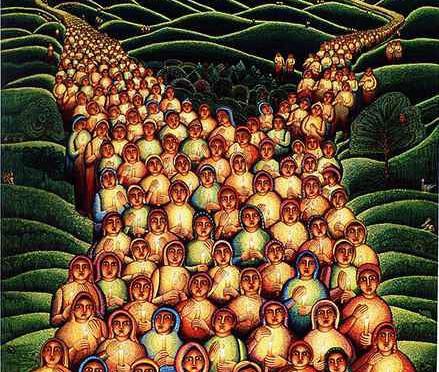
Last night children everywhere wandered the streets in costumes, going from door to door for Halloween. There were ghouls and goblins, superheroes and villains, princes and princesses. Almost everyone takes part, whether it is handing out candy, providing scary decorations or accompanying children on their pilgrimage for the biggest hauls of chocolate bars and sweets. In many ways this mirrors the practice of medieval Christians making pilgrimage for All Saints. Dressing up, lighting candles, journeying on the road was all part of the belief that spirits would often wander the earth until All Saints Day, and the costumes would be to scare away vengeful haunting spirits, and the candles, often lit in each room in a house or door way that would guide good spirits home.

As the end of the middle ages saw the Reformation, our forebears sought to reshape the feast of All Saints. Rather than praying to the Saints on November 1st and then praying for all souls still in purgatory on All Souls Day November 2nd, Lutherans and other protestants have mashed the two together, recognizing that saints are not special or holy people. But that all those who have died in faith are made Saints by God’s Holiness poured out for us.

On All Saints Day, we gather to pray in thanksgiving for those who have gone before us in faith, and we pray to God that we too may join the saints and heavenly hosts in the always ongoing great high feast. We recognize today, that our worship is not something that we create, but rather something we are invited to join with the heavenly hosts. We are like thirsty pilgrims who approach the always flowing river of heavenly worship and we wade into the water again and again, week after week, briefly pulling back the veil between heaven and earth until one day we too will be swept up into the great worship of all the saints and we too will join the heavenly hosts.

And yet today is not all sweet visions of heavenly worship and dreams of joining those beloved saints who have gone before us.

Today, we also face the reality death. Like Jesus on the road to Bethany, we are confronted with the real, messy, emotional and overpowering experience of grief. Our spirits are disturbed like Jesus’ is. We churn and twist deep in our beings with Mary.

As Jesus makes his way to Bethany to mourn the death of his friend Lazarus, we are not meant to see a doctor calling a time of death, nor a pastor leading prayers at a funeral, nor a funeral director guiding a grieving family through grief. Jesus is going to Bethany as a friend, a brother to Lazarus, family to Mary and Martha.

On this grieving journey to Bethany, Jesus meets a desperate Mary. “Lord, if you have been here my brother would not have died” she pleads. And Jesus is disturbed, Jesus is moved. The greek is points to a deep churning passion, even anger within Jesus. He doesn’t just recognize and acknowledge the grief in the Mary like a therapist would. But Jesus feels it too, but Jesus loves Mary, Martha and Lazarus. Even knowing what he is about to do, Jesus feels the depths of grief too.

The kind of grief that we all know. The kind of grief that always comes with death. Whether it is the grief of a community witnessing an overturned boat near Tofino, the grief of world citizens who are watching people choose the risky waters of the Mediterranean because they are safer than home in Syria, the grief of families who keep vigil at hospital bed knowing that death long awaited is soon to arrive, the grief of empty spots at dining rooms tables, vacant passages seats in cars, or beds meant for two with only one to sleep.

The grief that Jesus feels today is the same personal, raw, churning grief that we know in our lives. And while grief makes death feels so personal and lonely, death is also transcendent, cosmic, universal. It is found on the road between two friends grieving a dead brother and it also the great darkness hanging over all creation:

See, the house of God is far from mortals

Death hovers over them as their master;

they will all suffer the same fate

and death will spare not one;

Life will be no more;

there is nothing but mourning and crying and pain,

for the first things reign over all.

This is the old heaven and the old earth, this is what All Saints pilgrims carried with them on their journey, this is the personal grief that we bring today for loved ones.

This is death.

This is death, and Jesus stands in front of the tomb, tears running down his face and defiantly says, “Take away the stone.”

And grief, personal and cosmic says, “But Lord there will be a stench” because death is too strong, too powerful, too overwhelming.

Except for God.

Except for the God who created something from nothing.

Except for the God who is creating a new heaven and a new earth.

And out walks a dead man, out walks Lazarus alive again.

The very last thing that Mary or Martha expects is to see their brother alive. Grief cannot imagine that there is an answer to death. That is why Jesus meets Mary and Martha in their grief. That is why God’s spirit churns with anger, that is why God grieves with us on the road to the tomb, that is why God, even knowing that the stone is about to be rolled away, weeps along with us.

And there walking out of the tomb, the personal and cosmic realities of death collide into the personal and cosmic promises of God. The reality of stinking rotting dead flesh that we know too well suddenly smashes into the loving, heart-pounding, passionate love of God for all creation.

As Jesus stands at the tomb, calling for the stone to be rolled away, beckoning forth believed brother and friend, Mary, Martha and Lazarus finally see the the reality of Jesus promise, of dreams and visions of Revelation made tangible:

“See, the home of God is among mortals.

He will dwell with them as their God;

they will be his peoples,

and God himself will be with them;

he will wipe every tear from their eyes.

Death will be no more;

mourning and crying and pain will be no more,

for the first things have passed away.”

And the one who was seated on the throne said, “See, I am making all things new.”

Our All Saints pilgrimage this morning is the same mixture of personal and transcendent grief. We acknowledge that death comes for our loved ones and us, death comes for all.

But with Mary, Martha and Lazarus, we discover that in our grief, God in Christ meets us on the road. God in Christ churns with anger and grief, with sorrow and sadness weeping with us just as if death had the last word.

Yet Jesus has also come to meet us with that great Revelation promise,

“See, I am making all things new.”

As Jesus stands there, tears running down his face, disturbed in spirit… He commands the stones be rolled away from all of our tombs. Jesus enacts the cosmic and transcendent promise of resurrection, Jesus declares that God has come to live with mortals. Jesus declares that death is not the end for those whose names we will read today, not the end for those whom light candles for… Jesus declares that death is not the end because,

“See, I am making all things new.”

As we gather on All Saints, with hearts full of both grief and thanks, of joy and sorrow, we discover a God who is deeply and powerfully and intimately involved in the affairs of mortals, who sheds real tears for Mary, Martha and Lazarus out of love.

We discover a God who cannot help but love us. A God who cannot help but love us in our grief and a God who cannot help but make all things new in our world.

Today on All Saints we confront grief and death, we confront the personal and cosmic and we make pilgrimage to tombs and graves, sealed shut forever.  But then we see a passionate and loving God, weeping with us AND calling us out of our graves into new life.  And all of a sudden, those great promises of resurrection, those promises of a new heaven and a new earth collide into us.

They collide and smash into us as the creator of all things stands before us and says,

“See, I am making all things – including you – new”

Amen.

We can’t do Gold Star Christianity anymore – Clinging to the Wrong Trappings

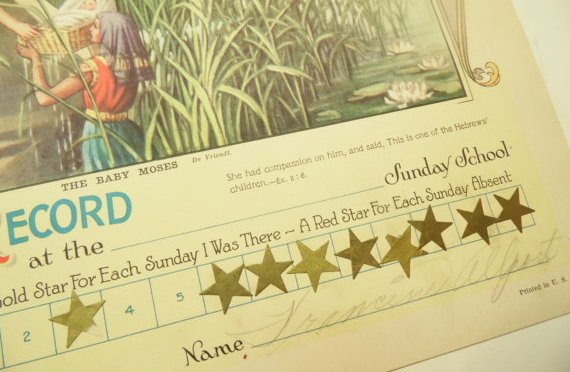
This spring, I attended a continuing education event featuring Craig Van Gelder, a professor of missiology at Luther Seminary, St. Paul, MN. He told a story about his experience growing up in the 50s and 60s and going to Sunday School. Each year, gold stars were handed out for students with perfect attendance records. Craig recalled receiving several such stars over the years. My first thought was that surely even faithful every Sunday church attenders at least took holidays or travelled on occasion?

Craig continued his story talking about how the gold stars were not just a quirk of the church he grew up in. When his family travelled, they made sure to attend church of the same denomination as his home church. He would attend Sunday School, get a signed form proving his attendance, take it back home and hand it in to make sure he could receive a gold star.

The Sunday School programs across the denomination were set up to promote the Gold Stars. Gold Stars were a denominational industry! Craig said that these gold stars really meant something at the time.

I have been thinking about the Gold Stars for months… The Gold Stars are symbolic of the intangible gap in my experience in church land as I serve as a pastor. The Sunday School that I attended growing up was full of regular, nearly every Sunday attending children and families. But I doubt there would even be one student who would achieve Gold Star status. I don’t understand what the Gold Star means, I never will.

These days regular attenders are measured by those who attend monthly, not weekly, because most churches would not have a statistically relevant group of Gold Star members. That means most kids attending Sunday School these days attending once month during the program year (September thru November, January thru May) might go to Sunday school around 8 times a year.

A Gold Star means 52 times. A regular active Sunday School attendee today is attending 8 times. 52 down to 8.

And while most churches are probably not handing out gold stars, we so often try to keep “doing” church as if the gold star criteria is the ideal.

Another way of putting it, we are holding on to the trappings of church while forgetting what they were created for in the first place.

When Gold Stars were used, it was understood that Sunday School was an effective tool for faith formation. Achieving Gold Stars was a good tool to promote people accessing Sunday School, and thereby being formed in faith.

But is Sunday School an effective tool to form children in faith when it is only accessed 8 times a year?

Last weekend I participated in a panel discussion at a church event with 3 other young leaders in the church. We challenged our older colleagues, parishioners and church members to consider the struggles and opportunities facing the church in North America as we enter deeper and deeper into the 21st Century.

We didn’t plan it, but we all talked about dropping the trappings of the 50s and 60s, so that we can proclaim the Gospel today. We talked about inclusive and transcendent images for God. We talked about how judgemental attitudes have stood in the way of young people connecting with their faith at church. We talked about re-evaluating and putting to bed out of date church programs and structures. We talked about changing modes of communication and how people now access community differently through technology.

And it was a welcome message. People of our generation and people of that 50s and 60s generation, those before and those in between all embraced the need for change that churches face today.

Yet, I could sense that letting go of the trappings was not so easy.

And it is the trappings that are killing the us. Churches are aging, shrinking, and closing because we so often refuse to let go of the trappings of the past.

So what are the trappings?

During the panel I suggested that learning to ask good questions, questions that cannot be answered with yes or no, questions that we don’t already have the answer to are good questions.

Good questions show us where we are clinging to the trappings.

Questions like:

How do we best do faith formation for children?

If Gold Stars and Sunday School for students who only come 8 times a year is the answer, you are clinging to a trapping.

How do we best carry out the various ministries of the church?

If the answer is committees and councils full of vacancies or who don’t meet at all and who don’t know why they exist is the answer, you are clinging to a trapping.

How do we best express images for God in a diverse and inclusive way?

If your answer is male only language rooted in the bible and hymns published in the 50s is the answer, you are clinging to a trapping.

How do we best communicate the activities of our church in our community?

If your answer is phonebook ads, newspaper buys and posters mail outs, you are clinging to a trapping.

How do we best proclaim God’s forgiveness and mercy for sinners? If your answer is condemning people for not having the right gender, skin colour, age, religion, vocation, etc… you are clinging to a trapping.

How do we best reach our friends and neighbours? If your answer is to wait for the young people to come back and to do their share, you are clinging to a trapping.

The trappings are killing us. The trappings are often why churches are shrinking and closing. Gold Stars have nothing to do with Jesus. At least not in 2015.

Yet, the struggle that churches have giving up the trappings, giving up all those things that we think are so central to being church and to having faith, but are not… The struggle is so often rooted in guilt and a sense of failure. We think if we stop doing Sunday School or having an Evangelism committee, or saying the old version of the Lord’s Prayer or putting an ad in the phonebook or if we welcome people different than us or if we aren’t full of young people like churches were in the 50s… we think we have failed.

Here is the thing about trappings. They worked for a time. Gold Stars worked for a time. And the trapping that replace Gold Stars for Sunday School students that come 8 times a year will eventually be out of date and unhelpful too. But we need to figure out the trappings that are right for today. Just as those other trappings we refuse to let go of, were right in their day too.

We can’t do Gold Star christianity anymore because its day has passed. Just like being an iPhone pastor will sound old fashioned some day in the future… probably in about 6 months.

Because in the end, it isn’t about Gold Stars or iPhones…

It is about Jesus, and grace for sinners and mercy for the marginalized and bread and wine for the hungry, and being God’s church doing God’s work.


What are the trappings that are holding you back? How do we let go of the trappings?Share in the comments, or on the Facebook Page: The Millennial Pastor or on Twitter: @ParkerErik

Creflo Dollar, Last Rites and the Rich Young Ruler

Mark 10:17-31

As Jesus was setting out on a journey, a man ran up and knelt before him, and asked him, “Good Teacher, what must I do to inherit eternal life?” …

Then Jesus looked around and said to his disciples, “How hard it will be for those who have wealth to enter the kingdom of God!” And the disciples were perplexed at these words. But Jesus said to them again, “Children, how hard it is to enter the kingdom of God! It is easier for a camel to go through the eye of a needle than for someone who is rich to enter the kingdom of God.” … But many who are first will be last, and the last will be first.” (Read the whole passage)

Sermon

Thanksgiving has become an odd holiday for us. And it isn’t just that Thanksgiving isn’t really a Christian holiday… since it isn’t about Christ specifically, because we do practice thankfulness as Christians each time we gather for the Eucharist or Lord’s supper. Eucharist means Thanksgiving in greek.

No, thanksgiving is odd because for most of us it is out of context. Thanksgiving’s origins are becoming distant from our lives. Thanksgiving is a North American holiday meant to celebrate the end of the harvest, time of abundance before the scarcity of winter. A time of rest following the hard work of keeping and tilling the land and animals through spring and summer.

Most of us don’t orient our lives according to nature’s seasons. We are far removed from the subsistence lifestyle… we don’t depend on our own hands to grow our own food.

And it is of course, still important for us to remember where our Canadian society came from and to give thanks that there are those who still do provide our basic needs… yet, how we do that by hosting a fancy meal for ourselves is a good question.

Thanksgiving is a holiday that survives mostly on tradition, but as we take the time to give thanks and to reflect on our own blessings… we might discover an uneasiness with our wealth and possessions much like the rich young ruler in the story we hear today.

Sometimes we can forget where the famous sayings of our language come from, and today we are reminded. As Jesus speaks with this wealthy young man and challenges him to give up his possessions, we hear familiar sayings. “It is easier for a camel to pass through the eye of a needle, than for a rich man to enter the Kingdom of heaven” and “The first shall be last and the last shall be first”.

Jesus seems to be coming down hard on the rich today. And this might make us uncomfortable. We know that we are the world’s wealthy. Anyone with an income over 34,000 is in the top 5% of income earners on the planet. And Jesus says that if you are rich, it will not be easy for you to enter the Kingdom of God. That means most of us. Ouch.

But for those who have been here week after week listening to a difficult year of Mark’s gospel, where Jesus has been uncharacteristically harsh, calling people dogs, or Satan, or telling them they would be better off dead or that they have hard hearts…

Jesus might just be letting us off the hook for our particular wealth today.

This story about the encounter between the rich young ruler and Jesus is all about absurdities. So let’s put it into modern terms so the point can be made.

If you watch TV preachers and televangelists you might have heard of Creflo Dollar… quite the last name for tv pastor. Anyways, Creflo Dollar recently shared the following gem of wisdom to his hundreds of thousands of twitter followers: “Jesus bled and died for us so that we can lay claim to the promise of financial prosperity.”

Jesus didn’t die for our sins. Or to show us God’s love. Or to conquer death.

But so that we can be rich.

Creflo Dollar also asked each one his church’s 200,000 members for $300 each so that he could buy a 70 million dollar luxury jet in order to bring the gospel to people around the world.

What does Creflo Dollar have to do with today’s story? Well, when we hear about this young man coming to Jesus, we aren’t meant to think of a nice young middle manager at the bank. We are meant to imagine someone like Creflo Dollar pulling up to Jesus in an expensive sports car with loud base booming in the air long before you can see the car and that neon glow coming from underneath. And then Creflo steps out to ask this wandering, near homeless street preacher named Jesus, “What must I do to inherit eternal life?”

It is easy to get bogged down in Jesus’ criticism of the rich… which may be warranted. But the point is not to hear Jesus criticizing us for trying to be faithful citizens, spouses, employees, and parents by providing for our families.

We are meant to see the absurdity of someone as rich a Creflo Dollar thinking he has fulfilled all the rules of righteousness and done enough to get himself into heaven.

The point isn’t the problem of heaving a certain amount of money or having possessions. The problem is thinking that being rich is a blessing from God.

When the rich young man walks away from Jesus unable to give up his possessions in order follow Jesus, the disciples want to know what is up too.

And that is because like our world, they live in a world that thinks being rich is a blessing from God. They have been taught that being rich and wealthy and healthy is a sign of God’s favour. Just like so many of us have heard on TV or from pulpits or from well meaning friends and relatives. Our world thinks that God is in heaven dolling out the cash to the good people and suffering to the bad. That’s until we see a person who is rich but not a good person. Or we see a good person struck by illness or tragedy. And then we wonder what is going on with God.

An odd thing happened to me this week as I was leading a service at a personal care home. Right in the middle of my sermon, a staff member gave me urgent message that I was needed at the hospital for an emergency. Even though I was certain I was not the pastor who the message was intended for, I quickly concluded the service and left for the hospital.

There I found a family sitting by the death bed of a loved one. I also found out that I wasn’t the intended recipient of the urgent message. Never the less, I offered to pray with the family anyways… as this is part of the calling of a pastor and something I have done many times.

And so there was I was with a dying stranger and his family praying the commendation for the dying, or what used to be known as last rites.

In the commendation, a section of the litany goes like this:

By your holy incarnation,

deliver your servant. 

By your cross and passion, 

deliver your servant. 

By your precious death and burial,

deliver your servant. 

By your glorious resurrection and ascension,

deliver your servant. 

By the coming of the Holy Spirit,

deliver your servant. 

You will notice that we don’t pray:

By all the money he made in this life,

deliver your servant.

By all the good things he did,

deliver your servant. 

By all the rules he followed and commandments he kept,

deliver your servant. 

When all there is is a hospital bed, and a ventilator and tearful loved ones –

money, rules and good deeds don’t mean a thing.

And this is what Jesus is trying to make the rich young man understand. A camel could never pass through the eye of a needle. And even a rich man cannot enter heaven by his own effort.

Rich or poor.

Healthy or ill.

Sinner or saint.

The only way we get into heaven is by God’s mercy.

The only way the Kingdom of God is opened to us, is because Jesus died on the cross for us.

The only person who earns our salvation is God.

God is the one who does the work.

We do not inherit or earn or achieve eternal life.

God gives it to us.

Jesus accomplishes it for us.

And maybe, just maybe that is what Jesus means when he says the first shall be last and the last shall be first.

Those who are relying on their own righteousness, their own goodness, their own faithfulness, their own achievements, their own 70 million dollar jets, their own riches and health and wealth, those who are relying on those things to get themselves into heaven will be incredibly surprised when they find out none of that stuff mattered. They might go from feeling first to feeling last.

But those who feel like sinners, like wretches, like unworthy and unloveable people. Those who know that they don’t measure up, that they aren’t good enough, or powerful enough, or important enough, or rich enough, or pious enough for God to show them mercy… won’t they be shocked when they find out that none of that stuff mattered. That God gives grace and mercy even to them. They might feel like they have gone from last to first.

We might feel like we have gone from last to first… because we have.

Because, thanks be to God regardless of our blessings, possessions, wealth or lack thereof, God has decided to give us mercy, to show us grace, to grant us eternal life through Jesus.

Amen. 

When Jesus talks about divorce, he is not talking about divorce

Mark 10:2-16
Some Pharisees came, and to test Jesus they asked, “Is it lawful for a man to divorce his wife?” He answered them, “What did Moses command you?” They said, “Moses allowed a man to write a certificate of dismissal and to divorce her.”

People were bringing little children to him in order that he might touch them; and the disciples spoke sternly to them. But when Jesus saw this, he was indignant and said to them, “Let the little children come to me; do not stop them; for it is to such as these that the kingdom of God belongs. (Read the whole passage)

Sermon

When I was 7 or 8 years old, I remember the first one of my friends telling us that his parents were getting a divorce. It was a strange and complicated situation. Over the following weeks and months, he began living one week with his mom and one with his dad. And while there were two birthday parties, two thanksgivings, two Christmases, I could tell that having parents who didn’t live with each other anymore and having to move your whole life back and forth every Saturday was not something I would ever want.

And then when I was 19 years old working as a camp counsellor, we got a panicked call from the camp director to our group of counsellors during our hour off. We were needed to come and settle a group of unruly campers. The old pastor who was doing bible study with the group of high school aged campers, had gotten into a heated discussion with one teenaged girl over whether or not it was a good thing for her parents to divorce. He was insisting it was a sin. She was insisting that the fighting, and anger and frustration that was tearing apart her family had finally gone away once her parents separated and that this was a good thing.

Despite being relatively common and something that many couples experience these days, divorce is still a word that carries stigma and shame. The wounds of divorce can be deep and slow to heal.

So, when we hear Jesus offer some pretty strong words about divorce, it can sound like condemnation. “Because of the hardness of your heart.” he says… and yet ask anyone going through a divorce what their heart feels like and they will probably tell you the story of a heart being ripped to shreds, a wounded and broken heart. Not a hard one.

So what is the deal? Doesn’t Jesus get how messy and complicated this is? Doesn’t God have compassion and mercy for two flawed people who don’t know how to find their way back to each other? Can’t Jesus see that sometimes a marriage needs to die for the individuals in it to live?

We can’t forget which Gospel we are reading today. This is the Jesus who has called the Syrophoenician woman a dog, who has called Peter Satan, who has told John that it would  be better if he were dead than get in the way of Jesus’ mission.

Jesus in Mark’s gospel does not suffer fools and he doesn’t have time for people who don’t get it.

So what are we not getting?

For a long time the church has used this passage to clobber anyone considering divorce. Pastors have told abused women that it would be a sin to leave their husband. We have told incompatible couples that they must continue to suffer together. The church has forbid divorce on any grounds, just like Jesus seems to be doing here.

So again, what we are not getting that Jesus gets? The clue is in the in the question. “Is it lawful for a man to divorce his wife?”

Not is it lawful for a couple to get divorced, but for a MAN to do the divorcing.

The Pharisees and Jesus are not talking about marriage as we know it. This is not about two people who enter into a loving covenant to share a life of love together.

This is about the contract between a man and a woman’s father. This is about men buying women just like they would buy a cow or a sack of grain or a piece of land.

In the world of the Pharisees, women were not people. They were property. Property whose function was to serve and provide pleasure for the man, and ultimately provide a male heir. And if these things were not provided whenever the man wanted them, this was grounds for divorce. In fact, pretty much any dissatisfaction was grounds for divorce.

All man had to do was say, “I divorce you.” and his wife was cast out of the marriage and onto the street, where her only two options were prostitution or begging for survival.

So when Jesus calls the Pharisees hard of heart, he is speaking of a power imbalance in a contractual and economic relationship. Not hardness of heart between a modern husband and wife.

Jesus is calling out the Pharisees for being selective in their reading of the law of Moses. They say that the legal procedure of divorce is simple. But they know that the law of Moses is full of concern for widows and destitute women. It was the duty of a widower’s brother to marry a widow. It was the duty of a widower’s kin to provide a widow with children if she didn’t have any. And if re-marrying was not possible for a widow, it was the duty of the community to care for her. The men harvesting fields were to leave a portion of the harvest behind to be gleaned and collected by the widows. It was a law that a portion of the offering collected in the synagogues and temple be given to the widows and poor.

For a set of laws to be so concerned with the care of husbandless women on a community to make it so easy for a man to divorce his wife doesn’t make any sense… it is a deliberate misreading of the rules.

And Jesus knows it. The Pharisees know it. The disciples know it. Mark knows it.

It is why the passage about people bringing children to Jesus is tacked onto this passage about divorce.

Jesus is calling the people around him to care for the weak and vulnerable among them. He is telling men that it is wrong to dump their wives onto the community to care for. He is telling those in power that they don’t get to abdicate their responsibility to care for the powerless. Jesus is calling out and condemning those who would tell the weak and vulnerable to pull themselves up by their own boot straps. He is telling those in authority that their power comes with the obligation to use it for good.

If Jesus were to have this conversation with us today, it would not be about divorce at all.

If Jesus were talking about our hardness of heart he would be calling us out for very different reasons.

Jesus would say, because of your hardness of heart you condemn women in niqab’s at citizenship ceremonies.

Let those are who taught to believe to hide their face in this world come to me because the Kingdom of God belongs to them.

Jesus would say, because of your hardness of heart you will not call for an inquiry into missing and murdered indigenous women.

Let those who are lost and forgotten by the world come to me, for the Kingdom of god belongs to them.

Jesus would say, because of your hardness of heart you are afraid of refugees.

Let those who, because of persecution and strife, have to flee their homes come to me, for the Kingdom of God belongs to them.

Jesus would say, because of your hardness of heart you let vulnerable children fall through the cracks of underfunded child welfare systems.

Let the children who are forcibly taken from their homes, who do not have the care and support they need come to me, for the Kingdom of God belongs to them.

Jesus would say, because of your hardness of heart you have told married couples on the ropes that their need to divorce is a sin.

Let those who dying to separate in order to live come to me.

Yeah… it is hard to hear Jesus challenge the hard places in our hearts.

Yeah… it has been rough to listen to Jesus call us out week after week.

Yeah… this might not feel like good news.

And just when it feels like Jesus has just come to stomp all over us for having hard hearts, Jesus reminds us that we easily forget who we are, and we easily forget what Jesus is doing for us, to us.

Today, Kinsley will be brought forward to the baptismal font. She will be held by her parents. The pastor’s voice and hands will say the words and hold the water. We will all make promises.

But Jesus will be the one blessing her. For hers is the Kingdom of God.

And just as Kinsley is the little one brought to Jesus, so also are we. We are all the little ones who have been brought to Jesus to be touched and blessed. To be washed and forgiven. To be named and claimed as children of God.

And because it is Jesus doing the blessing, baptized is now not something we were, but something we become. Washed once, children of God forever.

Yes we have hard hearts. No we have not lived up to the power and responsibility we have been entrusted with.

Jesus names that and it is hard to hear.

But Jesus names us the little children too.

Despite our hard hearts. Despite what we have failed to do for the weak and vulnerable, Jesus says, come to me. All of you. Because you too are the weak and vulnerable. For because I have named you my children and the Kingdom of God belongs to you.

Amen.