Tag Archives: Church

Advent, Annunciation and Apoclaypse

The arc of Advent can be frustrating to those who see Advent as a countdown or barrier to the season of Christmas—four weeks of doing things that are Christmas adjacent but decidedly not Christmas. At church, we don’t tend to sing Christmas music; we decorate with hints of what is come, and we tell Apocalyptic stories different from the familiar Christmas ones. Only on this Fourth Sunday of Advent, when we are introduced to Mary, do we finally meet a familiar character from the Christmas story. 

Advent in the Church can feel like a counter-example to Christmas. In public, we notice the Christmas muzzak blaring on radios and store speakers from November onward, the ubiquitous Christ decor, Christmas menus, Christmas concerts and parties. Advent in the Church is slower, quieter, more reverent and expectant. Christmas is all about joy and celebration. 

Yet, is a Christmas that starts November 1st all that different from Advent? Even with weeks and weeks of “Christmas stuff” going on, there is still a secular understanding that Christmas does not truly come until December 25. Even though we try to have two months of Christmas, it is more like two months of stressed consumerism, extra cooking, baking, cleaning, hosting, socializing and preparation. It is almost like all the worst parts of Advent—a mountain of preparation for something that we are trying to convince ourselves has arrived already.

That is why, even though we meet Mary and her cousin Elizabeth this week, they piercingly represent a different kind of Advent. This isn’t pregnant Mary bouncing down the road to Bethlehem on the back of a donkey; this is Mary at the beginning of her pregnancy. Pregnancy is one of the most Advent experiences of all, where preparing for a new child involves a complete transformation of the self—physically, psychologically and spiritually. I pregnancy there is nothing that can be done to hurry the process along, instead, we live by the adage that “things happen when they happen.” 

When we let our human desires and fears guide our approach to Christmas, we try to jump to the ending right away. Instead, we create two months of stress and extra chores for ourselves. Because we can feel like we are in control of that version of Christmas, at least we are the ones choosing what we do and when we do it. But the version of Christmas that needs Advent to come first forces us to admit that we are not in control, that we do not get to decide when the apocalyptic in-breaking of God in incarnate flesh happens. Rather, Advent is a process of letting go of our control, and the Spirit opening us up to the revealing of Emmanuel—God with us. 

As we come to the end of Advent, Mary models for us that experience of letting go. Certainly, her encounter with the Angel Gabriel and the news that she would bear Emmanuel was life-altering—in both good and terrible ways. Her recourse is to let go, for her to receive the gift of faith in the Spirit and to know that God’s intention for her and for us is mercy and goodness. This is something she would have heard about over and over again in her faith community and from her ancestors—just as her song declares. One almost wonders if she believes it herself yet; but that, too, is part of the process. Mary prays back to God the Word of Promise that a faithful God has first given to all of us, so that we continually hear the Gospel. 

In this way, Advent, Annunciation and Apocalypse are intertwined. In our waiting, God’s promises are revealed. God breaks into human history, breaks into our lives, and delivers news that changes our reality. God in flesh is coming, in the space of the love between unexpectedly pregnant cousins and the space of a child growing in a mother’s womb, preparing to enter our world. 

*** I am grateful to daughter/father podcasting team, of theologians Sarah Hinlicky-Wilson and Paul Hinlikcy for there articluation of Apocalypse (which of coruse, they would attribute ultimately to Paul!) Check out their podcast here: https://www.queenofthesciences.com ***

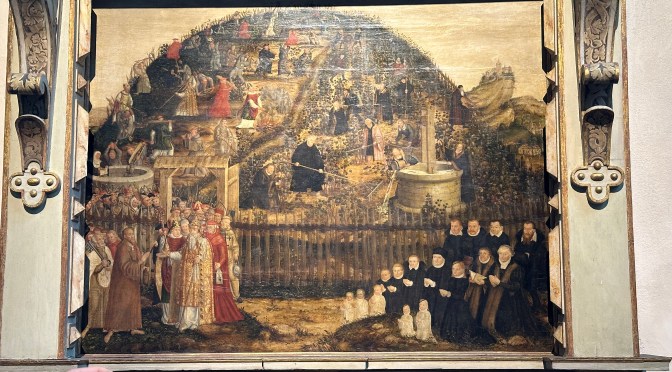
Photo: “The Vineyard of the Lord” from St. Mary’s Church in Wittenberg

The Apocalypse of John the Baptizer’s Community

You may have noticed that for a few weeks now, the titles of my weekly reflections have had mention of Apocalypse in them. You may be thinking that I am starting to sound like one of those Hellfire and Brimstone types. Maybe that is true. However, unlike in the movies, Apocalypse biblically carries a different definition than just the end of the world. Apocalypse comes from the Greek meaning ‘uncovering’ or ‘revealing.’ Apocalyptic literature speaks to the revealing of God’s plan or designs for the world or God’s intention to make right. This lands at the heart of created existence, where this ‘making right’ is contested or in a state of conflict. The Apocalypse or revealing is where God’s Kingdom coming to make the world righteous is in conflict with the powers of sin, death and the devil – forces that we experience in this world that are in opposition to God’s great love for us. 

Phew…

With that understanding of Apocalypse, we pick up with John the Baptist. Who is speaking to the crowds who have come out into the wilderness to hear him and be baptized for repentance and the forgiveness of sins. This follows with the long history of Israel seeking out prophets sent by God in times of crisis and seeking to repent of the ways in which God’s people have turned away from God. John is standing in a role they know and can identify from the Scriptures, and they are seeking to repent just as good people of faith should. 

Yet, they don’t quite get there. John isn’t just preaching repentance like the prophets of old. He is also preaching the coming of another, a Messiah. 

The crowd responds peculiarly. They ask John, “What then should we do?”

They ask this three times: “What should we do?”

In a time of crisis, when the world feels like everything is falling down around them, when the powers are threatening to crush them, when the future feels terribly uncertain, they want to know what they can do. Each of John’s answers is unsatisfying. 

Sounds familiar doesn’t it?

In a time of great uncovering and revealing the deep and uncomfortable truths at the heart of our existence, the apocalyptic conflict between God’s making right and the powers of sin, death and the devil that we can feel palpable in our world… the answers to our wonderings of, “what should we do?” have proven equally unsatisfying.

Maybe that is the point. It seems to be John’s point. Maybe what we need to do isn’t the chief issue. In this moment of Apocalypse, what we do just might be secondary to our salvation. The uncovering of what is really happening to us as God’s people is still in process, still being made known to us. But as we turn to the second half of Advent, I am sure it has something to do with the One we are waiting for, the One who is coming. 

The Messiah is on the way. 

Waiting for the Apocalyptic Kingdom

We have arrived at Christ the King Sunday. This is the end of the liturgical year, which means we have made our way through the stories of Jesus’ birth, journey to Jerusalem, death and resurrection as told by the season of Advent through Easter. We have also made it through Jesus’ teaching and ministry as told by the Gospel of Mark. 

Altogether, these two parts of the liturgical year serve to create a narrative that takes us through the story of Jesus each year. 

There is another piece to this journey, however. This liturgical move is more than one that moves us from one year to the next. The move we make in our calendars and in our Sunday worship shows us a glimpse of the much larger scale movement that is happening all around us. 

Christ the King Sunday, or perhaps more accurately, the Reign of Christ Sunday, lifts the Apocalyptic veil on our world. No, not an apocalypse like the movies imagine with zombies, nuclear war, environmental catastrophe, or exorcist priests fighting demons.

Rather, the Apocalypse as the Biblical Narrative imagines it, the one that we have had in the background in this year of reading Mark, and perhaps in the background of pandemics, wars in Ukraine and Gaza, the election of populist leaders that are tracking to fascism. Apocalypse hardly seems like the thing of movies and novels these days, it is out there in the world. 

The Apocalypse that the Bible imagines is one that is rooted in the conflict between the Kingdom of God and the Kingdom of Sin, Death and the Devil. On Christ the King Sunday we are equally concerned with the fact that the Kingdom of God has entered the battle plains of this world with the intention of striving against those forces that would defy the One who holds all creation and us within God as we are with Christ’s Kingship. 

This is the work of God’s Kingdom in the world, to push back against all those forces that cause suffering and death, the forces of systematic sin and evil that cause oppression and enslave us.

But God’s Kingdom’s work is not the one of military might or political and economic power.  Rather, it is accomplished on the cross, in the one who takes our sin and death to the grave while exchanging with us the gifts of forgiveness, righteousness and life. The Kingdom’s work is to meet the powers of this world with the reconciling mercy of God, with true Kingdom power that can transform this world for the better. 

On the Christ the King Sunday, we prepare for the Apocalypse of Biblical proportions to come – for it to flip us over into the Advent of God’s new world, where we will be new creations. 

Giving thanks over the years – Pastor Thoughts

I don’t think I could have ever imagined feeling this way, but I could have used a little more September this year. Between the program year ramping up, my foolishness in agreeing to a few too many things, the kid’s school year and activities starting and my coursework ramping up, it has felt like a busy few weeks. Thanksgiving should not be here this soon; I thought there was more time! 

When I was a kid, Thanksgiving felt like it was deep into the school year. Summer was already a distant memory, while Halloween was still three weeks away! Now, all that feels like it passes in the blink of an eye. 

Thanksgiving, like all holidays or holy days, comes at us differently at different times in our lives. When I was young, Thanksgiving weekend often felt like a great long break to eat lots of turkey and have an extra glorious day off from school before the snow arrived. For those with grandkids and large extended families, these important holiday events feel like touchstones yet provide fleeting opportunities to spend time with loved ones, chances to make memories, and opportunities to invest in what matters. For those of us in middle age, millennials are now middle-aged! – these holidays feel frantic managing kids, work schedules, social calendars, volunteer responsibilities and extended family obligations. Of course, there are those for whom Thanksgiving may be lonely or difficult and might be grief-filled with a notable spot at the table now empty. 

Ever since seminary, when in the course of learning theology, biblical studies, biblical Greek, and liturgy, we were taught that the word Eucharist means ‘thanksgiving,’ my brain always conflates the Great Thanksgiving that is a part of each worship service with communion and the holiday of Thanksgiving. I have started to see Thanksgiving weekend in Eucharistic terms – imagining this weekend around the second Monday in October as a time when Canadians practice Eucharist in our homes with family, friends and community. Thanksgiving tables aren’t necessarily the same as the Lord’s table that we gather around in worship. They are not public tables of welcome where we encounter the true presence of Christ as the Lord’s table is. But they are gatherings with a Eucharistic quality where often a motley collection of people gather together to share a meal and wind up somehow bound together into a new community in the process. The yearly gatherings are small reminders of the kind of community that we joined each Sunday around the Lord’s supper. 

So pay attention to who you eat with this weekend, know that you are joined to a new community of Eucharist and Thanksgiving. 

Redefining ministry in 2024 – Pastor Thoughts

This week (for Sunday October 6th), the gospel of Mark covers an uncomfortable passage about divorce, where Jesus gives no reason that makes divorce palatable. The passage certainly feels like divine judgment hurled on something pretty common in our world (if you want to know why Jesus’ comments on divorce meant something very different than we may think, see this sermon from 2021). Whatever Jesus might actually be saying about divorce, the bigger question might be about the place of faith and religion in our world. There is the general question about the secularity of our North American culture but also the place and input that our faith has in our lives. 

It is a question that I have been circling for the past month or so. Topics that have to do with faith in society and the church in the world include colonialism, Christian identity, how we talk among ourselves and others about the Church and so on. The question at the heart of my doctoral research is grounded in how we understand the role of Christian ministry in our lives.

On the surface, my research is asking about how people understand the work of clergy and the expectations out there that are placed on clergy. Deeper down, this is about exploring the place of Christian ministry in the world, as the work of clergy is done, along with, and equipping lay folks to be the hands and feet of the Church in the world. This, in turn, means digging into how contemporary Christians understand ministry and our collective work of ministry as the Church. 

Perhaps more simply put, asking people what they think the job of a pastor is has to do with how we understand all of our roles in the work of ministry. 

Answering this question is interconnected with another question facing many churches, including Sherwood Park, these days: What is our place and purpose in the world around us?

Like my research question, discerning our place and purpose in the world is a multifaceted question. There are lots of ways to begin answering it and lots of pieces that impact how we answer. What are we called to do and be as a community of faith in this time and place? Do we have the resources we need to carry out this ministry? Are there possible ministry partners around us with whom we can do more together than alone? What would happen if we didn’t carry out this ministry here? What would be lost? How can we change to faithfully entrust the legacy of our ministry to the next generation and into the future?

These questions take time to sort out. To answer them well as congregations requires us to put on the hats of researchers exploring all avenues of wondering, not knowing what answers might be out there. It isn’t easy to ask these questions because we aren’t used to the circumstances that we are in. Even if the Church has taken a few decades to slide into this situation, it feels new and uncertain and nothing like the version of being church that we know. All the things that we are talking about these days are not the things that pastors and church folks talked about in the past… at least that is not what I remember. 

But on the longer time scale of the history of Christianity, questions about our place and purpose in the world are not new. The Apostle Paul addresses these questions frequently in his letters. The early Church had to deal with similar questions as it navigated living in the Roman Empire. The Reformers had to reinterpret the Church’s place in the world during the Reformation. Today, we are being called into another moment to ask this question – What is our place and purpose in the world?

Photo: The modern chancel set into St. Mary Cathedral in Erfurt, Germany founded in 724 CE.