Tag Archives: Church

Practicing faith over our days, weeks, seasons and years – Pastor Thoughts

This week I am bending the rules of worship and preaching ever so slightly. I am switching the gospel lesson that we normally hear on the 2nd Sunday of Easter for a different story. Instead of the story of Thomas, we will hear the Road to Emmaus – the gospel appointed for Easter Sunday Evening and the story that comes immediately after the resurrection gospel from Luke that we heard last Sunday.

I am sure you are thinking to yourself that Pastor Erik is quite the liturgical rebel… that is if you haven’t fallen asleep reading already.

Pastors often gravitate towards particular areas of ministry more than others. Some are excellent counsellors and caregivers. Others have the gift of the gab and work a room like a politician. Others are great organizers and administrators. Still others are great with seniors or youth or families or 12 step groups or other kinds of program ministry or small groups.

One of my retired predecessors revealed one of his gifts after I asked him to preach at the 60th anniversary of the congregation I was serving at the time. For the first 5 minutes of the sermon he had the congregation in stitches – clearly one of his gifts was stand-up comedy!

Anyway, I am sure you have surmised by that worship/liturgy and preaching are a couple of the areas of pastoral ministry I am quite passionate about.

When I first arrived at Sherwood Park, a change that I made right off the bat was to switch us from the Narrative Lectionary (NL) back to the Revised Common Lectionary (RCL). The Lectionary is the schedule of appointed readings that we hear in church each Sunday.

The RCL includes the First Reading from the stories of God’s people, a Psalm from the hymnbook of Israel, the Second Reading from the letters of encouragement and exhortation of the early church and a Gospel reading from the stories of Jesus’ life and ministry.

The NL was created as a response to a sense that the RCL included too many readings and that people in the pews were unfamiliar with the bible, and so the NL is usually based on one longer reading and makes it way through different books of the bible chronologically to encourage Biblical literacy.

While there is lots to debate regarding the merits of either lectionary, the RCL is designed to fit and serve the liturgical calendar whereas the NL is more suited to bible study. So if your worship is crafted around the liturgical or church year, then the RCL will serve worship better. But if worship is more about teaching and educating folks in the faith, the NL is a good alternative.

Again, you can probably see where my sensibilities lie.

Worship and therefore preaching are meant to help us walk through the story of Jesus’ life and ministry that we tell throughout the church year. Beginning in Advent and until Pentecost we hear the story of Jesus’ life. And then after Pentecost until Christ the King Sunday we hear about Jesus’ teaching and ministry.

So going all the way back to where I started… it might not seem like a big deal to change the gospel reading on a particular Sunday, but for me it is. While the RCL is technically only about 40 years old, it is based on the lectionaries and traditions of Christian worship that go back almost 2000 years (and even beyond into the Jewish tradition). The church year and stories appointed to Sundays and Feast Days have been used by Christians throughout the centuries to help tell and re-tell the content of our faith. In particular to pass on the faith to the next generation.

As we hear these stories year after year, and start to learn them by heart, like:

In those days a decree went out from Emperor Caesar Augustus…

This my Son My Beloved…

Jesus was led in the wilderness by the Spirit…”

There they crucified him, and with him two others..”

Early on the first day of the week

We can start to bring these stories home, we can start telling them not just at church but in our family gatherings and holiday (Holy-Day) traditions. The biblical stories that accompany our days and years graft themselves into our lives this way, even if we don’t know exactly where to find them in the bible (Pastors and google can always help with that).

It isn’t an accident that the Gospel lesson I am borrowing from Easter Evening is the Road to Emmaus. Emmaus is a microcosm of our life of faith.

The disciples meet Jesus on the road, he opens their hearts and minds to the word, Jesus is revealed in the breaking of the bread and then he sends them out with a story to tell the world. Gathering-Word-Meal-Sending.

The way we worship, the way we observe our days, weeks, seasons and years, and the stories we tell along the way all serve to help faith grow in us. And as these things begin to take root in us they become central in our lives. The stories of faith help us understand ourselves and God’s purposes for this world. They connect us to all the faithful who have gone before us, all the faithful on the journey with us and to those who will follow after us.

And like those disciples on road, we are not left to sort it all out on our own, rather God meets us again and again in Gathering-Word-Meal-Sending. Week after week, season after season, year after year. And God brings us into God’s story; one told by peoples and communities from time immemorial and around the globe.

A story given to us on the road and journey of faith.

Who Gets to Tell the Easter Story?

Luke 24:1-12
On the first day of the week, at early dawn, the women who had come with Jesus from Galilee came to the tomb, taking the spices that they had prepared. They found the stone rolled away from the tomb, but when they went in, they did not find the body. While they were perplexed about this, suddenly two men in dazzling clothes stood beside them. The women were terrified and bowed their faces to the ground, but the men said to them, “Why do you look for the living among the dead? He is not here, but has risen. Remember how he told you, while he was still in Galilee, that the Son of Man must be handed over to sinners, and be crucified, and on the third day rise again.” Then they remembered his words, and returning from the tomb, they told all this to the eleven and to all the rest. Now it was Mary Magdalene, Joanna, Mary the mother of James, and the other women with them who told this to the apostles. But these words seemed to them an idle tale, and they did not believe them. But Peter got up and ran to the tomb; stooping and looking in, he saw the linen cloths by themselves; then he went home, amazed at what had happened.

We have arrived. Through this long season of Lent, through the challenges of Holy Week. We have arrived at the day of the resurrection, the empty tomb and promise of a new creation. 

And yet there is some discomfort. This isn’t like Advent that builds to the birth followed by a couple of weeks of holidays over Christmas. Easter morning brings a lot of discomfort. If Maundy Thursday was the funeral lunch, and Good Friday the burial. Today is the moment of wondering, “Okay, now what?”

But it is more than just not knowing what comes next. It is more than sorting through all that has taken place. It is wondering about how this story will be told? Who will tell it? Who gets to tell it?

We can see already, that the question of who gets to tell the Easter story was there on the first morning. The disciples didn’t believe the first reports, they had to verify. 

And some 2000 Easters later, the question remain. Who will this Easter story? Who gets to tell it? Who should tell it? Questions that add some unexpected discomfort to our Easter experience. In a world of Pandemic, Protests, Inequality, Racism and Colonialism, War, Violence and death… who tells this Easter story is still a question we have NOT truly answered. 

Being uncomfortable with this story and who gets to preach it is not something new. In fact, Luke tells us that discomfort with the resurrection story and the ones telling it is as old as the story itself. 

Three women have gone to the tomb early Sunday morning. It was only on Friday, three days ago that they watched Jesus die on the cross. And because of the sabbath (Saturday), his body hadn’t been properly prepared for burial. They were on their way to do this last thing, one final act of love for Jesus. 

But they arrive at the tomb, and the stone is rolled away. Jesus’ body is gone. Luke says the women were perplexed, but that hardly seems to describe what these women were probably feeling. 

And then a couple of guys in dazzling white clothes show up and tell these “perplexed” women that Jesus has been raised from the dead. 

This isn’t an “Aha” moment. This is more of a “Holy (you fill in the blank)” moment. 

And in that “holy” moment the women are snapped from their grief, their perplexity, their terror and are reminded of what Jesus had been telling them the whole time. 

And they go racing back to tell the other disciples. 

And it is at this point that Luke really starts to get interesting. 

The women go back to tell their news to the “male” disciples. But the men think it is nonsense. Now what the english translation says is that the men think it is an “idle tale.” You know, the kind of inane chit chat of no importance that men think they can just tune out because it’s the womenfolk talking. But that is not what the greek says. The greek says the men hear the story as nonsense or crazy or nuts. The kind of story you hear someone tell and you respond by saying, “No way, that’s not possible, that didn’t happen.”

And then the english translation says the men didn’t believe the women, as if the men actually took the time to consider the content of their story. But the greek says the men didn’t trust the women. The story wasn’t believable because of who was telling it. The men didn’t bother listening to the story right from the beginning.

And then there is the last bit about Peter. Peter runs off to check the tomb for himself. Why would he do that if he didn’t trust the women enough to listen to their idle chit chat in the first place? Well, in most bibles there is a little footnote that comes at the end of this verse about Peter’s “checking on things” at the tomb.

The footnote that explains that verse 12 (this whole bit about Peter verifying what the women had reported) is not included in other ancient manuscripts. Or in other words, the verse is likely an addition to the story. 

So here we have this story of the resurrection that is hard enough to make sense of on its own but the real problem with this story seems to be not with the story itself, but with the people who have been chosen to tell it. The disciples think the women’s story is nonsense because they are untrustworthy women. Recent English translators, who still have a problem with the fact that women are the first ones to tell the story, try to turn the nonsensical report into an idle tale – something not even worth being listened to at all by the men. 

And to top it off, the early christian community added this bit about Peter verifying what the women reported so that somebody credible would be the one telling the story of the resurrection. Because Mary Magdalene, Joanna, and Jesus’ own mother Mary weren’t credible witnesses on their own because they were women.

Oh, how things haven’t changed.

As hard as it is to makes sense of somebody being raised from the dead, our real problem is still with who gets to tell the story. 

Christians have spent a lot of time and energy in the past 2000 years telling people who can and who cannot tell the story of Jesus. And it’s not just women. Christians at various times have told people of colour, LGBT people, poor people, uneducated people, and even lay people that they are not among God’s chosen story tellers. 

For some reason our issue has been less with the content of the resurrection story itself than the character of the ones chosen to tell it. 

Because it is hard to believe that of all the people to find the empty tomb, God sends the very people who were considered untrustworthy and unreliable as witnesses. 

How would this story have been different if the disciples simply trusted the women?

When the women arrive at the tomb, early on that Sunday morning they were expecting to find the body of Jesus. Mary’s son, Mary Magdalene’s and Joanna’s friend and teacher. They expected to be anointing a body with spices and oils. They were expecting to finish the Jesus story for good, one last goodbye to the one they loved. 

They most certainly did not expect that all that crazy talk that Jesus had been going on about for 3 years to be true. Betrayal, trial, crucifixion… and now resurrection. They did not expect to find the living among the dead, they did not expect that Jesus had been raised. 

They didn’t yet understand just what Jesus’ death and resurrection had accomplished. They did not know yet that the Risen Christ overturns and undoes the established orders of the world. The first order of which is the established order of death. The Risen Christ upends the order of death and replaces it with a new order, a new system, a new way – Resurrection and New Life. 

But Jesus doesn’t stop there. The Risen Christ also overturns the established order of power and privilege. It cannot be understated just how significant it is that the first witnesses (and therefore preachers) of the resurrection are those without power, those on the margins, those whose testimony is discounted before it is even given because they cannot be considered “trustworthy” by decent and proper folks.

When these women are met with news of the resurrection, they would not have expected that of all the disciples that they would be the ones called upon to deliver this news – Jesus has risen. They weren’t the leaders, the gifted ones, the talented ones, the respected ones. They weren’t even considered trustworthy by the disciples who knew them well. They were just women. They were forgotten, unimportant, unworthy. They were not the kind of people anybody would expect to be called upon to carry out such an important task. They were the wrong people. 

But for the Risen Christ, they were the right people. Because the God of New Life has turned the world upside down. Death is now Life. The Powerful are now the powerless. The weak and lowly are lifted up. And the wrong people to deliver this news, the wrong people like those women… for God, they are exactly the right people. 

The Risen Christ completely changes our world and our reality, Christ’s death and resurrection turns everything and everyone upside down. All the old orders, all the ways in which we told others and in which we were told we aren’t good enough – those orders, those ways are ended. And the Risen Christ says the good news of new life is for not just for the right people, not just for the wrong people. The Good News is for all. Resurrection and New Life is for us. 

And maybe that is crazy nonsense in a world like ours. 

But it is not crazy nonsense for God. 

Easter Expectations vs Easter Reality – Pastor Thoughts

Unbelievably, this is our 3rd pandemic Easter. Remember back in 2020 at the beginning of all of this when we thought that we might celebrate Easter together but just a few weeks late?

Now we have done a whole lectionary cycle of Matthew, Mark and Luke, all shedding new light on this world we are living in. And I will be honest, there is no small measure of disappointment that I am carrying this year. Not in anything in particular, but more generally a sense of loss at how much of a struggle and slog it is to navigate something that should be a grand celebration.

As a pastor, I have learned to temper my expectations about many things. I have learned that every congregation I serve has its own little quirks and idiosyncrasies that I just need to accept. I have learned that making changes to Christmas traditions, like when we sing Silent Night on Christmas Eve, may as well come with my resignation letter. I know that pulling that beloved picture of Jesus off the wall of the church basement might result in a special congregational meeting.

But I have also learned that there are other places where there are all kinds of freedom to shape and create as I see fit: Holy Week and Easter being one of them. The breadth of traditions from between Palm Sunday, Maundy Thursday, Good Friday and Easter Sunday often carry with them the sense that these things ought to be done in the ways that Christians have been doing them for centuries. Sure there are particular traditions here and there, but often congregations have been very open to Holy Week and Easter ideas.

For example:

On Palm Sunday there is a palm procession, even though it is a bit awkward. And if we can awkwardly do that with a neighbouring congregation, even better!

Maundy Thursday it is often an opportunity to gather around the table and delve into the richness of the Lord’s supper…  and maybe even try foot washing!

On Good Friday there is often a procession the cross, long expansive prayers, long solemn psalm chants or the solemn reproaches and sometimes even the chance to reverence the cross. 

And for the really adventurous, Holy Saturday might include the Easter Vigil with its gathering around the New Fire, its 12 readings and 12 psalms and then a whole communion service to conclude!

And of course on Easter Sunday people have gathered early for Sunrise services, cooked Easter breakfast, shouted “alleluia” on command, dance in the aisles  and more.

And the thing about many of these traditions (unlike Silent Night which was written because one congregation’s organ broke on Christmas Eve and so the organist wrote a carol for guitar) is that they are rooted in scripture or in the ancient practices of the early church.

Which brings me back to my disappointment. I wish the past 3 Holy Weeks and Easters were more about all that other stuff I listed above than about pandemic and snow storms. I wish our biggest concern had been about how to gather and tell the Passion and Resurrection stories again and anew in our community… and not whether it was even safe to gather in-person.

And then I hear the Easter gospel anew.

Particularly Luke’s Easter story. One of my personal heresies about Luke is that I think the writer of the gospel was actually a woman.  Luke has a particular insight into those who occupied the bottom of social ranks, those who lived on the margins. The way Luke tells the story of Mary (rather than Matthew who tells Joseph’s story) as she receives the news that she will bear God’s child. Rather than Matthew’s spiritualized beatitudes, Luke’s beatitudes focus on physical needs: Blessed are the poor, the hungry, the thirsty. Luke tells the story of the Prodigal Son (Loving Father) and the Good Samaritan.

And Luke’s resurrection story is messy and chaotic. Matthew has Jesus meet the women. Mark has the women run away in fear. John has Jesus meet Matthew and then Thomas and then the disciples several times.

But the women only see the empty tomb and then rush back to the disciples only to be disbelieved.

It makes sense. All along the way, Luke tells the stories of people who are struggling, who don’t have it together, who make mistakes, who are victims of life, who are often overlooked by the powerful.

And Luke’s Easter is no different. It is messy and real and still connected to the real problems of our world. Just as Jesus has been throughout.

And maybe that is the reminder that we need, that I need. An Easter where our only concern is how nice we can make our Holy Week experience is a blessing. But Easter that comes to us with all the messy and hard parts of life, with all the struggles and failures and suffering that are a part of things right now… Well that is how the first Easter was. And why we need Easter in the first place.

So despite all the things Holy Week and Easter won’t be this year, and all the things I wish it could be….

Easter and the Risen Christ will be all that we need.

Good Friday is neither special nor unique

John 18:1-19:42

Good Friday is neither special nor unique.

What happens on Good Friday is no different than what happens others days. 

One falsely convicted man killed by a merciless and cruel government is barely even news-worthy in our world. 

Jesus was no unarmed black man killed by the cops, causing marches in the streets, social media hashtags and widespread shows of support. Jesus’ followers hid away after his death. 

Jesus was no Ukrainian family shelled in from of new cameras by careless or cruel Russian military. Only a few devoted followers wept for Jesus. The whole world weeps for Ukraine and the atrocities committed there. 

Jesus was no missing and murdered indigenous woman, no victim of residential schools. His beating, his death did not spark an inquiry. His unmarked grave did not spark an apology from the Pope himself.

There were no news reports for the crucifixion. There were no hashtags like #PrayforJesus. There were no flags to put on profile pictures, no pundits or reporters or commentators who talked and talked and talked. 

Good Friday is not special. It is just another day for us. 

Good Friday is everyday in our world. 

Just in the past year we have come up with so many new names for Good Friday, so many new names for the violence and death that we simply cannot end:

Kyiv, Bucha, Kharkiv, Mariupol. Shanghai, Tel Aviv, Sacramento, Kabul. Ukraine, Yemen, Sudan, Pakistan, Sri Lanka, Afghanistan.

Putin, the Kremlin, Zelenskyy, COVID-19, Variants, Omicron. Convoys, protests, truckers. Inflation, housing, poverty. January 6th, Capitol Riot, Insurrection. Residential schools, reconciliation, climate change.

Our list of new Good Friday words is so long we forget what we were listing off in the first place. 

Our list of new Good Friday words is so long that we forget them almost as soon as we create them. 

Our list of new Good Friday words makes us numb. 
Our list makes violence and death feel normal. 

The first Good Friday was not special. One man died on a cross. 

One man who angered those in power, so they go rid of him. 
One man who didn’t give the chanting crowds their King, so they started shouting crucify. 
One man whose own followers betrayed and abandoned him in his worst hour.

Jesus died like the rest of us, 
Jesus suffered violence and cruelty and hate like the rest of us,
Jesus was just another person to suffer an unjust and merciless death, 

The cross of Good Friday was not special.

Except that not being special is what makes Good Friday special.
We didn’t think that God would be on that cross. 
We didn’t think that God would die at our hands. 

The cross of Good Friday was not special, the violence of the death was not special, the ones who condemned were not special. 

The one who died was. 
The one who died changed everything. 
The one who died was God.

Today, God has died. On Good Friday God has died. 

And all those other words for Good Friday, for death and violence in our world. Those words from that list so long we forget. Those words lose their power. All those days of death and violence and suffering that seem to come at us unrelentingly from the news, from around the world, from our backyards.

All those Good Fridays that seem to happen far too often. 

They lose their power. 

Because the God who died, died with us. 
Because the God who died, lived with us. 
Because the God who died, loved with us.

God died on Good Friday.

But death did not destroy God. 
And God is not forgotten.
And God is not finished. 

Good Friday and all our other words for violence and death are not bigger than God is. 
On Good Friday, God who is bigger than death showed us something new. 
On Good Friday God gave us truly new words. Words that change the world.

Words likes:

Mercy
Forgiveness
Compassion 
Grace
Love

New words that God uses to change us. 

On Good Friday God dies with us.

But what is ended,
What is finished,
What is over is,
the power of death.

On Good Friday death is ended. 
On Good Friday death is no more
On Good Friday death will never have the final word.

Today, on Good Friday, God has a new word. 

One word that changes everything.  

Life. 

__________________________________

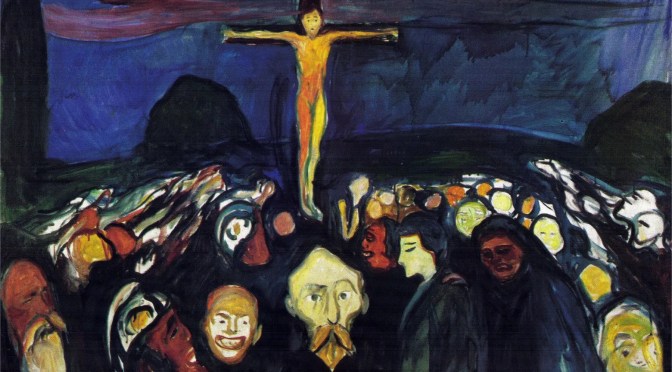
Artwork –  Golgotha by Edvard Munch, 1900.

Maundy Thursday: The Last Supper and Funeral Lunches – Moving to the New Order of Things

GOSPEL: John 13:1-17, 31b-35
Now before the festival of the Passover, Jesus knew that his hour had come to depart from this world and go to the Father. Having loved his own who were in the world, he loved them to the end. 2The devil had already put it into the heart of Judas son of Simon Iscariot to betray him. And during supper 3Jesus, knowing that the Father had given all things into his hands, and that he had come from God and was going to God, 4got up from the table, took off his outer robe, and tied a towel around himself. 5Then he poured water into a basin and began to wash the disciples’ feet and to wipe them with the towel that was tied around him. 6He came to Simon Peter, who said to him, “Lord, are you going to wash my feet?” 7Jesus answered, “You do not know now what I am doing, but later you will understand.” 8Peter said to him, “You will never wash my feet.” Jesus answered, “Unless I wash you, you have no share with me.” 9Simon Peter said to him, “Lord, not my feet only but also my hands and my head!” 10Jesus said to him, “One who has bathed does not need to wash, except for the feet, but is entirely clean….”

Each year we arrive at this night having made the journey through Lent. With Jesus we have come through the Wilderness to the gates of Jerusalem on Palm Sunday. Sometimes it has been long a difficult journey, sometimes it has been a chance to step out of the business of life and reflect, other years it has been race through the season to Holy Week. 

This year we have been pulled and dragged through the dust and dirt of Lent, maybe just holding on day to day, week to week. The world around us has not made Lent easy, or perhaps rather, the reality of all the struggles that our world faces, that we face have been laid bare before us this year. Pandemic, war, inequality, violence, suffering, colonialism, poverty, violence and death. 

And having come through all that, and still being in the middle of all of that, we arrive on this first night of the Great Three Days of the church. The days in which we reserve time to carefully and painstakingly retell the story of Christ’s Passover from death to life. 

Tonight we arrive at the dinner table of the disciples to watch Jesus and friends through the Last Supper. It is a small and intimate story, one that take places at the family table, in conversations between friends, over the span of just a few moments. And yet each part is worthy of being the focus of a sermon: The dialogue between Jesus and Peter, the teachings on servants and masters, the new commandment given to the disciples. 

And yet there is something about the whole scene which catches our attention. The movement that brought us from Palm Sunday to his feast of unleavened bread reminds us that there is something big coming. One does just ride into Jerusalem being hailed as a king and conqueror only to be forgotten and left to eat a quiet passover with friends. 

As the scene opens, we are reminded that Jesus knows what is coming shortly for him, he knows that Thursday will lead to Good Friday. As he washes feet he is taking the time for a final moment of intimacy with his disciples. And Peter’s argument with Jesus isn’t really about whether Jesus can wash his feet or not. Whether Peter knows it, he is stalling. He is trying to avoid the big thing that is coming next. Peter isn’t even the first disciple to do this. While it was all the way back on the 5th Sunday in Lent that we witnessed Mary washing Jesus’ feet with perfume while Judas objected, it is a story that only comes a few paragraphs before in the Gospel of John. 

The connection between the images couldn’t be clearer and the discomfort of Jesus’ disciples with what Jesus is up to couldn’t be either. 

Peter is holding onto the old ways and the old order. Servants washed feet, but priests washed the whole body to make one ritually clean. But Jesus isn’t concerned with ritual purity like Pharisees, Scribes and Temple Priests were, he was more interested in a new order for the world. And Peter knows that this new order will only lead Jesus into confrontation with the people in charge of the old world. And so he is trying to avoid it, trying to turn Jesus back from the brink of chaos and destruction… but he can’t. 

So they continue on towards the inevitable. 

Then as Jesus speaks to the disciples at the table, it might sound like he is passing on instructions to all future disciples on how to be faithful. But that isn’t really he intention. Rather, he is speaking to his worried friends, knowing that he will soon leave them. Knowing that soon all they will have is each other. Knowing that all that early church community – in which these gospels took shape – would have is each other. 

There is familiarity to the pattern and movement of this scene. We follow a similar ritual of movement today when we gather for a funeral lunch. Unlike just any meal, it is one that arrives from moment of procession and worship, from a time of formal lament and prayers for salvation.

And then when we come to meal, we know it isn’t about the food as much as it is about the community. The greetings and condolences, the company and the words that we share all serve to carry us to the next thing, to the big thing that comes next. As we move through the meal, we know that the burial is still come, followed by a life changed forever. A world with a new order to it. 

And so we know what Peter and the other disciples are feeling on this night, because it is a journey we have taken ourselves. A journey that carries us to the coming grave, to a new world.    The love that we give and receive in community, the hugs and knowing looks, the greetings and care we give to those who are grieving most, the words we share and stories we tell, the community we choose and keep are all the things that buoy us for what is coming, for the grave and the unknown world that comes after. 

Yet, there is one who does know what is coming. The One who washes his disciples feet, the One who bids his disciples to share in bread and wine in remembrance of him, the One who gives a new commandment and order to the world rooted in Love rather than self-righteousness… this One, this Christ leaves his disciples not with instructions on how to live but with a community shaped and formed in his image. 

Jesus is on the way to the Garden of Gethsemane, to betrayal, trail, crucifixion and death. 

But the Body of Christ born in this moment, born at this meal, given to this world is the new order of things. And is the same new order promised and given to us. 

While we know that this meal will lead us into the unknown, into the big thing that coming, to the cross and drama of Good Friday… 

While we know that every funeral lunch sets us towards uncovering a difficult world without a loved one, with an impossible to fill hole in our lives, with another reminder that we too are mortals and one day that funeral and that grave will be ours…

Jesus leaves us with the washed feet, that bread and wine, the new commandment that is found in the Body of Christ. Jesus leaves us with the promise proclaimed by the Body of Christ each time we gather. Jesus is leaving us only to find us again in the new life that comes after Good Friday, in the resurrection that is on the other side of the big thing that is coming, in the grace and mercy of God that will not leave this world to death and the grave. 

And so on this first night of the Triduum – the Great Three Days – we begin with the disciples at the table. We begin knowing that we are being carried from this moment to what comes next, to confrontation between Jesus and sin and death. 

But Jesus begins with us. Jesus begins by washing our feet, by welcoming us to the table, by giving us the care and support and love that we need for what is to come. 

And by reminding us that we now belong to one another and to the Body of Christ.