Tag Archives: chruch

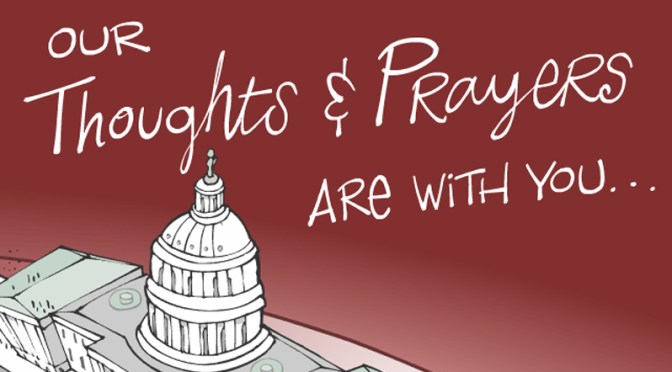
Why ‘Thoughts and Prayers’ Don’t seem to Work

Luke 11:1-13

Jesus was praying in a certain place, and after he had finished, one of his disciples said to him, “Lord, teach us to pray, as John taught his disciples.”(read the whole passage)

Sermon

For every prayer that is offered around the world today, there must be an equal amount of opinions and ideas, rules of thumb and conventions, that tell us how prayer works. Ask, seek, knock. Ask and keep asking. Seek and keep seeking. Knock and keep knocking. Pray boldly and you will receive. You need more faith to pray. You need to pray more. You need to pray for God’s will. You didn’t pray enough and you were punished with illness, suffering or death. Prayer brings us closer to God. Prayer doesn’t do anything. Prayer is for us, so that we know our needs. God hears the prayers of holy people more, especially pastors. God hears all prayers. God only gives us what we need. God will give you what you ask for. There are three answers to pray, yes, no and maybe later. Prayer is like meditation. God speaks to us in prayer. You have to pray from the heart, you need to pray with words that have been prayed by the faithful for centuries.

Lost and confused yet?

Prayer is a key aspect of Christian life. We pray together each Sunday, we pray alone.  We pray for many things here: for rain and sunshine. For Justice and peace. For those who are ill, who are grieving and in distress.

And still prayer can be a very frustrating aspect of Christian life. We want to know the hows, and the whens and the whys. Prayer carries with such expectation that it has the power to make things happen, and yet… we have prayed for and with those for whom prayers have not been answered. We have all had prayers that are not answered. And it begs us to wonder what use is prayer, and perhaps more painfully, why God does not hear us.

The disciples ask Jesus how to pray. And he gives them a mouthful.

Father, hallowed be your name.

Your kingdom come.

Give us each day our daily bread.

And forgive us our sins,

for we ourselves forgive everyone indebted to us.

And do not bring us to the time of trial.”

It sounds familiar, but not quite. Of course it’s the Lord’s prayer, but not quite the one we remember. There is no earthly will of God mentioned in Luke’s version, but it is an earthy prayer that gives us a foundation. The Lord’s Prayer has grounded Christians for 2000 years. Daily bread, forgiveness of sins and salvation from trial and temptation.

This prayer is so engrained in us that we pray it without needing to think… like breathing. It becomes part of the most basic aspects of our living. Its a prayer that goes with us through life from beginning to end. A prayer prayed at baptisms and prayed at funerals.

Yet, the disciples surely were not hoping for a prayer like this. They maybe wanted one of the cool ones like Jesus would pray. When Jesus would look to heaven and bread and fish would multiply, or dead children would be raised, or demons would scatter, or the sick, blind and lame would be healed, or when a man who had been a corpse for four days would rise up from a sealed tomb. The disciples, 70 of them, had been just sent out and had been healing and casting out demons in Jesus name. Yet, like us, they probably wanted to control such power, not for it just to happen without really knowing why. They want to know the trick, the formula to prayer.

We want prayer to be the same as rubbing a magic lantern. We hope that prayer can gives us wealth and happiness. We hope that it will save us from harm and heal everyone who is sick. Or at the very least, we all wish that prayer and its effects would be something we can measure simply and easily. But it isn’t… Jesus doesn’t do simple and easy.

With yet more shootings in Baton Rouge, Miami and Munich this week, we have heard politicians and other leaders stand up and offer ‘Thoughts and Prayers’ for victims and families. It is starting to feel like an empty phrase. Every time there is yet another horrendous act of violence, thoughts and prayers abound, but nothing seems to change. It makes us wonder, if all this praying is doing anything at all. It makes us wonder if there is a point to praying at all.

When the disciples ask Jesus how to pray, it may seem like they are looking for some angle on power, on the ability to get stuff from God. They might be looking for what so many TV prosperity gospel preachers are offering.

But they might also be more like us and how we feel about prayer. They might be asking Jesus how to pray, because for them, prayer feels empty and powerless.

And so Jesus offers them a place to start, a beginning. Jesus give the disciples instructions on how to achieve great things in prayer, but how to start and begin.

Daily Bread, Forgiveness, Salvation from Trial.

God’s Kingdom come.

Jesus shows them that prayer doesn’t achieve the results but begins the process.

Praying for Daily Bread doesn’t feed all who are hungry.

Praying for Forgiveness doesn’t reconcile all peoples.

Praying for salvation from times of trial, doesn’t alleviate all suffering and pain.

Praying begins those things. Prayer is the starting place.

To put it another away, what would it look like if we didn’t pray the church, the world and those in need.

How many refugees would find new homes if we didn’t pray for displaced persons week after week? None. Yet ELCIC congregations, including ours, have helped to sponsor over 250 refugees just in the past year.

How many congregations would run food banks, serve at soup kitchens or offer meal programs if we didn’t pray for the hungry week after week? None! Yet, churches and people of faith have been the primary feet on the ground for feeding the hungry for years, decades, centuries!

Would we will be able to offer forgiveness if we didn’t pray that God would help us forgive? No we wouldn’t. Yet, as we ask for forgiveness, God shows us how to give forgiveness.

Where would we turn in times of trial, if we didn’t pray that God would save us week after week? We don’t know. Yet, as we pray that God would deliver us, God reminds us that we do not face the trials of our world on our own, but together as the Body of Christ.

Prayer is the beginning. In Prayer God reveals to us all the places where God’s Kingdom comes into world. In prayer, when we pray for daily bread, for forgiveness, for salvation from time of trial, we see that God’s Kingdom is breaking into the world with food for the hungry, with mercy and forgiveness for sinners like us, with salvation for those suffering under the shadow of death.

But even more than that, God gives a way to speak about the needs of the world in prayer. God gives us words in prayer to speak about the hungry, the poor, the suffering, the dying without it sound like a depressing new report. Instead, prayer allows us to see where God is already at work meeting the needs of the world, and God gives us words to express this reality in prayer.

Prayer is a starting place, when we so often treat it like the end point. Prayer helps us to see where God is at work in the world, where God’s Kingdom is coming.  Prayer helps give us the language to talk about the needs of the world without being overwhelmed and depressed like we are watching the news.

And so when we wonder with the disciples about whether prayer has any meaning or purpose, Jesus shows us that prayer is the starting place. The starting place to see God in our world. When another politician or leader or Facebook post offers “Thoughts and prayers” for something and we wonder if that does anything to help… Jesus shows us how to begin in prayer, how to begin with daily bread, with forignvess and salvation from trial.

Jesus shows us that in prayer God’s Kingdom begins to come.

Amen.
The Gospel of Avoiding Triangulation

Luke 10:38-42

But Martha was distracted by her many tasks; so she came to him and asked, “Lord, do you not care that my sister has left me to do all the work by myself? Tell her then to help me.” (Read the whole passage)

As we continue through the summer, we are rolling through the scenes from Jesus’ ministry. Healings, exorcisms, forgiveness, parables and more. Last week Jesus challenged the young lawyer’s views on what it means to be saved and who our neighbours are, by telling the story of the Good Samaritan. The Good Samaritan whom we found out is not someone we are supposed to be, but who God is. The one who comes to find us and rescue us from the ditch.

Today, we take a break from ministry and work. Instead, Jesus goes to dinner. Dinner with his friends, Mary and Martha. These two sisters have have become icons and symbols of hardwork, effort and busyness on the one hand and reflection, attentiveness and faithfulness on the other.

Jesus is waiting for the meal to prepared, something we have all done in the living room of someone else’s house. Presumably Martha is not just cooking for Jesus, but for his disciples, and maybe even Lazarus, Mary and Martha’s brother too. This is probably a big job to get the meal ready. And Mary is sitting at Jesus’ feet, listening to what he has to say. Martha is annoyed that her sister is not helping cook the meal (we will just leave the fact that she isn’t mad at her brother aside). So Martha comes to Jesus and tells him to set her sister straight and send her into the kitchen. And then we get this famous line from Jesus: “Martha, Martha, you are worried and distracted by many things; there is need of only one thing. Mary has chosen the better part, which will not be taken away from her.”

Mary and Martha can become two of the ways we categorize and label each other in the church. This week, church members from congregations across the interlake gathered together in Arborg to talk about ways that we can work together in the midst of declining membership and resources. The leader of the meeting began with a short bible study on Mary and Martha. We were asked to self identify as either one or the other. Martha was understood to the be do-ers of the congregation. The ones ushering, folding bulletins, pounding in loose nails, planting flowers, making coffee, keeping things neat, tidy and clean.

But Mary… well, Mary was a little harder to define. But we assumed Mary was understood to the be the ones interested in faith, in learning, thinking, praying. The ones at bible study, looking for books on spirituality, asking questions about faith.

Once all the hands had been raised, there were a lot more self-identified Marthas than Marys.

I wonder why that is in the church?


There is something universal about these two women aren’t there? It is easy to see ourselves in either or even both. Yet, the way this story is told, there are two opposing approaches to hospitality, to faith, to being in community.

But two things about the story of Mary and Martha has always bothered me. 

The first is that Martha seems to get an unnecessarily bum rap from Jesus. Sure she is frantic and whining when she could take it a bit easier. But Jesus seems to have no sympathy.

The second is that despite Jesus’ emphasis on the value of Mary’s choice to slow down and listen, we tend to value Martha’s work ethic above Mary’s desire to learn and grow.

And I will confess, for a long time, I didn’t know what to do with this story… particularly, Jesus’ apparent scolding of Martha.

But then just a few weeks ago, I read something that put this story in a new light.

Jesus’ issue with Martha is not her work ethic or busyness. While he does say that Mary’s desire to learn and grow in faith is good and important and something to value. Jesus is setting a boundary with Martha. A boundary about being drawn into her conflict with her sister. When Jesus’s pushes back against Martha’s request, is not because he is judging her choice of activity. Jesus is refusing to be drawn into a conflict between two others. If Martha has a problem with her sister Mary, she should take it to Mary directly. Jesus is refusing to be triangulated. 

Usually, the good news sounds like Jesus healing, forgiving, exorcizing demons, raising to life, rescuing us from the ditch of sin and death. Yet, while it may sound odd, Jesus setting a boundary is good news too. Jesus refusing to be triangulated is good news too.

When Jesus sets a boundary refusing to be drawn into our drama, it means that God is free from the burdens our of conflict, the burdens of our sins, the burdens of our suffering. God is free to let go and forgive. God can act to take hold of us and care for us. God can respond in a way that we need, rather than the one we want.

When Jesus refuses to be triangulated, it means that God will not be distant from us, that God makes no obstacles for our salvation, that God does not operate through intermediaries. Rather God deals directly with us. God does not talk about our salvation with someone else, but deals directly with us.

When Jesus refuses to get involved with Martha and Mary’s issue today, Jesus is showing us something much more important about how God deals with us. And that is directly.

God speaks to us directly through God’s word.

God washes us directly in the waters of baptism.

God feeds us directly in the bread and wine of the Lord’s supper.

God saves us directly, not through works or laws or prayers or righteousness.

When God saves us, God just saves us. 

Today, we might wonder if we are Marys or Marthas, we might feel like both.

But there is no question about how Jesus deals with us. Directly.

Amen

The Frustration of Discipleship

Luke 9:51-62

When his disciples James and John saw it, they said, “Lord, do you want us to command fire to come down from heaven and consume them?” But he turned and rebuked them. Then they went on to another village. (Read the Whole passage)

Sermon

Our Lutheran seminary in Saskatoon works in cooperation with an Anglican seminary and a United Church seminary. While I attended, students from the 3 schools started a hockey team to play in the University of Saskatchewan intramural league. One way that the 3 schools worked together was to regularly have shared chapel services, and one particular service there were a number of hockey team members in attendance. During the prayers of the people, the  worship leader opened up time for petitions from the congregation. One of the hockey players piously added a prayer for the hockey game that day,

“Dear Lord, bless our team and keep us from injury or harm. Give us strength and unity in our play. And finally, Lord, reign down a hellfire of pucks on our opponents.”

Suffice it to say, there were those among the other students and some professors who were not impressed.

When Jesus and the disciples enter into a Samaritan Village, and things don’t go as planned, the disciples pray a similar prayer to the seminary hockey player. They wonder if fire from heaven that will consume the Samaritans would be appropriate for the unreceptive villagers. And Jesus is not impressed.

The disciples just don’t seem to get it. They are supposed to be out working alongside Jesus to proclaim the Kingdom of God coming near. They are not supposed to be wanting to destroy people whom they think are their enemies. But as usual, the disciples end up frustrating Jesus.

But frustration doesn’t end there for Jesus. As Jesus comes along to potential disciples, he invites them follow. It isn’t a glamorous lifestyle and there are some drawbacks. But the disciples Jesus invites seem to have a commitment problem. The first says that he will only come once he has buried his father… and not that his father is already dead or anything. The second says that he will only come once he has said goodbye to his family, the group of people most likely prevent his leaving. These potential disciples are lukewarm at best.

Discipleship and following Jesus seems particularly frustrating for Jesus today. If the disciples aren’t getting the whole point completely wrong by wanting to punish and destroy the very people they are trying to reach, potential new recruits are are balking at jumping in with two feet.

These two experiences of disciples are something we know all too well. The disciples’ desire to destroy their enemies, or to the blame foreigners for their troubles sounds disturbingly like the motivation behind the violence in Orlando, like some of the reasons that Britons voted to leave the European Union, or like the words of a certain blustery presidential candidate.

But the disciple’s frustration with the Samaritan village for not receiving Jesus is also the same experience of churches who put time and energy into a new program or initiative only for the people they are trying to reach not to respond.

And this leads us to the half-hearted commitment of the potential disciples. It isn’t just that we all have things tying us down at home and at work, things that prevent us from spending all our time at church. But our hesitancy to jump in with two feet is just as much about uncertainty. We just don’t know where all this discipleship and faith stuff will take us. Jesus says follow, but he doesn’t alway give a clear picture of where. Jesus invites us to leave everything behind, but without much promise as to what we will earn in return. Like the non-committal recruits, we just don’t know where God is calling us to go and that scares us.

That is the thing about discipleship, it is messy, it is uncertain, we don’t know where it is taking us. Jesus doesn’t give us a roadmap, but just an invitation to follow. And like Jesus who is frustrated with the disciples and non-committal recruits, we can get frustrated with trying to follow Jesus without getting the results we expect. The fact is, discipleship is hard.

It it hard when the people we are trying to reach don’t respond the way we hope. It is hard when the disciples like us just aren’t in with two feet.

And maybe that is the heart of issue today.

As Jesus sets his face to Jerusalem before heading out with the disciples, it isn’t just a place. Jesus is setting himself towards the cross. Towards the empty tomb. And as we know the story before and after those things, that the disciples seemed just as confused about discipleship after Jesus rose from the dead as they were before.

So maybe the point isn’t the disciples and how good they are at discipleship.

Maybe the point isn’t us and how good we are at discipleship.

Maybe this is about God, and what God is doing in the world. Maybe this is about who God uses to accomplish God’s mission in the world. Maybe this is about God who is doing the saving and God who able to use us for God’s mission of saving all of creation.

In fact, Jesus’ frustration with discipleship is about exactly these things.

Today, isn’t about being better disciples.

Today, Jesus sees that the disciples that he has, the disciples that we are, are exactly who God needs for God’s mission.

Disciples who don’t get it, disciples who are only partially committed, disciples who find discipleship frustrating.

These are the disciples, we are the disciples, that God uses despite our flaws. We are the ones whom God uses to be God’s hand and feet in the world. We are the ones who are same before and after the crucifixion and resurrection, but who are still transformed to be the Body of Christ in the world.

And somehow, through us, God is saving and transforming, God bringing the Kingdom near.

Today, on the 6th Sunday after Pentecost, after we have seen Jesus heal a sick slave, raise a dead son, forgive a forgotten woman, and cast out an unclean spirit… we see the people that God chooses to be disciples.

And those people are us. Imperfect, uncertain, confused, uncommitted us.

And somehow through us, even with all the frustrations and complications and uncertainty, God is bringing Good News to the world. God bringing Good News for us, with us and through us. And God is using exactly the people that God needs to save the world.

Amen

The Widow’s Dead Son and Interrupting Jesus

Luke 7:11-17

When the Lord saw her, he had compassion for her and said to her, “Do not weep.” Then he came forward and touched the bier, and the bearers stood still. And he said, “Young man, I say to you, rise!” The dead man sat up… (Read the whole passage)


In this third Sunday of Ordinary Time, we hear the second part of a story that really began last week. Jesus was simply minding his own business when the Centurion sent for him to come and heal his beloved slave. Jesus was surprised to find such faith in this Roman Officer – a gentile and an enemy, but the slave was healed.

Today, the story is much the same. The focus is on a grieving loved one. A widow whose only son has died, is processing with the community to the grave where she will say goodbye to her son.

But beyond this shared grief over the death of a loved one, the widow and Centurion do not share much else. The Centurion was a man of power and control. He existed almost entirely outside of Israelite society, other than to command the military force occupying the land.  The Centurion was faced with the loss of a slave, someone who served him.

The Widow is a person of weakness and dependance. She is completely dependent on the structures of society around her. She would have first been a servant to her husband, and then to her son. She would not have been permitted own land or to make money on her own. Without her son to provide for her, she would be left destitute, reduced to begging on the streets, dependent on the charity of society around her.

And yet, before they encounter Jesus, the Centurion and the Widow are equals before death, there is nothing they can do about it on their own. Perhaps that is why the Centurion, being a man of power, tries anything, reaching out to a local rabbi and healer knowing that this something outside his control. Perhaps that is why the widow is simply accompanying he son to the grave, here again is another confirmation that she no power in her world.

And so with no other recourse, the Widow is doing the only thing that she and her community know how to do. They turn to the rituals that can add the tiniest bit of dignity to the death of a loved one. They have gathered for worship, they weep and mourn, they console one another and pray. And now they are marching to the grave of this dead son. They are doing the only thing that they can do at a time like this.

But the widow is not just marching her son to the grave. She has marched her husband before her son. And now that her only son has predeceased her, her life as she knows it over, and she will soon become a forgotten widow surviving on scraps in the streets. She is marching to her own grave too.

Like the Centurion, like the widow, we too occupy the same place in life. When we stand before death, we have no power over it. It happens to all of us, weak or strong, powerless or powerful.

And like the widow today, we have the same response. When we are faced with death in our community, we gather together to do what we can to add some dignity to tragedy. We gather for worship, we weep, we mourn. We console one another and we pray. We offer hugs and casseroles, we do all that we can. And do these things without question, because these things are all we have in the face of death. This is what powerless creation, powerless humanity can do in the face of death.

And so the widow and her community do that know, they take this dead son to his grave as best they can.

Yet… while they are focused on the task grieving and mourning, of doing the last things for a loved one… Jesus does something that neither that the widow and her community would ever expect.

Jesus interrupts.

As the widow walks with her dead son to his grave, Jesus interrupts the whole funeral procession. There is no mention of a request for healing, there is no mention of the faith of the son or widow, no mention that they even knew who Jesus was.

Jesus interrupts and raises the dead son to life.

Jesus interrupts this community focused on the task of attending to and adding the smallest dignity to the death of one of their own… Jesus interrupts in an almost playful, even flippant, manner.

Yet he is touched by the widow’s hopelessness and helplessness. “Do not weep” he says.

It is out of compassion he walks up to this woman who has not seen him. He walks into the widow’s broken community and reaches out to death.

Jesus interrupts the flow of the last things and brings the steady march of the inevitable to a halt. The pallbearers stop in their tracks.

Death stops.

Death stands still.

And then Jesus does the unimaginable: he commands the widow’s son to rise.

Death hears the Word of God speaking.

Death hears the words of the Lord of Life:

‘Young man, I say to you, rise!’

And the dead man sits up.

Jesus’ compassion for the widow, his compassion for the community turns their world upside down. Jesus shows up at this funeral and interrupts the un-interruptible. Jesus stops the most powerful force known to humanity, and Jesus sends death away.

And Jesus raises not only the son, but the mother. But not only the mother, but the whole community. But not only the community, but us too.

Jesus raises us from the dead, just as the son was raised. Jesus raises us in this community week after week in the words of forgiveness and mercy, in the Word of God that we proclaim to one another, in holy baths where we are washed with grace, in holy meals where we are fed with love. In this community, with the very things that we fall back to when faced with death, with tears and prayer, casseroles and consolation, Jesus us raises from the dead.

Today, Jesus interrupts. Jesus interrupts the widow on the way to her grave. Jesus interrupts the ritual of the last things that consumed all the attention of the community and turns their words upside down, turns the finality of death into the beginning of new life.

And Jesus interrupts us too. Jesus interrupts us at our graves, Jesus interrupts our deaths. When we are powerless in the face of death, when we are consumed with the last things. Jesus comes along, interrupts our community and makes us sit up with the command:

People of God, I say to you, Rise!

Why did no one help the man for 38 years?

John 5:1-9

Now in Jerusalem by the Sheep Gate there is a pool, called in Hebrew Beth-zatha, which has five porticoes. In these lay many invalids– blind, lame, and paralyzed. One man was there who had been ill for thirty-eight years. When Jesus saw him lying there and knew that he had been there a long time, he said to him, “Do you want to be made well?” (Read the whole passage)

Sermon

We are coming to the end of the season of Easter. Over the past 6 Sundays we have been with the women at the empty tomb, locked away with Thomas, fishing on the other side of the boat with the disciples, walking in temple with Jesus at Hannukah, and back to Maundy Thursday with the new commandment to love.

But today we reach way back into the story of Jesus. Before Last Suppers, betrayals, trials, crucifixions. Before resurrection and miracles. We go back and see with Easter eyes that the resurrection was not just on the Sunday morning of the empty tomb. We see that Jesus has been showing us resurrection right from the beginning. But we can only see it now, only after we have made our way through the Easter story.

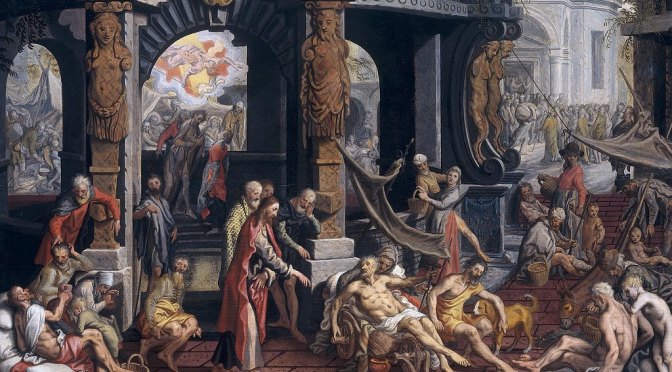
Today, a man who cannot walk lays between the pillars of the Sheep Gate Portico. A public square in Jerusalem. He watches as people file by, merchants, soldiers, farmers, religious authorities. He watches as other beggars, the lame, blind, deaf and unclean lay there with him. Many are bathing in the spring water pool hoping to be healed of their infirmities, but the man who cannot walk has no such hope. Instead, he is only looking for the charity of others, as he has been doing for 38 years. Legend has it that at certain times, an Angel of the Lord comes to stir up the waters of the pool. The first person into the water after this is believed to be healed. This portico is a place that gatherers people in need of healing. But the man cannot walk, and there is no way he could ever drag himself into the pool first – without help.

As the man who cannot walk lays there, a group of men come by and stop, one of them speaks to the beggar, asking him question. But without really hearing what has been asked, the man who cannot walk launches into his story, his hands extended. ‘Sir, I have no one to put me into the pool when the water is stirred up; and while I am making my way, someone else steps down ahead of me.’ Its a well rehearsed story, it is short, to the point and designed to make people dig deep in their pockets. The man has been telling it for decades. He isn’t expecting healing, he is expecting pity or charity. A few coins so he can provide for himself a few more days.

But the question that is asked to the man is not “Why haven’t you bathed in the healing waters of the pool?”

That question is too absurd to contemplate. 38 years is far too long for no one to have done anything for this man. Its is impossible to think that this man could have been laying just a few meters from healing for nearly four decades. The answer that this man has simply fallen through the cracks of human compassion for so long if too painful to imagine. How could that happen?

This story demands a question. “Why has no one helped this man? How could he have been left to suffer for 38 years?”

It seems ridiculous… almost too absurd to be true.

And yet the same question could be asked all around us in our world. This story is not only NOT absurd, but it is a story told all around us.

How long must the community of Shoal Lake First Nation go without clean water? 100 years? 200 years? Why has no one helped this community?

How long must Syrian refugees camp out a the boarders of closed nations? 5 years? 10 years? Why have these nations turned their backs?

How many people have to die of fentanyl overdoses until we do something? 100? 1000? Why has no one helped them?

How many children on First Nations must attempt suicide before we commit to making their living situations worth staying alive for? 50? 100? Why has no one noticed before now?

These questions are hard to ask, and even harder to imagine the indifference it took to let these things happen in our world.

Yet, there is a problem will all these questions. The questions are no more compassionate than the indifference and inaction that they question. Asking why no one has helped is more about us than the people suffering. It is more about making our own guilt go away, than offering what suffering people really need.

Notice that when Jesus approached the man who couldn’t walk today he didn’t ask, “Why has no one helped this man in 38 years?”

Jesus doesn’t jump to solving problems. He doesn’t define the man by his condition. Jesus doesn’t dehumanize the man in some attempt to be the white knight riding in to save the day.

Instead, Jesus asks the man who cannot walk, “Do you want to be made well?” 

Jesus presumes nothing. Jesus doesn’t jump right to problem solving. Jesus isn’t worried about saving the day or about making his own guilty feelings better.

Jesus is concerned with the man. Jesus recognizes the man. Jesus humanizes the man.

Jesus isn’t there to save the day, but to save the man. Jesus doesn’t do it by dragging the man into the pool. He doesn’t even do it by helping the man walk.

Jesus saves the man by seeing a person first and condition second. By seeing a person rather than a problem. Jesus embraces and acknowledges the man’s humanity.

“Do you want to be made well?”

It is a question that is about what the man who cannot walk needs and wants. It is about how the man wants to address his own suffering. Jesus isn’t there to force solutions on a problem, but to care for a person in the way they need to be cared for.

It is this that saves the man. Not the healing pool. Not the command to walk.

Jesus saves the man by caring for him as a person. But turing him from a problem into a human being. Before the man ever takes a step, Jesus welcomes this man back into relationship. Jesus welcomes this man back into life.

And the man who had been lame for 38 years gets up and walks. He walks because Jesus has seen him, recognized him, welcomed him back to life. Restored him to true life, to be more than his problems, to be more than injustice, to be more than legs that don’t work right.

“Do you want to be made well?”

Jesus’ question is rarely one we ask of those who are suffering. Human beings rarely take the time to ask this of each other, because it requires we get out of ourselves.

Because we when ask it we realize that problems we see around us are not just situations needing solutions. If we were to ask questions that humanize one another, we would see that we too are the people of Shoal Lake living for generations without clean water. That we are refugees fleeing for our lives. That we are those dying as we try to numb our pain with drugs. That we are people whose living conditions aren’t worth living for. We are all those people, just as we are the man who has not walked for 38 years too.

We are the ones whom Jesus is asking “Do you want to be made well?”

Today, as Brooklyn is dunked into the healing waters of Baptism, we are reminded that Jesus has asked us this question too. That God has seen us, recognized us, named us and claimed us. In the waters of baptism Jesus turns into people, Jesus welcomes us into new life. We stop being defined by the problems of sin and death, we stop being the sum total of the suffering we endure. And Jesus turns is into people. Into beloved children of God.

And in this act of God, in these cleansing and healing waters, God says to us, “Stand up and walk.” And through the waters of Baptism, we are raised to new life, we are raised to walk, to walk in this life of faith.

Today, as we near the end of Easter, we see that Jesus has been showing us resurrection all the way along. We just couldn’t see it before now, we couldn’t see it without Easter eyes. As Jesus sees the man who couldn’t walk, whom no one bothered to help for 38 years, Jesus sees us too. Jesus sees all the suffering and injustice of our world, Jesus sees us – not as the problems that define us, but as people who are beloved and cherished by God.

And because God has seen us and loved us we are able to stand up and walk.

Amen