Tag Archives: change

What have you to do with us Jesus?

Mark 1:21-28

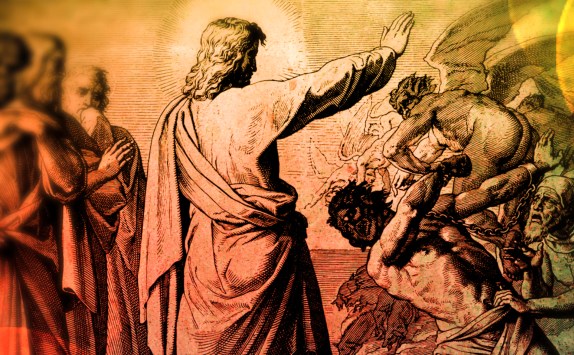
… a man with an unclean spirit, and he cried out, “What have you to do with us, Jesus of Nazareth? Have you come to destroy us? I know who you are, the Holy One of God.” But Jesus rebuked him, saying, “Be silent, and come out of him!”… (Read the whole passage here.)

Sermon

Today, we pick up in Mark’s gospel where we left off last week. Jesus has preached his first sermon, “The Kingdom of God has come near” and called Simon and Andrew, James and John to be disciples.

Now the group of them head to Capernaum, which becomes the home-base for Jesus’ ministry. It is the Sabbath, the day of worship, and they go to the synagogue. Jesus begins teaching, as was the right of any circumcised Jewish man. Usually, it was local scribes or rabbis who preached but sometimes travelling preachers like Jesus would come by to teach.

As Jesus begins, the congregation notices something different. Jesus is not teaching like the scribes. The scribes who were like walking encyclopedias of religious knowledge. The scribes were experts in the law, in the teachings and interpretations of the Jewish faith. The scribes didn’t innovate or interpret, they simply memorized what had been interpreted and written down by rabbis and other authorities long ago. New teaching was dangerous and probably heretical. It was important to stick to what they knew to be tried and true.

Yet, Jesus was preaching something new. Something different. Jesus was preaching from his own authority. Preaching like he had some special access to Moses, Elijah and the other prophets. Like he had special access to God.

While most people weren’t sure what to make of this Jesus guy, who he was or where his authority came from, one person did. Or rather an unclean spirit did. While regular humans don’t see who Jesus really is, the supernatural unclean spirit knows. And the spirit knows that Jesus is a threat to the established order. The spirit knows that Jesus has come to turn things upside down. The spirit knows the world that he and the people around him are stuck in is the past. The comfortable systems, traditions and ways of being that they are used to are over. Jesus is going wreck things.

The spirit is the one who speaks.

What have you to do with us? I know who you are!

The man with a spirit might just be a man with an unclean spirit. But for Mark the man might also represent the ways in which that community, that world, was possessed by tradition. Stuck in past. Unable to introduce any change that threatens the status quo.

Sound familiar?

Churches these days often struggle with this issue. We often long for things to be as they once were. We long to have Sunday schools with 100 kids every Sunday, and services that are standing room only. We long for offering plates to beoverflowing, we hope for more baptisms than funerals. We long for the past, or at least the way we remember things to be.

As a faith community or as individuals we can be possessed by our past. We can fear change, block anything new, strive to keep things the same. As the old joke goes,

How many Lutherans does it take to change a lightbulb?

Change!??! That lightbulb was good enough for my grandfather, so it is good enough for us.

When the unclean spirit names the threat that Jesus is not only to the good deal that the spirit has possessing some poor man, but also the threat that Jesus represents the whole world of the people of Capernaum and beyond, Jesus will have none of it.

Be silent and come out of him!

Jesus will not be deterred by the anxiety and fears, or the unwillingness of the spirit or people to let go. Jesus is preaching a new world, Jesus is calling the people around him into the future, into a new way of living. Jesus’ new teaching is astonishing, radical, unheard of. And it comes from a place that people don’t understand, but that the unclean spirit gets. The unclean spirit knows that the old ways, that the established approved way of doing things is safe, is comfortable, it is known. The spirit knows that people would so often rather be possessed by trying to maintain the past than face the unknown future.

Be Jesus knows that God is calling us into something new and unknown. And Jesus knows that we need to be exorcized of our fears and worries if we are going to see God’s future. Because we are often possessed by maintaining our past, by trying to recreate what we once were. We hold onto the traditions, systems, and ways to doing things that were good for our grandparents and so, we believe, are good enough for us.

Now don’t hear Jesus wrongly. Jesus is not saying that the past is wrong or bad. Jesus is not saying that God wasn’t active in the past, or that God wasn’t working through the ways we used to do things. Often when churches and individuals face change, letting go of what we once were is so hard because it feels like we are dishonouring our forebears. It feels like we are saying our parents and grandparents were wrong, that they weren’t being faithful.

That is not what Jesus is saying. Jesus knows that God has been present among the people, among us the whole time. Jesus isn’t exorcizing us of our past. Jesus is exorcizing us of our holding on, of our resistance to change, of our need for safety and comfort. Of our fears and anxieties.

It is not the past that keeps us from seeing God’s future, it is our efforts to keep things the same, to recreate what once was, what we once were.  And Jesus’s new teaching is really about showing us that new world. Showing us God’s future. Showing that God is coming to, meeting us in the future. God knows we cannot go backwards.

And that is what is so radical to the people in the synagogue in capernaum, so radical for us today. God is not a God of the past, God is not about keeping things, keeping us the same. God is about resurrection, about turning death and forces that hold us back, into new and abundant life.

Let us pray,

O God, you have called your servants to ventures of which we cannot see the ending, by paths as yet untrodden, through perils unknown. Give us faith to go out with good courage, not knowing where we go, but only that your hand is leading us and your love supporting us; through Jesus Christ our Lord.

Amen.

The Gospel According to Downton Abbey

Around New Years, my wife and I jumped on the Downton Abbey bandwagon and binged-watched the whole series in about a week. For those who don’t know, Downton Abbey features an aristocratic household in the early 20th Century, following the lives of the Lords and Ladies who live “upstairs” and the servants who live “downstairs” at Downton Abbey.

Downton’s appeal is that it is like a view into a time that our world can almost remember. My grandfather born in 1919 would have been a baby just around the time the show takes place. It is almost memorable for us but still so very different.

Now, I promise no spoilers.

Downton-Abbey-CastOne of the main themes of the show is change. The early 20th Century was much like the early 21st Century is now. There was a technological revolution taking place, and it is funny to watch the characters of Downton deal with the newness of very old technology. Electricity, phones and automobiles were transforming the way people communicated, traveled and worked. There were new jobs which required new skills, while old skills and jobs were being made obsolete. Communication over long distances was now instant and ubiquitous, with phones being installed in houses. Cars allowed people to travel farther and faster. Medicine was being revolutionized with anti-biotics and surgical procedures. And of course, warfare became more deadly with inventions like machine-guns and tanks.

Alongside this great technological change was social change. The established social orders were unravelling, the servant class looked forward to new opportunities, while the upper class watched as their power and influence eroded. While the show hasn’t made it as far as the Great Depression, this event would become a seminal moment of this era, leading into a very different middle 20th Century. Communication and technology were creating a new democratization of opportunity. The social playing field was levelling.

The technological and societal changes were evolving a world for the young adult generation that was very different than the world of their parents and grandparents, causing generational tensions.

This all sounds somewhat familiar doesn’t it?

I don’t think Downton Abbey would have worked as a show 10 years ago. Yet, today we can equate the experience of a phone in every house with a smart phone in every pocket. We can understand the experience of new ubiquitous instant telephone communication like new social media connectivity. We experience clear class distinctions with our growing economic disparity and inequality. These mirrored experiences with our great-grandparent’s generation make the show appeal to our present.

However, as a pastor, there is one thing that makes my hair stand on end, episode after episode.

Throughout the show, characters often talk about how “everything is changing.” Even though it isn’t always clear what this new technology and these new social attitudes will mean for the world, everyone carries a deep sense of change. Some embrace the change and look forward to this new world. Others grieve it and lament what these changes will mean. In particular, the privileged upper class is generally fearful of what they will lose and often work to prevent or slow the change. The servant / working class generally embraces the change, looking for what they can gain and attempt to hasten the arrival of this new world.

The experience of “change” that the characters are having is uncannily like the experience of change that so many churches are going through today. In fact, there are moments in the show that feel so much like my day to day life in ministry, as those around me have the same deep sense of the “changing” world of our time. The image of our contemporary church that Downton presents is not lost on me for a second.

As these once great aristocratic families wander about this great house, this great mostly empty Abbey (or church), bemoaning the change going on about them; they have no idea how they got to where they are, they do not know how to react or what to prepare for. As it becomes clearer that their traditions and social standing are no longer relevant or guaranteed by society itself, the upper class holds on tighter and tighter to what they once had and long for a return to earlier times.

Just to make sure there is nothing missed, the completion of the mirror image comes in the grief the upper class carries for their loss of privilege.

No, the image that Downton presents of present day Christianity, especially mainline Christianity, is not lost on me at all.

Downton Abbey should become required watching for churches today.

It would serve us well to see just how blind we are to our entrenched societal privilege. It would serve us well to see how our traditions are viewed by those forced to attend to them rather than benefit from them. It would serve us well to see how our privilege is not going to last forever, in fact, it will probably not even last the decade.

As our privileged position of being the state and social religion, of being the dominant culture and moral system, of being able to discriminate for “religious reasons” is coming to an end, it can only be a good thing for us.

This is where the gospel part of Downton Abbey comes in. The privileged class sees only the loss of their position and power in the world, but the under class starts to see the beginning of something new. They see hope for a different world.

As a millennial, I only have the foggiest or vicarious memory of the glory days of Christian privilege. As a pastor, I don’t remember being a well respected authority figure in the larger community. I don’t remember churches having much, if any, influence over society around us. But like the young aristocrats of Downton Abbey who are far more comfortable with this new world, and who are far more comfortable interacting with the lower classes, I am ready to be – and to lead – the Church into this new world.

It is very tempting to lament our loss of privilege, we could just wander about our big empty churches wondering how we got to where we are, but the Good News of Downton Abbey is that our privilege is being stripped from us. It is Good News because the barriers that prevented the under-privileged from integrating with us are falling down. It is Good News because we can now begin to play on a level playing field, a democratized playing field where people can choose us, rather than be forced to adhere to us. It is Good News because, like the aristocrats of Downton Abbey, it is time for the world to stop serving us and for us to start serving the world.

Besides, I think serving the world was kind of big deal for that guy we like to follow… Jeeves was it? Or Juan?

Oh right… Jesus.

So are you a fan of Downton Abbey? Experienced the Church’s struggle with change? Share in the comments, on Twitter: @ParkerErik, or on Facebook

More posts about change:

Why Christians have lost the argument for faith before it started

Old and New: Thanks about the World Differently