Why White Supremacy is a Sin

Update: this post was written in August 2017, but still applies today in 2020

The events of Charlottesville, VA over the weekend were truly tragic and deplorable. One of the things that struck me was just how groundless and arbitrary the reasons were for white nationalists to gather for a rally. How pointless was the violence and death inflicted on people over a statue?

Even here in Canada, this kind of open display of hatred evoked a visceral reaction. To see nazis and klan members taking the streets was surreal. This is something that used to belong only in historical source footage and fictionalized movies. And yet there it was, in my newsfeed along side the regular photos of friends on holidays, recipe videos, cat pics and other news articles.

As a white Christian, I cannot help but feel outraged and shamed by the images and videos of white men who look just like me “rallied” thinking they were standing up for themselves. There is simply no excuse or moral justification for what took place in Charlottesville.

As a pastor, I struggled with how to address the events of the weekend. And I confess, that I did not re-write or change my sermon to address the issue of white nationalism (I did address Charlottesville in the intercessory prayers). But still I agreed with the many calls for pastors – white pastors in particular – to name the sin of white supremacy and racism. This article in particular named the need for pastors to speak out very well.

But one thing I noticed that was largely absent or only briefly address are the reasons why white supremacy is a sin. And while it may seem obvious to many or most people that this kind of hatred is sinful, I don’t think it is understood by or obvious to all.

In fact, I quite honestly doubt that those who espouse white supremacy and Christian faith understand why the two are incompatible. While some may choose to hate knowing that it is ‘wrong,’ I think many simply don’t understand that this hatred is, in fact, wrong and sinful.

So hopefully to add some clarity to the call to name white supremacy as a sin, here is the  why:

Sin

To begin with, we need to understand what is sin. So often we think of sins as “bad things” that we do. This is only a surface and passing understanding. To better understand sin, it needs to be more deeply understood in two ways. First, sin is distortion in our relationship with God. Second, sin is distortion in our relationships with other people and creation.

Sin is when we put ourselves first. When we put ourselves above God, trying to be God in God’s place (Commandments 1-3 in the Lutheran order). It is also when we put ourselves above others and creation, tying to be God over others and creation (Commandments 4-10 in the Lutheran order).

The sin of hierarchy

White supremacy is a sin because it elevates some people above other people for arbitrary reasons. It attempts to claim that some (white people) are more fully human, while others (people of colour) are less human. This is a violation of commandments 4-10 meant to keep our relationships with others and creation in balance. This is also a violation of commandments 1-3 meant to remind us of who is God, and that God alone defines our humanity.

The sin of trying to be like God

White supremacy is also a sin because it also tries to claim who is worthy of God’s love and favour, saying that God has arbitrarily chosen some people (white people) over others (people of colour). God alone chooses who is worthy of God’s love and favour, and God has chosen all peoples and all nations.

The sin of limiting the Gospel

And finally, the most important, white supremacy is a sin a because it tries to constrain and control the gospel, and ultimately to control and constrain God. God in Christ has declared that grace is given for all people. To restrict the Gospel or the Good News is to attempt to confine and control God, to be God in God’s place.

Trying to be God in God’ place is at the root of all sin.

The Gospel overcomes sin and death

God became incarnate in flesh to show us (all humanity) that the New Life given in Christ is given for all people. And there is no ideology based on arbitrary differences (like skin colour) that can constrain that Good News.

And in the face of racism and white supremacy, the Good News is that Christ is not controlled or restricted by white supremacists (not matter what they claim) or any others who would claim to limit Christ’s saving act of dying on the cross and rising to New Life so that New Life may be given for all.

The Gospel of Christ’s death and resurrection is something that God has given to all peoples and no one can change that.

So as pastors and other leaders in faith continue on through this week and into next Sunday naming and condemning the sin of white supremacy, my hope is that we also take the time to say why.

Because in saying why white supremacy is sinful, we also remind people that God’s love, mercy and grace is given for all.

The scary thing isn’t sinking, but walking on water.

Matthew 14:22-33

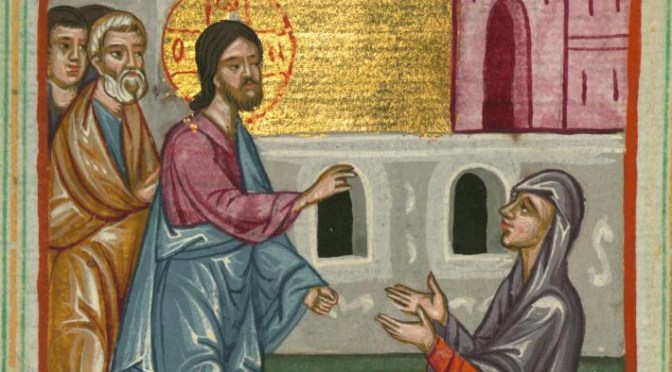
Peter answered him, “Lord, if it is you, command me to come to you on the water.” He said, “Come.” So Peter got out of the boat, started walking on the water, and came toward Jesus. But when he noticed the strong wind, he became frightened, and beginning to sink, he cried out, “Lord, save me!” Jesus immediately reached out his hand and caught him… (Read the whole passage)

What a quick turnaround from last week. As we go with the disciples into the stormy waters, we have and they have just been feeding the masses with Jesus. With five loaves and two small fish, Jesus fed the 5000 and there was enough for all.

Yet, within moments of enjoying a feast with the great crowd, Jesus sends the disciples  in a boat to the other side of the lake, while goes by himself to pray. And then follows one of the most famous stories in the bible, where Jesus while walking on the water, invites Peter to walk on water with him.

As the disciples are out on the water in a storm, it is not the first time these experienced fisherman have found themselves in bad weather. The first time in the Gospel of Matthew, Jesus was with them in the boat. With but a few divine words he calmed the storm and the fears of the disciples.

So this time, as the storm comes upon the hapless group of Jesus’ followers, they are not afraid of the wind and the waves. Instead, it is the apparition of Jesus on the water that brings out their fears. They are not certain of what or who they see. Some think it is a ghost.

Jesus approaches the boat and calms the disciples fears. “Take heart, it is I, do not be afraid”. Jesus calms the disciples, who are storming within, by speaking words that alleviate their fears. But Jesus’ words to the disciples are reminiscent of words spoken to another disciple. As Moses approached the burning bush, the Lord God told him to not be afraid. And Jesus echoes the name that God gave himself. When Moses asked the burning bush by what name should he call the one who was sending him to free the Israelites from slavery in Egypt, God said, “Tell them, I AM who I AM sent you”.

Jesus invokes the same divine name. Jesus words to the disciples from the side of the boat could have been translated, “Take heart. I AM. Do not be afraid”.

The disciples realize, this is no ghost. This is God at the side of the boat, walking on the water. But Peter still has some questions… is it Jesus? And I can walk with him?

Now I don’t know about you, but getting out to walk on the water does not seem like the obvious thing to do in this situation. The disciples are sailing in the middle of storm, and this is the moment that Peter decides to see if he can also do what Jesus is doing. Maybe Peter would have been smarter to start with multiplying some bread and fish into enough food for thousands…disappointed dinner guests, and not drowning, would be the worst possible outcome.

Yet, Peter steps out. In the hopes of meeting Jesus on top of the water, the hopes of having the power over creation too.

Most of us are probably not as daring or foolish as Peter… but at the same time, there are moments in our lives and in our faith where we are compelled to step out of the boat. To take a risk, to chance losing everything. Whether it is a individuals or as a community of faith, there are moments when we have to stop worrying about the worst possible outcomes and see what happens on the waters, outside the safety of the boat.  We are faced with trying something new, venturing into the unknown, exploring places we wouldn’t have dared go before.

Peter’s question is the question that we all must ask before stepping out of the boat. It is the question of identity. Who will meet me on the other side of this great risk? Who am I to take this risk?

So many of the sermons preached on this text tell us that if we want to know the answer to that question, if we keep our eyes on the one walking on the water, than we will not drown or sink. Just have enough faith, and everything will be alright. Just take the risk with faith, and walking on water should not be a problem.

But the difficult part of stepping out of the boat and stepping into the unknown is that we do not know where we will end up. We do not know what is on the other side.

Peter steps out of the boat… and in a way, he shows us what indeed almost always happens to us in those moments of risking it all.

We sink.

Stepping out of the boat is to sink.

Stepping out of the boat means is to get wet.

Stepping out of the boat means we will need to be saved.

The drama of the story is that when Peter steps out onto the water and he begins to sink. His risky choice seemed like it had potential, and it seemed to be going well at first. But Peter does what we so often do. He self-sabotages. He becomes afraid of the unimportant things, not the water, not sinking, not the lack of a boat under his feet. He is frightened by the wind, by something that should have no impact on his ability to walk on water.

And how often is this what we do too. When trying something new begins to work, we become not afraid of failure but of success. We stop wondering whether we will sink, but what it means to discover that Jesus did actually invite us into something new and different. Something that means we will be forever changed…  Like Peter, we let the inconsequential sink us. The wind, the thing that is a sign that we are on top of the water is what makes us sink.

Yet, just as Peter begins to sink, “Jesus immediately reached out his hand and caught Peter.”

You see, this is part of the story where we finally find out who we are. Where we finally find out who it is that is calling to us from the other side of boat. Jesus knows very well that Peter will sink, but Jesus still says, “Come”. Before Peter steps out of the boat, he wants to know if it really is Jesus walking on the water. But once he begins to sink, Peter knows exactly who he is calling to, “Lord, Save me”.

Inside the boat, we forget who we are and who Jesus is. But on the outside, with the water rising quickly around us, we know that we need to be saved, we know that only Jesus is the one – the ONLY one – who can do the saving.

Hopping over that edge and onto or into the water is a part of life. As human beings, as communities of faith, as sinners in need of saving, we need to hop over the edge every so often. We need to discover what it is like to be on the outside of the boat, to experience the unknown and to find out where we are going.

But in the end we will always sink. In the end there is always the wind, the thing of little importance that we can blame for our fear of succeeding, our fear of change and newness.

But even as we sink, Jesus is there. Right there, immediately grabbing us by the hand and pulling us from the stormy waters.

Jesus is right there knowing that our problem is not wind, nor the water, not the missing boat. Jesus knows that we are our own problem… but Jesus also knows that we will never save ourselves. And so Jesus pulls us out. He doesn’t make the wind go away, or throw us backwards into the boat, or even tell is to stop waling on the water… Jesus brings us through. Jesus pulls us out of sinking death, into unexpected new life on top of the water. New Life on the other side of risk, on the other side of the safety of the boat. New life on the other side of change and new ways of being.

That is the promise of Jesus walking on the water. That is the promise of God who says, “Tell them I AM who I AM sent you”. That is the promise of our Lord and Saviour. No matter where we are. In the boat, on dry land, or sinking like a stone. Jesus is there, reaching out to us, pulling us from the waters, saving us from ourselves, saving us no matter where we go or where we end up.

Reaching out and pulling us into new Life.

Setting aside our mustard seed dreams for a mustard bush Kingdom

Matthew 13:31-33,44-52
Jesus put before the crowds another parable: “The kingdom of heaven is like a mustard seed that someone took and sowed in his field; it is the smallest of all the seeds, but when it has grown it is the greatest of shrubs and becomes a tree, so that the birds of the air come and make nests in its branches.” (read the whole passage)

To consider the immensity God’s kingdom usually defies our imaginations. For those sorts of people who ponder the mysteries of life, thinking about the Kingdom of God, about heaven, is as attractive as it is frustrating. There are so many possibilities, yet few particulars. Dreaming big comes pretty easy for most of us. We are taught to dream about the future at an early age. “What do you want to be when you grow up? A Hockey Player, an astronaut, a rock star, prime minister or maybe all of the above! But the motivation to dream big doesn’t end in childhood, but rather it is ramped up and stakes are higher as we grow older. Imagine life with that new car, with that new house, with no debt, with a wealthy retirement, with that new and better paying job.

We like our big stuff in this part of the world. And to dream big about the Kingdom of God, about Heaven is fair game. To imagine a lavish wedding banquet, or a cloudy paradise where friends and family greet you, or perhaps dozens of golf courses all empty and waiting to be played on nice sunny days.

There is no shame in dreaming big, and yet there is the inevitable downer of not having these dreams realized, of our hopes and dreams always and only being only hopes and dreams. All too often, our expectation, our anticipation is of something big and exciting happening in our lives. We spend a lot of time waiting for the next mountaintop experience by simply glossing over the rest. Weekdays are for getting us to weekends, school is for getting us jobs, jobs are for making money to spend on weekends and to save for retirement… retirement is about waiting to die? I hope not.

Jesus presents us with a scandal today, but we may have glossed it over waiting to get to the good part. For Jesus, the Kingdom of heaven is like a mustard seed, like a treasure small enough to bury in a field, like pearl only worth a lowly merchants wages, like a net that catches fish. For Jesus, the Kingdom of heaven seems to be nothing like we have imagined it. The Kingdom of heaven is more like these mundane and trivial objects, than the great golf course we imagined. We almost should ask, “What are you talking about Jesus?”

But Jesus is the one who has asked us first, “What are you talking about?” Jesus sees through our dreaming, and addresses us at our deepest insecurities, at our fears. Our fears that are hidden by our dreaming. Our fears about what we are capable or incapable of accomplishing in life, our fears about our futures, our fears about death. The Kingdom God is stripped from our dreaming and replaced with something that we don’t like, something that we want to avoid. Jesus names and points to the Kingdom of God, right here in the mundane boringness of everyday life.

Jesus’ examples of the Kingdom of God challenge everything we have been taught. It challenges each incidence where we were asked, “What do you want to be when you grow up?” “What school do you want to go to?” “Where do you want to retire to?” Jesus’ proposal about the Kingdom is not the way we are supposed to imagine things, it challenges our constant future orientation, our glossing over of the present, our displeasure with reality. For to imagine a Kingdom of God in the future is to deny that this world has much meaning and importance, this unsatisfying existence is not what our selfishness nature desires. And for Jesus to see the Kingdom of God in small, inconsequential things is to go against our desire for always something bigger and better.

And yet, when Jesus names the Kingdom right here and right now in the world, it changes and transforms this reality that we are constantly wanting more from. The world becomes something that we do not expect, something that we have never anticipated or dreamed of. It becomes God working among us.

To see this small thing, this small mustard seed is to see the Kingdom of God at work. What Jesus is getting at today, indeed, initially challenges our dreams of bigger and better. But once we those dreams are set aside, we see that what Jesus is describing is a dream much bigger than we can imagine. It is to see God’s Kingdom right here among us, right here among in the unsatisfying and undesirable conditions of life. Right here among us turning the tiny and trivial into life changing and life altering experiences.

God’s Kingdom comes to us in the present, it comes to us where we are. And it comes in forms that we do not expect, in ways that we cannot imagine. It comes to us in the flesh of Christ, in God as a lowly human being. It comes to us in small seeds, hidden treasures, and fishing nets. God’s promise of love and grace for us small and insignificant sinners will be made known the Baptism that we will see this morning. In the Holy Bath that we all share, in simple water that changes who we are and that makes us members of the Body of Christ, of God’s Kingdom.

Jesus says today, the Kingdom of Heaven is like a mustard seed, the smallest of all seeds bringing about the fullness of God.

There is life in the Wheat and Weeds

Matthew 13:24-30,36-43

The slaves said to him, ‘Then do you want us to go and gather them?’ But he replied, ‘No; for in gathering the weeds you would uproot the wheat along with them. Let both of them grow together until the harvest; and at harvest time I will tell the reapers, Collect the weeds first and bind them in bundles to be burned, but gather the wheat into my barn.’” (read the whole passage)

Most of us know the annoyance that weeds cause in gardens and lawns and even fields. Weeds steal energy, water and resources from the plants that we placed purposefully in our gardens. Weeding is probably one of the more joyless parts of maintaining our plants and gardens. Pulling those prickly, finicky nuisances that seem to do anything they can to stay in the ground is not fun.

And so when we hear Jesus tell the parable of the Wheat and Tares or wheat and the weeds, we can identify with the experience of the servant who wants to get the weeding done.

Yet, as anyone who regularly walks down neighbourhood streets knows keeping and maintaining gardens, in particular the weeds, is an individual approach as anything. On the street that we live on, the gardens, flower beds and lawns of our neighbours vary wildly. There are some lawns and flower beds kept impeccably. Hardly a blade of grass out of place, not a weed to be seen. And then there are others where the weeds and grass seem to be growing in harmony… and growing tall. The contrast is noticeable when there are next door neighbours with these two extremes of garden and lawn styles. A golf green lawn next to a patch of wild grass and weeds.

This tension sits at the heart of the parable of the wheat and weeds. The crops have been planted, the wheat is growing… but so are the weeds. And the servant and the master have very different approaches to deal with this tension. The slaves of the household wants to get down to weeding. They want to purify the fields, get ride of bad and unwanted weeds right away, resolve the tension that they are experiencing… but the master wants to wait. Let the wheat and weeds grow together, for in pulling up one you will destroy the other.

Now of course, when we slow to think about it, this parable is not about wheat and weeds. Jesus isn’t discussing gardening philosophies.

But nor is this parable about the explanation that Matthew puts in Jesus’ mouth either. This isn’t about the weeds being like the evil ones of the world who will be thrown into the fire, or about the good wheat being gathered into heavenly grain bins.

In fact, the explanation to the parable about what the wheat and weeds are seems to have missed the point.

The point just might be the tension.

We are not good at living with tension.

The master says to leave the weeds be, but we are most often more like the slaves who want to get down to weeding. We don’t do well with tension because we would rather get to resolution. Its why most TV shows tell a complete story each episode, and why cliffhangers frustrate us so much. It is why most music is careful to end with resolving notes, a song that ends without sounding finished feels wrong. It is why we want to get the weeding done, instead of letting the weeds grow with the garden… the tension bothers us.

But the tension extends far beyond gardens and into our lives and work, into our relationships and even into our faith. We don’t like it when things we perceive as good and bad, right and wrong, exist at the same time in the same place. We don’t like weedy things infecting our wheat.

As Matthew attempts to unpack this parable by telling us what it means, he puts it in terms of faith, or more specifically faith communities. As faith communities, we know that we need to welcome new people, to try new ways of doing things, to open ourselves up to new life and the places it could grow among us… yet, new people can feel weedy to us, new ideas and new ways of being can feel like they are taking our limited energy and resources… new life can feel like it is choking our life out.

How often do we turn down new ideas because they are too weedy… they seem like they will just take energy and life from us like weeds?

How often are we concerned only about whether we will get a fruitful return, a wheat crop as reward for our efforts? How often do we weed out potential new members to our community because we expect them to be wheat instead of weeds?

How often does new life in our midst need to be a bit weedy… need us to sacrifice some of our own resources, our soil, our water, our energy in order to let the new life take root among us?

We really do struggle with with letting the wheat and the weeds co-exist, especially as people of faith. We struggle with the tension, of living in the grey areas, and not being able to define our world in the terms of good and bad, right and wrong.

And yet the tension, the place in between good and bad, right and wrong, even life and death, is where so much of our faith rests. It is the grey ares where God seems to show up, in the places where wheat and weeds are growing together.

God comes to us a king of creation, yet born as a nobody peasant in the backwater town of Bethlehem.

God comes preaching good news, but to the lost, least and forgotten of the world.

God comes to save us, by dying on a cross.

And so we are sinners yet forgiven and righteous.

And so we find our lives by losing them.

And so we are made alive by dying in Christ.

And so God chooses to love us, even though we should be unloveable.

The master tells his servants to leave the weeds be, leave weeds because pulling them out will uproot the wheat.

The master tells the servants to live in the tension, because that is where life can grow. The weeds will steal from the wheat… but both will grow. The tension is the place where life grows.

It is the same message that God gives to us, that God proclaims in and through God’s church.

Come you who are sinners, to this community of people made righteous. Here your sins are forgiven.

Come you who are suffering, to this community of healing. Here you will be made whole.

Come you who are hungry, to this community of bread and wine. Here you will be fed.

Come you are dirty and unclean, to this community of the washed. Here you will be cleansed.

Come you are who are dead, to this community of life. Here you will be raised.

The tension is the place where life grows.

Here is the thing… just as wheat fields without wheat doesn’t exist in reality, there is no community of people without sinners, without suffering, without hunger, without being unclean, without death.

The Master knows that the weeds are always part of the growing, all part of the fruit producing. The Master knows that the weeds are a part of life.

And God knows that it is in the grey areas that life is found.

God knows sinner meets righteousness in the grey area of forgiveness.

God knows that suffering meetings healing the grey area of mercy.

God knows that death meets life in the grey area of resurrection.

And so the Master says to us, let the weeds be. Let the bad grow with the good because it is in the grey areas that life is found.

The parable of the sower – The soil is not the point

Matthew 13:1-9,18-23

Jesus went out of the house and sat beside the sea. Such great crowds gathered around him that he got into a boat and sat there, while the whole crowd stood on the beach. And he told them many things in parables, saying: “Listen! A sower went out to sow. And as he sowed, some seeds fell on the path, and the birds came and ate them up. Other seeds fell on rocky ground, where they did not have much soil, and they sprang up quickly, since they had no depth of soil. But when the sun rose, they were scorched; and since they had no root, they withered away. Other seeds fell among thorns, and the thorns grew up and choked them. (Read the whole passage)

This is one of my favourite readings. For my installation service in my second call, I chose this parable as the gospel lesson. I just love the idea of a sower or farmer planting seed with wild abandon, willing to imagine and see if seeds will grow – even in the unexpected places. The excitement of potential, the willingness to see possibilities seems so hopeful.

And yet, anyone who knows anything about modern farming, knows that this kind of hap hazard seeding is not how things are done. These days GPS plows make for the maximum use of soil, air seeders measure density and plant at the optimum places. Good soil maximized for productivity, seed isn’t wasted and poor soil avoided.

But ancient farming, while a little more low tech, wouldn’t have been much different. In fact, isn’t that the point Jesus is making. A good sower knows where to seed and where to avoid just wasting valuable seeds on soil that won’t produce.

Yet this parable that Jesus tells, describes a sower who is not so efficient and careful with his seeds and soil and planting techniques. This farming style seems crazy to us and to the crowds listening in Jesus time. This haphazard sower who scatters seed anywhere, draws our attention to the different kinds of soil. To the hard packed soil of the paths, not unlike gravel roads or waking paths. We hear about rocky soil with no depth to it. Soil that is in amongst the thorns and thistles. But perhaps the most interesting soil of them all is the soil that gives 30 or 60 or 100 fold return. These kind of returns from good soil are almost unimaginable. In fact, anything that gives even a 30% return is almost unheard of in life. Anyone with a savings account knows that a 30% interest rate is crazy.

And so as soon as we hear Jesus talking about these incredible returns, we want to jump right to part where we figure out how to be good soil. We want to separate those who are bad, hard, inhospitable soils from those who are good soil. We want to see ourselves as the good soil, we like the ability to categorize and label, to judge and condemn. This lens of productivity is one we know well. It is one that all 3 gospel writers, Matthew, Mark and Luke, give with their telling of this story. If we want to be productive, we need to be good soil. If we want to be righteous, we need to be good and faithful.

Yet, we know that this kind of productivity just isn’t realistic, we know that this really isn’t the way the world is. And if we are honest with ourselves, we know that life is full of unpredictable, unexplainable, and unknowable outcomes. We know that sometimes the people with strongest faith, those who are gentle and kind, those who are most vulnerable sometimes receive the hardest lot in life. We know that suffering and sin doesn’t really seem to follow a pattern but rather happens to us at random. We know that there are those out there who seem to have an easy and blessed time with life, who get all the legs up without really trying or even when they don’t seem to deserve it.

And when it comes to hearing the word as Jesus says, we know that much of the time we are much more like the hard, or rocky or thorny soil than the good soil. We we all wish we could pray more and pray better. We all wish that we gave more to the church, more time and money. We all wish we could share our faith more easily, that we could tell our friends and neighbours just why this place means so much to us, that is when we ourselves find the time to come.

But we don’t feel like good soil… we can see and feel in ourselves what we know to be failure. We can see and feel the rocks, the thorns and the hardness within us.

In the parable, we get caught up in the business of the seeds and the soil. We like to imagine the details of where we fit. And we are struck by the reality of what it means to be soil, good or otherwise.

But the parable isn’t about seeds or soil. Jesus gives us the clue right at the beginning.

Jesus says, “Hear then the parable of the sower”. This parable is not about soil, it is about the sower.

Not about us.

But about God.

About this sowing God who seems radical, haphazard, and all over the place. God whose seeds end up everywhere.

When Jesus explains this parable, he never encourages or exhorts anyone to be good soil or good seed. He says that the parable is about the sower. It is about the one who owns and works the fields, the one who owns and plants the seeds. This parable is about a God who is willing to see that there is possibility even in the rocky, hard, shallow and thorny soil. Even knowing that the seeds may not grow in poor conditions, God scatters and plants anyways.

This parable is about God who declares that the hard packed soil, the rocky soil, the thorny soil and that dark, nutrient soil… God declares that all these soils are acceptable. All these soils are good enough to sow. Good enough for the Word to be scattered on.

The sower seems to be scattering seed, knowing that it probably will not grow, but seeing the possibility that it might. So are we the soil or the seeds in this parable? That part isn’t clear. And maybe it doesn’t matter if we know where we fit exactly. What this parable does show is a God who has decided to scatter grace, mercy and love in all directions. This parable shows a God who has decided to scatter on the rocky, the shallow, the thorny soil and the good soil. It is a God who is wants the Word of the Kingdom to be heard everywhere and anywhere. It shows a God who is determined to let this creation, these seeds and this soil, to let us know, that we are cherished and loved, imperfections and all.

This sowing God is showing us that the lenses of good and bad soil that we see the world through are not how the sower sees. The productivity of the soil does not determine the whether the sower sows. Whether we are good and holy, whether we are hard, rocky or thorny… these things do not determine whether God loves.

The sower sows because the sower has decided to scatter the seed. God gives God’s word of grace to us because God has decided that we are God’s beloved. And there is no amount of fruit that we can bear or fail to bear, no good works that we can do to earn or sins that we separate us from God’s love and mercy.

“Listen!” Jesus says, “a sower went to sow…” and with those first few words gives us the good news. The good news that God has decided to love us, no matter whether we feel good enough or not. Because God’s love is given because God has declared it is given – for us.

An iPhone Pastor for a Typewriter Church