
I shared the manuscript of this presentation a few weeks ago, but here is a video of the TED Talk style presentation I gave:

I shared the manuscript of this presentation a few weeks ago, but here is a video of the TED Talk style presentation I gave:
Mark 3:20-35
” And he called them to him, and spoke to them in parables, “How can Satan cast out Satan? If a kingdom is divided against itself, that kingdom cannot stand. And if a house is divided against itself, that house will not be able to stand. And if Satan has risen up against himself and is divided, he cannot stand, but his end has come. But no one can enter a strong man’s house and plunder his property without first tying up the strong man; then indeed the house can be plundered. (Read the whole passage)
It is only the second week into this long season of green, and Mark is giving us some unusual stuff. We don’t often remind each other of that story from the gospel when Jesus’ family thought he was nuts and tried to drag him away.
Now, of course, last week we heard the story of Jesus’ healing a mean with a withered hand on the sabbath. An action which enraged the pharisees so much that they began plotting to destroy him.
And so as we explore this next interaction between Jesus and the people around him, it is probably helpful to remember that Mark might be intending us to see the extreme behaviour or reactions… the Pharisees who plot to destroy Jesus followed by family who think Jesus is crazy.
Mark invites us to reconsider again and again just what Jesus is up to in the world, and who Jesus is, often by acknowledging our own extreme responses to God’s call to follow.
Mark uses the structure of the story to make a point. We begin and end with the crowds. The unwashed, poor, unclean and desperate crowds are pushing in on Jesus and his disciples. They are looking for something, someone to give them good news. And by the end, Jesus names those same crowds as his brothers, sisters and mothers.
Inside of the bookends of the crowds, Jesus’ family comes to take him away because he is out of his mind. And just before the last mention of the crowds, we are reminded that Jesus family is desperate to get him away, to end their shame and embarrassment at what Jesus is doing.
And finally the scribes sit in the inner sections of the story. They claim that Jesus has a demon. And Jesus rebukes the scribes for trying to control the actions of the spirit.
So the order of the story goes: Crowds>family> scribes. Scribes<family<crowds. And right in the middle, Jesus gives us this strange image of Satan’s house. A house divided cannot stand. Satan’s house divided cannot stand. Satan’s house is not divided. Satan’s house, the strongman’s house, IS the undivided house.
A house divided cannot stand.
As Jesus’ family attempts to restrain him and as the scribes declare that Jesus is acting with a possessed spirit, Jesus speaks about the human search for normalcy and conformity. Conformity is often touted as unity, and yet when we consider what it often takes to achieve a unified community with no outward divisions, it is not a healthy community. Unity often required totalitarian leadership, speaking with one mind and voice requires that most people bend and twist themselves into the vision and view of another. It is the house of the strong man that cannot stand if divided, therefore the strong man’s standing house is not divided.
Yet, Jesus is here to tie up the strong man and plunder his house.
Jesus speaks to the crowds, his family and the scribes who all believe that they have the world figured out and that they have God figured out.
The crowds know that they are on the outside of God’s love, unclean and inadmissible to the temple. Unable to make sacrifice in order to received God’s mercy and forgiveness.
Jesus’ family knows that family unity is essential to the Hebrew faith. They know that Jesus’ actions will not only reflect badly on him, but will bring shame to the whole family. They will lose standing in the community.
The scribes know they are part of the religious authority. They know that because they have kept the law that they are permitted to make judgements about who is clean and unclean, who us righteous and who is unrighteous.
Jesus speaks to these groups who believe they have it all figured out and turns their whole world, their whole understanding of God on its head.
Jesus tells all of them that they are wrong.
Like the crowds, Jesus’ family and scribes, we so often think we have things figured out. Whether we think like the scribes, that we can determine where God begins and ends and make judgements about who is outside of God, or like Jesus’ family that we need to keep from being shamed and embarrassed or like the crowds that we are too sinful for God to possibly love us.
Jesus hears all of that and turns it on his it head. Jesus challenges our assumptions, challenges our claim to be the arbitrators of God’s love and declares a completely different reality.
“Truly I tell you, people will be forgiven for their sins and whatever blasphemies they utter; but whoever blasphemes against the Holy Spirit can never have forgiveness, but is guilty of an eternal sin”
Whatever we think we have figured out, whatever understanding of God’s activity in the world we claim to have Jesus tells the crowds, tells his family, tells the scribes and tells us that it is opposite of what we think. God is usually doing things very differently than we imagine.
A house divided cannot stand.
Yet God’s house, divided for 2000 years, continues to stand.
It has stood despite our inability to agree. It has stood because the Church has been full of people who thought differently.
God’s house stands divided because it is able to hold within it the differences that we bear as the Body of Christ. God’s house stands because even when we cannot hold our differences between us, God can.
God’s house stands because it stands on Christ.
Satan’s house is the undivided house.
But Christ, who ties up the strong man and plunders Satan’s house, is our foundation.
God’s house stands divided between the many members of the body, the many members who serve and live in different ways, the many members whose different gifts are used in different ways, the many members who are each chosen and loved by God.
God’s house stands divided, as the Body of Christ broken and given for the world, as the Blood of christ shed and poured out for a world in need of forgiveness.
Just as we are all guilty of same eternal sin, of the same original sin, of wanting to be God in God’s place, of standing in judgement of others. Just as we are guilty, like the crowds, family and scribes of standing in Judgement of Christ. Jesus is declaring a new reality.
A reality where people will be forgiven for their sins.
The Body of Christ, the House of God, stands broken and divided in the world. And today, Jesus reminds us, that it is not by agreeing or finding unity that we stand. In fact, Jesus reminds us that it is Satan’s house that stands undivided.
Rather, Jesus declares today that God’s house divided and broken house stands only by God’s forgiveness. God’s house stands only by God’s stubborn insistence that we are all brothers and sisters in the Body of Christ. God’s house stands only by the turning of our world upside down.
A house divided cannot stand.
Yet, God’s house, broken and divided stands here.
God’s church stands because of the many members gathered together in the waters of Baptism, waters that erode and split away our unity with sin and death.
God’s people stand because of the the Gospel Word proclaimed in our midst that divides us from all the things that we cling to that are not of God.
God’s Body gathered in Christ kneels together in order to be broken and shed for the world, so that grace and mercy can be seen and known by a divided and scattered world.
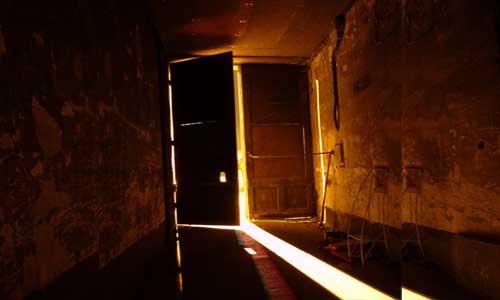
God’s house is the divided and broken house, the house with cracks and rifts because of the light and mercy of God bursting out in as a sign of God’s promise of new life given for us.
Mark 2:23-3:6
Again he entered the synagogue, and a man was there who had a withered hand. They watched him to see whether he would cure him on the sabbath, so that they might accuse him. And he said to the man who had the withered hand, “Come forward.” Then he said to them, “Is it lawful to do good or to do harm on the sabbath, to save life or to kill?” But they were silent. He looked around at them with anger; he was grieved at their hardness of heart and said to the man, “Stretch out your hand.” He stretched it out, and his hand was restored. The Pharisees went out and immediately conspired with the Herodians against him, how to destroy him. (Read the whole passage)
Today begins the second half of the church year, the first of Ordinary Time or Sundays after Pentecost. For the first half of the church year, we told the stories of Jesus’ life, beginning with Advent and Christ’ birth at Christmas. Than we continued on through Epiphany and Jesus’ baptism to Lent, and the story of Jesus going to the cross on Good Friday. And then there was the resurrection on Easter and Pentecost, the beginning of the Church. Today, we begin a six month period, 26 Sundays, of telling the stories of Jesus’ ministry, teachings and parables.
This year we will hear mostly from the Gospel of Mark. Mark is the oldest and first Gospel to be written. And Mark’s Jesus is perhaps the most interesting. Unlike Matthew where Jesus is like a Jewish religious authority, or Luke where Jesus is a kind healer, or John where Jesus is like a philosopher, Mark’s Jesus is a wild and untamed prophet. A cantankerous mystic who has got a mission follow yet keeps getting sidetracked by people looking for help with their issues.
And today, there is no warm up to the story… Mark throws us straight into the deep end of what Jesus is facing. It is only chapter 2 and the Pharisees are already plotting to destroy Jesus.
The disciples and Jesus are walking along, and as they walk the disciples are plucking some heads of grain from the nearby wheat fields, presumably to munch on. Yet, this almost mindless act catches the ire of Pharisees. For it is the Sabbath and plucking grain seems a lot like work. And working on the sabbath is against the 3rd commandment – Remember the Sabbath and keep it holy.
And so begins the ongoing conflict between Jesus and the Pharisees, who find Jesus’ constant flaunting of the rules to be infuriating.
So then Jesus enters into the local synagogue where the Pharisees are waiting for him. Waiting for him so that they can catch him breaking the rules, doing something truly offensive and awful… hoping that he might heal a man with a withered hand on the Sabbath. How terrible of Jesus!
And Jesus falls for the trap… or does he, as he scolds the Pharisees for their hardness of heart.
In case it hasn’t become obvious by now, the issue isn’t what Jesus is doing on the Sabbath. Rather, it is a familiar problem to us.
It is the problem of “That’s not the way we do things around here.”
The summer following my first year of university, I got a job working as a camp counsellor at one of the Lutheran Bible Camps near to my hometown. Now, if you think churches can get stuck in ruts of holding to traditions and rules above all else, Bible Camps have this problem on steroids. Campers, both young and old, come year after year, generation after generation, and they expect everything to stay exactly the same. That they will sing the same songs, eat the same food, play the same games, paddle the same canoes, sleep in the same cabins, make the same crafts and on and on and on.
My first summer working at camp, most of the staff was new, including the Camp’s Director. Being new meant we didn’t know the old traditions and rules… and there was no way we could even try to keep them and live up to expectations. So every week, when all the campers had arrived and we gathered together for the first time, the Camp Director would begin by having everyone chant three times, “That’s not the way we used to do it.”
And then he would say, “we have heard you and we know that things are different this year. And things aren’t going to be like they used to be anymore… but this is still the camp you know and love, even if how we do camp is a little different.”
Whether we are the Pharisees or people going to bible camp or folks who go to church, it can be easy for us to hold on to the traditions and rules of how we think things should go. And sometimes we can get a bit overzealous, holding onto the traditions no matter the cost.
But usually the rules and the traditions were created in order to help us. The law of Moses and Israel was created so that God’s people could know God and God’s love and mercy. Bible camp brings far flung people together for a week of intentional Christian community, and the traditions help bind them together. Church helps communities of people like us come together and tell the story of Jesus again and again through lifetimes and generations so that it becomes part our bones, part of our families, part of our history and our future.
But when the traditions and rules and laws and practices become more important than the purpose they were created for… they begin to do the opposite. They deny access to God’s love and mercy, they create tension and divide communities, they tell different stories of community, stories of judgement and conflict, exclusion and isolation.
“That’s not the way we do things around here.”
The Pharisees think they are protecting God by making sure the rules are followed at all costs.
But then God comes traipsing into their communities in the person of Jesus… and their reaction is to plot to kill God in order to protect the laws and rules.
And likewise, we are guilty of the same, protecting the rules and traditions even as the spirit comes blowing into our midst showing us new ways of being.
Thankfully, Jesus doesn’t show up expecting something different from us. Jesus knows that we are fallible human beings, prone to clinging to things that ultimately get in our own way.
And so Jesus reminds the Pharisees that life comes first. “Is it lawful to do good or to do harm on the Sabbath, to save life or to kill?”
Or in other words, what are these laws and rules for in the end. They are to help us know God and God’s love and mercy for us.
And that is what Jesus has come for.
To show us God’s love and mercy.
Mercy that sometimes means the rules have to be broken.
Love that sometimes means the traditions have to be adapted and changed.
Because here is the thing.
Sometimes we are the rule and law oriented Pharisees. Sometimes we are the protectors of tradition at Bible camp or church.
But sometimes we are also hungry disciples. We are also the man with the withered hand. We also people coming to camp or to church in need of God’s love and mercy. People who need a sign of God’s promise of life because we do not see it anywhere else in the world.
And so Jesus comes.
Jesus comes into our communities that cling to wrong things and try to protect the rules and laws and traditions that get in our own way.
And Jesus reaches out to us, reaches out to our hungry souls, to our withered bodies, to our tired spirits. To people tired of keeping the rules and to people tired of being crushed by the rules.
And Jesus reminds us of why we are here in the first place.
That God has brought us together and given us the tools to share God’s love and mercy to the world – laws and traditions that help us to proclaim the Good News of Jesus Christ. Tools that should remind us that God’s mercy is for everyone, and God’s mercy is especially for us.
And even when we loose sight that, even when we are busy trying to protect the ways we have always done it, Jesus comes to us again and again.
Jesus comes to us week after week, right in the very places where we try the hardest to hold onto the rules.
And Jesus comes to us in the waters of Baptism, in the Word we hear proclaimed and in the meal of mercy we shared. Jesus comes and takes our hands and restoring us to wholeness. Jesus grabs hold of us and welcomes us into God’s mercy and love, into God’s promise of new life.
John 3:1-17
There was a Pharisee named Nicodemus, a leader of the Jews. He came to Jesus by night and said to him, “Rabbi, we know that you are a teacher who has come from God; for no one can do these signs that you do apart from the presence of God.”…
“For God so loved the world that he gave his only Son, so that everyone who believes in him may not perish but may have eternal life.
“Indeed, God did not send the Son into the world to condemn the world, but in order that the world might be saved through him.” (Read the whole passage)
We last heard the story of Nicodemus back in January. As part of our trial through the Narrative Lectionary we heard his story in the lead up Lent, and his confusion was one we resonated with. Jesus is being especially confusing in his conversation with Nicodemus. And today is no different, but we hear this story again for a different reason. We hear it for its connection to the feast day that we celebrate today, and the way this conversation between Jesus and Nicodemus speaks about God.
Holy Trinity Sunday is a celebration a thousand years old… as the church tried to reign in the heresies taught by earlier missionaries to newly conquered peoples in Northern Europe, bishops of these northern kingdoms ordered the celebration of Trinity Sunday in order spread right belief.
And since then, the practice has stuck. So once a year, on the Sunday after Pentecost, just before we begin six months of green Sundays in order to hear the teachings and parables of Jesus, we remind ourselves what good and proper Christians believe.
And we believe in the Trinity – God who is Father, Son and Holy Spirit. Co-equal, co-eternal, all of one being, yet distinct persons. But not divided by identity or purpose, instead all of the same essence, all of the same God. Three in one, one in three – Father, Son and Holy Spirit.
Simple right?
Now you can all explain the proper, orthodox understanding of the Trinity?
Maybe you aren’t ready to teach a Sunday School class on the Trinity just yet? Well in fact, most of the things we teach about the Trinity are wrong, especially those children’s sermons where the pastor pulls out water in 3 states, or a pie or an apple in order to explain how God is one yet three. Usually what ends up being taught it one of the many heresies of the early church.
In fact, the only thing that might be completely reliable about Trinitarian doctrine is as soon as you try to teach it, you are likely to become a heretic.
And so you might wonder, why does the church set aside one Sunday each year to talk about this doctrine describing God rather than tell the stories of God and God’s people and God in Christ like we do all the other Sundays. Why do we have a day that is supposed to be for making us believe the right things, where we so often we end up teaching the wrong things? Why observe this Sunday at all and not stick to the regular program that we know and trust?
Trinity Sunday feels like it leaves us with this murky, mysterious, hard to explain doctrine of the church. The one God – Father, Son and Holy Spirit.
And yet, some of the haziness and fogginess of our understanding of the Trinity just maybe says more about what it means to live out this Trinitarian faith – this Christian Faith, than a solid definition of the Trinity. Because the challenge in understanding Trinity feels a lot like the challenge of trying to make sense of what it means to be a part of this mysterious and confusing family we call the Church. Just like we know that the Father, the Son and the Holy Spirit are all of the same God, we might not be very clear on just how it is that these three pieces come together into one God. And in the same way we know that we are are brothers and sisters in faith, and that our little community at Good Shepherd is just one part of a larger Body of Christ, we might not be clear on just how it is that we all come together into one Church.
In fact, most days we probably wonder just what is God doing with us… and why is the business of faith so rife with uncertainty.
Perhaps it is fitting here (at Good Shepherd), one part of the Interlake Regional Shared Ministry, that we observe and celebrate Trinity Sunday today. Perhaps our understating and clarity around Trinity feels pretty similar to our understanding and clarity about our future… in particular about the announcement (your pastor) made last week regarding the call to serve the shared ministry. Already we have been journeying towards something we that we do not fully understand and that we are not sure of. Coming together with 4 other congregations to share pastors and how all of that is going to work between 5 points, one full time pastor, one half time pastor and one supply pastor for the time being.
As if that wasn’t enough, my announcement that I am not taking the call to serve the shared ministry and rather beginning a search for another call actually means that I am going to technically remain the pastor of Good Shepherd a little longer than we thought. Yet… I am still in the end going to be serving as the regional pastor… but in an interim capacity. And all of that is compounded by a new search for a candidate whom God is calling to this new ministry, while I search for what God is calling me to next.
If we thought Trinity was confusing… just try understanding the Interlake Regional Shared Ministry for a few minutes.
So maybe struggling to understand Trinity for 2000 years has really just been practice for trying to understand just what God is up to with us at any given moment.
Or maybe… just maybe, understanding isn’t what this is all about. Nicodemus didn’t leave the conversation with Jesus today seeming to understand any more than when he first showed up.
Yet, Jesus reminded him of something important… and in the midst of all the confusion of Trinity and the Interlake Regional Shared Ministry, the reminder is the same for us.
Here in this place, the things that we do understand and know and trust will remain the same.
God still continues to gather us as the Body of Christ – the Church.
God continues to hear our confessions while offering us mercy and forgiveness.
God continues to open our hearts and minds to hear the word, the Good News of Jesus Christ.
God continues to stir our hearts to faith because of that same good news.
God continues to bind us together in prayer and peace.
God continues to welcome us to the table of the Lord – the communion of the saints where we share in the feast of heaven.
God continues to offer us Christ’s very Body in order that we might become that which we eat – bread for the life of the world.
And God continues to send us out transformed and renewed to be workers in the Kingdom.
And all of that happens because of the God who has named and claimed us in Baptism, the risen Christ who has shown us the way to new life, Jesus who meets us here week after week.
Whether or not we understand the Trinity and whether or not we know just what is going to happen to us as a congregation and fledgling new ministry in the Interlake, God’s promise to us remains… ‘how’ it all works is not really for us to worry about. God is assuring us that here, among this community and family of faith, that the things we need are still given – that Jesus continues to meet us here in Word and Sacrament.
As Martin Luther’s right hand, Philip Melanchthon wrote about the Trinity,
“We adore the mysteries of the Godhead. That is better than to investigate them.”
Or in other words, better than understanding the Trinity and how it all works, is to gather together in worship and communion as the Body of Christ.
And the Mysterious Triune God who calls and gathers us together will do there rest. The Trinity will continue to bring us into New Life, found in Christ.
*As I am currently on vacation, here is a guest sermon from Rev. Courtenay Reedman Parker, whom you can find on Twitter @ReedmanParker and on Instagram: creedmanparker
Gospel: John 17:6-19
[Jesus prayed:] 6“I have made your name known to those whom you gave me from the world. They were yours, and you gave them to me, and they have kept your word. (Read the whole text)
Here we are, the end of the Easter season. Seven weeks later, many stories and experiences of new life – unexpected life. These stories begin with grief and loss: death, an empty tomb, and no body. They do not begin in a place of joy or jubilation, or even peace. They begin from a place of fear and anxiety. From a place of not knowing what the future will hold.
In this season of Easter, these 50 days between the Resurrection and Pentecost, we spend a lot of time within the setting of that first day of the week. And the starting place for most of the these stories is so far from what the worship committee plans. The faithful women, the disciples, those who followed Jesus, are in a state of shock and disbelief. They can’t see Jesus when he stands before them, they don’t believe the testimony of others – at least not at first.
Like us, the early followers of Jesus, the faithful women, the disciples, have ideas about who God is, and how God acts in the world, how God acts through us. And what they were seeing and hearing didn’t match those expectations. Those ideas. Their long held beliefs.
Like the disciples, the faithful women, the early followers of Jesus, it’s hard for us to see, to understand, to follow Jesus, God, even when God is staring us right in the face!
But these stories don’t stay in a place of disbelief or lack of sight for long. Because God stays with those people – God stays with us – until they see. Until they believe.
Seeing what was previously un-seen. Believing in what previously was un-thinkable, un-heard of, un-imaginable.
Jesus lives. Alleluia!
New life, it turns out, is full of unexpected, unanticipated realities. Ask any new(ish) parent, and they will likely tell you, “this was not what I expected”. New life is hard work. Navigating these new realities, navigating not only the new life, but the new life and role as parent not easy. Not by a long shot.
And for all the planning, all the reading, all the advice and preparations, the most accurate version of what to expect when you’re expecting is to get ready for the unexpected. It would be a short book.
And maybe that’s part of the problem, part of the challenge for us – the un-expected. the un-planned.
Like it or not, we like to know what to expect. We like to know what’s ahead of us. We like to follow the rules. Or at least know what the rules are, so we know what the consequence is of breaking them!
We see this throughout scripture – how rule-bound the Pharisees become, not being able to separate the rule of law from the spirit of the law. Good and faithful people become so rule-bound that they are unable to see how God is at work in and through the ways and means and people that were above or beyond the rule.
Today is no different. In our first reading from Acts, we encounter the disciples taking up the task of choosing who from their community will fill Judas’ spot as a disciple after Judas’ betrayal of Jesus.
This community, and this group of people in particular, has already been through a lot! They want, and probably need, someone who they can trust. Someone they can depend on. Someone who won’t betray them the way Judas betrayed Jesus. They want to ensure that they “get it right”. As though getting it right will somehow ensure that they will not be disappointed again in the future. Or worse, that they will disappoint God in their decision making. That not getting it right, will somehow reflect upon their faithfulness.
But we know that even when we follow all the rules, when we follow the letter of the law, when we attend to every detail – it’s still possible to be disappointed. It’s still possible to not get it right, not all the way anyhow.
And that’s the rub. When we’ve done all the things we’ve been taught to do, and still find ourselves wanting… waiting… hoping for things to turn out in a way we can predict and anticipate. And then disappointed when they don’t.
But here’s the thing: that’s not how faith works. It’s certainly not how God works.
Note how the disciples put so much time and effort into choosing the correct candidate to take Judas’ place. Note the “rules.” Has to be a man, has to be someone there from the beginning, has to be someone who has witnessed the resurrection. [Only] two qualify. We learn their names. Lots are drawn. A man was chosen. And we never hear from him (or the other guy) again….
Because God was busy calling Paul. And Lydia. And the Ethiopian Eunuch. And so many more who weren’t in the narrow subset of ideas about who could be God’s messengers.
This is who God is. And this is who God reveal’s God’s-self to be over and over and over again. When God’s people become so rule bound that they cannot see God’s unconditional love and mercy, God chooses Mary to mother God’s son. Jesus arrives in a lowly stable and leaves the world by a procession on a donkey and hanging on a cross. And in his life, Jesus chooses the least likely candidates to help him proclaim God’s message to the world. He hangs around with the weirdos and the misfits, the outcasts and the strangers no one wanted – or by virtue of following the law – ought to be hanging around to be ritually clean. Jesus does all the things the law, the rules, tell him not to do. Talk about unexpected. This is who God is. Unexpected.
God does the unexpected. That’s what new life is – unexpected. The way God uses us is unexpected. How we get to live out God’s love and mercy in the world usually unexpected.
And so too, for us here gathered at Gimli Lutheran Church, maybe wondering how on earth is God working in and through us? Maybe you are feeling like you’ve followed all the rules and are still coming up short. Maybe you wonder where God is in the midst of this time of transition – between pastoral leadership, as the place and prominence of the church – not just here, but towns and cities, in families and communities changes.
Like the faithful women and the disciples on that first morning of the resurrection, we might feel like we are staring into an empty tomb. Like the disciples after Jesus’ ascension, we too might wonder how to find a leader to help us grow in our faith and equip others to know about Jesus and this great love God has for us.
But God does not wonder about us. God knows us inside and out. God knows our deepest desires and longings. God knows our fears and our dreams. God knows both what we want and what we need. And just like the early disciples, God is already out in the world calling forth new life, new leadership for this community. God is already stirring in us new life, new ideas, new ways of being that we can expect will be completely unexpected to us. This is who God is. Unexpected in the grace extended. Unexpected in the mercy given. Unexpected in the ways God continues to bring about new life in us and throughout the world.


 The Millennial Pastor