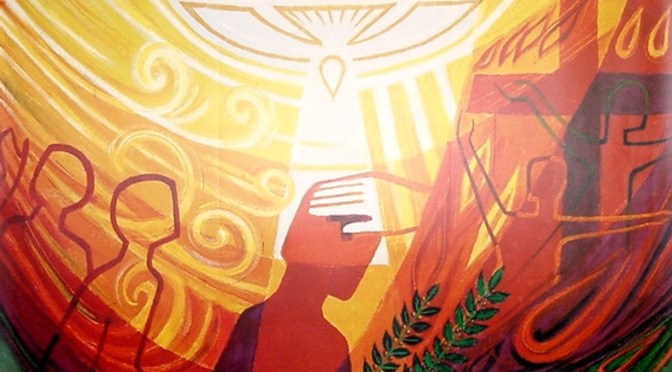
Being Salted with Fire

GOSPEL: Mark 9:38-50
38John said to [Jesus,] “Teacher, we saw someone casting out demons in your name, and we tried to stop him, because he was not following us.” 39But Jesus said, “Do not stop him; for no one who does a deed of power in my name will be able soon afterward to speak evil of me. 40Whoever is not against us is for us. 41For truly I tell you, whoever gives you a cup of water to drink because you bear the name of Christ will by no means lose the reward.

49“For everyone will be salted with fire. 50Salt is good; but if salt has lost its saltiness, how can you season it? Have salt in yourselves, and be at peace with one another.”

Today, we continue through the gospel of Mark, delving deeper and deeper into the question of what it means to follow Messiah, to be a disciple, to figure out our place in the world. As we head into these homestretch weeks of this long season of green, we will continue to be confronted with the difficult questions of faith and the difficult questions of our human condition. 

And as we face these questions, Mark is revealing a vision of how God is breaking open our world to make room for the Kingdom. Slowly but surely, we are being invited into this mission that Jesus is on in Mark – the Mission of bringing the Kingdom of God near to those who need it. 

One of the things about Jesus in the Gospel of Mark is that he gets a little cranky. Jesus has been cranky off and on during the past few weeks. Yet, last week he showed surprising restraint and patience with his struggling disciples. But this week he more than makes up for it, by ranting in frustration about the inability of his disciples to get out of their own way. 

Today, we continue from were we left off last week, when Jesus had sat down his disciples to unpack their struggles. They had been arguing about who is the greatest among them because the didn’t know where they fit in their world. Jesus had picked up a baby and holding the baby in his arms, told them the first must be last and the last must be first; that Kingdom of God was for the least of these. 

Still in that moment, gathered around, baby in arms, the disciple John interrupts his teacher.

“Teacher, we saw someone casting out demons in your name, and we tried to stop him, because he was not following us.”

Rather than letting Jesus’ message sink in – the message that in the Kingdom of God there is no order or rank or hierarchy, there is only belonging – John cannot let go of his insecurities. John is thinking that if the group cannot be measured by rank, then at least they can figure who is inside the group and who is outside. It is almost as if John needs to be able to quantify his worth and place this group. He cannot trust that God knows. 

Even still, John’s question reveals a particularly deep insecurity. He is upset that there are people out there casting out demons in Jesus’ name because the disciples had struggled to do the very same thing. Jesus had sent them out, but when the disciples had retuned they were unable to do the deeds of power. Now, here were some people doing the thing that the disciples could not do and they weren’t even a part of the group. 

John is revealing the thing that keeps the disciples from ever really getting what Jesus is up to – their insecurities about their role as Jesus’ followers. 

It is an insecurity that still pops up for us – the thing inside of us that cannot rejoice in the successes, talents and abilities of others, but instead seeks to tear down those who seem to threaten our place and position. On the sports team, dance group or musical ensemble, it is person who cannot abide the talent and ability of teammate.  In the workplace, it is the one who undermines the capability and productivity of a co-worker. In the church, it is the leader who shoots down every new idea before it is given a chance. In a family it is the jealous sibling, spouse, parent or child, who resents a loved one for the gifts they show, rather than rejoicing. 

This insecurity is almost certainly at the heart of most divisions and conflict we endure in our world. It is why political campaigns start out positive but go negative when another seems to poll better. It is why internet debates turn so rancid so quickly, when argument and reasons cannot sway opinion, people quickly turn to attacks and insults. It is why expert opinion no longer holds the water it once did, because so many of us think we should be experts on everything and get our backs up when it feels like someone or something is suggesting we might not know as much as we think we do. 

It is an insecurity rooted in the deepest part of our humanity, in the sinful self who just cannot let go of our own needs to feel adequate and needed and capable at all costs, even the denigration of our neighbour. 

And this insecurity is why Jesus erupts into his angriest rant to date:

42“If any of you put a stumbling block before one of these little ones who believe in me, it would be better for you if a great millstone were hung around your neck and you were thrown into the sea.”

And on Jesus rants, declaring that if one part of our bodies cause us to sin, they should be cut off and thrown away. For some reason, preachers and other church folk have heard this rant from Jesus as some kind of formula or prescription for dealing with sin – a tough love approach to community conflict. But certainly it is not that. It is Jesus losing his cool with disciples who just cannot get out of their own way – disciples who cannot see that good ministry happening in Jesus’ name does not need their approval or sanction. 

But what is perhaps the most striking about Jesus’ angry rant is not the vivid imagery of being tossed into the ocean with a rock tied around one’s neck, nor cutting off hands, feet or pulling out eyes that cause sin. It is that Jesus is still holding the baby, that little one, the least of these. 

As Jesus has gathered his struggling disciples, who just need to know how they fit into their new world, as he tries to give them a symbol of their equality before God. As he reminds that God has room and a makes a place for even a helpless baby – a person with little value or import in that world – Jesus is frustrated that the disciples cannot let go of their insecurities. They cannot get past their fears and trust what has been promised and given to them by God. 

But then… before going too far, Jesus reels himself back in. And though it may sound cryptic, Jesus comes back to the point:

  49“For everyone will be salted with fire. 50Salt is good; but if salt has lost its saltiness, how can you season it? Have salt in yourselves, and be at peace with one another.”

Ancient salt and fire were central elements of daily life. Salt was used for money (or salary), for roads, to preserving food, for making brine for forging metal. And it worked along with fire to make things pure and safe. But ancient salt was also impure and needed to be carefully maintain and used. Fire and salt worked together in so many areas of ancient life. 

Jesus is using this image of salt and fire – obscure to us, but common to the disciples – to remind them again of their role in the mission of the Messiah. The Messiah who realized that God’s grace was give for all people by the Syrophoenecian woman. The Messiah who is on the road to crucifixion AND resurrection, no natter Peter’s objections. The Messiah is not concerned about first and last, but about gathering up all God’s people. This Messiah reminds the disciples to be at peace – God is making them worthy!

It is no accident that at the lowest of the lows, hiding away in the upper room after the crucifixion of Jesus, that the risen Christ appears to his followers saying “Peace be with you.”

And it is no accident that this is God’s message for us too. 

Even as we feel like our hands and feet and eyes have been cut off, even as feel as though our saltiness is fading away… Jesus’ promise to us that that God is transforming us for the Kingdom. 

Despite our inability to get out of our own ways. Despite our tendency to hang on to our insecurities. Despite feeling unworthy of the mission of the Gospel. 

Jesus is salting us with fire. God is making us ready for Kingdom. 

Yes, that might mean that some of our baggage needs to be dropped. Yes that might feel like parts of ourselves are being cut off. Discipleship is not easy. Being transformed by God sometimes takes us to uncomfortable places and out future is less certain than it ever was. 

But it is exactly in these times of change and crisis, that the work of transformation takes place. This is exactly where God is doing God work. Here with insecure people who are certain we aren’t good enough, who want to know if and where we belong. 

And yet, God is salting us with fire, removing our imperfections, making holy, and preparing us for the mission of the Kingdom. 

Who is this greatest? There are only sinners, like us.

GOSPEL: Mark 9:30-37
35He sat down, called the twelve, and said to them, “Whoever wants to be first must be last of all and servant of all.” 36Then he took a little child and put it among them; and taking it in his arms, he said to them, 37“Whoever welcomes one such child in my name welcomes me, and whoever welcomes me welcomes not me but the one who sent me.”

Sermon

As we round into the final weeks of this long season of green, on our way to the end of the Church year and Advent, we continue to hear Jesus interact with his disciples. Last week, Jesus asked them who they thought he was. It was a moment of revelation followed by rebuke. Peter declared that Jesus was the Messiah but then turned around and lost the plot, getting upset with Jesus for following the path set out for the Messiah, the path of suffering and death. 

This week, following this key revelation, as they are traveling between towns, the disciples begin to bicker about who among them is the greatest. It sounds childish considering who they are following and the teaching about what it means to take up their cross that Jesus had just given. Arguing about who is the greatest feels like it is something that belongs on the playground, a conversation for children….

And yet, it is an argument that drives so much of our world these days. Only about a month ago three billionaires raced to see who could be the first private citizen to fly to space. As we speak, Canada is in the midst of a Federal election with the leaders’ debate was last week, where every question was a nuanced version of ‘who is the greatest?” And of course, our society is full of controversy over COVID-19 public health measures, including vaccine requirements. My home province of Alberta tried to win the race to be the greatest in declaring the pandemic over in July, only to now be looking at a total healthcare system collapse over increasing numbers of COVID-19 cases. 

So this argument that the disciples are having might seem immature, but it is certainly not an unusual one. Maybe it is worth considering just what is really going on. 

As Jesus continues to preach and teach, he has been speaking more and more about what is the come for the Messiah – more and more about his impending suffering and death. And the disciples have started to put it all in the context of understanding Jesus to be the Messiah – just as Peter confessed last week. 

Yet, the disciples still don’t understand what this all means for them. Before, when they were fishermen and tax collectors, they know their place in the world and their place in their communities. In their extremely ordered Hebrew society, they knew their rank and station.

Yet now, as Jesus has called them out of those known places and into this unknown position of being his followers, followers of the prophesied Messiah, they are struggling to know who they are and where they fit. The place of the Messiah in the world comes predicted and described, but where Messiah’s number 2 through 12 followers fit might not be clear. 

So they do what human beings so naturally do, they try to sort out where they fit and who they are, within the context of their community. They try the best they can to answer that deep question within all of us that asks who we are and how to we fit into the world around us. 

But also like us, they go about it in toxic and self-destructive ways. They try to order their community by rank, putting themselves on top and those around them below. It comes from the same place that the question that the serpent posed to Eve came from, the question about knowing her place in the garden. 

This question is one that continues to plague us today, this desire to know where we fit and who we are. And even though it can feel like the kind of question that children ask or argue about – think “my dad is stronger than your dad” – it is is one what drives so much of our world. 

It is a question subtly asked in car commercials, suggesting that a new car would improve our station in life. It is one baked into the marketplace and corporate world, constantly demanding more productivity, more profit, more loyalty. It is part and parcel with every political move and decision, and at the heart of every political campaign. It often shows up in churches when we look at and wonder about the neighbour congregation down the street and how they are doing. 

And in the midst of crisis, as we are now, it shows up as we try to figure out what to do and how to proceed. And when opinions differ, especially when agreeing to disagree isn’t possible but instead decisions have life and death consequences, we can be guilty of posturing according to our position rather than searching for the course of action that it is best for all. 

Trying to sort this all out, trying to understand where we fit – or more specifically “Where do I fit?” is something deeply imbedded in how we understand ourselves. We need to know where we stand and where we fit into the world around us, no matter how destructive the search for the answer can become. 

When Jesus hears the childish argument of his disciples, we might expect the grumpy Jesus who called the needy but persistent Syrophoenician woman a dog two weeks ago or the angry Jesus who rebuked Peter. 

But instead Jesus stops and calls his disciples to gather around and asks “What were you arguing about on the way?”. When none of them has an answer, Jesus has them sit down with him. You can imagine that Jesus sees beyond the childish argument, and instead sees disciples who are struggling to understand their place in the world. Disciples who need reassurance rather than competition, disciples who need to be reminded that they belong. 

“Whoever wants to be first must be last and servant of all.” he declares.

Then Jesus brings in a little child and puts it among them. But not just any child, but greek suggests that Jesus has brought an infant into their midst. Children in this world were considered to be blessings but also people for whom you didn’t get too strongly attached, lest they didn’t survive childhood. Children’ weren’t considered full persons until grown. 

So with this baby in his arms, Jesus holds one who is considered to be the least of all in that world. And Jesus says that whomever welcomes this one, who is the least and lowest in world, welcomes him. 

Jesus is chipping away at the disciples need to establish an order, their need to know where they fit by creating ranks and status among themselves. Jesus is using the tangible example of this baby as the means of showing his disciples what it means to belong to the Kingdom of God. There is no rank, first and last have no meaning. Belonging is what matters. God welcomes them, they belong to the Kingdom. They are children of God, servants to one another, members of the Body of Christ. 

The question about who is the greatest doesn’t apply here, instead who do you belong to is what matters. And with God, all belong in the Kingdom. 

It is a message that almost does’t compute in our hyper competitive world. Defining ourselves by who is on the top feels like the only way to understand ourselves. But God gives us a different understanding, an understanding based on belonging and not on rank. 

It is a part of our understanding of who we are that has been challenged by this pandemic. Our sense of “we” or community has been shaken. We have had for more opportunity than we really need as individuals to contemplate our individual identity.

Yet, God reminds us again and again, there is no greatest among us. 

There are only sinners to whom God gives grace, mercy and absolution. 

There are only suffering people for whom God promises healing and reconciliation

There are only the lost, least and forgotten, whom God welcomes into the Body of Christ. 

There are only the unwashed, whom God makes clean in the waters of Baptism. 

There are only the hungry and starving, whom God feeds at the table of the Lord. 

There are only disciples, whom God sends out to heal a world in need. 

In confession, in the Word, in praise and prayer, in baptism and the Lord’s Supper, God reminds us again and again of not who, but whose we are – we belong to God. There is no greatest and there is not least, but instead there is a place for all in the Body of Christ – all belong to God. 

Even our small lives don’t get in way of God’s big picture

GOSPEL: Mark 8:27-38
31Then he began to teach them that the Son of Man must undergo great suffering, and be rejected by the elders, the chief priests, and the scribes, and be killed, and after three days rise again. 32He said all this quite openly. And Peter took him aside and began to rebuke him. 33But turning and looking at his disciples, he rebuked Peter and said, “Get behind me, Satan! For you are setting your mind not on divine things but on human things.”

This week, I sat down to watch the movie Worth. The story dramatizes the real life story of Ken Feinberg, the lawyer who was tasked to run the 9/11 victim compensation fund. In the opening scene, Ken lectures a law school class about the value of a human life. “What is a life worth” he asks? Certainly the question of what is the value of a human life is interesting to think about. But the real impact of the movie was to bring me back to my own memories of September 11th, 2001. Even on this 20th anniversary of 9/11, most of us can instantly remember where we were and what we were doing when the news that planes had hit the two towers.

There are a handful of such events that ground our lives, that we can instantly remember where we were and what we were doing when they are brought up. Victory in Europe Day in 1945. The assassination of JFK in 1963.  9/11… these moments are etched in our memories because they changed our world forever.

And now many of us remember the middle week of March 2020. When the first cases were announced in Manitoba, when the shutdowns were enacted and our whole world changed. 

In more normal times, we can be guilty of just going about our lives without too much attention paid to the larger things going on in the world. The business of what to make for supper, when to water the garden, remembering to change the furnace filter and pay the water bill, of being on time for work, of making time for coffee with friends, of caring for family and making time for rest… we can be pre-occupied with all the things of living life day to day. But those moments when the picture stops us in our tracks often stick out in our memories, they even have the power to shape and form us into new and different people. Still most of the time, the big picture isn’t forefront in our minds. 

Today, when Jesus takes a moment to ask his disciples who people say that he is, he is very much addressing this conflict within us of letting the small everyday things of life overtake the big picture. 

Jesus and the disciples are in Caesarea Phillipi, which is not just relevant because of its place on the map. Jesus and his disciples have left Hebrew territory, and are in gentile lands. They have stepped outside of the chaos, into a place where they are mostly unknown, where they can find a moment’s rest from the crowds and religious authorities. 

And it is here that Jesus asks his disciples, “Who do people say that I am?”

Being good disciples who know the faith of Israel, they provide answers that cover all the bases. John the Baptist, Elijah, a prophet… all examples of roles within the Israelite religious understanding. 

But Jesus takes it a step further, “Who do you say that I am?”

In a moment of insight, Peter gets it, “You are the Messiah.”

And with that revelation, Jesus takes the opportunity to unpack just what this all means. He reminds his disciples that the Messiah must undergo what the prophet Isaiah wrote about – the Suffering Servant. Rejection, persecution, suffering and death. 

And all of a sudden Peter’s bubble pops. The insight he brought forward just moments earlier is gone, and he pulls Jesus aside. He begins to rebuke his teacher and master for talking this way. Jesus does not like this shift from Peter, and gives a rebuke of his own, “Get behind me, Satan! For you are setting your mind not on divine things, but human things.”

Just as we heard last week when Jesus called the Syrophoenician woman a dog, Jesus can lash out when tired and frustrated. Here again, Jesus’ rebuke of Peter might be less of a condemnation of Peter’s flub and more a frustrated teacher annoyed by one of the students interrupting the lesson because he is missing the point. 

As we hear the story again, it is easy to think that we would never be as foolish as Peter to tell Jesus what to do at the precisely the wrong moment. But Peter is not special in his misunderstanding. Peter is simply wanting to preserve the relative comfort that he has found as a follower of Jesus. He has found purpose and importance, found a mentor and teacher that he wants to follow. Jesus dying will mess that all up.

Just like Peter, it is very easy for us to let our lives – our thoughts, our desires, our plans – fill the world. It is easy to come to church and to hear of God’s plan for the salvation of creation and then only a few minutes later be more concerned with what lunch will be. It is easy to let the busyness of our lives fill the world and push God aside. 

And even in mid pandemic, when our busy lives have been made smaller, we probably haven’t made more room for God and faith… instead our smallness has still managed to fill our world. Peter is sidetracked by the thought of the suffering and death of his teacher and master. And we are guilty of letting the slog of just getting from one day to the next push God out of our attention. 

Our fears about work, family, friends, and community push God out. 

Our keeping up with news updates, or trying to ignore the news at all costs push God out.

Our navigating a world that we both miss and that is more dangerous push God out. 

Our attention to politics, economics, social justice, reconciliation, climate justice and more push God out.  

All of it pushes God out of our thoughts and attention.

Yet even when Peter pulls an irritated Jesus aside to rebuke him,… Jesus still finds a way to re-orient Peter’s hangs up. 

You can imagine the group standing in a circle as Jesus speaks. At first when Peter identifies Jesus the Messiah, everything within the circle, within the group feels right. But then Jesus starts talking about how the Messiah must suffer and die. Peter must have felt like the world outside the circle starting to close in, dark shadows forming around the group making everything feel dangerous and overwhelming. When Peter cannot take it anymore, he pulls Jesus aside, making his circle of safety even smaller. Peter is trying desperately to hold on to what is good and comfortable, to his life following this popular teacher and preacher… not following a Messiah toward suffering and death. 

But then Jesus turns from Peter, back to the disciples. Jesus opens up Peter’s little circle. Jesus pushes back the dark shadows and scary outside world. Jesus opens himself up everything around him.

The Messiah, the Son of Man, has not come to create a small comfortable circle of disciples, but to save the whole world. Jesus has come to bring the whole world back into the grace and mercy of God. 

Peter’s smallness and details won’t push Jesus away. Instead the opposite happens, Peter’s life becomes part of the story of God in the world.  

In fact it isn’t just Peter, nbut the story of the Messiah, the suffering and death of Messiah gathers all of our busyness – all of our concerns that fill the world, or our small day to days that take all our attention – and Messiah folds us and our lives into the story of God. We might try to push God to the margins, but faith will let go of us. 

From the beginning, Jesus has reminds his disciples that the work they are doing and that this path that they are following are a part of God’s promises salvation. The way of the cross is about saving the world. And that way of cross the transforms us to the core.  

It isn’t just that God is saving our troubled world, but God is changing us along the way. All of our busy, small, inward looking selves… all the thing that occupy and distract us from faith, that cause to forget God…  God is folding and working them into the story of salvation, the story of grace and mercy given for all.

Peter’s desire to keep things they way they are, to keep his friend safe…. And our focus on getting through each day, living in a topsy turvey pandemic world… these things are now a part of God’s story. God story gathers us all up, no matter how much our lives try to fill up the world. 

The Messiah is on the way of the cross. The way of suffering, rejection and death. But also the way of resurrection and new life. 

And the Messiah is bringing us along… even when we cannot see it, even when it feels like the details of life gets in the way…. Jesus brings us in. Jesus take up his cross and carries us too… carries us to empty tombs, to resurrection and into New Life. 

Crossing the Boundaries of Faith

Mark 5:21-43
And a large crowd followed him and pressed in on him. Now there was a woman who had been suffering from hemorrhages for twelve years. She had endured much under many physicians, and had spent all that she had; and she was no better, but rather grew worse. She had heard about Jesus, and came up behind him in the crowd and touched his cloak, for she said, “If I but touch his clothes, I will be made well.” Immediately her hemorrhage stopped; and she felt in her body that she was healed of her disease. Immediately aware that power had gone forth from him, Jesus turned about in the crowd and said, “Who touched my clothes?” And his disciples said to him, “You see the crowd pressing in on you; how can you say, `Who touched me?'” He looked all around to see who had done it. But the woman, knowing what had happened to her, came in fear and trembling, fell down before him, and told him the whole truth. He said to her, “Daughter, your faith has made you well; go in peace, and be healed of your disease.”

Last week, Jesus crossed the Sea of Galilee with his disciples. As a storm blew upon them, the frightened disciples worried about Jesus sleeping in the boat. But Jesus woke up, calmed the storm and wondered what the fuss was all about. 

Before returning across the lake to the point in the story we heard today, Jesus went to Gentile territory. There, Jesus exorcised a demon-possessed man living with the pigs. In the short trip, Jesus crossed the boundaries of Gentile and Jew by crossing into Gentile territory and interacting with people and things with whom he should not normally be interacting.

In just that quick trip across the lake, Jesus showed that the boundaries most people observe, don’t scare him. 

And today, when Jesus lands back on the Jewish side of the Sea of Galilee, the boundaries have been crossed and the rules broken. There is no going back now. 

Today, it is first Jairus who eschews social norms to throw himself at the feet of Jesus to beg for healing. Jairus, an upstanding leader in the synagogue, begging a wandering preacher for mercy for his sick daughter. 

And then the woman who had been bleeding for 12 years breaks nearly every rule imaginable to get access to Jesus. 

As Jesus responds to these two very different requests for healing, it can feel like one story is jammed into another. Jairus and his dying daughter, and the woman who had been bleeding for 12 years. It can even feel disjointed and a bit like an interruption…. In fact, Jesus starts to seem like a traveling medi-clinic. Like a place for the sick to go for healing, a source of power for those in need. But as we heard earlier in Mark, Jesus has not come to be a miracle healer, but to preach the Kingdom of God coming near. 

So these two stories start out on the surface to be about healing, but turn out to be about so much more. 

When Jesus arrives on the shore of Galilee, Jairus, a leader in the synagogue throws himself at Jesus’ feet and begs for help for his sick daughter. Jairus, an important community leader, who would usually have a servant for errands like this, comes to Jesus directly. Jairus, who should have considered Jesus an equal, if not a subordinate, throws himself at Jesus’ feet. Jairus, who should have requested, commanded or ordered Jesus to help, begs. He begs immediately and without shame. In desperation, Jairus breaks the rules of how a man in his position should behave. 

And then there is the bleeding woman. The woman who had been poked and prodded by doctors to no avail. The woman who had been suffering for 12 years in an unclean and impure state. The woman who is not allowed to be in public, or to touch others, especially men. The woman who has no voice and no advocate. The woman who pushes into the crowd and steals a healing without even asking Jesus for it. In her desperation, this woman crosses the boundaries of what polite and proper people should be and do.  

It is easy to gloss over these images of Jairus and the bleeding woman. It is easy to see no problem with persons of prominence and authority throwing themselves at Jesus’ feet. No problem with the weak and powerless reaching for the fringe of Jesus’ cloak. 

And yet, we live in a world full of boundaries. A world where we have needed to think carefully each day about how our actions and decisions will either run up against or cross boundaries.

And when we aren’t measuring risk and public health orders, we have been living with the boundaries of screens. The tools that simultaneously allow us to connect with family, friends and community when we otherwise would not be able to, but that also remind us of the distance we have been keeping from each other these past months. 

Now, as vaccines are rolled out, questions around who can do what, who can go where and what it means to be completely safe have arisen. Will businesses, schools, public services and even churches make distinctions between those who are granted access and those who aren’t? 

Of course, it hasn’t been just the pandemic that has placed boundaries on our lives. For the past year, the boundaries and barriers created by colonial and racists histories have lifted up the many obstacles that people of colour face in our society, and particularly the systematic and institutional barriers that Indigenous people face in Canada, put in place by predominantly White Christian Settlers through the Indian Act, the reservation system and residential schools. 

The boundaries and barriers of the world help us to make sense of things, help us to know how to follow the rules. They often define the way people belong, so that we can know where we belong. They allow us to know who is “in” and who is “out” among us. Who is permitted and who is not. 

And yet we also know that the rules and boundaries don’t always serve everyone equally. We know that sometimes people end up in places where the rules push them down and grind them into the ground. We know that the boundaries can become walls, keeping people out and in the darkness, isolated and alone. 

The rules and the boundaries that we live by, that we hold onto so that we can feel safe and secure… can also hurt and exclude and we know it, because sometimes we are the ones being pushed down and we are the one stuck on the outside. 

But Jesus has this habit of doing things and going places that we cannot. Calming storms and talking to demons.  

Jesus crosses the boundaries and breaks the rules. 

Jesus crosses the boundaries and breaks the rules because Jesus wants to bring God close, the Kingdom of God near. 

As the woman who had been bleeding for 12 years crosses every social boundary imaginable and steals a miracle from Jesus, and as Jesus himself is not quite sure what has happened, he demands to know who has touched him. We would expect that Jesus would have condemned and scolded this woman, but instead he stops to hear her story. And then he joins her. Joins her on the other side of the crossed boundary. As an unclean sinner, she isn’t supposed to be out in public or touching people … no one but family, that is. And so Jesus steps out of the public space and into a familiar one… “Daughter” he calls the woman. Jesus makes her a member of his family, a person whom he can be close to even if she is unclean. “Your faith has made you well.” And then he blesses her. By crossing the boundary, and breaking the rules, Jesus gives this woman the first bit of care and compassion, of healing and wholeness that she has known in 12 years. And it wasn’t by healing her of her bleeding, but by joining her in her isolation. 

And then Jesus continues on to Jairus’ home, and he enters despite the news of the little girl’s death. The waiting crowds tell him not to enter … they know the boundary that has come to this place.

And yet having just crossed boundaries to heal the woman bleeding for 12 years, perhaps Jesus is inspired to keep going. To keep crossing boundaries. He comes near to a sick person, a possibly dead person, and intrudes on a grieving family. 

But Jesus knows that the little girl will rise. 

Because Jesus is going to cross another boundary to join this little girl, this second daughter that he meets today. 

Jesus crosses the uncrossable. 

Jesus reaches across death and brings the little girl back to life. 

Jesus crosses the boundary of death. 

Jesus also crosses the boundary of resurrection and new life. 

And we saw it coming all along, because we know that story already. We tell it every week. 

For, you see, for all of our rules as human beings, we keep telling the story of God in Christ who breaks the rules. 

Christ, who gives forgiveness even though it is undeserved. 

Christ, who washes in the waters of baptism even though we are unclean. 

Christ, who brings peace even though there is conflict. 

Christ, who makes us one even though we are many. 

For, you see, for all of the boundaries that hem us in, we keep telling the story of God in Christ who crosses the boundaries and joins us where we thought God should NOT come. 

Christ joins us as the incarnate God, born into creation. 

Christ comes to us in the Word of God, spoken through human voices and heard with human ears. 

Christ gathers us together from every nation and tribe and corner of the earth. 

Crossing boundaries and breaking the rules shouldn’t be a new or surprising thing for us, because almost from the very moment we gather until we are sent out, God is doing just that in, through and with us. 

God is crossing boundaries and breaking rules in order to name us as daughters and sons, making us part of God’s family, bringing the kingdom near to us. 

No matter how much we love rules and cling to boundaries, God will always be willing to break and cross them, in order to love us more. 

The Kingdom is not in us. We are in the Kingdom.

Mark 4:26-34
Jesus said, “The kingdom of God is as if someone would scatter seed on the ground, and would sleep and rise night and day, and the seed would sprout and grow, he does not know how. The earth produces of itself, first the stalk, then the head, then the full grain in the head. But when the grain is ripe, at once he goes in with his sickle, because the harvest has come.”

Today, our journey into Mark’s gospel continues. Last week, we started this long season of green by hearing how Jesus’ family thought he was crazy. But we also heard that in the middle of all the human chaos, and the divided messy nature of human relationships, Jesus stays the course of bringing new life to us and to the world. 

Today, we return to more familiar parables: Parables of the Kingdom. And while this teaching may be familiar for us, it wasn’t for those to whom Jesus was teaching and preaching. When Jesus tells parables of the Kingdom, lessons that often begin, “The Kingdom of God is like…” we hear them with 2000 years of Christian tradition that has made us ready to hear them. But to the people of 1st century Israel, their understanding of the Kingdom of God was very different from ours. Before unpacking what Jesus said, it is important to know what the people would have expected. 

The Kingdom of God for the people of ancient Israel had a very specific form. As we are reminded each Advent, the Israelites were waiting for the Messiah, the Saviour King who would free them from foreign oppressors like the Egyptians, Babylonians, Persians, and Romans. And this Messiah King would establish an earthly Kingdom with divine approval – a powerful kingdom with powerful armies – maybe even powerful enough to do some oppressing itself. A wealthy kingdom with abundance – maybe with enough abundance that other nations would come begging to it. This Kingdom would keep Israel from ever again being ruled over by foreigners. This Kingdom would find favour with God, and would therefore be a holy and righteous Kingdom. This Kingdom would be centered in Jerusalem, with the temple, God’s dwelling place, as its symbol of power. The Kingdom of God was long hoped for but also had to live up to very specific criteria. 

Into this expectant time Jesus showed up. And he started telling parables about the Kingdom of God being like unknown seeds scattered in a field, with the sower having no clue how they would grow. Jesus told parables of how the Kingdom of God was like the humble mustard seed, the 

smallest of seeds that would grow into the most unruly of garden weeds. 

These parables would not have described a Kingdom like that which the crowds would have expected. This was not the Kingdom of God they were looking for. 

Even though we have heard all the Kingdom parables, we too can have a pretty narrow definition of what the Kingdom of God should look like. We too often want a Kingdom of power, security and predictability. We expect that God will fit into our narrow vision of what the Kingdom should look like. 

These days, just like those first century followers of Jesus, we too are in a moment of expectation. The world is waiting for things to get back to normal, for our pandemic misery to end, for all our pent-up desires for our favourite outings and gatherings to finally happen. 

But we are also reeling. Reeling from the discovery at Kamloops Residential school two weeks ago. Reeling from the next tragedy and reminder that we are a broken and divided house in Canada.  Reeling from the terror attack on a Muslim family in London, Ontario. Reeling from day after day of multiple COVID deaths in our province, including the death of a teenager this week. 

And this experience of tragedy pushes us to ask for, to demand, to expect something of our leaders, of those in charge. To demand and expect a response from God. 

Our hopes for the future, our hopes for the present can look a lot like the hopes and expectations of the crowds listening to Jesus today, wanting some very specific things because of our world in need, because of the cries for justice from the oppressed, grieving, and marginalized. 

Yet, today, we know that this parable of Jesus’ is about defying expectations, about doing the unexpected. God is asking us, in the middle of the chaos, to step back and consider just what the Kingdom of God might look like. 

So let me ask a question. And it is for the gardeners among us, in particular. 

Does anyone know of a seed that looks like the plant it produces?

I can’t think of any. 

You might never guess what plant a seed turns into until you plant it. In fact, many seeds also look very similar to each other and it can be hard to tell them apart without labels. Planting seeds is a bit of a guessing game. And churches, like all human beings, don’t like facing the unknown. 

In the best of times, churches often prefer to know that the things they do, the ministries, outreaches, projects or programs that they start will be predictable, identifiable, manageable.

As human beings in this moment, most of us are longing to regain some predictability into our lives (every day might feel the same as the last, but our weeks and months feel impossible to plan for). We want to go back to a world that is predictable and safe. We long for a world that isn’t blindsiding us every week with another tragedy or another big news story or another thing to get all worked up about.

But the Kingdom of God is simply not that way. 

God is up to something that is not safe or predictable or manageable. Scattering seeds is not predictable, or safe. Scattering seeds is not easily managed. Scattering seeds is a bit of a guessing game. And sometimes God ends up planting mustard seeds in the middle of the field – mustard seeds that grow into wild, weed-like over-powering bushes. 

This is what Jesus says the Kingdom of God is like: A sower who scatters seeds, but who isn’t sure just what will grow or how it turns from seed into a living plant. 

And yet again, this is what Jesus says the Kingdom of God is like: A small unassuming mustard seed, planted in a garden and threatening to take over. 

As people of faith, as workers and tenders of God’s garden, we declare that the Kingdom of God is near to us. That it is here. But sometimes we imagine that it is only here. That the Kingdom is contained only within the Church. And then God has other ideas, seizing opportunities to throw us out of our comfort zones, to call us to find new and unexpected ways of being. God demands that we give up our narrow vision of the world, and instead embrace the wide-open, possibility-filled vision that God has for us. 

We forget that the Kingdom of God is not contained within our imagination and expectations. The Kingdom of God appears and grows in unexpected places from surprising seeds. 

The Kingdom is not in us. We are in the Kingdom.

To people who have a very narrow view of what the Kingdom of God looks like, to the Israelites of the 1st Century, and to Christians of the 21st century who often have equally narrow views, Jesus reminds us that the Kingdom of God is so much more than what we know.

Jesus tells of how the Kingdom of God is spread with seed that is scattered all over.

Jesus tells of how the Kingdom is sprouting in un-expected places.  

Jesus tells of how the Kingdom of God is growing into life that we would never have predicted from the seed. 

Jesus tells of how the Kingdom of God is teeming with life where we would have only imagined barrenness. 

The Kingdom of God is meeting us on our screens, in our social media pages, in the outpouring of righteous outrage and compassionate support for survivors of residential schools and Indigenous communities, for the family and community of victims of the London terror attack, and for Muslims across the country. 

And in the scattered seeds of the Kingdom, God is reminding us that there is more work for us to do in order to achieve reconciliation – the work of justice, education, and change is upon us. God is reminding us that there is a new and unknown way of being the Church and a community of faith ahead for us, even if we don’t know what that will look like. 

New plants growing from the most surprising of places.

So as we struggle in this moment to find a world that meets our expectations, that conforms to a controllable, manageable state… we are reminded that God is busy with other plans. 

God is scattering seeds of the Kingdom all over. God is growing plants that we would never have guessed from the seeds. And God’s Kingdom is showing up, taking over, filling the fields with life. 

An iPhone Pastor for a Typewriter Church