Category Archives: Theology & Culture

How we screw up prayer and how social media teaches us to do it right.

We have a problem with prayer. So many Christians seem to think prayer can only happen in one way. One dimensional prayer I call it.  Let me elaborate…

As a pastor, one would think that I spend most of my time in my own congregation. However, one might be surprised just how often I worship in other churches, and it is always interesting to watch how my fellow colleagues have planned and then preside at (lead) worship. I try to bring a sense of curiosity when I worship at a church other than my own. Often there are little things to learn and borrow.

prayer11However, over the years, maybe even for decades I have noticed many churches operate with an understanding of prayer that I just cannot get behind.

In Lutheran liturgy, our worship contains many different kinds of prayer. There are prayers said in silence like confession, prayers said by the presider (worship leader) like the collect/prayer of the day and eucharistic prayer, prayers said by an assistant minister like the prayers of intercession and offering prayer, and there are prayers said by the whole assembly, like the Lord’s Prayer.

Prayer is used in a variety of ways, with the understanding that there are a variety of ways to pray. This has been the way the church has done liturgy and understood prayer for hundreds, almost thousands of years.

Yet, even as a child I remember prayer being taught and spoken of largely with one understanding, and so often this one understanding is how many christians understand prayer today.

Prayer is talking to God. Specifically, it is us talking to God. More specifically, it is us saying words with our mouths to God. And there are all kinds of teaching and theories and styles to saying these words with our mouths to God.

As teen and young adult in church, I remember being sent on occasion to different workshops on prayer, and I remember all the courses that were offered that I didn’t go to. I recall thinking it was strange that learning how to pray was all about becoming more open and vulnerable in my prayers, learning how to “open my heart” to God. As if prayer was some kind of divine therapy session, and I had to learn how to say the words just right.

As a pastor, one of the chief concerns of our church, and of many of my friends and colleagues is that we aren’t spiritual enough as leaders. Specifically, that our prayer life isn’t up to snuff. When I ask more about this, it seems that many pastors worry that they don’t pray enough (translation: not enough time saying things to God). We worry that we are not spending enough time in silent meditative prayer (saying things to God in our head), or enough in morning devotions (telling God our daily plans), or enough in small group prayer (taking turns saying words to God in front of others).

So many Christians and Christian leaders seem to have the notion that prayer is saying words to God, and the better we get at saying these words, the better our faith will get, the better our “relationship with God” will be. Prayer becomes exceedingly one-dimensional in this view.  Whether praying is done alone, in a group, or in church, we seem to believe that only the one speaking is the one praying.

What this translates into is a lot of pressure to be pray in this one way. Pressure to pray at home, and pressure to pray at church. For Lutherans this has translated into a poor understanding of the worship and liturgy. We treat liturgy like vegetables. You have to eat them, but nobody likes them.

imagesPrayers that were once prayed on behalf of the assembly by one voice are now prayed by all. And pastors have this awful, awful habit of saying little phrases that betray our one-dimensional understanding of prayer:

“Let us pray the offering/collect/post-communion prayer together”

“Pray with me this prayer…”

“Let us all pray out loud.”

These phrases reinforce the idea that praying only happens when we say words with our mouths.

Liturgy is not to be understood this way. Prayer is not only prayer when we say words with our mouths.

(As a tangent: I think it interesting that we are increasingly leaving our music making to a group of experts like a band, while we are all praying out loud which has been normally done by one voice).

Before I say what I think is a healthier understanding of prayer, I think there is an example we all use regularly that would help us into a deeper and broader understanding of what prayer looks like.
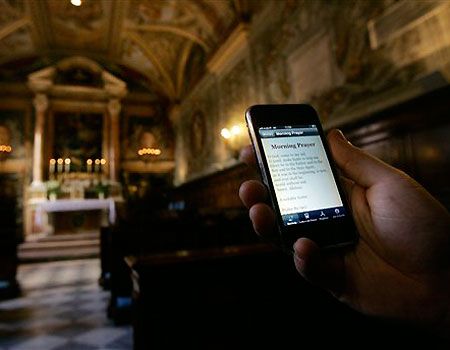
0_23_ibreviary_churchSocial Media.

Yes, Facebook, Twitter, Instagram, Youtube, Pintrest etc…

Okay, so I know that Social media at its worst is a lot of people cyber “yelling” at each other.

But social media at it is best is conversational. It involves speaking AND listening.

In fact, most of social media is not speaking at all, it is mostly hearing. Social media wouldn’t work if most of us weren’t listening, reading, hearing, receiving.

But social media takes it a step further. With social media you can like, favourite, share, retweet and more. You can read or hear what others have said and add your approval or endorsement without adding your own words.

Likes, favourites, shares, retweets are nothing new. We have been doing them in church for 1000s of years. They are the equivalent of “Amen.”

Social media teaches us that it isn’t always about saying words with our mouths. Sometimes it is important not to say anything at all but to let the words of others speak as if they were our own. You can probably see where I am going.

As a pastor, my voice is often the one that speaks for the assembly in worship. It is my voice that voices the prayers of the whole group. And so when I worship in other churches where I get to be in the pew and the presider or worship leader says, “let’s all pray together this prayer…” I say nothing. I sometimes wonder if the people around me think I am not participating.

When we see prayer only as saying words with my mouth, we all have to mumble the unfamiliar texts of liturgical prayers in an unpracticed and monotone way. Have you ever paid attention to how a congregation prayers the Lord’s prayer versus the prayer of the day? The Lord’s Prayer is the same every week, and we learn how to pray it together. But the Prayer of the Day/Collect changes every week and so we stumble through if we try to say it out loud together.

C1010109prayerYet, when we understand that when the presider or worship leader says a prayer with one voice, and still we are all praying together (one by speaking, the rest by listening) with one voice as a group, prayer becomes deeper and broader.

When we understand that the deep breaths and moments of silence before a prayer is spoken are the moments when we can, in fact, all truly pray together (instead of all reading monotonously at the same time), prayer becomes deeper and broader.

When we understand that in the “Amens”, the “and also with yous”, the “Lord’s Prayer” that we not just praying individually at the same time with our voices, but with the voice of the whole church, with every Christian who has ever said “Amen”, with every Christian who will ever say, “Our Father in heaven”, prayer becomes deeper and broader.

When we understand that prayer is more than one dimensional, more than saying words with my mouth, prayer becomes deeper and broader. Prayer becomes something we really do together, not something that we do individually at the same time which is really what we are doing when we say those phrases like, “Pray out loud with me.”

I think a deeper and broader understanding of prayer would help us realize that sometimes saying nothing, or just “Amen” at the end is prayer just as much as saying words with our mouth. Just like we know that a like, favourite, share or retweet is using social media the same as updating a status.

So let’s start praying with our ears, likes, retweets, with our Amens, in the silences and, when it is appropriate, together with many voices.

For more on social media and liturgy read this: Social Network Liturgy: Putting down the iPhone


So, how do you see prayer? Can we learn about prayer from social media? Share in comments, on the Facebook Page: The Millennial Pastor or on Twitter: @ParkerErik 

PS I recently read that one fewer hour of sleep a night for a week gives you the equivalent mental capacity of someone with the blood alcohol level of 0.10. With a new baby in the house, that would make my mental capacity the equivalent of 0.40, I think. This has been the reason for few posts lately, but I hope to pick up the pace again soon.

PPS Twitter has been flagging my blog as spam lately. If you would like to help get it unflagged (because according to wordpress and google it is fine), file a ticket with a link to my blog here


10 Lessons #YesAllWomen has taught this man

bodqhc2ciaawthw_19o506m-19o506tI am not sure I should even be writing this. I have written about women and inequality, especially as it relates to Christianity. But these past few days have felt different somehow.

Unless you have been under a rock, you will have heard of the twitter hashtag #YesAllWomen. It was begun in response to Elliot Rodger’s killing spree, because he was feeling unfairly rejected by women.

Even a 30 second glance at the hashtag gives insight into the issues that all women face, on a daily basis, because of misogyny and patriarchy. If you haven’t done so, go to twitter and scroll through the hashtag by clicking here.

#YesAllWomen is primarily about women speaking to their experience. Unfortunately, too many men have gotten defensive about it and have responded with #NotAllMen. Defensiveness, or worse misogynistic trolling masked as defensiveness, just doesn’t help. The men who are loudly declaring that they aren’t the ones treating women badly have missed the point. No, not all men are rapists, cat-callers, abusers, misogynist or sexist. But all women suffer because of the men who are.

safe_image.phpI have been hesitant to write, because I have been worried about co-opting, as a white male, the issue of a marginalized group and making it about me. After reading articles and many tweets, I realize that I do have something to say because misogyny is about me. No, I am not the one victimized directly by it, but I suffer along with all women AND all men because it exists.

Perhaps more importantly, #YesAllWomen has taught me several lessons in these past days, lessons that I think are worth sharing. I hope they can benefit you too:

1. #YesAllWomen has shown me that the women in my life all suffer silently from misogyny. My wife, my mother, my sister, my friends, they have all been the victims of the entitled attitudes of men and they have not told me because getting a man they care about angry at another man seems not worth the effort. Especially not worth it when there are so many misogynists out there. Just trying to move past these experiences as quickly as possible feels like the best way to survive.

2. #YesAllWomen has made it clear to me, as a new father to a son, that he is the most important person to teach about misogyny and patriarchy. It is a sad reality that we have to teach our daughters to protect themselves from men, even sadder that we don’t teach our sons not be a danger to women. Each boy that grows into a man that we teach to work fight for, and not against, the women in their lives is so important. Lets teach our sons not to abuse, oppress or feel entitled towards women, at least as much as we teach our daughters to avoid these experiences.

3. #YesAllWomen shows just how blind men are to their behaviour. The fact that #NotAllMen exists shows just how much we suck at “getting it” as a gender. As of this writing, there is no one tweeting under #OnlySomeWomen, yet there are many men defending themselves with #NotAllMen. This only shows how far we have to go to get it.

4. #YesAllWomen has taught me that people will defend their privilege in disgusting ways. As a pastor, I have seen many privileged groups try to defend their position in all kinds of circumstances. Invariably, defending one’s privileged position never has good reasons. There are never justifiable reasons as to why I should automatically get more, be more respected and have more power than others. So to defend privilege, people resort to shame, ad hominem attacks, victim blaming, playing the victim card, verbal abuse, mind games, emotional manipulation, bullying and all sorts of absurd behaviour. It is all there is to defend privilege. And men have been doing it all in response to #YesAllWomen.

5. #YesAllWomen is for women to speak and for men to hear – a reversal of roles. Most men, myself included, are not used to others having a voice more prominent and more important than ours. We are not used to being talked over, interrupted or lectured (mansplained) to. We are not used to being called out and justifiably shamed. It is role reversal for us to listen and for women to have the megaphone. And it is time to hand it over.

6. #YesAllWomen is not about men solving the problem of misogyny. It makes me so angry to hear about people treating the women in my life badly, especially other men. My instinct is to hop on my white stallion and chop some legs off with my viking battle-axe. This is not realistic, of course. But neither would it help for men to resolve all conflicts for women. This only teaches those who behave badly, that as long as man is not around, they can continue behaving badly and that women aren’t meant to be taken seriously. Again and again, as I hear about people acting badly towards women, it is best to be an example of a man that treats women equally and with respect.

7. #YesAllWomen reminds me that I cannot help but take advantage of my privilege. As a man, I can basically go anywhere at anytime of day or night and feel safe. I can call people to task for their bad behaviour and a good deal of the time they change it. I can speak without being interrupted and know that my words are taken seriously. I carry an innate sense of authority, regardless of the actual position I have in a group. I know that my voice will always be heard and heeded. I also know that none of this will likely change in my lifetime. And deep down, I know that there is room for everyone to experience the world this way. More people living in a world of respect and equality, won’t mean I have less. Yet, so many of those (men) in the privileged position want to maintain their status, and keep the privilege to a few. This is because more respect for everyone feels like less privilege for me.

8. #YesAllWomen has taught me the absurdity of gender roles. Every time some person, some article, some meme, some thing tries to say, “Men are like this, Women are like that” it contributes to patriarchy and gender inequality. We can all sense the racism when someone says, “Black people are like this, white people like that” or the religious intolerance of “Christians are like this, Muslims/Jews/Hindus/Atheists are like that” or the arrogance of “university grads are like this, high school dropouts are like that”. Yet when we hear “Men are like this, women like that” so many of us knowingly nod along and smile. Knowingly nod and smile like many in my grandparents generation would have at racist jokes! As long as there is a gender imbalance we need to recognize that saying “Men are like this, women like that” really means “This quality that Men supposedly carry is preferred, and that quality that women supposedly carry is inferior.” We all should know that characterizing people in such broad strokes reduces our beautiful diversity to broken categories

9. #YesAllWomen has taught me that understanding this issue requires empathy. The difference between sympathy and empathy is this: Sympathy is feeling what someone else feels, empathy is understanding what someone else feels. Sympathy can be helpful when someone is happy or sad, joyful or grieving. But as someone who looks more like a victimizer tries to sympathize with a victim, it is patronizing and unhelpful. Empathy is hard. Empathy requires getting away from my feelings, away from my context, away from my experience and looking out of someone else’s window. Seeing and understanding what they are feeling, what their life is like, what they are experiencing. Like I said, Empathy is hard, but men need to learn it. All of us do.

10. #YesAllWomen has taught me what my role is in supporting the empowerment of women and ending misogyny. I should have made the connection sooner, as it is my job as a preacher. As a pastor I point to God, I name what God is doing in the world. That means pointing away from myself, that means getting out of the way. As a man who is a feminist, who supports gender equality it is my role to support by pointing to women. By lifting up their voices and by getting myself out of the way.

So these are the lessons I have learned. Now I am going to get out of the way. Go read #YesAllWomen on Twitter. Find the articles by women about how misogyny and patriarchy and sexism and sexual violence and abuse affects them. Read. Think. Be changed like I have been.


How has #YesAllWomen affected you? What is your experience? Share in the comments, on Facebook at The Millennial Pastor Page or on Twitter: @ParkerErik

Special Thanks to my wife, Courtenay, who worked through these thoughts with me and is my brilliant editor. You can follow her on Twitter:  @ReedmanParker


St. Paul and Moralistic Therapeutic Deism

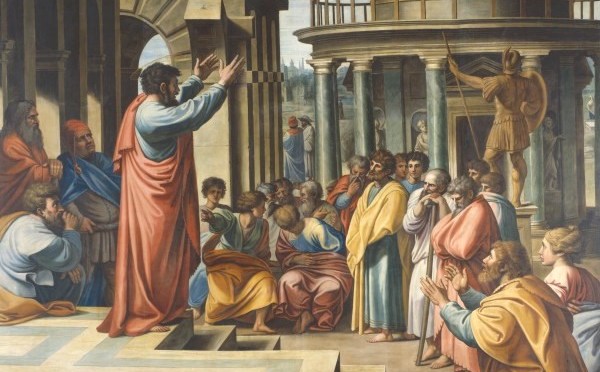
Acts 17:22-31

Paul stood in front of the Areopagus and said, “Athenians, I see how extremely religious you are in every way. For as I went through the city and looked carefully at the objects of your worship, I found among them an altar with the inscription, `To an unknown god.’ What therefore you worship as unknown, this I proclaim to you… (Read the rest).

Sermon

image019It would serve us well to listen carefully to Paul today. Paul is telling us about a radical God that we don’t get to hear about very often. His words might have originated in Athens, from the place where Greek philosophers would gather to argue and debate ideas. But make no mistake, Paul is speaking directly to us. And there is a sadness in his sermon and there is a certain joy. The joy is the proclaiming the living God in whom we live – we move- and have our being. The sadness is in realizing that God is essentially unknown to most North Americans.

The place and people to whom Paul was speaking was not much different than our world today. The Athenians were careful folks who liked to hedge their bets when it came to religion. Scattered throughout the city would have been statues and temples to numerous Gods. To Greek Gods, Romans Gods, Persian Gods, and many more. Newborns would often be dedicated at each temple, just to make sure that all the bases were covered. Zeus, Athena, Mithras, Poseidon were all honoured just to be sure.

And just in case any gods had been overlooked, there was the statue to the unknown God. A coverall, so as not to offend any other gods out there that didn’t have specific statues or temples.

When Paul was in Athens, his purpose wasn’t to preach or evangelize. He was just visiting, waiting for his friends to re-join him while they preached in a neighbouring city. Paul, was more like a tourist than a traveling preacher. Yet, when he saw this statue to the unknown God, he must have seen an opportunity. An opportunity to address a culture that was quite concerned with covering their religious bases by doing the right rituals and keeping the right rules. The Athenian philosophy of religion was, make the gods happy and they won’t bother you,

The pluralistic religious system of the Athenians is not all that far off from our modern version of religion that is practiced today. In fact, sociologists have come up with a term for the most widely “practiced” religion in North America, and it is probably not the familiar name of a denomination. Moralistic Therapeutic Deism. This term was born out of study North American Teens and their views on religion. There was a surprisingly high level of agreement on what teens thought about God and the faith. There was no difference in views between those who were regular church attenders their whole lives to those with no church background at all.

monkimage


These are the core statements of their faith:

1. A God exists who created and ordered the world and watches over human life on earth.

2. God wants people to be good, nice, and fair to each other, as taught in the Bible and by most world religions.

3. The central goal of life is to be happy and to feel good about oneself.

4. God does not need to be particularly involved in one’s life except when God is needed to resolve a problem.

5. Good people go to heaven when they die

Moralistic Therapeutic Deism is basically the belief that God sets out some ground rules for behaviour which is the moralistic part. The Therapeutic part is that God is a being who exists to make us feel good and solve our problems. Deism is belief in a God who just created the world and left it to its own devices, God does not have much bearing on the rest of our lives and doesn’t really engage us personally.

The God of Moralistic Therapeutic Deism is the God of Oprah, Hollywood and financial gain. It is the God of inspirational greeting cards, reality tv, music videos and consumerism.  Making money, being self-centered and ignoring the big issues of life are also encouraged, because God wants to send us to heaven as long we are good people, which most of us are.

This distanced, self centered approach to religion is precisely what Paul’s words address today. And this kind of religion is exactly what our sinful selves wish religion to be. The pluarism of the ancient greeks and modern day Moralistic Therapeutic Deism appeal to us at our basic levels. They are religions were we get to be in control, and God gets to be a divine therapist and butler. They don’t demand anything of us, and they don’t intrude on our daily lives in any kind of real way. They are the perfect religion for a curved in on itself humanity.

As Paul walked around the Aeropagus, looking at the variety of statues he must have been asking himself,

What about sin?

What about evil?

What about death?

What about hope?

What about grace?

What about love?

Grace_wordle


For Paul, all of the greek Gods would have been unknown. His are the questions that none of the unknown Gods could begin to answer. These are the questions that sit below the surface when life is going well, but that rise up and force us to consider them when things go wrong, when life begins to hurt, to be painful. The God of Moralistic Therapeutic Deism seems pretty empty in the face of addiction, disease, divorce and separation, in the face of death. It seems pretty empty in the face love, beauty, sacrifice and wonder too.

In fact, the unknown gods of the ancient greeks and of our modern world are not really gods at all when compared to the God who washes, names, dies with us and raises us to new  life all in the one baptism. These gods not compare to the One who feeds, forgives, joins and loves in communion. The god of Moralistic Therapeutic Deism does not compare to the God who was born, who lived with us, who died on the cross and rose on the third day in the person of Jesus of Nazareth. 

Paul sees the opportunity with the statue of the unknown God, to show his audience that God is known. And even more so, that God knows us. As Paul preaches to the Athenians:

What you therefore worship as unknown, I proclaim to you. God is known.

What a radical difference from what the Athenians knew. Paul does not just re-interpret the unknown God, but re-interprets the whole religious system. The God that Paul knows is the one who created all things. The God that Paul knows is the one who gives us life and movement and being — and does not require petty sacrifices in order to show mercy. The God that Paul knows, know us — knows what it is like to be born, to live, and die as one of us.

The God knows us sees us — all of us. Sees our faults and failures, our imperfections and loses. Our confusion and blindness. Our intolerance and bigotedness. Our despair and frailty. Our successes and hopes. Our dreams and desires. Our joys and our loves. All of these God sees.

The God who knows us hears us — our pleas for help. Our anger and frustration. Our sadness and sorrow. Our celebrations and thanksgivings. Our happiness and our wonder. Our normal and everyday words. All of these God hears.

This God who know us loves us — all of us. God loves all of us as a whole. All of us as individuals. All of us personally, intimately, completely. This God loves us despite our sinfulness and despite our faithfulness. This God who knows us simply loves us without condition.

The unknown Gods of ancient and modern times promise heaven for good behaviour.

But the God who knows us promises New Life to those that are dead. New Life for all creation. New Life for each one of us.

In a world that is often looking to cover its bases and for people whose best vision of what God could be is a divine therapist and butler, God offers so much more.

As Paul preaches to the Athenians and to us, the unknown distant gods that we try to make happy are not gods at all. The God of all creation, of all life, of all that moves of all that is. This God is known. This God is known because this God first knew us. As Paul preaches:

What you therefore worship as unknown, I proclaim to you. This God knows us. 

Amen.

Can we kill the church?

It is no secret that Christianity in Europe and North America is in decline, at least in terms of numbers, attendance, budgets and societal influence. Christian leaders in the United States, in particular, are really starting to name and deal with this reality more and more. What many Americans may not know, is that Canada is about 20 years ahead  in this process, and the UK 20 years ahead of Canada. In a way, I am speaking from the future of American Christianity, if things continue on the same path of decline.

dying churchThere have been a number of articles and/or sermons, making their way across social media, exploring the “Dying Church.” Sojourners (sojo.net) has recently run a series called “Letters to a Dying Church.Mark Sandlin’s letter, in particular, articulates the decline of the influential church of the middle 20th Century that rested at the centre of western society. Mark describes a church that has moved into a fringe community that exists in the largely forgotten margins. The letter also articulates great hope in dying, and promise in God’s resurrecting work.

Meanwhile, while Sojourners was running their series, Nadia Bolz-Weber published a sermon entitled, “Stop Saying the Church is Dying.” Her sermon also articulates the distinction between the social-cultural church of influence, which is in decline, versus the church that proclaims the Gospel, administers the sacraments and declares forgiveness of sins. While her title provocatively suggests the opposite of the Sojourners series, the point is largely the same.

So, we all know that Christendom or imperial Christianity is losing ground and is, by all economic and social measures, dying. 

And we all know that the Church – that is primarily concerned with announcing the Gospel, providing the sacraments, providing the Body of Christ a time and place to gather and reconciling creation with creator – is alive and well.

But there is an aspect to all this dying talk that I find curious, if not troubling. It is hard to argue that the church isn’t dying or transforming from what it was a generation or two ago. However, I think there is a flaw in our diagnosis.

I think there is no small amount of hubris in the notion that the church is dying and we are killing it. Consider the weight of this claim. In nearly 2000 years, the church has survived barely getting off the ground for 400 years, it survived being imperialized, spreading across the known world, going to war, reformations, counter-reformations, splits, scientific revolutions, the discovery of new worlds, nationalism, revival, charismatic movements and global wars.

2361002313_58cdf68fffAnd while yes, the church is in decline by all social metrics and economic indicators like membership numbers, budgets and sociopolitical influence, do we really think that because current generations are more interested in iPhones, new age spirituality, worshipping God in sunsets and grocery shopping after kid’s soccer on Sunday mornings, that the church is going to die because of us.

Now let me be clear like Mark Sandlin and Nadia Bolz-Weber were clear, the Church, as the body of Christ, the spirit-led community tasked with proclaiming the gospel, administering the sacraments and declaring forgiveness of sins will continue to exist long after the structures of imperial Christianity are gone, long after the institution is gone.

But even that claim misses the point.

When I hear Christians talk about this institution-less, egalitarian, consensus church to come, I think we are dreaming. I think we have forgotten the realities of human communities. I think we have forgotten that almost immediately after the Ascension, Christian communities started setting up structures and systems to govern church life. And over time, these institutions have grown, changed, become flawed, reformed, and declined. But they are necessary.

Just like the rules of grammar that allow language to convey meaning, foster creativity and breed emotion, the structure, institution even, of the church allows the gospel to be preached, sacraments administered and forgiveness declared. More importantly, the free, open, consensus based community that many Christians hope for in the midst of decline is a church that will cease to exist faster than our current iteration. Without structures to carry on our practice, everything that we believe would be forgotten in a generation.

Even though the institution is guilty of oppression, violence, murder, war, discrimination and many other atrocities, the institution is also what carries the community through history. The institution bears the life of the community in a way that we time-bound humans cannot. The institution has preserved the good along side the perpetration of tremendous evil – a sinner/saint motif. All along the way, the institution has borne the witness of those who have gone before, whose words and music and art and actions are worth remembering beyond the lifespan of their originators. The institution is imbedded in our doctrine, theology and liturgy. The church is one, holy, catholic and apostolic, not because human beings have kept is so, but because in the traditions, structure and institution those four marks have somehow remained, by the guidance of the Holy Spirit. 

So what does this mean for our declining church? As much as many of us would like, we are not headed to a Christianity without buildings, budgets, and constitutions. We won’t get far without hierarchies, structures and systems. We will always need pastors, leaders and teachers. We even need, dare I say, bishops. Here is the thing, we can’t all preach and nor can we all listen. There will always be some doing one and some doing the other – that is structure.

So yeah, our current version of the institutional church will probably continue to decline, at least for a while. But church has never really successfully changed itself… rather the world has changed around it. In in 1950s, the church did nothing to create a society in desperate need of an institution to rely on, to find hope in, to experience reconciliation with. Decline has mostly happened to us as the Church today, and before we can adapt to that, our world will change again.

In fact, as economic inequality grows, as conflict looms in the Middle East and Eastern Europe, as the environment faces crisis, as nations and economies become increasingly globalized, I don’t think it will be long until people start looking for organized communities and institutional structures that proclaim the gospel, administer the sacraments, and declare the forgiveness of sins. Before we can do ourselves in, the world will need us again… in fact, the world needs us now. 

So, can we really kill the church?

We never had a chance.

The Featured Photo at the top of this post is the burned down St. Boniface Cathedral in Winnipeg - this is the new rebuilt one.
The Featured Photo at the top of this post is the burned down St. Boniface Cathedral in Winnipeg – this is the new rebuilt one.

So what do you think about all this dying talk? Is the church dying? Can we kill it? Share in the comments, on Facebook: The Millennial Pastor or on Twitter: @ParkerErik 


14 Things I Learned During 2 Days on a High Risk Labor and Delivery Unit

On May 1st, my wife, Courtenay, and I had our first child. We are overjoyed to have our son out in the world and in our arms. But it was quite the ordeal to get him here. For 9 months we did all the pregnancy planning. We filled our world with books, lists, websites, apps, maternity clothes (for my wife), baby stuff and plans for the labour and birth. We filled our hearts with hopes, dreams and fears for this child.

And then as the due date came and went, we were booked for a routine fetal assessment (extra involved ultrasound), and all of a sudden we found ourselves, with potential complications to an otherwise healthy pregnancy, being admitted to a High Risk Labour and Delivery unit – not where we planned on being for the birth.

IMG_0493Throughout the next 48 hours, neither of us slept for more than a couple hours and we endured a medically induced labour, all the way to the pushing stage, when my wife was told to stop pushing (and go back to the really painful part of labour) to help things progress. A few hours later we were faced with more waiting or a riskier than normal C-Section. Over the 48 hours, there were things about labour and delivery that I learned that no one teaches you in prenatal classes and that you cannot read about in a typical pregnancy book or website. They were the hardest 48 hours of my life. Here are some of the things I learned, from a husband’s perspective, about High Risk labour:

1. Things don’t go as planned.  When you are expecting a “normal” birth and show up for a routine ultra sound at a different hospital than your birth hospital and you hear the words: “We are keeping you here, looks like you’re going to have your baby today” – it is NOT COOL.

2. No seriously, when things don’t go as planned (and often they don’t) it sucks. Like the websites and books say, make your birth plan and imagine how you want birth to go when the day comes. And then be prepared to scrap it all, because when it doesn’t happen like you planned, you can be thrown for one of the biggest loops of your life.

3. No amount of preparation will give you a sense of being in control. You can throw out the lists, hospital bags, books, iPhone apps etc… You don’t actually need any of that stuff when doctors start talking about low amniotic fluids and uncertain kidney function. You can show up to have a baby with just your wallet, phone and your wife’s purse – and that is too much stuff.

4. The sounds of labour are… weird and frightening.  Women will generally sound like they are dying, shout profanity and cry out funny and ridiculous things in labour – and you can’t laugh. Well, not too loudly anyways.

5. Sometimes things don’t make sense. If the one questionable issue that landed you in the high risk unit turns out to be false you won’t get to leave. But the totally cool staff is going to come and hang out in your room as a place of refuge because you are friendly and chill. Especially, if your wife loves to chat them up and hear their life stories, even while she is in labour.

6. Singing happy birthday is not funny on a labour and delivery unit. You will think it is funny for about 2.7 seconds and then realize it isn’t. Not at all. Don’t sing it.

IMG_04927. Be prepared to do nothing. Most of labour and delivery can be doing nothing. You will just sit around, check heart beats, do more nothing, drink a glass of water, do nothing, take a walk, do nothing, sit around the hospital room looking at each other having exhausted 13 hours of conversation, then more nothing.

8. There are real life Dr. Houses (from the TV show House M.D.). There are doctors who will decide to admit you, decide your treatment, decide where you go and you will never see them, meet them or speak with them. I have been making hospital visits as a pastor for 6 years and I spent 3 months doing chaplaincy in a mental hospital – the fact that mystery, eye-in-the-sky doctors exist still shocked me.

9. Be funny. All the massaging, birth coaching, breathing stuff, being supportive is not as important as being funny. I don’t mean cracking jokes like an idiot. I mean being funny in ways that make everyone laugh especially the mom-to-be. Humour lightens the mood, keeps people relaxed and adds perspective. If you can keep the mom-to-be, other support people and hospital staff laughing, things will be so much better.

10. Labour does not look like the TV shows, websites, pre-natal class videos or grandmother stories of pre-1950 birth. Contractions can happen every five minutes like clockwork, of feel like general never ending menstrual cramps, or anything in between. Don’t expect anything, and you won’t be surprised.

11. You will not know when it is going to happen. Every time you feel like the baby about to come, it probably isn’t. Every time labour picks up a little steam, the baby is not about to come. The baby only arrives when the baby is good and ready.

12. Birth complications are terrifying and you will feel helpless. Doctors and nurses will be hesitant to give you definite answers. When hospital staff check vitals or labour progress and pause before speaking, the heavy weight of those silences will crush you. You will know that something isn’t right immediately and you will have no power to do anything about it.

Erik waiting for the c-section to begin.

13. You will not know what worry is until your wife and unborn child are in danger. The fear of something happening to my wife and child were the scariest things I have ever encountered. Even after a few days of parenting now, I know that the extra caution you take while driving with a newborn on board, or the heart-skipping-a-beat moments when you sleepily almost lose your grip on a squirming baby are one thing. But knowing that if circumstances don’t change, as in some kind of extreme medical intervention i.e., C-Section, and the two most important people in your life are in grave danger, is entirely another level of worry.

14. You will never be as grateful for a baby’s crying than at birth. Standing behind the OR screen, with your wife, waiting for the doctors to pull that baby out is an indescribable moment. You only get to be there once, and you only get to feel that feeling with those three people once. Once is enough to last a lifetime.


For Courtenay and I, it had been 48 hours of waiting and labour before we finally got to meet our baby. Forty-eight of the most difficult, tiring, hard hours of our entire lives. But a healthy recovering wife and a healthy and beautiful baby boy was worth every moment of fear, concern, worry, sleeplessness. To see my amazing wife through the whole ordeal only makes me love her all that much more. And today, I look at the little miracle baby that finally emerged from the chaos and I cannot help but feel like Mufasa from the Lion King.

cub-cute-lion-lion-king-mufasa-simba-Favim.com-91525


Have your own hospital birth wisdom? Share in the comments, or on Facebook: The Millennial Pastor or on Twitter: @ParkerErik