Category Archives: Theology & Culture

Alan Kurdi, the Syrophoenician Woman and Breaking Jesus’ Prejudice

Mark 7:24-37

Now the woman was a Gentile, of Syrophoenician origin. She begged him to cast the demon out of her daughter. He said to her, “Let the children be fed first, for it is not fair to take the children’s food and throw it to the dogs.” But she answered him, “Sir, even the dogs under the table eat the children’s crumbs.”  (Read the whole passage)

Sermon*

Most of us had a moment this week when we first saw the image of little Alan Kurdi lying face down on a beach in Turkey. The scene seemed unreal: childlike innocence contrasted with devastating tragedy. It seemed to jar the world out of our summer sleepiness and into a deeper awareness of the reality of the humanitarian and refugee crisis happening out of Syria.

It’s not that there haven’t been news reports, articles written, and videos posted showing the thousands of migrants clashing against police, migrants struggling to cross borders or telling us of migrants dying trying to make their way to a better life.

It’s also not that we haven’t responded to the crisis, which has been going on for 5 years: CLWR asked our national church for 10,000 sweaters and we responded with 70,000. We’ve given with financial support, we have hosted fundraisers, and we have even had ongoing conversations in our congregation about how we can support refugees.

And yet, the reality of this crisis has always seemed far away. Something distant and removed from us. That is until this week when one photo scooped us up from our living room couches, plucked us away from computer screens, and transported us around the world.

Unlike the news reports, the articles and videos of migrants, one photo of a Turkish beach made us feel like we were standing just a few feet away from little Alan Kurdi and demanded that we come near and truly see this humanitarian crisis.

Perhaps it is serendipity or perhaps the Holy Spirit is up to something, because Jesus has his own close encounter with a foreign woman this week. A parent doing anything she can to provide a better life for her child.

And it is this desperate parent who seeks Jesus out, hoping that he will help her and her demon possessed daughter.

As seems to be usual in Mark’s gospel, Jesus is tired and cranky. He is seeking refuge from the demanding crowds, and so when this woman comes into the house where he is staying, Jesus is well… very un-Christ-like with her.

She begs for his help, and Jesus puts her off. In fact Jesus tells her off. Jesus compares her to a dog. And not the beloved family pets many of us have at home, but a pest and nuisance. The word he uses is more akin to that pejorative name for a female dog.

Mark the gospel writer, doesn’t usually provide details unless they are important, so the fact that he mentions that this woman is Syrophoenician should not escape our notice. Syrophoenicians were mixed race gentiles living in the border lands of Tyre and Sidon, just beyond Galilee. Syrophoenicians were half Phoenician and half Syrian (the coincidence here should not be lost on us).

The Israelites of Jesus’ day saw these particular gentiles living just beyond their borders as lesser peoples. People unworthy of Jewish attention or compassion.

As the Syrian-Phoenician  woman comes to Jesus, she humbles herself at his feet, and she begs for his compassion on her daughter’s behalf. And she crosses the boundaries of proper social behaviour, by being a woman who speaks to a man in public, by being a gentile who approaches a Jew, by being a beggar hounding a respected teacher and authority. And Jesus responds to this woman’s bold yet desperate plea by expressing a common Jewish prejudice of his day in the way he deals with this desperate mother. He is willing to put her off, because her needs, her tragedy, her desperation are not worth his immediate action. Jesus makes it clear that she, and others like her, will only get help once the people the world has deemed more worthy have their needs met.

Jesus sounds a lot like our political leaders have sounded this week… and that should not sit well with us. In fact, it should make us squirm in our seats. This is not the Jesus who eats with tax collectors and sinners, the Jesus who is forgiving prostitutes, the Jesus who is welcoming the unworthy.

Jesus today sounds too much like world leaders who can’t be bothered with people who are just too different from them. Jesus sounds like those who blame others for the problems facing the poor and marginalized, passing the buck. Jesus sounds a little bit too much like us.

It is uncomfortable to watch Jesus succumb to the same prejudice that we fall victim to. It is disturbing to see him place walls and barriers in front of suffering people just like we do. It is strange to think that Jesus would deny anyone compassion just because they are different from him, just as we are often guilty of doing.

Our prejudice often affords us the excuse to remain passive in the face of human suffering. This week it was a photo of Alan Kurdi that reminded us of this fact. Last year, it was the story of Tina Fontaine. The year before, it was the case of Brian Sinclair… and the list goes on from there. Maybe it goes all the way back to the Syrian-Phoenician woman.

“Even the dogs under the table eat the children’s crumbs”

Just when we expect the Syrian-Phoenician woman to reject Jesus’ prejudice and bigoted words, she does the opposite. She holds them up as a mirror to Jesus’ prejudice and accepts the dog epithet. She is still begging for compassion, she is still asking Jesus for help. But instead of asking for help person to person, she is willing to lower herself… she is already on her hands and knees at Jesus’ feet… to the place of a dog. She is asking for the least that Jesus could do.

And in that moment, Jesus is faced with either turning her away and abandoning not only her humanity, but his own, or dropping his prejudice in order to show compassion.

Ephphatha. Be opened. 

It is not just the deaf man who is opened up today, but he instead re-iterates the opening up that Jesus experiences just before. When Jesus unplugs the ears and loosens the tongue of the deaf man, he makes a connection to a person who had no voice, who was on the margins and excluded from normal community. The deaf man can now speak because Jesus is listening.

It is a connection that Jesus first learns through the Syrian-Phoenician woman who presses him to show compassion. Jesus learns something about giving up his own prejudice, Jesus learns what it is like to have his own walls and barriers broken down. By holding Jesus’ prejudice up before him, by making her need for compassion heard, Jesus breaks open God’s compassion into the world. Compassion and mercy given to more than just the children of Israel, compassion now for Jew and gentile alike, compassion for all creation.

What starts as a tired and cranky Jesus refusing to help a person whom he thought was too other, too different, too unworthy becomes the means for God’s transforming compassion and mercy to enter the world. As Jesus is opened, God’s compassion meets a Syrian-Phoenician woman and a deaf man. As God is opened, the world is opened.

And it is the same thing that happened to the world and to us, this week. A single photo of a young Alan Kurdi, holds up a mirror to our prejudice, to the walls and barriers we build between ourselves and people who are different from us. When faced with tragedy like this, we are left with the option of going on with life as usual, where people like Alan don’t matter, or having our prejudice broken down and our compassion broken open by the realities of the Syrian migrant crisis through the heartbreaking photograph of a three-year old boy lying dead on a beach.

Still, even as the world now calls for compassion, even as we have been sending sweaters, praying, giving what we can, and discerning how to do more, even if our country opens our doors to as many refugees as we can take… we know that it is not enough. We know that our compassion has not and will not save the world. The power of the human spirit cannot do it alone, if at all.

Today, we are reminded, even as the Syrian-Phoenician woman pushes Jesus for compassion, that God is doing the work of breaking us open. God is speaking to us Ephphatha – Be open. 

There is no human cry for compassion, no human grief that will save Alan. There are just some walls of prejudice, some walls of indifference that we cannot break down.

And so like the Syrian-Phoenician woman, like the deaf man, and now like Alan Kurdi, we turn to God.

God alone who can meet our prejudice and open us up. 

God alone who can meet the walls and barriers we place in front of the suffering of our brothers and sisters.

God alone who can meet death,

God who knows what it is like for a son to slip from his arms and die on a cross. God who knows what it is like to die in the borderlands of a foreign and oppressing empire.

God alone who on the third day walked out of the tomb, breaking open death once and for all.

Today, we turn to God who speaks to us in the midst of prejudice and tragedy –

Ephphatha – Be Open. 

Amen

*This sermon was co-written between my wife, Courtenay @ReedmanParker and I. We haven’t done this before, but as we talked about our own reaction to the photo of Alan Kurdi this week, we decided to come together and write one sermon. It is something we will definitely do again. 

When our words are weak – A Lament for Alan, Ghalib and Rehanna Kurdi

Yesterday, I was scrolling through my social media feeds and a vivid photo of a beach passed by. I scrolled back to see a very young boy in shorts and a t-shirt laying in the sand.

It took me a moment to piece together that this wasn’t a child playing on the beach, but instead a wordless and unimaginable tragedy. It was Alan Kurdi.

 I have a son. A little boy that has often been dressed in shorts and t-shirts this summer. Those hands and feet, those legs and arms, that little body is one I see everyday.

It was heartbreaking to see the same arms, legs and body as my little boy lying lifeless on a turkish beach. It was guilt inducing and gut wrenching to be grateful that there was dark hair and not my son’s reddish blonde.

I have regularly prayed for Syrian refugees in my church. I have just slipped in a few words for them along with prayers for rain in spring and sunshine in harvest, prayers for world leaders and peace, prayers for church ministries and programs, prayers for sick and dying people. It was the very least I could do.

I have regularly forgotten to pray for Syria when all those other things took all my attention.

I have have encouraged my congregation to collect sweaters for displaced Syrian refugees, to give money to our denominational aid organization working in the refugee camps, to be open minded about our muslim neighbours.

I haven’t pressed them as hard as I could have.

A few months ago as I sat in my office, a muslim refugee family came to me to ask for help. A father and mother just like Abdullah and Rehanna, 6 children just like Ghalib and Alan. A family just like Alan’s sat in my office and I hemmed and hawed about how much help I could provide, secretly wondering about how much effort I would need to put in helping them.

As a pastor, I have had grieving mothers cling to me. I have had to offer failing words and inadequate comfort to those who are grieving the death of a child – young and old.

My job is to point to hope, even when no one else can. My vocation is to be the one who declares “Life” when everyone else declares “death.” My calling is to give words to the grieving.

Words for Alan, Rehanna and Ghalib. Words to Abdullah.

Words that somehow make sense of death.

I wish I could say there is some purpose in this tragedy, but there isn’t. I hope that Alan’s  photo becomes as significant as the naked Vietnamse girl’s is, but it would better that neither needed to be taken. I wish that Alan’s death had some greater meaning, but would you volunteer your child’s life to be the one that moved the world to action?

I hope that Alan reminds us that the words ‘Syrian’, ‘Migrant’, ‘Refugee’ are synonymous with ‘person.’ I hope that we remember that Syrians, migrants and refugees are human beings, not numbers, not news headlines, not problems to pass off, or expenses we don’t want to incur.

The world – 5 years too late – cries out for Alan and for Syria.

Finally. 

Yet, world leaders, NGOs, military campaigns, and good intentions will not solve this crisis. At best, they will mitigate it, they will make things slightly less tragic.

That is where my job to speak words for Alan, Ghalib and Rehanna comes in…  to speak words that somehow spark hope in the midst of tragedy and death.

Words that are not mine… words that belong to and are given by God. 

Because when are confronted with images of tragedy that make us cry out,

Because when we know that our leaders don’t have the will to respond, nor could they adequately respond if they did will it,

Because our good intentions have never solved our problems.

Because the human spirit, as noble as it might be, will not save us.

Because when we cannot redeem senseless death, God can. 

God makes sense of that which we cannot. 

God turns our tragedy into something better – into mercy and resurrection.

God does have the answer, God has life and love for a little boy laying on a beach.

God has life and love for our broken world.


Featured photo courtesy of Leadnow.ca

5 Reasons Why Underpaying Pastors is Poor Stewardship for Congregations

The topic of clergy pay is a touchy one at best. Churches, pastors, denominational bodies all have vested interests in how clergy are paid… but sometimes those interests aren’t always aligned.

Determining what is appropriate pay requires that a number of questions be answered: How is professional ministry measured when it comes to compensation? How do you compensate someone who is fulfilling a calling? How do congregations balance shrinking membership and budgets with the need to keep clergy pay increasing, if even with just the cost of living? How do denominational bodies recommend guidelines that congregations can meet and that adequately provide for clergy?

Lately, I have heard a number of troubling comments and stories from colleagues about clergy salaries. Money troubles, like in marriages, can often be the straw that breaks the camel’s back between a congregation and pastor, and result in separation.

Unfortunately, clergy often end being underpaid for a variety of reasons, which ultimately ends up hurting the congregation just as much as it hurts the pastor who is not being adequately compensated. Going by the stories and comments I have heard from friends and colleagues surrounding pay, there are reasons that I see as being problems that will haunt congregations when they choose to underpay their pastor.

Disclaimer: The congregations I have served have always paid me according to the guidelines provided by the Bishop’s office. In my view these are fair and adequate, for the most part. I am grateful to the churches I have served for not making my compensation a big issue. 

The reasons that are often given for keeping clergy underpaid, might sound reasonable on the surface, but dig deeper and they become truly problematic:

1. “Pastors work for God, not for the money.”

It is absolutely true that almost no pastor packs up to attend 4 or more years of seminary in order to hit the jackpot as a parish pastor. Other than the handful of mega church pastors and televangelists who are making millions, most pastors earn modest, if not meagre wages.

But it is a false notion to equate working for God meaning that clergy are fine with working for free. All the clergy I know genuinely want to serve God’s church and God’s people. And they want to serve knowing that they can pay their bills, put food on the table and perhaps enjoy a meal out or a holiday away from home once in a while without breaking the bank.

The work that clergy do is NOT supposed to what earns their salary. The compensation is supposed to allow clergy a comfortable living so that they can attend to their work without having to worry about earning their pay.

2. “Pastor, the denominational guidelines are too high. You can accept less.”

I have heard of congregations negotiating one salary with the Bishop and Pastor in the call process, and the asking a pastor to accept less once they have settled into their new charge.

I cannot express how offensive this is. Clergy salaries are designed to be fair to both pastor and congregation. Asking a pastor to take less is effectively declaring that a pastor is not valued by the congregation, which is basically a non-confidence vote in the ministry.

3. “Oh, pastor ‘so and so’ never asked for raise”

This particular practice of some of my clergy colleagues infuriates me. I have heard of a number of pastors not asking their congregations to keep up with clergy pay guidelines. If this were simply a matter of the effect on one’s own family, then I wouldn’t care so much.

However, not insisting that congregations keep up with guideline salary is bad for your successor, and even worse for the congregation itself.

A congregation told me a story of how one their pastors had accepted a pay freeze during a period of renovations. The agreement was that once the renovations were complete, the congregation would “catch the pastor up” to guideline pay. I was told this was so difficult for the congregation to catch up in the end, that they made a policy never to fall behind guideline minimums again.

When a pastor accepts less than the minimum guidelines set out by a denominational body, it means the congregation becomes accustomed to a lower salary burden. And what happens when that congregation needs to call another pastor? They have to, all of a sudden, come up with thousands of dollars in their budget in order to pay the minimum. And congregations are really good making large year by year increasings in giving, right?

Worse yet, a new pastor might be asked to take a pay cut or accept less than what is supposed to be the minimum. (see point 2).

4. “Pastors get a housing allowance which is like a bonus”

Housing allowances are very misunderstood things. They originated as a means to allow congregations to provide a house that clergy could live in, without paying taxes on the benefit. Another way of looking it at was that the small salary or stipend that clergy earned (sometimes paid in chickens and garden vegetables) would be further taxed if the parish provided housing was considered a taxable benefit.

Once clergy began purchasing their own homes, there needed to be a way to make tax system equitable, regardless of the housing option a parish could provide – a home or an allowance.

In Canada, housing allowances can only be for the fair market rental value of a house up to 1/3 of total compensation.

But really, housing allowances are not benefits to clergy. They are benefits to congregations because they allow congregations to pay clergy less. If housing was taxable, congregation would have to make up the difference in take home pay by raising wages.

So to those who object to clergy receiving this benefit, I would argue that tax free housing is small price to pay in exchange for the virtually free civil services that clergy (and therefore churches) provide to their communities by performing legal marriages, by providing free chaplaincy care to many health care institutions, and by providing inexpensive or free counselling services to the community among other things. Not to mention the fact that studies show that people of faith are also the most likely to volunteer in communities and to donate to non-religious charities.

5. “Pastors should be poor and we are paying them too much already”

Another argument that makes me mad. If pastors should be poor, then so should anyone else who calls themselves a Christian. Really this is about controlling a pastor, where s/he lives, what car s/he drives, what clothes s/he wears, all in an effort to make the pastor the symbol of modesty on behalf of the congregation.

Still, a pastor who cannot afford the necessities of life really isn’t going to be effective in ministry. This argument makes no sense when considering that in many denominations, pastors have graduate degrees and as much education as doctors and lawyers. Pastors are expected to have the skills to administrate like a CEO of a small non-profit, to provide care and counselling like a social worker or secular counsellor, to teach children, teens and adults like a professional teacher, to provide event planner level organization to things like weddings and funerals, to oversee staff like middle managers, and then to provide spiritual leadership, guidance, and formation to a faith community.

The reality is most pastors could earn two times, three times or four times as much in a similar professional field with a similar education. But instead most clergy have chosen to forego that kind compensation in order to serve God and God’s church, to serve the people of God.

Ultimately, finding reasons to underpay pastors is poor stewardship

Underpaying clergy stems from a stewardship ethos that asks one person to bear an unequal share of the burden of providing ministry. It is shortsighted as it puts a congregation into a position where it won’t be able to keep up with minimum required to pay for a pastor when it is time to call a new pastor. And this poor stewardship assumes that pastors aren’t already making a huge sacrifice in order to follow a calling by taking on the burdens of student loans, of reduced pay compared to secular work and by working all overtime for free, most major holidays for free and being ‘on call’ 24/7.

When congregations underpay their pastors, it isn’t about saving money or stretching declining resources. It is about the value that congregations place on pastoral ministry. It is about the value that congregations place on their own work and following God’s mission.

The reality is that finding a way to pay a pastor less is really the first step in choosing to kill a church. Because the things that pastors do need to be done by someone in order for congregational ministry to go on. And as congregations who have been forced to make do without a pastor can attest, it is not an ideal nor a viable long term option.

But perhaps most importantly, adequately paying a pastor recognizes that ministry costs time, resources and money. It recognizes that ministry is worth the time, resources and money that is costs us. It recognizes that God’s mission for us in the world is worth our time, our resources and our money.


Does your congregation adequately pay your pastor? Do you have horror stories of being underpaid? Share in the comments, or on the Facebook Page: The Millennial Pastor or on Twitter: @ParkerErik

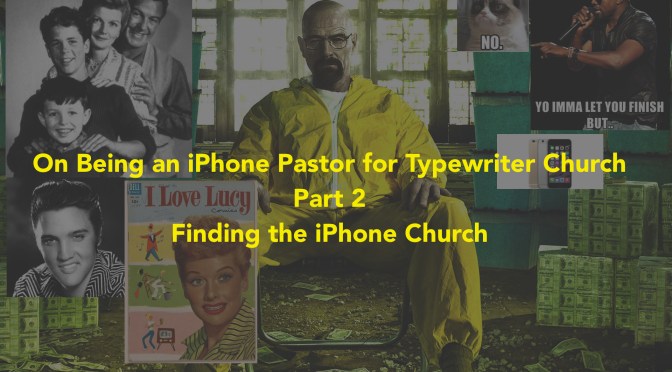
On Being an iPhone Pastor for a Typewriter Church Part 2: Finding the iPhone Church

Last month, I wrote about Being an iPhone Pastor for a Typewriter Church. In particular, I mused on the concept of cultural commute – having to operate in a cultural different than one’s own. As a millennial and as a Lutheran pastor, I find myself often operating in a Baby Boomer culture. And while this doesn’t compare to the struggle of making a language commute, an ethnic commute or even socio-economic class commute, making this generational commute is a struggle. And it is one of the reasons I think millennials find the church frustrating these days.

Since writing that last post, I have been wondering what would an ‘iPhone Church’ look like.

Part of me loves the idea of serving a church full of people who are social media addicts like me. Where the bulk of our community planning and organization could happen on our Facebook page. Where ‘Netflix Binge Night’ with discussion afterwards could be a legitimate study and fellowship activity. Where I could make reference to Grumpy Cat, Walter White, #ThanksObama, Donald Trump memes, Taylor Swift and Apple without explaining memes, hashtags, Ferguson, Netflix, Breaking Bad, Apple Music… basically without having to explain the internet.

But the more I think about the ‘iPhone Church’, simply replacing the ‘Leave it to Beaver’ references with Kanye West “Imma let you finish” references doesn’t really solve the issue of the cultural commute.

One the one hand, the Church absolutely needs to be culturally savvy more than ever before because our society is more up to date and inundated with the latest news than ever before.

Just a few weeks ago, the denomination I serve in – the Evangelical Lutheran Church in Canada (ELCIC) – worked hard to bring our denomination up to date on current issues facing our country and our congregations.

At the ELCIC’s National Convention, our church live streamed our gathering and many delegates were using social media to share the very relevant work we were doing:

  • We addressed issues of right relationships with Indigenous Peoples by having a Truth and Reconciliation Commissioner present to us only months after the Truth and Reconciliation Commission released its report with much national media attention.
  • We adopted resolutions on Missing and Murdered Indigenous Women (#MMIW), Climate Justice, Restorative Justice in the Canadian Corrections System
  • We talked about decline and adapting to current cultural realities through constitutional and bylaw changes.
  • And we embarked on an ambitious 500th Anniversary of the Reformation Challenge to:  Sponsor 500 refugees to Canada, Provide 500 scholarships for Evangelical Lutheran Church in Jordan and the Holy Land schools, Plant 500,000 trees, Give $500,000 to the Lutheran World Federation Endowment Fund

I have to admit, that at the end of the 4 Day convention, I was feeling like my church was working hard to address issues that are important to me and to my peers (most of whom are not church members but are very socially conscious).

So yes, on the one hand the church absolutely needs to be more culturally savvy and up to date.

On the other hand, ‘Being an iPhone Pastor for a Typewriter Church’ really doesn’t fully express just how cultural commuting is inherent to the life of the church.

Really the tag line should be ‘Being an iPhone Pastor to Typewriter members of a Papyrus Church.’

The Church has always been demanding a cultural commute of its people.

500 years ago Martin Luther was a ‘Printing Press Reformer for a Hand Copied Books Church.’

2000 years ago Jesus was a ‘Papyrus Saviour for a Stone Tablet Temple Religion.’

As church people in the 21st century, we have to realize that the good news is constantly being transmitted to us through the cultures of our forebears. Our stories of faith are told in a book that represents a whole swath of Ancient Near Eastern culture and history spanning thousands of years. Our manner and symbols of worship come from Ancient Israelite roots into Roman customs and symbols adapted by medieval culture and readapted through enlightenment, reformation and modern eras.

Our sacred stories and histories have been constantly reframed by political and secular influences. The Church has been coopted by the rise and fall of empires.

The church has been dealing with cultural commutes for 2000 years… maybe longer.

So yes, it seems trivial that the fact that Boomer pop culture references makes it hard for this millennial pastor to sometimes feel understood and at home in the church. But our post-modern world is changing so rapidly with technology that generations living today are taking in the same amount of information in a day that most people would not have access to in a lifetime even just 100 years ago.

The effect, I think, is as significant on church as the Roman Empire coopting the church for its imperial bureaucracy, as significant as printing presses making bibles and other writings widely available, as significant as scientific and scholarly advancements challenging the way people of faith understand the world and their history.

The good news is that the church will survive. It might become an iPhone Church for a while, it might then become something else. But the church knows how to survive cultural commutes.

The challenge is that knowing that the church will adapt. The challenge is knowing that we have to adapt. Boomers will have to speak Millennial. Millennials will have to speak Boomer. Gen Xers, Silent, Builders, Boomers, Millennials, Generation Z, we all have to learn to speak to each other, just as we speak with Ancient Near Easterners, with Medieval Christians, with Reformers, with moderns and more.

As an iPhone pastor, finding an iPhone church won’t really solve my issues of cultural commutes. It will just change my role and experience in the problem. Some version of Typewriter churches and iPhone pastors will always exist. The real issue will be to recognize the ways in which the dominant cultures that exist in our churches keep us from connecting with people from outside of our own experience.

And in the same way that we work to understand the cultures and speak the languages of the bible, of the ancient church, of the reformation and of our forebears in faith, we will need to work to understand the culture and speak the language of a rapidly changing world and the variety of people that make up our church communities and congregations.

Being an iPhone Pastor for a Typewriter Church requires a cultural commute… but that is simply being a pastor and being the church.


How does the cultural commute affect you? Share in the comments, or on the Facebook Page: The Millennial Pastor or on Twitter: @ParkerErik

If the 2015 Canadian Federal Election was about doing the dishes

Canada is currently in an official Federal Election. For readers in the United States, that means that our government is dissolved and political parities are campaigning for votes. All in the longest election in decades – 78 days.

With endless media streaming at us for the next three months, I tried to articulate what the parties would be trying to do if the elections was not about security, the economy, the environment, jobs, etc… but instead about doing the dishes.

Please share!

Dirty_dishes2015 Election