Category Archives: Theology & Culture

We can’t do Gold Star Christianity anymore – Clinging to the Wrong Trappings

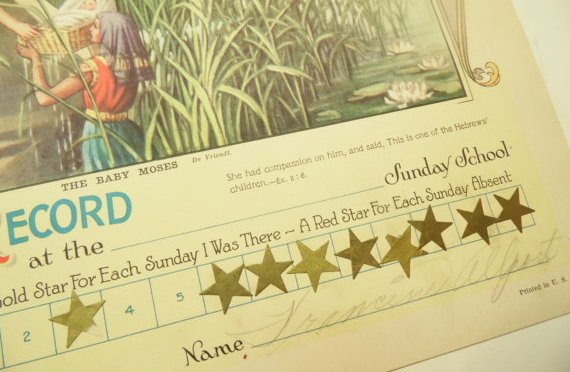
This spring, I attended a continuing education event featuring Craig Van Gelder, a professor of missiology at Luther Seminary, St. Paul, MN. He told a story about his experience growing up in the 50s and 60s and going to Sunday School. Each year, gold stars were handed out for students with perfect attendance records. Craig recalled receiving several such stars over the years. My first thought was that surely even faithful every Sunday church attenders at least took holidays or travelled on occasion?

Craig continued his story talking about how the gold stars were not just a quirk of the church he grew up in. When his family travelled, they made sure to attend church of the same denomination as his home church. He would attend Sunday School, get a signed form proving his attendance, take it back home and hand it in to make sure he could receive a gold star.

The Sunday School programs across the denomination were set up to promote the Gold Stars. Gold Stars were a denominational industry! Craig said that these gold stars really meant something at the time.

I have been thinking about the Gold Stars for months… The Gold Stars are symbolic of the intangible gap in my experience in church land as I serve as a pastor. The Sunday School that I attended growing up was full of regular, nearly every Sunday attending children and families. But I doubt there would even be one student who would achieve Gold Star status. I don’t understand what the Gold Star means, I never will.

These days regular attenders are measured by those who attend monthly, not weekly, because most churches would not have a statistically relevant group of Gold Star members. That means most kids attending Sunday School these days attending once month during the program year (September thru November, January thru May) might go to Sunday school around 8 times a year.

A Gold Star means 52 times. A regular active Sunday School attendee today is attending 8 times. 52 down to 8.

And while most churches are probably not handing out gold stars, we so often try to keep “doing” church as if the gold star criteria is the ideal.

Another way of putting it, we are holding on to the trappings of church while forgetting what they were created for in the first place.

When Gold Stars were used, it was understood that Sunday School was an effective tool for faith formation. Achieving Gold Stars was a good tool to promote people accessing Sunday School, and thereby being formed in faith.

But is Sunday School an effective tool to form children in faith when it is only accessed 8 times a year?

Last weekend I participated in a panel discussion at a church event with 3 other young leaders in the church. We challenged our older colleagues, parishioners and church members to consider the struggles and opportunities facing the church in North America as we enter deeper and deeper into the 21st Century.

We didn’t plan it, but we all talked about dropping the trappings of the 50s and 60s, so that we can proclaim the Gospel today. We talked about inclusive and transcendent images for God. We talked about how judgemental attitudes have stood in the way of young people connecting with their faith at church. We talked about re-evaluating and putting to bed out of date church programs and structures. We talked about changing modes of communication and how people now access community differently through technology.

And it was a welcome message. People of our generation and people of that 50s and 60s generation, those before and those in between all embraced the need for change that churches face today.

Yet, I could sense that letting go of the trappings was not so easy.

And it is the trappings that are killing the us. Churches are aging, shrinking, and closing because we so often refuse to let go of the trappings of the past.

So what are the trappings?

During the panel I suggested that learning to ask good questions, questions that cannot be answered with yes or no, questions that we don’t already have the answer to are good questions.

Good questions show us where we are clinging to the trappings.

Questions like:

How do we best do faith formation for children?

If Gold Stars and Sunday School for students who only come 8 times a year is the answer, you are clinging to a trapping.

How do we best carry out the various ministries of the church?

If the answer is committees and councils full of vacancies or who don’t meet at all and who don’t know why they exist is the answer, you are clinging to a trapping.

How do we best express images for God in a diverse and inclusive way?

If your answer is male only language rooted in the bible and hymns published in the 50s is the answer, you are clinging to a trapping.

How do we best communicate the activities of our church in our community?

If your answer is phonebook ads, newspaper buys and posters mail outs, you are clinging to a trapping.

How do we best proclaim God’s forgiveness and mercy for sinners? If your answer is condemning people for not having the right gender, skin colour, age, religion, vocation, etc… you are clinging to a trapping.

How do we best reach our friends and neighbours? If your answer is to wait for the young people to come back and to do their share, you are clinging to a trapping.

The trappings are killing us. The trappings are often why churches are shrinking and closing. Gold Stars have nothing to do with Jesus. At least not in 2015.

Yet, the struggle that churches have giving up the trappings, giving up all those things that we think are so central to being church and to having faith, but are not… The struggle is so often rooted in guilt and a sense of failure. We think if we stop doing Sunday School or having an Evangelism committee, or saying the old version of the Lord’s Prayer or putting an ad in the phonebook or if we welcome people different than us or if we aren’t full of young people like churches were in the 50s… we think we have failed.

Here is the thing about trappings. They worked for a time. Gold Stars worked for a time. And the trapping that replace Gold Stars for Sunday School students that come 8 times a year will eventually be out of date and unhelpful too. But we need to figure out the trappings that are right for today. Just as those other trappings we refuse to let go of, were right in their day too.

We can’t do Gold Star christianity anymore because its day has passed. Just like being an iPhone pastor will sound old fashioned some day in the future… probably in about 6 months.

Because in the end, it isn’t about Gold Stars or iPhones…

It is about Jesus, and grace for sinners and mercy for the marginalized and bread and wine for the hungry, and being God’s church doing God’s work.


What are the trappings that are holding you back? How do we let go of the trappings?Share in the comments, or on the Facebook Page: The Millennial Pastor or on Twitter: @ParkerErik


Creflo Dollar, Last Rites and the Rich Young Ruler

Mark 10:17-31

As Jesus was setting out on a journey, a man ran up and knelt before him, and asked him, “Good Teacher, what must I do to inherit eternal life?” …

Then Jesus looked around and said to his disciples, “How hard it will be for those who have wealth to enter the kingdom of God!” And the disciples were perplexed at these words. But Jesus said to them again, “Children, how hard it is to enter the kingdom of God! It is easier for a camel to go through the eye of a needle than for someone who is rich to enter the kingdom of God.” … But many who are first will be last, and the last will be first.” (Read the whole passage)

Sermon

Thanksgiving has become an odd holiday for us. And it isn’t just that Thanksgiving isn’t really a Christian holiday… since it isn’t about Christ specifically, because we do practice thankfulness as Christians each time we gather for the Eucharist or Lord’s supper. Eucharist means Thanksgiving in greek.

No, thanksgiving is odd because for most of us it is out of context. Thanksgiving’s origins are becoming distant from our lives. Thanksgiving is a North American holiday meant to celebrate the end of the harvest, time of abundance before the scarcity of winter. A time of rest following the hard work of keeping and tilling the land and animals through spring and summer.

Most of us don’t orient our lives according to nature’s seasons. We are far removed from the subsistence lifestyle… we don’t depend on our own hands to grow our own food.

And it is of course, still important for us to remember where our Canadian society came from and to give thanks that there are those who still do provide our basic needs… yet, how we do that by hosting a fancy meal for ourselves is a good question.

Thanksgiving is a holiday that survives mostly on tradition, but as we take the time to give thanks and to reflect on our own blessings… we might discover an uneasiness with our wealth and possessions much like the rich young ruler in the story we hear today.

Sometimes we can forget where the famous sayings of our language come from, and today we are reminded. As Jesus speaks with this wealthy young man and challenges him to give up his possessions, we hear familiar sayings. “It is easier for a camel to pass through the eye of a needle, than for a rich man to enter the Kingdom of heaven” and “The first shall be last and the last shall be first”.

Jesus seems to be coming down hard on the rich today. And this might make us uncomfortable. We know that we are the world’s wealthy. Anyone with an income over 34,000 is in the top 5% of income earners on the planet. And Jesus says that if you are rich, it will not be easy for you to enter the Kingdom of God. That means most of us. Ouch.

But for those who have been here week after week listening to a difficult year of Mark’s gospel, where Jesus has been uncharacteristically harsh, calling people dogs, or Satan, or telling them they would be better off dead or that they have hard hearts…

Jesus might just be letting us off the hook for our particular wealth today.

This story about the encounter between the rich young ruler and Jesus is all about absurdities. So let’s put it into modern terms so the point can be made.

If you watch TV preachers and televangelists you might have heard of Creflo Dollar… quite the last name for tv pastor. Anyways, Creflo Dollar recently shared the following gem of wisdom to his hundreds of thousands of twitter followers: “Jesus bled and died for us so that we can lay claim to the promise of financial prosperity.”

Jesus didn’t die for our sins. Or to show us God’s love. Or to conquer death.

But so that we can be rich.

Creflo Dollar also asked each one his church’s 200,000 members for $300 each so that he could buy a 70 million dollar luxury jet in order to bring the gospel to people around the world.

What does Creflo Dollar have to do with today’s story? Well, when we hear about this young man coming to Jesus, we aren’t meant to think of a nice young middle manager at the bank. We are meant to imagine someone like Creflo Dollar pulling up to Jesus in an expensive sports car with loud base booming in the air long before you can see the car and that neon glow coming from underneath. And then Creflo steps out to ask this wandering, near homeless street preacher named Jesus, “What must I do to inherit eternal life?”

It is easy to get bogged down in Jesus’ criticism of the rich… which may be warranted. But the point is not to hear Jesus criticizing us for trying to be faithful citizens, spouses, employees, and parents by providing for our families.

We are meant to see the absurdity of someone as rich a Creflo Dollar thinking he has fulfilled all the rules of righteousness and done enough to get himself into heaven.

The point isn’t the problem of heaving a certain amount of money or having possessions. The problem is thinking that being rich is a blessing from God.

When the rich young man walks away from Jesus unable to give up his possessions in order follow Jesus, the disciples want to know what is up too.

And that is because like our world, they live in a world that thinks being rich is a blessing from God. They have been taught that being rich and wealthy and healthy is a sign of God’s favour. Just like so many of us have heard on TV or from pulpits or from well meaning friends and relatives. Our world thinks that God is in heaven dolling out the cash to the good people and suffering to the bad. That’s until we see a person who is rich but not a good person. Or we see a good person struck by illness or tragedy. And then we wonder what is going on with God.

An odd thing happened to me this week as I was leading a service at a personal care home. Right in the middle of my sermon, a staff member gave me urgent message that I was needed at the hospital for an emergency. Even though I was certain I was not the pastor who the message was intended for, I quickly concluded the service and left for the hospital.

There I found a family sitting by the death bed of a loved one. I also found out that I wasn’t the intended recipient of the urgent message. Never the less, I offered to pray with the family anyways… as this is part of the calling of a pastor and something I have done many times.

And so there was I was with a dying stranger and his family praying the commendation for the dying, or what used to be known as last rites.

In the commendation, a section of the litany goes like this:

By your holy incarnation,

deliver your servant. 

By your cross and passion, 

deliver your servant. 

By your precious death and burial,

deliver your servant. 

By your glorious resurrection and ascension,

deliver your servant. 

By the coming of the Holy Spirit,

deliver your servant. 

You will notice that we don’t pray:

By all the money he made in this life,

deliver your servant.

By all the good things he did,

deliver your servant. 

By all the rules he followed and commandments he kept,

deliver your servant. 

When all there is is a hospital bed, and a ventilator and tearful loved ones –

money, rules and good deeds don’t mean a thing.

And this is what Jesus is trying to make the rich young man understand. A camel could never pass through the eye of a needle. And even a rich man cannot enter heaven by his own effort.

Rich or poor.

Healthy or ill.

Sinner or saint.

The only way we get into heaven is by God’s mercy.

The only way the Kingdom of God is opened to us, is because Jesus died on the cross for us.

The only person who earns our salvation is God.

God is the one who does the work.

We do not inherit or earn or achieve eternal life.

God gives it to us.

Jesus accomplishes it for us.

And maybe, just maybe that is what Jesus means when he says the first shall be last and the last shall be first.

Those who are relying on their own righteousness, their own goodness, their own faithfulness, their own achievements, their own 70 million dollar jets, their own riches and health and wealth, those who are relying on those things to get themselves into heaven will be incredibly surprised when they find out none of that stuff mattered. They might go from feeling first to feeling last.

But those who feel like sinners, like wretches, like unworthy and unloveable people. Those who know that they don’t measure up, that they aren’t good enough, or powerful enough, or important enough, or rich enough, or pious enough for God to show them mercy… won’t they be shocked when they find out that none of that stuff mattered. That God gives grace and mercy even to them. They might feel like they have gone from last to first.

We might feel like we have gone from last to first… because we have.

Because, thanks be to God regardless of our blessings, possessions, wealth or lack thereof, God has decided to give us mercy, to show us grace, to grant us eternal life through Jesus.

Amen. 

Syrian Refugees: This 9-Year-Old Girl is doing what Stephen Harper refuses to do

I am sorry for the Buzzfeed style headline, but this is an important topic.

For Canadian readers, you may or may not know that it was reported today that Stephen Harper and the Prime Minister’s Office directed Canada’s immigration officials to stop processing application for Syrian Refugees this spring. (Read the Globe and Mail article here)

I read this article this morning, and then later today came across this video:

Isn’t it unbelievable that Canada’s Prime Minister is willing to let more Alan Kurdi’s drown trying to make it to a better life. Why is  a 9-year-old girl doing more to save children than our government?

For readers in other countries, investigate to see what your political leaders are doing. Unless you live in Germany, the answer is not much. So why are we our leaving  it to our children to save the vulnerable children of the world? Maybe we need to elect leaders based on what they will do for our neighbour and for the most vulnerable among us, rather than voting for tax breaks and trade deals.

I hope Selina’s efforts remind us that we can all do more and that we should expect more from our political leaders.

Please scroll to the bottom of this post and share it on social media and if you want to participate in Selina’s project, here is more information about Selina and what she is doing, written by her parents:

Many of you likely know the story of Alan Kurdi, the 3 year old refugee whose body was washed up on a Turkish beach after he and his family attempted to flee from the conflict in their home country of Syria. http://www.macleans.ca/news/world/his-name-was-alan-kurdi

When my daughter Selina saw his picture and learned of the crisis, she was deeply affected and immediately wanted to take action. She is initiating a child-focused project to raise awareness of the conflict, especially among her peers, and to motivate the world to take action. We are sending this message to request your child’s involvement in the project. Selina explains it best. Please take a short minute to view the following video of Selina explaining her vision.  
One way to support the refugees is through donations, so a focus of the video – and the project in general – is to encourage people who view it to donate to one of the humanitarian organizations that are assisting with aid in the area. 

It doesn’t matter if you are a boy or a girl, or what age or grade you’re in – Selina is hoping to reach children and youth from all walks of life to support this project.

If you are able and willing to support this initiative, please create a simple poster with a message of support for the refugees. A few examples include – “save the refugees”, “care for others in need”, “remember their suffering”, etc. (These are just a few examples, feel free to use your own words of support). It doesn’t need to be fancy – it can be as simple as pen on white paper, or as complicated as you wish to decorate it. The message of compassion is the important element. 

When taking the picture, please have your child cover their face with the poster. As Selina explains it, most of these children are invisible to us on this side of the world, and by covering our faces, the Canadian children stand in solidarity with the refugee children. In addition, this is also a safety net for our children involved in the project in that they will not be identified on the video. 

Selina is hoping to collect between 25-50 pictures to create the final project. We are asking that all pictures be sent to the following email address canadiankidsforrefugees@gmail.com by Saturday, October 24th. After we have compiled it, the final product will be put up on youtube. 

Thank you so much for your time and attention to this important cause. 
Shirley & Gavin 

With love and thanks from,
Selina


And if you would like to donate to help Syrian Refugees Canadian Lutheran World Relief is an excellent place to go.

A Sermon on WX 2015: How Jesus uses Stumbling Blocks and Useless Salt

Mark 9:38-50

John said to Jesus, “Teacher, we saw someone casting out demons in your name, and we tried to stop him, because he was not following us.” But Jesus said, “Do not stop him; for no one who does a deed of power in my name will be able soon afterward to speak evil of me…

“For everyone will be salted with fire. Salt is good; but if salt has lost its saltiness, how can you season it? Have salt in yourselves, and be at peace with one another.” (Read the whole passage)

Sermon

It seems like the disciples may have finally pushed Jesus over the edge this week.

Peter was rebuking Jesus a couple weeks ago, which caused Jesus to answer by calling Peter Satan and telling him to start getting with the program or else. Last week, Jesus found the disciples arguing amongst themselves about who is the greatest, and Jesus’ annoyance was clear.

But this week, John, the beloved disciple, comes to Jesus with a dubious complaint. He says, “Someone was casting out demons in your name, and we tried to stop him, because we not following us.”

Wow, John… Is this grade 3 where we tattle to the teacher?

Wasn’t it just a few weeks ago that Jesus said, “if you want to become my followers, deny yourselves…”

John has clearly not been paying attention.

And we know that Jesus in Mark’s gospel can be harsh. He called the Syrophoenician woman a dog a few weeks back.

But Jesus’ response to John is more than harsh. Jesus really rips into John and other disciples for failing to get it.

“If would be better to be tossed into the ocean with a millstone around your neck, than to be a stumbling block to one of these littles ones.” Jesus begins.

“Cut off your hand if it is the problem. Cut off your foot if it is getting in your way. Tear out your eye if necessary.”

If throwing people into the ocean to die, or cutting off body parts sounds extreme it’s because it is extreme. But this is not an instructional manual on how to deal with sin.

Jesus is trying once again to make the disciples get it. To make the disciples understand just how much they are getting in their own way. He is trying to express just how frustrating it is to have a bunch of followers who are so focused on themselves and how he doesn’t have time for John’s self-centred non-sense.

It goes without saying that we might be uncomfortable with this frustrated Jesus. And not just because Jesus is supposed to be gentle and nice, but because John’s actions are familiar to us. We too struggle with wanting to be clear with who is in and who is out when it comes to our families, friends, neighbours and churches. We don’t have to look much farther than the niqab and citizenship ceremony debate to be reminded.

Last weekend, I attended the Why Christian? Conference in Minneapolis. There, I was reminded of just how much like John we can be.

The conference was organized as a response to the vast majority of other conferences for Christians that exist. Most conferences feature white, male, middle aged and older speakers who are brought in as experts to lecture attendees. If women or people of colour are asked to speak, it is usually tokenism. One women out of 20 men. One person of colour out of 20 white speakers. And women speak to women’s issues. People of colour speak to issues facing ethnic minorities. They are never asked to experts on the real stuff.

Why Christian? was not a women’s conference. But the two organizers were women. A Lutheran Pastor from Denver and a Christian Author and Blogger from Tennessee. And all 11 of the keynote speakers were women. Straight women, gay women, women of colour, young women, transgender women. And all of them pastors, authors, writers, professors and leaders in Churches throughout the United States. All of them have been and still are being told that they shouldn’t be allowed to do their work, to lead people of faith because of their gender, the colour of their skin, because of who they love, because of their age, because of their tattoos or their voices or the clothes they wear or any number of arbitrary reasons.

It makes us wonder… what would have John the disciple said to Jesus about them?

John would have objected and tattled on them too.

But here is the thing about John.

Jesus called John out of a fishing boat and John has forgotten that. Jesus called him even though the people in power, proper upstanding appropriate people would have objected to Jesus calling a lowly fisherman to be the disciple of an important rabbi, to a position of status and privilege.

Or maybe John hasn’t forgotten… and maybe that is why he is tattling on this person who is out doing Jesus’ work in the world despite not being part of the club. John is worried that Jesus might replace him. John and the other disciples had just failed at casting out demons… Jesus might be on the lookout for new and improved disciples who can get the job done.

John should know better than to tattle on the outsider, because he has been one too. John as been both an outsider and an insider. Both one who has been deemed unworthy and now one worthy of privilege.

And whatever the reason John is tattling to Jesus, whether he has forgotten where he comes from or whether he is afraid… maybe Jesus’s extreme frustration with John has less to do with the fact of John being a stumbling block and more to do with that thing inside of John, the source of that forgetfulness and fear that is keeping John from realizing just who gets to gate-keep the Kingdom of God.

Jesus is frustrated because John’s sinful self is making him forget that Jesus decides who is in and who is out. Not John, not us.

As I listened last weekend to speakers who almost certainly wouldn’t have been given the chance to speak at any other Christian Conference, it was incredible to hear these women tell their stories, and as the name of the conference, Why Christian? suggests, answer the question of Why Christian? Why continue in a religion, tradition and institution that so often seeks to silence their voices in the very name of these women follow.

It was incredible to hear these women speak because even as they all had stories where some well intentioned but misguided disciples like John had told them that they weren’t worthy of doing God’s work because of their gender, their skin colour, their sexual orientation, their impropriety… even as they all their stories of being shut down and pushed to outside by John…

They also had stories of being welcomed and brought back in by Jesus.

They told the 1000 of us who gathered in beautiful and appropriately named St. Mark’s cathedral about the ways in which Jesus continually draws them back to Christianity. How Jesus draws them in by being outraged along with them at the injustice they experience. How Jesus draws them in by declaring that they are beloved and that they belong. How Jesus draws them in through the grace and mercy filled word of God, draws them in through the cleansing water of baptism, draws them in through bread that gets faith under our fingernails in the Lord’s Supper, draws them in through the community that swirls around in the cup of wine.

They told us how Jesus continually draws them back and offers them a place in the Kingdom.

And the stories those women told about Why Christian? tell us something about us.

We are all like John.

We have all been both the ones on the inside and on the outside. We have been told we aren’t good enough to do God’s work and we have told others the same. And we have done so because of our forgetfulness and our fear.

We have done so because of our sin.

And just when Jesus is enraged by the fact that we don’t get it. Just when he seems to be annoyed to the extreme with John and us.

Jesus pulls it back together and Jesus talks about salt.

Salt that acted as currency, food preservative, and fertilizer. Ancient impure salt that had the habit of going bad and becoming useless. Salt that once it became flavourless white powder had no purpose.

No purpose but one.

To be thrown on the roads where it helped keep the roads flat and walkable.

Kind of opposite to stumbling blocks.

Even though like John, we get in the way of our brothers and sisters, even though we have a habit of making things messy and complicated. Even though our sinful selves prevent us from seeing what Jesus is up to… Jesus has a use for flavourless salt.

Jesus has a use for people on the inside who are afraid of losing their place. And Jesus has a use for people on the outside who are excluded because of their gender, their skin colour, their sexual orientation, their voices and tattoos, their lowly jobs and lack of social standing.

Jesus has a use for us.

Because we are both. We are insiders and outsiders. We are tattling on each other and the ones being tattled on. We have been the ones trying to be gate-keepers, and we have all been told we aren’t good enough.

And for Jesus… none of that matters.

Because Jesus decides who gets to be part of the club, who gets to be disciples, who gets to speak, and teach, and serve on his behalf.

And Jesus decides that his kingdom will be full of stumbling blocks AND useless salt. Jesus decides that is Kingdom will be full of people just like you and just like me.

Insiders and outsiders

All beloved by God.

Amen. 

Why Christian? – The difficulty of having a Progressive Faith in a Conservative Tradition

I consider myself an orthodox Christian.

Not Eastern, but orthodox in the sense that I adhere to the essential core doctrines of Christianity, like the Trinity, Original Sin, two natures of Christ, the real resurrection, etc…

I also belong a Lutheran denomination (ELCIC) that allows same-sex marriage, ordains women and LGBT people, teaches its pastors historical-critical methods of biblical scholarship, and does any number of other things that many Christians consider heretical.

There is an inherent difficulty in operating in an orthodox and small “c” conservative faith tradition while adopting socially progressive ethics and post-modern scholarship. This difficulty has been churning in the back of my mind for months, and this week it is about to come to the forefront.

My wife and I are headed to the Why Christian? Conference hosted by Nadia Bolz-Weber and Rachel Held Evans. In preparation for the conference, Rachel Held Evans asked the question on her Facebook page “why christian?

And the question was asked in light of recent events in news: The hype around Kim Davis’ stand for “Christian values” in refusing to issue marriage licenses for same-sex couples contrasted by the photos of a dead three-year-old Syrian refugee washing up on a Turkish beach.

When fellow Christians are rallying behind someone trying to use the government to impose her beliefs on others in the name of religious freedom, how does one stick with this Christianity business?

When ‘Christian nations’ seem so passive about doing anything about the plight of refugees escaping violence because they are muslims, how do you continue to call yourself Christian?

By definition, Christianity is a conservative faith. No, not conservative in the political sense. Christianity is conservative in the practical sense. Christianity seeks to maintain, protect, promote and conserve the teaching, preaching and good news of God in Jesus Christ. Christianity is trying to bring the past forward – a conservative way of being. And yet, along the way Christianity has also conserved things like patriarchy, sexism, systems of power and abuse, bigotry and racism, judgementalism and close-mindedness.

Christianity has a lot of baggage to contend with, and our baggage is frequently getting in our own way. Our baggage is often the thing Christians mistakenly hold up and shout loudly to the world that this is what God – not just Christianity – is all about.

A common refrain among those who struggle with the conservative baggage has been to drop the Christian label in favour of “following Jesus.” And who can blame them? Considering the Christianity that is so frequently presented in the media and practiced so widely, or when Kim Davis or Donald Trump or Fox News is our spokesperson, we should want to say, “I am not with them.”

The Kingdom of God is Near - the Lion of St. Mark
The Kingdom of God is Near – the Lion of St. Mark

Ten days ago, I got a tattoo (insert joke – “a pastor walks into a tattoo shop…”). Getting a tattoo is a very intimate experience. For four hours I had to lay still as someone literally did artwork on my body. And yet, during those four hours I had an extremely familiar experience. My tattoo artist and I talked for hours about all the ways that Christians are judgemental, agenda-filled and often put off and offend unchurched people like her. Yet she didn’t find me that way.

My tattoo artist told me that I was not like any pastor she has ever met (well, not quite, as my wife spent an afternoon with her a couple of  weeks before me). I get told that a lot. When I meet with unchurched couples coming to get married, when unchurched families come to have a child baptized, or when unchurched families come for funerals they often tell me that I am not what they expected. Most unchurched people that I get to spend some time with tell me I don’t sound like the Christians on TV, or like their one friend who can’t stop talking about their megachurch pastor, or like their grandma who looks down on them for having tattoos, piercings, not going to church, living in sin or whatever else. I don’t sound like those other Christians because I am cool with questions, even encouraging of them, I share my doubts, and I even share my own frustrations about the judgemental behaviour of many fellow Christians.

Maybe this should make me wonder if I got Christianity wrong along the way? Is the way I practice it so uncommon?

It isn’t.

I have spent far too long studying history and theology in university and at seminary to not know that the way I practice Christianity is fairly consistent with the way it has been practiced throughout history. And most of the Christians I know approach faith the way I do.

Yet, despite the baggage that Christianity carries these days, despite the undignified death that Christendom is undergoing, despite the pop-culture caricature that Christians have become, I can’t walk away from the religion.

I am a Christian, even if Kim Davis gets to speak for me, or Fox News or even… heaven forbid… Donald Trump. 

And I am Christian because following Jesus means being a Christian. It means hanging out with sinners and other people who struggle with the baggage. With people who want to hold on to the baggage at all costs, or people who have been trying to toss it from the bandwagon since before they can remember.

Because believing in Jesus just doesn’t work outside of community. Because taking up our cross and following means we don’t get to avoid all the crosses in the world, but instead Jesus’ ministry happens right where the crosses are. The crosses of hypocrisy, judgmentalism, abuse, control and power.

Dumping Christianity to follow Jesus doesn’t jive with the God who put our baggage on, who literally became our baggage, who used our baggage as his flesh in order to come and meet us in the incarnation.

And of course our baggage, our flesh, made things much more difficult for Jesus, but that was the only way to reach us.

As much as I shake my head this week every time I see a Kim Davis news story scroll by on Facebook. As much as I get enraged when I read that Christians are rallying behind Donald Trump, or rallying behind Stephen Harper here in Canada. As frustrating as it is that the Christianity that is represented in the media is one I neither recognize nor practice.

But I know that this is not the whole story.

I know that the church I grew up in is full of people just like Kim Davis, and they have sponsored 3 refugee families over the past 15 years. In fact, churches are some of the most frequent sponsors of refugees. I know that the grandmothers who guilt their grandkids into bringing their babies to be baptized also knit quilts for Canada’s northern communities and brought sweaters by the truck-load so that Canadian Lutheran World Relief could send 70,000 sweaters to Syrian Refugees last winter. I know that church people who struggle with how fast world is changing and who long for the golden age of Christendom are also regularly volunteering at the soup kitchen, filling the food bank, visiting people in hospitals and old folks homes and are caring for the world in their own small ways.

But most importantly, I know that Christianity is at its best when it is practiced by sinners. Even when those sinners like to tell everyone outside the church that they are the sinners. Christianity is still for sinners.

Christianity, the religion with all this baggage, is also the means by which God meets our broken world and speaks words of promise, grace, and mercy. The baggage filled traditions of Christianity are the means by which God washes and claims us as God’s own, the means by which God feeds us with God’s very Body.

Christianity is the community where God transforms us from broken and flawed people into forgiven and whole. 

And as filled with baggage as Christianity is these days, I need it. We all need it.

Because we need God

and those promises

and that washing

and that food.

I can’t believe in Jesus alone, I need all these messed up people – Christians – to do it with me.


Why are you still a Christian? What are your frustrations with Christianity? Share in the comments, or on the Facebook Page: The Millennial Pastor or on Twitter: @ParkerErik