Category Archives: Theology & Culture

Why did no one help the man for 38 years?

John 5:1-9

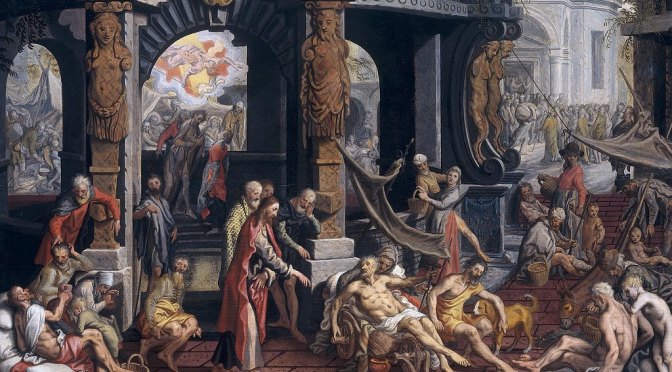
Now in Jerusalem by the Sheep Gate there is a pool, called in Hebrew Beth-zatha, which has five porticoes. In these lay many invalids– blind, lame, and paralyzed. One man was there who had been ill for thirty-eight years. When Jesus saw him lying there and knew that he had been there a long time, he said to him, “Do you want to be made well?” (Read the whole passage)

Sermon

We are coming to the end of the season of Easter. Over the past 6 Sundays we have been with the women at the empty tomb, locked away with Thomas, fishing on the other side of the boat with the disciples, walking in temple with Jesus at Hannukah, and back to Maundy Thursday with the new commandment to love.

But today we reach way back into the story of Jesus. Before Last Suppers, betrayals, trials, crucifixions. Before resurrection and miracles. We go back and see with Easter eyes that the resurrection was not just on the Sunday morning of the empty tomb. We see that Jesus has been showing us resurrection right from the beginning. But we can only see it now, only after we have made our way through the Easter story.

Today, a man who cannot walk lays between the pillars of the Sheep Gate Portico. A public square in Jerusalem. He watches as people file by, merchants, soldiers, farmers, religious authorities. He watches as other beggars, the lame, blind, deaf and unclean lay there with him. Many are bathing in the spring water pool hoping to be healed of their infirmities, but the man who cannot walk has no such hope. Instead, he is only looking for the charity of others, as he has been doing for 38 years. Legend has it that at certain times, an Angel of the Lord comes to stir up the waters of the pool. The first person into the water after this is believed to be healed. This portico is a place that gatherers people in need of healing. But the man cannot walk, and there is no way he could ever drag himself into the pool first – without help.

As the man who cannot walk lays there, a group of men come by and stop, one of them speaks to the beggar, asking him question. But without really hearing what has been asked, the man who cannot walk launches into his story, his hands extended. ‘Sir, I have no one to put me into the pool when the water is stirred up; and while I am making my way, someone else steps down ahead of me.’ Its a well rehearsed story, it is short, to the point and designed to make people dig deep in their pockets. The man has been telling it for decades. He isn’t expecting healing, he is expecting pity or charity. A few coins so he can provide for himself a few more days.

But the question that is asked to the man is not “Why haven’t you bathed in the healing waters of the pool?”

That question is too absurd to contemplate. 38 years is far too long for no one to have done anything for this man. Its is impossible to think that this man could have been laying just a few meters from healing for nearly four decades. The answer that this man has simply fallen through the cracks of human compassion for so long if too painful to imagine. How could that happen?

This story demands a question. “Why has no one helped this man? How could he have been left to suffer for 38 years?”

It seems ridiculous… almost too absurd to be true.

And yet the same question could be asked all around us in our world. This story is not only NOT absurd, but it is a story told all around us.

How long must the community of Shoal Lake First Nation go without clean water? 100 years? 200 years? Why has no one helped this community?

How long must Syrian refugees camp out a the boarders of closed nations? 5 years? 10 years? Why have these nations turned their backs?

How many people have to die of fentanyl overdoses until we do something? 100? 1000? Why has no one helped them?

How many children on First Nations must attempt suicide before we commit to making their living situations worth staying alive for? 50? 100? Why has no one noticed before now?

These questions are hard to ask, and even harder to imagine the indifference it took to let these things happen in our world.

Yet, there is a problem will all these questions. The questions are no more compassionate than the indifference and inaction that they question. Asking why no one has helped is more about us than the people suffering. It is more about making our own guilt go away, than offering what suffering people really need.

Notice that when Jesus approached the man who couldn’t walk today he didn’t ask, “Why has no one helped this man in 38 years?”

Jesus doesn’t jump to solving problems. He doesn’t define the man by his condition. Jesus doesn’t dehumanize the man in some attempt to be the white knight riding in to save the day.

Instead, Jesus asks the man who cannot walk, “Do you want to be made well?” 

Jesus presumes nothing. Jesus doesn’t jump right to problem solving. Jesus isn’t worried about saving the day or about making his own guilty feelings better.

Jesus is concerned with the man. Jesus recognizes the man. Jesus humanizes the man.

Jesus isn’t there to save the day, but to save the man. Jesus doesn’t do it by dragging the man into the pool. He doesn’t even do it by helping the man walk.

Jesus saves the man by seeing a person first and condition second. By seeing a person rather than a problem. Jesus embraces and acknowledges the man’s humanity.

“Do you want to be made well?”

It is a question that is about what the man who cannot walk needs and wants. It is about how the man wants to address his own suffering. Jesus isn’t there to force solutions on a problem, but to care for a person in the way they need to be cared for.

It is this that saves the man. Not the healing pool. Not the command to walk.

Jesus saves the man by caring for him as a person. But turing him from a problem into a human being. Before the man ever takes a step, Jesus welcomes this man back into relationship. Jesus welcomes this man back into life.

And the man who had been lame for 38 years gets up and walks. He walks because Jesus has seen him, recognized him, welcomed him back to life. Restored him to true life, to be more than his problems, to be more than injustice, to be more than legs that don’t work right.

“Do you want to be made well?”

Jesus’ question is rarely one we ask of those who are suffering. Human beings rarely take the time to ask this of each other, because it requires we get out of ourselves.

Because we when ask it we realize that problems we see around us are not just situations needing solutions. If we were to ask questions that humanize one another, we would see that we too are the people of Shoal Lake living for generations without clean water. That we are refugees fleeing for our lives. That we are those dying as we try to numb our pain with drugs. That we are people whose living conditions aren’t worth living for. We are all those people, just as we are the man who has not walked for 38 years too.

We are the ones whom Jesus is asking “Do you want to be made well?”

Today, as Brooklyn is dunked into the healing waters of Baptism, we are reminded that Jesus has asked us this question too. That God has seen us, recognized us, named us and claimed us. In the waters of baptism Jesus turns into people, Jesus welcomes us into new life. We stop being defined by the problems of sin and death, we stop being the sum total of the suffering we endure. And Jesus turns is into people. Into beloved children of God.

And in this act of God, in these cleansing and healing waters, God says to us, “Stand up and walk.” And through the waters of Baptism, we are raised to new life, we are raised to walk, to walk in this life of faith.

Today, as we near the end of Easter, we see that Jesus has been showing us resurrection all the way along. We just couldn’t see it before now, we couldn’t see it without Easter eyes. As Jesus sees the man who couldn’t walk, whom no one bothered to help for 38 years, Jesus sees us too. Jesus sees all the suffering and injustice of our world, Jesus sees us – not as the problems that define us, but as people who are beloved and cherished by God.

And because God has seen us and loved us we are able to stand up and walk.

Amen
Why nothing seems to get people back to church – The issue at the core of decline

“People just aren’t committed like they used to be”

This week, I came across this satirical article from the site BabylonBee “After 12 Years Of Quarterly Church Attendance, Parents Shocked By Daughter’s Lack Of Faith

The article humorously reveals an issue facing many churches today. I can’t tell you how many times (56,819 times) I have had the conversation where someone talks about the fact that young people aren’t as committed as they once were. People aren’t coming to church like they did in decades past, and those left behind have started to notice. Many congregations are feeling older, thinner, and tired out. The future feels bleak. The studies tell us that the church is declining.

And so churches try any number of things to attract people back to church. Youth group programs, revamped and modern music, renovated worship spaces, hip and cool pastors with tattoos and any number of other gimmicks.

But nothing seems to work. At least I haven’t heard of any churches successfully bringing back all the members who drifted away. And yet we keep at it, week after week, year after year worrying about people who were once here. Our grand plans for revitalization is to try and appeal to people who have already chosen to leave. Sure, it works once in a while, but this is probably not a strategy for success.

Yet, while churches fret and worry about those who were once there, we rarely take the time to understand what we are asking people to come back and commit to.

Commitment to church

A lot of sermons, bible studies, meetings, conferences, lectures, consultants, coaches and more have been spent analyzing and communicating the message that the social advantages of church that drove attendance in decades past no longer exist. It just isn’t the case anymore that good citizens born here are expected to become good church members. Schools, work, neighbours, businesses, governments don’t do –  society-at-large doesn’t do – our evangelism for us anymore.

Church isn’t an expected social commitment any longer.

Yet, almost always when we speak of getting people to start coming back to church, we say it just like that – ‘back to church.’ And the issue goes deeper to than that. So often when I ask church members what reason keeps them coming to church, there is almost always one things at to the top of the list: Church feels like family, church is a community.

Churches should be communities where we feel connected to each other in deep ways.  But family and community are still social commitments at the end of the day.

Social Commitment

Most churches are, at their core, institutions formed around a social or societal commitment. The core of churches have been based on the fact that people are expected to attend because of societal pressures. And when society taught us through family, friends, neighbours, schools, workplaces, TV, movies, newspapers, courthouses, and governments that being church attenders was important, churches organized around social commitment worked well.

These churches did good ministry, they reached people with the gospel and they were servant communities.

But now that society is no longer providing the pressure to be church attenders, attracting people to a social commitment doesn’t work.

In fact, it may be the very thing that is driving people away.

Our pitch for church has often become some version of “come to church because you should” or “come to church for your family” or “come to church for the community”

Yet, people are choosing sports or music or clubs or brunch with friends or sleeping in with family because they love those things. People are choosing things that they are passionate about, things that they love. Social pressure doesn’t hold much sway anymore, even if our society did push church on people.

When you love soccer, finding a team to play on is also finding a community with a shared passion. When you love brunch, finding a brunch club means joining a community that shares your love of brunch. When you love lazy Sunday mornings with family, you have a community that also loves sleeping in.

But what is our shared loved at church? Are we just communities to join without a shared passion?

Commitment to Jesus

If I had to guess, the vast majority of people who still might be looking for a church in 2016 are not looking for a social commitment to church.

As a millennial, I never lived in the era of social commitment or social pressure to go to church. While most of my peers growing up weren’t interested in church, nor exposed to it beyond Christmas and Easter, the ones who did express interest did not do it for the social commitment.

My church going peers were interested in following Jesus.

Now, imagine someone is looking for a church. They are looking for a church with a commitment to following Jesus at its core and they show up at a social commitment church. It would be like showing up for a soccer team that stopped playing soccer years ago, and who instead gathers for coffee and donuts with friends and family. But this gathering of people still call themselves a soccer team.

Now imagine members of that “soccer team” wringing their hands week after week over the fact that no one wants to join the team to clean up coffee and pick up the donuts. You can see why soccer players looking for a team wouldn’t join. You can see why many members of the team left a long time ago.

As churches try to understand why all the attempts to attract people back to church haven’t yield better results, I think it is because the core foundation that brings most church communities together is fundamentally at odds with what people who are looking for churches are seeking today.

If I had to guess, that if people are looking for church these days, they are doing it in the same way that someone would look for a soccer team. A soccer player looks for a team because they love soccer. A church seeker is looking for a church community because they love Jesus and want to follow him. They are not looking for a church because they love church.

And it goes deeper than that. If getting people to church is the chief concern, than we will always be looking to draw people in.

But if following Jesus, and letting people know about this gracious, merciful and compassionate God, is at our core, we will reach out. And reaching out to let people know about Jesus, may or may not include more bums in pews. Either way, building the church is not the goal, but at best is a symptom of reaching people with Jesus.

So how can churches address this? How can churches built on the social commitment to church have the conversation about the fact that the very thing that brings them together as a community is their biggest problem?

With a lot of soul-searching, a lot of questions, a lot of discerning and a lot of prayer. Changing our foundations and cores will not be easy. In fact, many churches will choose to die instead of changing to the core of following Jesus.

Despite the social commitment at the core of our churches, I think that many churches and church members do want to follow Jesus too. And it isn’t that a church has to choose between being a community or following Jesus. One doesn’t exclude the other.

But churches DO have to choose what is at their core. Churches need to choose the foundation that gathers their community.

Is it a social commitment to church?

Or are we followers of Jesus whose shared passion brings us together?


What is the core passion that brings your church together? How can churches change their core? Share in the comments, or on the Facebook Page: The Millennial Pastor or on Twitter: @ParkerErik

Why tattoos are like clerical collars  – On being a Pastor with Tattoos

Tattoos are everywhere these days. According to pew research in 2010, nearly 4 in 10 millennials had tattoos. And half of those have 2 to 5. Generation X isn’t far behind with 32% having been inked.

So it hardly makes me unusual to be a millennial with tattoos.

I am also a Lutheran pastor, but I am by no means the only pastor with tattoos out there. In fact, if I had to guess about the pastors that I hang with, we might be more tattooed than average. And there is of course that famous tattooed Lutheran pastor, who has also written a few best selling books and even been interviewed on national radio here in Canada.

Tattoo #1 

IMG_0831
ICTHUS- Jesus Christ God’s Son Saviour

I went under the needle for the first time in the summer of 2006. Part of me is hopeful that I was ahead of the mainstream 10 years ago but I am sure I wasn’t. I was working at a bible camp at the time, and I remember having long talks about the implication of being tattooed. It would need to be a christian image, but not a cross. Every rapper had a cross tattoo by then (and rappers are a bad thing to the kind of young adults who work at bible camps). It would need to be in a place I could cover with clothes on a regular basis so that I could be a proper pastor (I was already a seminary student by then). But I also wanted the opportunity to show it off now and then. An original artwork Jesus fish on the back of my calf seemed like the best option.

That first tattoo made me feel cool. The comments of my co-workers, the kids at the camp, and my seminary classmates that I returned to that September made me feel ‘edgy’. Don’t laugh, it was 2006.

In 2009, I was ready to be ordained, and I hadn’t really thought about my Jesus fish much for a while. Then a church called me to be their pastor. My family told me to make sure I wore pants whenever I was working (as opposed to?), which I laughed at. But I was worried about what my new congregation would think if they ever saw my “edgy” tattoo.

And then the very first council meeting I was to attend, was also the day the uHaul was available for me to move into the parsonage. I drove up to the house only a few minutes before the meeting and sure enough I was wearing shorts on a hot summer day with my clothes still in boxes. What would these pious church folk think?

No one seemed to notice enough to say anything. So nothing?

That church had called me despite the fact that I looked like Hagrid from Harry Potter, or a giant dwarf from Lord of the Rings. My proportions are of someone with short legs and a squat body, except I am 6’2. And I had long hair and a beard at the time. A little calf tattoo was the least to get past when it came to my appearance.

After that I didn’t ever worry about my “edgy” tattoo.

But then unusual things started happening. I played slo-pitch in a Lutheran league, to which I usually wore shorts. Often players from other teams would comment on my Jesus fish. A number of times when other players found out that I was a pastor, they would think it was cool. They had never met a pastor with a tattoo (one they had seen).

For years after, I always wanted another tattoo, but I got my first on a lark at the one tattoo shop open on a Saturday in the small town near the bible camp. Going about getting tattooed in a serious way seemed like a lot of work.

Then life put another tattoo on the back burner. New calls to new churches, marriage and a baby.

Tattoo #2

For our 3rd wedding anniversary, my wife and I started talking about tattoos – yes, a bit of a stretch for the “leather” anniversary. And we wanted them to be seen. Somewhere that would regularly visible.

IMG_3971
Great Colours

Forearms.
Courtenay got a peacock feather (we had a peacock feather themed wedding), and I got a lion of St. Mark with a greek bible verse (I am a pietist at heart and a church nerd).

So for the last 7 months I have had a tattoo that is visible the majority of time (I a

IMG_3956
The Kingdom of God is Near

m almost always in short sleeves or rolled up sleeves). And as Justin Trudeau says, “Because it is 2015” I really didn’t think much of getting a tattoo, even as a pastor. My congregation largely didn’t notice either – bless them. A few said they thought I always had it, after I used it as an object lesson in a children’s sermon. Others have asked about and admired my lion.

Yet, outside of my usual group of church people, unusual things have started happening again.

Most of the baptisms I do are for families who are seldom active in the church, but have returned for whatever reason to get their child baptized. For this reason, I have opportunity to invite myself into the homes of unchurched or de-churched people in order to talk about Jesus. I have been doing this for 7 years and I always thought it was going well. But something changed once I had this big lion tattoo on my arm. People started relaxing more quickly, I didn’t have to make 10 jokes just to put people at ease. These poor young families with a pastor intruding in their home to talk about Jesus started to sense that I am a real person. All it took was a tattoo to break the image of christian judgement robot that pastors often have on TV.

My second tattoo is a wedding anniversary gift and it makes me think of my wife every time look at it (the greek bible verse says “the Kingdom of God is near”, and my wife and kids make me feel as close to paradise as I have ever felt).

But I never expected that my tattoo would also be a tool for ministry. I never thought it would humanize my clerical collar… that it would make the person in the shirt a person and not a caricature.

I never thought that when I rolled up my sleeves halfway through a conversation about baptism with a young unchurched mother who was getting her baby baptized for her mother-in-law that she would say,

“You have a tattoo! Is that okay for pastors to have?”

And then we would get to have a great conversation that makes Jesus, christians and the church seem reasonable.

Tattoo #3

IMG_4544
Pete

A few weeks ago, I got my 3rd tattoo on my other forearm. A birthday present from my wife. An elephant for my son, whose constant companion day and night is a little stuffed elephant named Pete.

The day after I got it, I presided at a funeral. Funerals can be awkward for pastors as there are usually a lot of people and you become a momentary figure of importance on a small scale. Since they watch you lead worship, people feel like they know you, but you don’t know them. Some are friendly, but many people avert their eyes when you come strolling into the lunch. Either way, when you are the one in the collar, people react to you with different levels of comfort. Some see you as a friendly and safe person, others are wary or unsure.

As I was mingling before lunch, a women passed me, averting her eyes … which landed on my tattoo. This stopped her and she began asking about it. We then shared a brief conversation about where I got it, which opened the door to more conversation about the funeral itself. My guess is that this woman have likely avoided me, but the tattoos were an opening. Still, for those whom the collar is safe and friendly, that hasn’t changed. I am still a safe person to approach.

A few weeks later, I met a de-churched young couple coming for pre-baptismal preparation before worship. I was wearing my vestments, which cover my arms. They seemed nervous to greet me. But following worship, with my vestments off and my arms uncovered, I could see the tension and nervousness leave the couple. My tattoos made me seem more human and relatable.

Tattoos and Collars

When I made the decision to get inked with permanent body art, I did so because I wanted to. It wasn’t about ministry at all.

IMG_1360But in some ways tattoos are like clerical collars.

Becoming an ordained pastor or getting a tattoo is a deeply personal decision. When you put on a collar you are displaying publicly an important and personal part of yourself. Everyone who sees you knows important and personal details about your job and  about your religious beliefs.

Tattoos function in much the same way. Tattoos are personal symbols and images on public display too. Everyone who sees your tattoos is given an image of something that is likely personal and meaningful to you.

When I wear a collar I embody a symbol that carries a variety of meanings to the people I meet. Symbols that range from spiritual caregiver to pedophile.

When I am just a guy in street clothes with tattoos, I embody an entirely different symbol to people. Symbols that range from millennial hipster to Hell’s Angel.

When I wear both, two symbols that have traditionally not mixed before come together.

And the thing I never expected about wearing both – a collar and tattoos – was that they would would humanize and tame each other,  and they would together open doors that neither could on their own.


What do you think about tattoos? What do you think about Pastors? Do you have stories involving both? Share in the comments, or on the Facebook Page: The Millennial Pastor or on Twitter: @ParkerErik

If you are in the Winnipeg area and looking for a fantastic tattoo artist, check out Tattoos by Coral.

Good Friday is Not Special – Everyday is Good Friday

John 18:1-19:42

Good Friday is not special nor unique.

What happens on Good Friday is no different than what happens others days.

One falsely convicted man killed by a merciless and cruel government is barely even news-worthy in our world.

Jesus was no Steven Avery. Jesus was only convicted one for crime he didn’t commit. Steven Avery has been convicted twice of crimes he didn’t commit.

Jesus was no Alan Kurdi. Only a few devoted followers wept for Jesus. The whole world wept for Alan, the young boy laying on a turkish beach.

Jesus was no Rinelle Harper or Tina Fontaine or Delaine Copenace. His beating, his death did not spark an inquiry. A nation will start a soul-searching missing and murdered indigenous women inquiry for Rinelle and Tina and Delaine.

There were no headlines for the crucifixion. There were no hashtags like #PrayforJesus. There were no flags to put on profile pictures, no pundits or reporters or commentators who talked and talked and talked.

Good Friday is not special. It is just another day for us. 

Good Friday is everyday in our world.

Just in the past year we have come up with so many new names for Good Friday, so many new names for the violence and death that we simply cannot end:

Brussels, Paris, Ankara, Beirut, Mosul, Nigeria, San Bernadino, Charleston, Toronto, Syria, Iraq, Afghanistan, Egypt, Somalia, India, Pakistan, Indonesia, Israel-Palestine.

ISIS terrorists, soldiers, militants, jihadis, suicide bombers, cell groups, radicalization, mass shootings, racism, sexism, discrimination.

Migrants, refugees, human smugglers, closed boarders, giant walls built along national boarders, residential schools, climate change, inequality.

Our list of new Good Friday words is so long we forget what we were listing off in the first place.

Our list of new Good Friday words is so long that we forget them almost as soon as we create them.

Our list of new Good Friday words makes us numb.

Our list makes violence and death feel normal.

The first Good Friday was not special. One man died on a cross. 

One man who angered those in power, so they go rid of him.

One man who didn’t give the chanting crowds their King, so they started shouting crucify.

One man whose own followers betrayed and abandoned him in his worst hour.

Jesus died like the rest of us. 

Jesus suffered violence and cruelty and hate like the rest of us. 

Jesus was just another person to suffer an unjust and merciless death. 

The cross of Good Friday was not special.

Except that not being special is what makes Good Friday special.

We didn’t think that God would be on that cross.

We didn’t think that God would die at our hands.

The cross of Good Friday was not special, the violence of the death was not special, the ones who condemned were not special.

The one who died was.

The one who died changed everything.

The one who died was God.

Today, God has died. On Good Friday God has died. 

And all those other words for Good Friday, for death and violence in our world. Those words from that list so long that we forget. Those words lose their power. All those days of death and violence and suffering that seem to come at us unrelentingly from the news, from around the world, from our backyards.

All those Good Fridays that seem to happen far too often.

They lose their power.

Because the God who died, died with us.

Because the God who died, lived with us.

Because the God who died, loved with us.

God died on Good Friday.

But death did not destroy God.

And God is not forgotten.

And God is not finished.

Good Friday and all our other words for violence and death are not bigger than God is. 

On Good Friday, God who is bigger than death showed us something new.

On Good Friday God gave us truly new words. Words that change the world.

Words likes:

Mercy

Forgiveness

Compassion

Grace

Love

New words that God uses to change us.

On Good Friday God dies with us.

But what is ended,

What is finished,

What is over is,

the power of death.

On Good Friday death is ended.

On Good Friday death is no more

On Good Friday death will never have the final word.

Today, on Good Friday, God has a new word.

One word that changes everything.

Life. 

Why did Jesus have to die? – Why God didn’t kill Jesus on Good Friday

We are on the doorstep of Holy Week.

Clergy types will soon be setting out to write and preach sermons that somehow make sense of the passion story, from Triumphant Entry, to Last Supper, to Trial and Crucifixion and finally Resurrection.

Along the way, it will be important to say something about how the death of a wandering preacher, teacher and healer on a cross is the means of our salvation… and what exactly we are being saved from.

This is a tricky endeavour because the story of the passion doesn’t explain the reasons. Instead we are left to fill in the gaps, and Christians have been trying to make sense of Christ’s death since St. Paul was writing letters.

And so often on Good Friday, a strange and convoluted theory of the reasons for Christ’s death is presented… one that makes God seem merciless, if not plain incoherent.

Often, God is presented as the ultimate source of Christ’s condemnation, the one who kills Jesus on Good Friday.

And this is absurd.

It is my contention that Good Friday is the day of the most important facet of the Good News and it is not because God killed Jesus.

Satisfaction Atonement

One of the most common ways that Christians tend to explain the atonement is with Bishop Anselm’s satisfaction atonement theory. The cole’s notes version is that the punishment for human sin is our death. And the satisfaction, the making things right is Christ’s death (since he was without sin).

What is rarely stated is that Anselm used medieval legal practice to formulate his theory. In medieval law, a fine was the punishment for most crimes. Anselm saw then that death was the fine for sin. But that wasn’t the end of the matter. In order to compensate the victim, satisfaction was paid. An additional amount that would make things right.

Anselm figured that since death was the most human beings could pay, an additional payment to make satisfaction with God was needed. Christ’s death becomes the satisfaction for our sin.

Now, beyond the fact that his medieval legal system is flawed and very human like any other system, there are a number of problems with Anselm’s theory:

God requires blood in order to show mercy… which is not mercy.

God is bound by human laws… which means God isn’t free.

And finally God and Jesus split apart by the cross… which is trinitarian heresy.

Anselm’s atonement theory is certainly not the only one out there (Christus Victor/ Ransom theory, Moral influence theory, scapegoat theory etc…). But it shows a common problem that most explanations of what was going on on the cross seem to have – they undo the trinity.

The Cross and Trinity

For some reason preachers tend to get uncomfortable with God being too close to the cross of Good Friday. When I was a neophyte theology student, still two years from starting seminary I was asked to give a short reflection on Good Friday on one of the 7 last words of the cross. My words were “I thirst.” And I pontificated eloquently on how Jesus experienced the human condition fully on the cross. Sounds lovely. And I then expounded on how Jesus was fully separated from God, just like we were. Almost sounds legitimate… except for that whole trinity thing.

The doctrine of the trinity reminds us that the persons of the trinity are never separate because they are one God. They are distinct, but one. So the experiences of one are shared by all. The Father and the Son could not be separated, even on the cross.

And this the heart of the problem. We don’t like the idea of God suffering, the Father suffering. We would rather make God the killer than the sufferer.

But the Trinity necessitates that God the Father experienced the cross just as much the Son did. God was crucified and died on that cross.

So who killed God?

We did.

Humanity. Our religion. Our government. Our authorities. Our mobs.

Yes, I do think that God knew the cross was in store of Jesus even before that angel visited Mary to tell her she was pregnant.

But it was not because God was perversely and cruelly looking to punish someone for our sin. It is not because God needed blood to be merciful.

God knew the the cross was in store because God knew us. God knew that humanity couldn’t let God come close in the incarnation. God’s coming close threatened our godship. We cannot be god if God is God. We could not be god if Jesus is God.

And here is where the Good News of Good Friday meets us.

Even though God knew the consequence of incarnation – of coming close to creation, of coming in flesh – God followed through to the end. God was born, God lived, God died. God did all the human things. Good Friday was the completion. God declared that God is going to a part of all of created life. There is no part of human existence that would be apart from God.

So why did Jesus have to die? Because we said so.

And why do we get to live? Because God said so.

So this Holy Week, whether you are preaching or hearing the preaching, listen… listen for the good news of Good Friday.

Listen and know that it is not that God killed God’s son in order to show us mercy. The good news is never a demand for blood. That is sin.

The good news is that God chooses life. God chose to live. Chose to live all of created life, including death.

And because God lived it all, that whole resurrection thing that happens on Sunday becomes part of our story. Because God chose to live and die with us, we get to die and live with God.


What good news do you hear on Good Friday? Share in the comments, or on the Facebook Page: The Millennial Pastor or on Twitter: @ParkerErik