Category Archives: Theology & Culture

All Saints is hard, All Saints is beautiful -Pastor Thoughts

Oh, blest communion, fellowship divine!
We feebly struggle, they in glory shine;
yet all are one in thee, for all are thine.
Alleluia! Alleluia!
~ ELW 422 For All the Saints v.  4

The older I get and the longer I have served in ministry, All Saints Sunday becomes more and more meaningful to me. As we remember those who have gone before us in faith, it is natural to also look back at our own lives and experiences. As more and more years go by, the more poignant the themes and images of All Saints Sunday become. 

I haven’t counted the total, but I think I have been a part of around 100 funerals as a pastor (which is neither a little not a lot in 13 years). For perspective, there are about 50 Sunday and festival worship services to preside at each year (that includes Sundays on holidays). So in 13 and a half years of ministry, I have presided at close to two extra years of Sunday services made up of just funerals. 

In my early years as a pastor, that made me an oddity among my friends of a similar age (other than my pastor friends). Many of my grade school friends hadn’t ever been to a funeral or just a very few in their mid-twenties, while I was helping families plan and presiding at funerals regularly. 

It is still a strange thing to experience regularly something that so many tiptoe around, to know funerals inside and out when most people find even thinking about them uncomfortable. 

Funerals often come in bunches as there will be periods of time when months and months go by without having any to preside at. Then all of a sudden there will be three funerals over the span of two weeks. Death is unpredictable and there is never a way to truly be prepared for it, no matter how many times you have walked the path before.

There is quite a bit of All Saints artwork that portrays the great crowd before the throne of God as a faceless crowd more numerous than can be counted. After praying over urns and caskets, standing at gravesides and praying with families in mourning, the great crowd of Saints gathering before the throne isn’t just a bunch of faceless people anymore for me. I can picture many of the faces in the crowd of Saints that I have personally helped to usher into the Kingdom, and an even larger crowd of loved ones, family and friends attached to that crowd. Faces as old as 100 years and as young as two years, those who have died of natural causes, and those who have died because of accident and tragedy. Each All Saints Sunday brings with it a growing crowd of the faithful departed that sticks out in my mind. 

Often when death is portrayed on TV and in the movies, the big moment is the dying. Main characters, whether villain or hero, will prolong their death with powerful last words. Friends and family will pack a hospital room to be there as a character slips away, lingering on with sad but knowing faces in the final moments. And then the scene will cut to a brief funeral or to a glimpse of a headstone. The last moments of life linger, but grief slips by in a moment – at least in Hollywood.

In real life, that time after a loved one dies, those minutes, hours, days and weeks, months and years of grief can feel long, heavy and drawn out. The days before a funeral can feel like an eternity of planning and preparations. The weeks following can feel empty and hollow and meaningless. There is a discomfort that we have with grief, even as our culture has a fixation with death. How it is that our navigating the messy and complicated path of grieving does not hold the same dramatic appeal as life and death stories do? 

Walking the path of grief is hard and lonely. All too often those at the centre of the grieving are left alone, while those around them gradually decrease their care and support. The week before and after a funeral, there can be a flurry of cards, phone calls and casseroles. Even six weeks or six months on, the grief and sense of loss can feel as deep as ever. Yet, there can be an unspoken expectation that it is time to move on and stop being sad, even from the most caring and well-intentioned support networks. 

All Saints Sunday is our moment to attend to that grief outside of the raw emotions of a recent death and funeral. It is an opportunity to grieve collectively, even as we each grieve our losses differently. All Saints Sunday helps us to put in context the life AND death of a loved one, into the grand story of the lives and deaths of God’s people but also into the story of death and new life found in Christ. 

All Saints Sunday helps us to place all of our grief on the table. Our grief for loved ones gone before us, our grief for lives that did not go the way we expected, our grief for all the losses experienced in this life, all the other kinds of death that we deal with each day: change, failure, broken relationship, illness, addiction and so on. 

And finally All Saints Sunday reminds us of a day when we can hopefully hear it better; that all the grief we bring to the table, all the losses and scars we bear, that all the ways in which life breaks us down… that all of this is held by God. All of this is not too much for God to carry. God holds us and all creation until we are ready for new life. 
The Odd Observance of Reformation Sunday – Pastor Thoughts

A Mighty Fortress is our God…

I am in a Facebook group for young(er) Lutheran and Anglican clergy “born after 1973.” By the world’s standards we are decidedly middle aged. (I had to explain to my kids the story of Come From Away or 9/11 this week and it made me feel old). But in the Church we still seem like children to many colleagues and lay folk alike – so we still think of ourselves as young, despite the fact that many of us have been serving 10, 15 or even 20 years!

Anyway, each year right around Thanksgiving, one or another of the Anglicans will post a question about when All Saints Sunday is being observed. All Saints is always November 1st, and in years when it gets pushed back to November 6 or 7th, it can run into Remembrance Day observances. So the question is whether to have All Saints Sunday on the Sunday before November 1st or after. 

Since the group is about 10% Lutheran and 90% Anglican, I usually find myself chiming in with a reminder that for Lutherans, the Sunday before November 1st is Reformation Sunday and it is kind of a big deal for us. So All Saints is always on or after November 1st. Mostly my reminders go unheeded and probably sound like I am speaking Greek – or maybe German – to our Anglican siblings (whom I still love dearly).

It doesn’t help that Martin Luther chose to post his 95 theses to the church door in Wittenberg on October 31st, the first of a 3-day string of festival days – All Hallow’s Eve, All Saints Day and All Souls Day. 

It also doesn’t help that Reformation Sunday is an odd and difficult-to-observe day to begin with. Is it a celebration? Is it a commemoration? Are we happy to be Lutheran? Are we sad because of the wars and division caused? Are we bold to confess our faith? Are we humbled by our need of God’s mercy?

As is often the case with our historical observances, especially in recent years, things are more complicated then we always know how to handle. We know that Martin Luther stood up for the things that he believed were right: against injustices taking place at the hands of the Church, against the attempts to sell salvation by the Pope and the Church, against church leaders keeping control of the Word and the Sacraments. But there are also the hundreds of thousands of people who died in revolts and war directly inspired by Luther’s stand against Rome. There is the long-lasting division and splitting apart of churches who disagree with one another that it still going on today. 

The Reformation was a transformative moment for the Western world. The combination of the printing press and Luther’s writing made it one of the most significant events of the past 1000 years. But 505 years on from Martin Luther nailing his list of grievances to the door, what this all means for us today and how we move forward are still being unpacked. 

We are a Church born in a time of tumult and change, and we are still a Church in the midst of tumult and change. Yet, along the way the reminder that God’s faithfulness will lead us through is the same. And ultimately, Martin Luther’s reason for posting his 95 theses was to make sure that God’s faithfulness is the foundation and centre on which we stand. 

A mighty fortress indeed!

Being church in liminal space – Pastor Thoughts

We are living in liminal space. 

I don’t know exactly when I heard the word “liminal” for the time, but it has become a word that I keep coming back to since. For those that may not know, the “limen” is the space between things. The frame of a doorway is the limen between rooms. Threshold could be another word for limen

A liminal space is then the place or time in between things. 

Experiencing liminal spaces or times can be as simple as walking through a doorway, or it can be as long and complex as re-training for a new job or moving to a new city or being in palliative care. 

Two people engaged to be married are experiencing a liminal time. Seminary was a liminal experience for me. Puberty is a liminal space. Being on the road or travelling is a liminal experience. And as people of faith we believe death is liminal time. 

One of the key characteristics of experiencing a liminal space is that you have to give up parts of who you were before, and you take on the burdens and responsibilities of who you are becoming, without yet receiving the benefits, advantages or authority. 

An engaged couple, for example, relinquishes the freedoms of the single life, while (maybe truer in days gone by) has to wait for the benefits of marriage. A seminarian ceases to be a lay person, and takes on many of the responsibilities of being a clergy person, such as preaching and teaching according to the dogma of the church, conforming to a certain standard of ethics and a certain lifestyle. But they must wait until ordination for the authority and ability to serve a congregation independently and preside at the sacraments.

As we have been talking about for a long time, the Church is – we are – in a liminal space. We are transitioning from what we once were in some big and transformative ways. The relative stability of what churches and pastors looked like between 1950 and 1999 is falling apart. The bustling hubs of community that many congregations once were, with full pews, overflowing Sunday schools, strong choirs and much beloved Luther League youth groups is no longer possible or likely to return. 

But we haven’t arrived at what we might become next. This means we haven’t discovered the benefits and advantages of the new thing yet. We carry the burdens of doing Church together in smaller and more resource-scarce ways, but we haven’t yet realized what the good things are or the upside of this new thing we are becoming. 

As we gathered for our visioning meeting last Sunday, I could see that we are bearing the burdens of this liminal space. We are recognizing that things are changing and Church won’t be the same going forward. But I also saw hope and excitement for opportunities that might come. “What could be” is still uncertain and hazy, but there seems to be promise and possibilities.  

While it seems that promises and possibilities aren’t a lot to go on, they are the core of the stories of faith that we tell week after week and year after year. Because with God, a promise means everything. God is a God of promises, whose word brings us hope and who has travelled the pathways that we walk.

Wherever we end up, I am looking forward to navigating this liminal space with you – together. 

Don’t pray like either the tax collector or pharisee

Luke 18:9-14
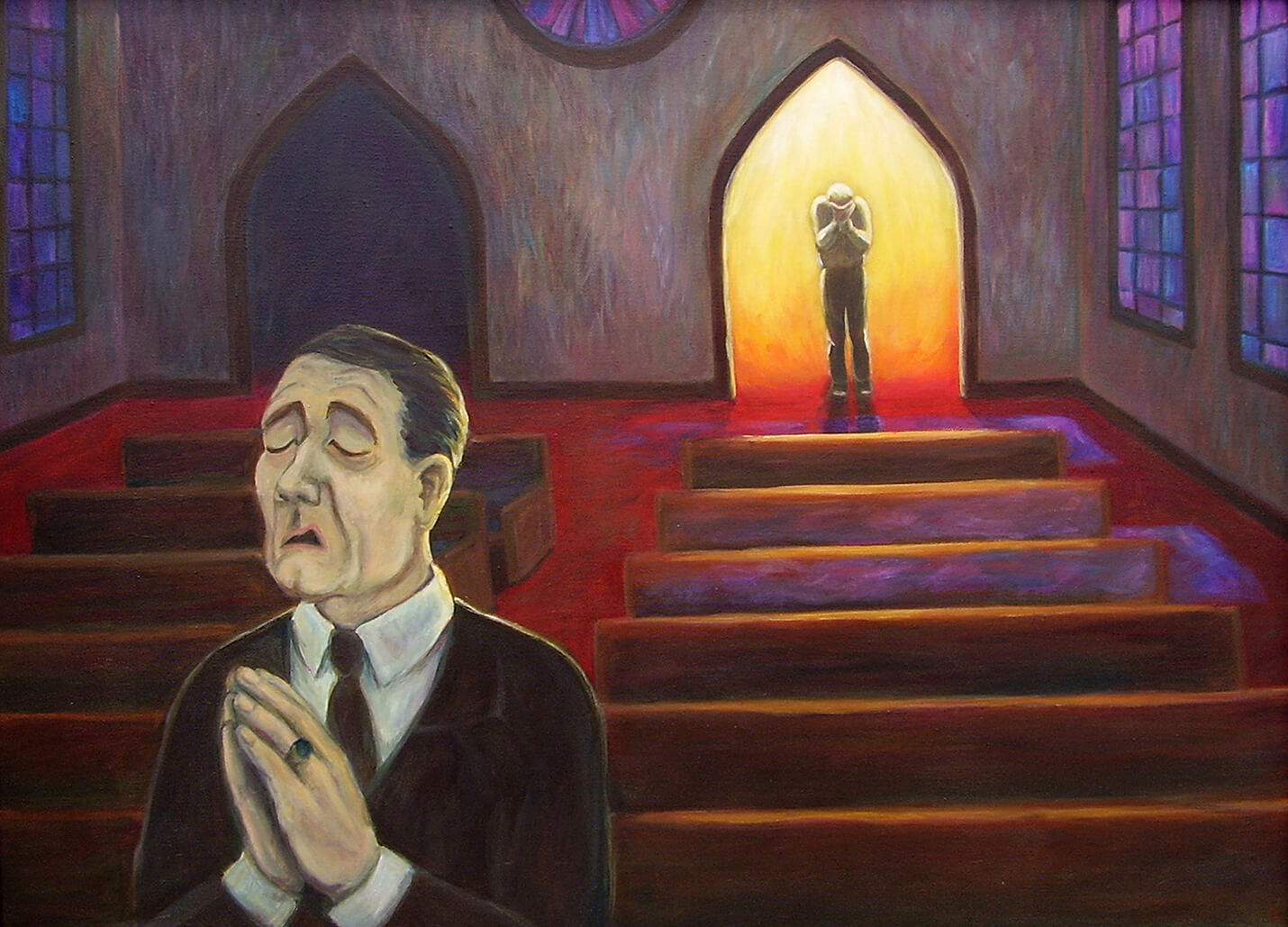
Jesus told this parable to some who trusted in themselves that they were righteous and regarded others with contempt: “Two men went up to the temple to pray, one a Pharisee and the other a tax collector. The Pharisee, standing by himself, was praying thus, `God, I thank you that I am not like other people: thieves, rogues, adulterers, or even like this tax collector. I fast twice a week; I give a tenth of all my income.’ But the tax collector, standing far off, would not even look up to heaven, but was beating his breast and saying, `God, be merciful to me, a sinner!’ I tell you, this man went down to his home justified rather than the other; for all who exalt themselves will be humbled, but all who humble themselves will be exalted.”

*Note: Sermons are posted in the manuscript draft that they were preached in, and may contain typos or other errors that were resolved in my delivery. See the Sherwood Park Lutheran Facebook Page for video

For the past several months, we have been hearing Jesus’ thoughts about discipleship. We have heard parables and stories that Jesus has been telling his followers about what it means to serve, about what it means to trust and about what God is up in the world. As we round the corner toward the final few weeks of this liturgical year, Jesus provides a parable seemingly about humility. About two very different people and their prayers to God. Prayers that maybe sounded a bit like this:

“God, I thank you that I am not like other people: proud, haughty, self-righteous, or even like that on-fire-for-Jesus Christian. I bow my head when I pray silently, and I cover the amount on my envelope with my thumb when I slip it into the offering plate”.   

Have you ever prayed that prayer? Or had those thoughts? 

“God, how could you love someone like me. I am not like those other people who have it all together, who give more than I do, who volunteer more than I do, who are better people than I am. Have mercy on me, because that’s all I have”

What about this prayer and these thoughts?

It is easy to hear this parable and think that it is a lesson about the value of humility. There is the Pharisee, incorrectly dividing the world into categories. Thankfully we are not like him. And there is the tax collector. He knows what this is about, he is a good Lutheran. All sin. The only hope he has is for God’s mercy.

To our ears listening centuries after this story was first told, the details of this parable can just fly over our heads. We don’t know what it was like to stand in the temple of Jerusalem, the grand centre of Hebrew religion and power. The term Pharisee in our world is a derogatory, not a position of honour and importance. Imagining a haughty religious type praying this prayer in an opulent setting can make it seem easy to identify the villain. Yet there is so much we don’t know, images and symbols we miss, we have not heard the standard prayers of the Hebrew faith.

Understanding the context, as always, is very important. The temple of Jerusalem would have been grand sight to behold. It was big and it had rules. The people believed that it was where God lived – in the inner sanctum, the holy of holies. The temple was the place where you had to earn every inch of God’s favour. Whether you were a Pharisee or tax collector, you knew where you stood in the eyes of God when you were inside the temple. 

The Pharisee knows that he is righteous. He prays a Benediction that every Jewish man was to pray each day. Thank you God that I am not a Gentile, a sinner, or a woman. The Pharisee modifies the prayer, but the point is still the same. He is genuinely thankful for who he is. The pharisees sees those around him and looks down on them because they are truly less righteous than he. 

The tax collector, on the other hand, knows that he cannot expect anything from God. His job requires him to break the rules of Judaism. To charge interest, to handle money with graven images on it, even to steal or assault. He is not righteous and his only hope is God’s mercy. The tax collector is so wrapped up in himself, that he doesn’t see the world around him. 

But both the Pharisee and the tax collector are quick to divide people into categories. It doesn’t matter if one places himself in the good category and the other in the bad 0 the effect is the same. Both are acting as judge on God’s behalf. The Pharisees judges himself righteous, the tax collector judges himself unrighteous. 

And when slow down and look at ourselves honestly, we are often guilty of the same.

Whether we are thanking God for not being thieves, rogues, adulterers or tax collectors, or whether we are thanking God because we are not arrogant, self-righteous, or prideful, the issue is the same. We divide humanity into categories, justified or unjustified, saved or unsaved, loved or unloved. 

In fact, being divided into tribes and factions has become so pervasive over the past few years that we argue about everything, politics, culture, science and more. 

Human beings are constantly looking for the ways that we can identify who is in and who is out. We might not be standing on the street corner, boldly thanking God in prayer for our certain salvation. But have we looked down on others, the homeless, those in financial trouble, those hold differing views about the pandemic, about the war in Ukraine, about climate change and even those who are sick, and we thank God that we are not them. “Therefore by the grace of God, go I”. 

But we are also often the ones thinking that we are worthless compared to those around us. That we unworthy, while everyone else seems so perfect. We are certain that no one has it as bad us, or that others have their act together while we are struggling to get by. 

Whether we are intentional about it, or whether we do not know that we are doing it, we too place ourselves in the same categories that the Pharisees and the Tax Collector do. 

Now, here is the problem with that kind of thinking. It is a trap of our own making. 

One that the parable today gets us to fall for again. 

We so easily identify ourselves with either the Pharisee or the tax collector, or both. But this parable is not about pride or humility, and it is just as much not about pharisees or tax collectors. 

The parable is about the storyteller. 

The parable is about Jesus.  

While we are busy trying to make things about us, God is reminding us that it is God alone who justifies. God alone decides who is good enough for the Kingdom.

According to the law, the Pharisee came into the temple righteous, and left the temple righteous. But Jesus says something about the tax collector that should grab our attention, 

“I… tell… you,  this man went down to his home justified”. 

There is nothing that the tax collector did that earned his justification. His prayer did not make him righteous. 

Rather, it is Jesus who says that the man is justified. It is Jesus who decides. 

In the world of the Jerusalem temple, there were those were in and those were out. But everything changes with Jesus. 

Through birth, life, death and resurrection, Jesus comes to tear down the categories we try to build. Whenever we try to make categories, God will stand on the other side, because God wants all to be included, all to receive grace, all to be loved. God has only one category – the Kingdom to which we all belong. We are God’s beloved children. 

The parable that Jesus tells is not a parable on how to act, or who to be like or how to pray. This is a parable about God. A parable that shows us God’s motives and shows us the way that God chooses to act in the world. That shows us that God wants to be with and care for the least, the lost, the sinners and the alone. God wants to care for us… because we are the least, the lost, the sinners and the alone.

Neither the Pharisee, nor the tax collector, nor us, want to see or admit, that being justified, that being saved is something that God does for us. Yet, that is what is told to us today.  The trap is laid that we try to divide humanity into saved and not saved. And it is God who alone who knows the way out. Through love and mercy God chooses humanity. God who chooses those who truly cannot be righteous on our own, God comes to us as Christ who lives and dies, with us, with imperfect and flawed human beings, God sends us the Holy Spirit to bring us into the resurrection and into new life. 

Perhaps our prayer today should be:

“God, we thank you that we ARE like other people: Pharisees and tax collectors, sinners and saints.  We are justified by your righteousness; we are saved by your love.”

Image source: https://canadianmennonite.org/sites/default/files/article_photos/07-01A-pic-4-the_parable_of_the_pharisee_and_the_tax_collector_2017.jpg

Why do churches do visioning? – Pastor Thoughts

VISIONING.

It is a word that gets used a lot by church leaders, and I am sure by those in the business world and public sector, too. 

The first Visioning event I attended was for the Mulhurst Lutheran Church Camp Board on which I was serving at the age of 22. We had a facilitator provided by the Province of Alberta (free to charities!) who came to help our board work through the process. The camp had been floating along in a middling way for years, if not decades. They could only afford a part-time director, their weeks of summer camp were never completely full, and their ideal property with picturesque cabins and dining hall overlooking Pigeon Lake just 35 minutes south of Edmonton could never quite live up to its potential. 

So on a mid-winter Saturday we sat in the dining hall and tried out the Visioning process. Right away the questions that we were being ask sparked my imagination: 

    What is the most important thing we do as a [community of faith]? 

    Why do we exist? 

    What is our purpose? 

    What are our values? 

    Who are we as a community? 

I loved stepping back and contemplating the big picture. My mind was set alight by pondering these questions, helping me to sort through just what the camp and our job and role was in the ministry of Lutheran churches in the Edmonton area. 

At the same time I could see that other board members were struggling. They seemed frustrated by having to step back from their usual modes of serving. The facilitator kept having to pull them back from trying to make concrete decisions and action plans. The struggling board members in this case were faithful old German-Canadians (men mostly) whose commitment and service was expressed in hammering nails, fixing things with their hands and putting in their time and energy for the camp. It was difficult to step back and ask about the identity and purpose of this place they had spent years and years caring for and serving. They didn’t want to ask ‘why?’ They didn’t want to interrogate their motivations or priorities. They wanted to remain in a world where they could believe everyone was on the same page about that stuff. 

Of course, they weren’t on the same page and that was the problem! The camp had had a succession of directors come and go. They wanted to add to their facilities, but could never raise enough money. There were conflicts about what was most important and for which projects or staff they should use the available resources. 

Though it took some hard work together to unpack what our Vision for the camp actually was, once we slowed down to understand our values and priorities, we were then able to have much more focused conversations about how to use our resources. In the years that followed (with more Visioning and strategic planning), the camp was able to build new or upgrade facilities, have longer-term directors and staff, and grow in some important ways. 

Does that mean that Visioning is a magic cure-all for the challenges that we face? Certainly not. 

But what Visioning does is provide a venue to have important conversations about who we are as a community, about what our values are, about where we are going and about where God is calling us to go. 

Visioning can be hard work, especially if you are the sort who prefers hammering nails, fixing things, making things or staying behind the scenes. It can mean questioning our past and our decisions, it can mean realizing that we need to change our present choices in order to move into a vibrant future. Visioning is discerning work, it is important work. It is the work of following God’s call for our community and living together faithfully. 

Now is an era for Visioning. Now, as the world changes rapidly around us and as we struggle with how to use our limited resources, coming together with a common Vision will be essential for us, as it is becoming for every church and faith community. It is hard work but holy work