Category Archives: Theology & Culture

What do Advent and Christmas in November have to do with each other? – Pastor Thoughts

A couple of weeks ago, our family made the choice (mistake?) of going to the mall on a Saturday. It was the afternoon of Remembrance Day and I have never seen the mall so busy. There were people in all the stores and busy streams of folks moving along the corridors. Then in something I had never seen before, there were all kinds of people just loitering, standing against the balcony railings, sitting on every bench and chair. 

There was even a line-up for the Lego store. I asked the employee waving people in if there was a special sale and he said, “Nope, just fire regulations.”

Now why was the mall so busy on November 11th? I am sure you know the answer already. It was the first unofficial day of Christmas shopping. In addition to the throngs of people, the mall was covered in the usual Christmas decor and blaring Christmas music. People were hauling bags and bags of things that were destined to be wrapped and put under a tree. 

Now two weeks later as we plan to begin Advent (and we are a week early!), secular Christmas has been in full swing for almost a month. I used to be upset by all the Christmas stuff going up nearly two months before Christmas actually begins (the season of Christmas starts on December 25th and is 12 days long). I would also be annoyed by all the Christmas stuff coming down on December 26th, on only the 2nd Day of Christmas.

In the last few years, I have been coming to see more and more that this season of lights and winter whimsy centred on Santa Claus; and the Feast of the Nativity and the Christmas season that follows are really two different things. The lights and displays that go up this time of year are a way for us to adapt to the winter season and darkness which can be hard to cope with. It is a way to push back against a world that would otherwise feel like it is closing in on us. 

In fact, secular Christmas is a lot more like Advent than the actual Feast of the Nativity. Even though it is full of Nativity and Christmas images (songs, displays etc…) Secular Christmas is about preparing and getting ready, it encompasses our struggles and desire for a different world, and it often reveals the contradictions and conflicts that exist in our families, relationships and society as we contend with the contrast between extravagant gift buying with increasing poverty and need.

Now, unlike Advent, it does not do these things intentionally, but rather quite accidentally.

So as we begin Advent this week, getting ready for the coming of Messiah, searching for the light in our darkness, for hope in our suffering world, we know that we are walking alongside a world that is also searching for hope – but maybe going about it in a strange way. 

And that in our waiting for Messiah, God is revealing again the promise given to our world that our darkness and struggle will not define us. And that no matter how we try to fill that void with store-bought gifts, light displays, Hallmark movies and Santa photo shoots, Messiah is coming to meet us with gifts of the love, mercy and life of God.

Making decisions above my pay grade – Pastor Thought

In 15 years of serving as a pastor, I have remained a mostly “by the book” person. That is to say, when it comes to worship and liturgy, I tend to stick to the orders, texts and traditions of the church. It is not that I am unwilling to try new or different ideas,  nor is it the case that I feel compelled to follow the rubrics (stage notes in our hymnals) as if they were written in stone. However, I find the structure and careful attention of our established liturgies to be the most compelling means of proclaiming the Gospel in the worshipping assembly. Or to put it another way, you would need to convince and show me how our liturgical worship practices are not the best for saying the important stuff about God for me to change a lot of stuff. 

So this Sunday, as we observe Christ the King Sunday at Sherwood Park, there is a small part of me that is uneasy. The reason for that is that we are technically a week early! … Gasp!

This year, the 4th Sunday in Advent falls on the morning of December 24th. As you all well know, there are evening services that are pretty important to a lot of folks that day as well. 

So rather than packing Christmas full of services from morning to night, we are leaving the Sunday morning of December 24thopen and moving all of Advent forward one week, as well as moving Christ the King Sunday. 

And yes, it was my idea. Even if changing the liturgical calendar feels beyond my pay grade.

In some sense, Christ the King Sunday is a strong reminder that so much of our life of faith is not up to us – beyond our pay grade, so to speak. It can be easy to reduce faithfulness to things like following the rules, being a good person or earning our salvation. 

But as we hear the readings for Christ the King Sunday, which paint a picture of God’s intention to restore and reconcile ALL creation into something new, we can begin to see that, as individuals, we are just small pieces in the great unfolding of God’s divine work.

As creation hurdles towards God’s future, we as the Church bear witness to something that extends far beyond our personal and individual faithfulness. We are witnesses to the work of God taking place all around us, to God’s transformation of all things into the reconciled and recreated beings that we were meant to be. 

So while we move Christ the King Sunday forward by a week, we do so knowing that while we can shift the calendar around here or there, it is God who is moving all creation into a new future that we have yet to see fully. 

All Saints according to Coco – Pastor Thoughts

All Saints Sunday is one of my favourite times of the year, and not because it is the same Sunday as the time change when we ‘fall back’ to daylight savings time. 

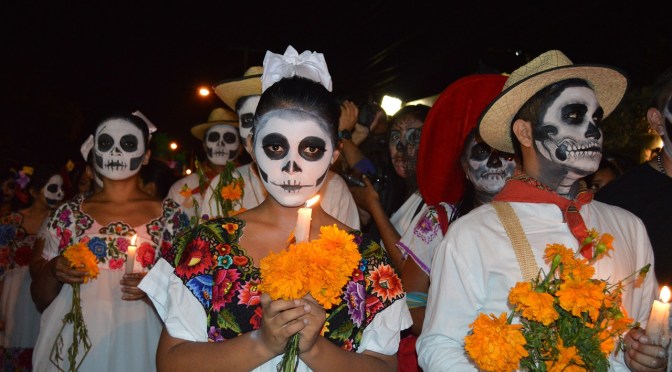
Our family has had an All Saints Sunday tradition of watching the movie “Coco” in the afternoon. Coco is a Disney/Pixar animated film that tells the story of a young boy, Miguel, in Mexico who is transported to the Land of the Dead on Dia de los Muertos (the Mexican holiday, Day of the Dead). The Land of the Dead is a colourful fantasy world of skeletons that more or less continue living as they did in fleshly life. As he tries to return home, Miguel encounters his family members and other adventures. 

Spoiler warning: the next paragraph describes the final scene of the movie.  

The final scene of the movie is back in the land of the living, at a Dia de los Muertos feast – an All Saints feast, surrounded by family both living and dead, enfleshed and skeletons. They are visiting and singing, eating and dancing, all as a great gathering of beloved family. The skeletons, with a golden glow, are imperceptible to the living, but there with them all the same. 

There is something in that scene that sparks an image of All Saints Day. The gathering of the great multitudes around the throne of God, singing and dancing, feasting and visiting. But it is not just an image for All Saints Day, but every time we gather at the Lord’s table, every time we gather to sing, pray and praise with beloved family⎯mothers and fathers who have gone before us in faith, siblings who gather at our side at the table, children and descendants yet to follow in our footsteps. 

This image of the whole host of heaven, the cloud of witnesses that holds us in our faith is one that we must encounter and remember on our way to Advent. It is the place to which the whole story of the Church Year has been leading us⎯ from Christmas and Easter to all the parables and stories of the Green Sundays. The vision of the Kingdom of God is as much our anticipated future as Christians as it is our present reality gathered around the table. 

As much as the great multitude is the end of the story, it is also what leads us back to the beginning, because All Saints and our forebearers in faith are also the ones who have handed on to us the story of Advent and the coming of Messiah. Our waiting for God’s promises was first begun by those who have gone before us. 

There is one more image from Coco that resonates with me. There is a cosmic scale to All Saints Sunday⎯the promises given to the whole company of heaven. But in that final scene in Coco, the vision of All Saints is also intimate and personal. It is a gathering in the backyard of the family shoemaking business; it is a family dinner with people who are truly known and loved. It is a vision All Saints where this little Mexican family of Miguel’s represents all families. It is God’s promise given not just to all generally and broadly, but also personally and directly. 

God’s promise that, in the Kingdom, there is a place where we truly belong. 

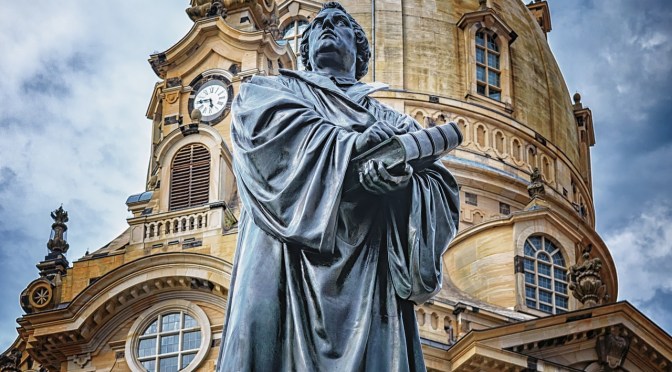
Reformation: A Compelling Origin Story – Pastor Thoughts

Last weekend, one of my colleagues invited me to come to a confirmation class to teach something about Martin Luther. 

Back in seminary, my classmates would often take to teasing me for quoting the Book of Concord or Augsburg Confession. They would roll their eyes when I answered professors’ questions with things like, “According to Luther…”

Lots of my colleagues still tease me for those kinds of things, and I am sure it doesn’t help to have started a Doctor of Ministry program with the intention of researching  Luther and Lutheran Confessions stuff. 

So I guess it made sense that I would get invited to teach a confirmation class about Martin Luther. I have taught many similar confirmation and adult-study classes about Luther and the Reformation before. But something about this particular group of kids struck me. 

It has been almost exclusively the case that no confirmation student has had a clue of who Martin Luther is when they arrived in my confirmation classes over the past 15 years. Thinking back, I doubt that I knew anything about him when I started confirmation either. Once in a while, an excited student will say that Martin Luther was a civil rights activist for African Americans when I ask students if they know anything about him – obviously, they are thinking of Martin Luther King Jr. 

Often, I have used the 2003 film Luther as a means of introducing him to confirmation students. I have always thought it was a good movie, with famous actors! Joseph Finnes, who was also in Shakespeare in Love. Alfred Molina who was in Spiderman.A real star-studded cast for 2003. I do an annotated version of the film where I stop the movie – almost annoyingly often – to explain who the people are, the historical background and setting, the veracity of the plot and so on. 

But it has been close to 6 or 7 years since I have last screened the movie with a group. So this past weekend, I was reminded again just how compelling the story of Martin Luther is. Four teenagers who didn’t know a thing about Reformation history were quickly caught up in the drama of the story where there are no explosions or sword fights or special effects. Just a monk getting upset with the abuses of the medieval church and deciding to do something about it by writing a list of 95 complaints. 

It was a good reminder for Reformation Day. There is a compelling origin story for our denomination (on top of the compelling origin story of our faith) that grounds us in God’s love and grace given for sinners like you and me. There is something to the idea that mercy isn’t for sale and that as people who follow in Martin Luther’s footsteps, we too are called to the work of proclaiming God’s grace. 

We are still called to preach God’s freely given mercy and grace to a world that often believes that such love could only come with a cost. A world that desperately needs to hear that we do not have to earn our way in this life or the next, but that God declares us beloved and forgiven right from the beginning. 

That the work that Martin Luther began in the Reformation, or really that he saw the church called to in scripture, is still the same calling that we share today. 

Imagining the Worst to Alleviate Stress – Pastor Thoughts

This week I handed in the first paper for my Doctor of Ministry program. It has been 15 years since I last had to produce papers or complete assignments for school. While it is certainly different and new at the doctoral level, a lot of those memories and feelings from another time in my life have been on my mind. 

When I was in high school, I remember the pressure I felt to do well. I was a busy kid with sports, music and church. Most nights of the week I had one or two practices for either a sports team, orchestra or musical group. I also remember how classes and homework started to take on more importance, as doing well was an important step in getting into university. 

When I would feel particularly stressed or burdened trying to balance school and extracurricular activities, I would workshop with myself worst-case scenarios: What if I failed a test? Failed a class? Couldn’t graduate? Didn’t get into university? 

Somehow imagining the worst of what could happen and then thinking of backup plans allowed me to worry less about the things on my plate and actually get them done. 

At present, worst-case scenarios globally and all the problems that the world is facing these days are not a good place to start. For instance: What would happen if just one of the many people with their hands on the little red button actually pressed it? Or what would happen if COVID suddenly became two or three times as deadly? Or what if the Earth’s temperature keeps rising? 

Those are worst-case scenarios for which only prayer and mutual consolation can help. 

Then there are those of us who are worried about the cost of bananas, losing a job, sharing with a loved one a particularly vulnerable feeling, singing the wrong note in choir, making a mistake on our taxes or any number of things. Sometimes just playing out the worst that could happen is a way to realize that the worst might not be as bad as we feared, or that following through with a plan B might not be so difficult. 

As congregations and faith communities face a lot of change and big questions, it is easy for us to fear bad things happening and do everything we can to avoid worst-case scenarios. 

However, allowing ourselves the time and space to slow down and consider just what might come next after the worst-case scenario could alleviate a lot of our worries and stress. 

In fact, as followers of Jesus, we know that God is not one to run away from a worst-case scenario, but to face it head-on… and then surprise us all on the Third Day with the news that on the other side of the worst-case scenario, there is new life.