Category Archives: Sermon

Following Jesus into the Deep

Luke 5:1-11
… For he and all who were with him were amazed at the catch of fish that they had taken; and so also were James and John, sons of Zebedee, who were partners with Simon. Then Jesus said to Simon, “Do not be afraid; from now on you will be catching people.” When they had brought their boats to shore, they left everything and followed him.

Last weekend, we decided to take drive across town to check in on the lot, or ditch patch as we  call it, where our new house is going to be built this year. On our way, we drove through downtown and encountered a large collection of tractor trailer, pick up trucks and SUVs with Canadian flags adorning them and lots of “freedom convoy” labels. It was a some unexpected drama that has captured our national attention. Last week, as Jesus confronted us as we were tired and edgy, he reminded us that no matter the messes that human communities find themselves in, that God continues to come and meet God’s people. This journey through this season after Epiphany has taken us from the the banks of the river Jordan, to the wedding at Cana, to the synagogue in Nazareth for the past two weeks. But now we end up in the boat with Jesus and his disciples. 

Today, the drama of this scene in Jesus’ story can be lost on us prairie dwellers. Last week Jesus was almost thrown off a cliff, while today he seems to go for a gentle boat ride. We are used to snow plows and SUVs, to eating beef, pork and chicken. And so when we hear that Jesus gets Simon to take his boat out and fish, and then Jesus provides overflowing nets, it seems like a nice story, a quaint story about Jesus making life a little easier for Simon and his companions. But dig a little deeper, and we begin to see that this is not just about Jesus providing fish. Today, Jesus is just as offensive as he was a week ago, and today, Jesus isn’t the only one in danger of losing his life.

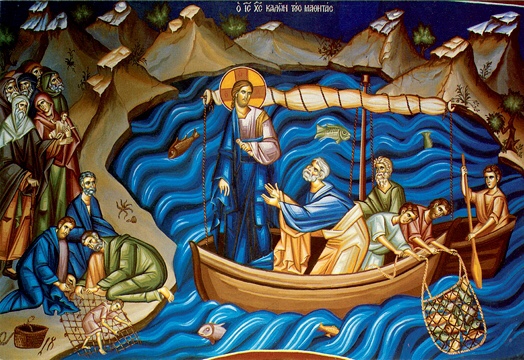
As Jesus begins to get more famous, people begin to follow him around. The crowds press in on him to hear what he is saying. And this time they press him right to the edge of the Lake, so when Jesus can walk no further, he hops in a boat, into Simon who will later be named Peter, and continues to teach. Simon has caught nothing and is going home for the day. Yet when Jesus hops in his boat, he obligingly takes him out a few feet. Simon would have seen that Jesus was an important teacher with all these people coming to hear what Jesus had to say. 

Yet, when the sermon ends, Jesus doesn’t ask to go back to shore, instead he tells Simon to go out into the middle of lake. The preacher in the boat tells Simon the experienced fisherman to do exactly what fisherman don’t do. They do not go out on the lake in the middle of the day. They fish at night, near the shore by lantern light. This is how they have fished for generations. Simon is not impressed with this teacher fellow sitting in his boat. In fact he begins to refuse, 

“Look teacher, we have been fishing all night, our nets need repair, maybe you should stick to speeches and let us do the fishing” Simon has just met Jesus, but it doesn’t take him long to use that impulsive mouth that he will become known for. But then, Simon changes his mind part way through his refusal and says, “Well I guess it won’t hurt, so if you say so Jesus”. 

We aren’t too different than Simon, we often wonder if God actually knows what is going on. Like Simon, we find it easy to stick to the routines and to stick to what we know. Even when sticking to the routines leaves us with empty nets. Yet, God is calling us away from the safety of the shore, out to the deep water, out the unknown.

The unknown is scary and terrifying. And these days we only have a certain level of tolerance for anything different, anything that demands something of us. The issue at the core of the freedom convoy and any protest against COVID-19 restrictions or mandates has often begun with the resistance to this calling into the unknown, the unfamiliar. Masks are uncomfortable. Staying home is boring and lonely and hard. Getting vaccinated might cause uncertainty. 

But our resistance to the deep water, to following Jesus away from the shore, to allowing ourselves some discomfort comes at a cost. Sometimes it might be missed opportunities, as a church it could mean missing out on reaching new people in new ways, and as we are discovering during this pandemic… refusing to do that unexpected, unknown thing is resulting in more people getting sick, more ending up in the hospital and more people dying… all for the stated reasons of freedom, but for the real reason of being unwilling to be uncomfortable for a while or give up something of ourselves for the sake of our neighbour. 

God’s call to the deep waters can feel so risky that we would rather starve doing what we know. 

But with Jesus in his boat, Simon decided to listen to the teacher in the boat. And imagine his surprise as he lets down his nets into the deep water and then begins to haul them back in. The weight of the net pulling back more than Simon ever expected, maybe more than he had ever experienced. And Simon tries to the get the net — and all the fish — in the boat, there is so much that he must call to his friends, James and John before the nets break, and still there is so much fish that they both begin to sink. If there was excitement at catching a lot of fish, it would have disappeared when the boats began to sink, in the middle of lake. The wandering preacher might have guessed where the fish were, but it wasn’t going to do Simon any good, if he drowned first. And yet, they catch an abundance of fish that they had never seen before. 

But fish isn’t Jesus purpose. Jesus has so much more in mind for Simon… And though Simon doesn’t feel worthy, Jesus speaks the words that angels have spoken to those being called by God into something new, time and time again, “Do not be afraid.”

Along with Simon, Jesus is calling us out to the deep water today. And today, that call seems as crazy to us as it did to Simon, who knew better than to go far from the shore. And yet, God is doing something totally unexpected. Something that does not make sense to us. God calls us to die. God calls us to die in the waters of Baptism… but the call does not stop in death. God also calls us out of our ruts, out of our routines, out of the water, out of death and into life.

To a people stuck in the ruts, in the routine of what is safe and known, Christ’s call to risk everything in the deep water seems like too much to ask. But there in the deep water, Christ is giving us life. Life in the form of fish for fisherman with nothing, and today, life for communities contending with far too much sickness and death, life for people who are feeling caged up and alone.  

Out in those deep waters God calls to us from those first promises made to us at the font “By the baptism of his own death and resurrection, [God’s] beloved Son has set us free from the bondage to sin and death, and has opened the way to the joy and freedom of everlasting life”. Out of death, God brings life. Out of drowning in the deep waters of baptism, God forces the breath of life back into our lungs and joins us into a community of newly alive people.

Certainly our instinct is to resist this call, to push back against the dangers that we think we see and feel in the unknown, in the loss that we believe will come with giving something of ourselves. 

But like with Simon, Jesus says, “Do not be afraid.”

Because we do not follow this call alone. We do not go out into the deep waters alone. We are not in this boat called the church all alone. Jesus is with us in the boat and Jesus has much bigger purposes for us. Jesus is preparing us things that entirely new. 

We don’t know what is far from shore, what is out in the deep water, but Jesus does. Jesus knows where we need to go, and what path we need to follow. Jesus knows what must be done for the sake of a hungry and dying world. 

So no, this story today is not a quaint story about a little boat ride and catching fish. It is about the fear and uncertainty that come with following Jesus, with stepping out of what is comfortable and known, of being willing to risk, to be uncomfortable, to give of ourselves. 

But it also the story that always comes after, “Do not be afraid.” 

It is the surprising story of God’s surprising abundance given for us, nets full of fish, salvation found in the waters of our baptism, new opportunities out in the deep water. 

It is about following God’s call into unknown AND of God’s promise that wherever we God, Jesus is in this upside down boat with us. 

Slowing Down for the Spirit

Luke 4:14-21
Jesus, filled with the power of the Spirit, returned to Galilee, and a report about him spread through all the surrounding country. He began to teach in their synagogues and was praised by everyone.
When he came to Nazareth, where he had been brought up, he went to the synagogue on the sabbath day, as was his custom. He stood up to read, and the scroll of the prophet Isaiah was given to him. He unrolled the scroll and found the place where it was written:

“The Spirit of the Lord is upon me,
because he has anointed me
to bring good news to the poor.
He has sent me to proclaim release to the captives
and recovery of sight to the blind,
to let the oppressed go free,
to proclaim the year of the Lord’s favor.”

And he rolled up the scroll, gave it back to the attendant, and sat down. The eyes of all in the synagogue were fixed on him. Then he began to say to them, “Today this scripture has been fulfilled in your hearing.”

A star that guides the Magi from the East to the Christ child. 

A voice like Thunder that declares “You are my beloved Son”

Water turned into abundant flowing wine to gladden a wedding celebration. 

We have been witnesses to big, bold and exciting events the past few weeks. We have seen God pulling back the veil between heaven and earth to show us that Jesus, that God is flesh, is near. The grandness of these stories makes us certain of God’s presence in the world. 

And as we have witnessed the divine spectacle this season after Epiphany, we have become accustomed to these kinds of signs. We see God interjecting the divine into the lives of everyday people, and we anticipate that God will do the same with us. 

But today, there doesn’t seem to be any flashy sign or action to accompany Jesus. Today is different. Luke tells us a story in a more pedestrian style, a seemingly casual and low-key vignette of Jesus’ ministry. 

Today, Jesus does only what is expected of any Jewish man in the synagogue. No miracles or signs of power. Jesus simply reads from the scroll of the prophets and then provides explanation. It should feel almost normal, it should remind us of the same worship that is our custom as well.  

We return to Luke’s Gospel, after a detour in John’s Gospel last week for the wedding at Cana and the pace of the action slows. The story is one of subtle details. 

Jesus has been preaching and teaching in Galilee. Reports of him have spreading, he is coming to be regarded as a well known teacher, a traveling Rabbi. And with news spreading, Jesus arrives in his hometown of Nazareth. 

Jesus goes to the synagogue on the sabbath, as was his custom. Jesus is not only a regular worship attender, it is clear that in the synagogues is where he is getting his message out, where he is making his ministry known.

Yet still, it was possible for any Jewish man to be asked to read from the Tanahk, the Hebrew Bible. However, as a wondering preacher, the people likely expected this hometown son to now preach for the folks who knew him as a kid. Jesus stands to read and is given the scroll of the prophets. Jesus makes is way through the scroll and chooses a familiar passage, from what we now call Isaiah 61. 

Luke brings us right down to the moment by moment details. Compared to the drama of voices from heaven and surprising good tasting abundant wine, Luke adds tension in the slowness of motion. Once Jesus has concluded the reading, he rolls up the scroll… He hands the scroll to the attendant… Jesus sits down and prepares himself to teach… The whole synagogue is waiting for what Jesus is going to say… All eyes are trained on Jesus…. 

(Pause)

In these past weeks, our story has slowed down as well to moment by moment details. Our world had finally begun to expand from summer on last year, we began to imagine a bigger and brighter future. But then the pandemic found a way to squeeze us again. We have been scaled back and pared down, and yet we wait with bated breath for when this latest wave may end and there will be signs of life renewed. 

It is hard for even one day to go by and for us not to see how our world needs signs of hope. The poor need good news, the captives need releasing, the blind need sight, the oppressed need freedom. We cannot help but be bombarded by a world in desperate need wherever we look, whether it is here in Winnipeg or far away on the other side of the planet. 

As Jesus reads from Isaiah, the people that he was reading to longed for good news, for release, for healing and freedom. It is a longing that has lasted throughout all of human history. 

And as we long for change, we begin to load God with expectations. We hear Jesus speak of good news for the poor but we long for riches. We see the captives that need releasing but we long to be released from any and all obligations we might carry for our neighbour. We heard of sight for the blind but we want every ache and pain, every experience of discomfort to taken away from us. We imagine the oppressed being freed, but we desire being given control, being the ones who have the power to make decisions and be in charge. 

It is so very easy for our longing for justice to turn into an expectation for results. We want our prayers to be heard and answered, and we are disappointed with God when they are not. Our sinful, selfish nature makes us turn hope for justice and peace into a sense of entitlement. Entitlement to God’s acts of power, entitlement to control of God’s blessing.  

We hear Jesus declare this new and hopeful reality, and we cannot help but imagine what we are going to get out of it. We cannot help but put ourselves first and imagine the world according to our own vision and our own image. 

(Pause)

But today, it is in the details that Jesus is pointing us to something much bigger than our expectations and desires. Luke slows down the pace so that we can hear the details, so that we hear the words of God anew, stirring deep within creation, stirring deep within the Church, stirring deep within us. 

The very first words that Luke puts in our ears: Jesus, filled with the power of the spirit. 

Though this feels like a slowed down smaller story than the Magi following the star, the voice thundering over the baptismal waters, the blessing of the wedding with good wine… We are meant to connect this moment in the local synagogue with the building movement of the spirit that has brought us here through this season. 

And the Luke draws us back to the spirit again:

“The Spirit of the Lord has named me the Christ. 

The Christ who evangelizes and brings the gospel to the poor.

The apostle who releases the captives and heals the blind and sets the oppressed free. 

The preacher who declares the year of the Lord’s grace and mercy.”

In these simple words of scripture Jesus describes a new reality. Not a new reality based on our wants and desires. A new reality grounded in the incarnation, in the God who speaks these words out loud and in our hearing. A reality grounded in the God who brings these words to life in our midst. Who makes the words real right before our eyes. 

As the people of the Nazareth Synagogue sit waiting expectantly for Jesus to interpret the meaning the Prophets words for them, Jesus has only a brief and simple sermon. 

“Today this scripture has been fulfilled in your hearing”. 

Today, these words from the prophet have come to realization. Today, the anointed one, the saviour, the Christ has become present in flesh. Today, the God of the poor, of captives, the blind, the oppressed is here. The work of God in the world is now. 

The same spirit that led the Magi, that spoke like thunder, that provided the abundance of wine… this same spirit in Nazareth, at the synagogue, announcing to all that Jesus is the Messiah. The anointed one. The saviour of Israel. Even in this small and slowed down and familiar moment, Jesus is subtly but surely making God’s presence known. God is not far away, but here. God is with us even in our smallness, with us even in our isolation, with us in our illness and struggling, with us even when we feel abandoned and alone. 

Jesus not only announces the work of God in the world, but lays a foundation for us. For the Church. The Body of Christ proclaiming the gospel and caring for the poor. The Apostles of Christ releasing the captives and giving them a home. The Church giving sight to the blind, freeing the oppressed. People of faith preaching God’s love for the world.

Today, Jesus simply and straight forwardly announces the mission of Christ. Of the Christ who is among us in Word, Water, Bread and Wine. The Christ who IS us, we who ARE the Christ in the world, washing and feeding and loving a world in need of hope. 

We arrived today having just heard and witnessed the bigness of God:

A star that guides the Magi from the East to the Christ child. 

A voice like Thunder that declares “You are my beloved Son”

Water turned into abundant flowing wine to gladden a wedding celebration.

And we add to that list today: 

A simple sermon, preached in a small synagogue to people of faith waiting for good news. 

These are all signs of God’s presence in a world in need. 

Yet today, fulfilled and realized in our hearing, 

with all eyes fixed upon Jesus, 

despite our desire to put ourselves first and get what we selfishly desire, 

The anointed one who is working for justice and peace among us, 

The Christ speaks God’s word and declares that God is at work here, 

working in us, 

right now. 

Amen. 

Sermon on the Wedding of Cana – Running Out on the 3rd Day

John 2:1-11
On the third day there was a wedding in Cana of Galilee, and the mother of Jesus was there. Jesus and his disciples had also been invited to the wedding. When the wine gave out, the mother of Jesus said to him, “They have no wine.” And Jesus said to her, “Woman, what concern is that to you and to me? My hour has not yet come.” His mother said to the servants, “Do whatever he tells you.” Now standing there were six stone water jars for the Jewish rites of purification, each holding twenty or thirty gallons. Jesus said to them, “Fill the jars with water.” And they filled them up to the brim. He said to them, “Now draw some out, and take it to the chief steward.” So they took it. When the steward tasted the water that had become wine, and did not know where it came from (though the servants who had drawn the water knew), the steward called the bridegroom and said to him, “Everyone serves the good wine first, and then the inferior wine after the guests have become drunk. But you have kept the good wine until now.” Jesus did this, the first of his signs, in Cana of Galilee, and revealed his glory; and his disciples believed in him.

On the 3rd day of the wedding in Cana, they ran out of wine. It might seem strange to be talking about a party running out of wine today. Last week, we heard the story of Jesus’ baptism where God spoke to the crowds and to us. It was a big deal. And then between Sundays, our world continued on through our collision course with the Omicron variant. Some have called it a new pandemic. 

Parties and gatherings and running out of wine, seems trivial in the face of governments seemingly giving up on managing the pandemic and the feeling of being left to fend for ourselves. Forget thinking about parties and gathering as friends and family, daily life has become serious business, stress filled and difficult business. So talking about a miracle where Jesus turns some water into wine at a wedding sounds almost trivial. 

Yet, despite being a place known mostly for its poor party planning, Cana is also a place a place where life is serious, stress filled and difficult too. Cana knows the dangers of the world. They too worry if there will be enough on the table, worry about bills and taxes, work and family. Cana was a small town in the middle of nowhere. They lived under and paid taxes to the Romans, to Herod, to the Temple, to the Synagogue, to the local authorities and to soldiers. 

And here they were, trying to have a nice celebration for the community. To set a couple off right for the start of their marriage. A small celebration in an otherwise dark, serious, and difficult world. 

But on the 3rd day of the wedding they run out of wine. 

Mary and Jesus and the disciples are in Cana for a wedding. They are probably at the wedding of a distant relative, but for Cana this would have been a whole community affair. Like weddings today, the weddings of ancient Israel were big celebrations. It was expected that a fortune would be spent on the party. Wine and food was to flow for a week – literally 7 days. The Bridegroom was meant to be broke by the end of the party. The hospitality, celebration and the extravagance were meant to be sign of blessing. If it was a good party, it would be a blessed marriage. 

Except it is only day 3 in Cana, and they have no wine. 

Mary points this out to Jesus in only the way a mother could. And Jesus responds in only the way a son could, “Woman, what concern is that to you and me? My hour has not yet come”. Jesus has different idea of timing than his mother. But, she doesn’t care. She tells the servants, “Do whatever he tells you”. 

Jesus seems to only to see a party that has been poorly planned. A party that has run out. But Mary sees something different. Mary knows that the wine has run out on day 3, not even half way through. If were only a matter of poor planning, the wine might run out on day 6, but not day 3. The family is probably too poor to throw a proper wedding. 

Maybe they didn’t know about Manitoba wedding socials in Cana. Maybe they didn’t come together as people have done here, knowing that if everyone contributes a little to everyone else, when the time comes to host your own, the burden won’t be so great. But the people of Cana almost certainly did know this, and probably had all already chipped in to the party. 

And Mary sees that this community is too poor, they don’t even have enough reserves to have one party for these newlyweds. 

Mary and Jesus embody the moments of scarcity that we face every day. We know what it is like to need for more, to fear running out, to know that the time isn’t right, to hope for something different and to long for change. We have been living small lives, the fullness and busyness of what we used to know having been curtailed dramatically. We know what it is like to have celebration plans come crashing down (just think back to Christmas Eve!).  We have experienced a kind of scarcity of living and relationship these past two years that seemed inconceivable before. 

And we know that we too are closer to running out than we like to admit. Running out of patience, and resolve, and resilience. 

Running out of hope. 

Running out is something we all fret about, and yet it is connected to a much deeper fear. At the core of our being is a fearful sense that there is not enough. That if we run out, we will suffer, we will lose, we will be alone, we will die. We fear not having enough so much that it can make us crazy. It is the fear of running out that makes fight with each other, that makes us stubborn and unable to see the needs of those people around us, that makes us hold on with all our might, even when holding on is what is killing us. 

So when Mary pushes Jesus to act and even though he resists… it is because she must see that it isn’t really about the wine or the party ending 4 days early. It is about a community without much else to hold on to, a people without hope. If there is not enough wine, then there is not enough to eat or drink. There isn’t enough to live on. The world will have overcome them. There is no future, no hope, only death. 

Mary sees this deep connection between running out of wine, and how Cana itself is not that far away from death. She sees a community that needs some hope, that needs a future. And she knowns the only person who can truly provide. 

And so Mary presses the issue, not with Jesus, but with us. 

“Do whatever he tells you.”

Easy instructions for the servants… but words that should take our breath away. 

As we face challenges and struggles of this most difficult moment of a long pandemic, of making ends meet and just keeping it together day to day…
As we wonder if there is any hope for us, if there is a future here…
If all we have to look forward to is death…
“Do whatever Jesus tells you.” is a word that demands faith from us. Faith that we really don’t know how to give. 

But God does. 

Even when it doesn’t seem like Jesus’ hour… Jesus steps into the void.

And it isn’t just an abundance of wine that Jesus provides. Instead, God breaks into the world. God comes to a small community that is forgotten by everyone else. And God blesses the wedding, blesses the whole community. 

It is not about the wine. It is about the blessing. About God’s presence in that moment. Mary seemed to know that with God present at that wedding in Cana, running out of wine was something that Jesus needed to do something about. 

And all of a sudden on the 3rd day of the wedding, when hope was lost, when there was no future… God breaks into the world and provided wine. God meets that community and gives them hope. God creates a new future. 

And if we haven’t recognized it yet, let us be clear. Our 3rd day moment of scarcity is upon us too. 

And here… today…  God is breaking into our world here and now.
God is here among us, here with us wherever we are are.
And God is offering hope.
God is offering us a future.

Even as things feel dire, God offering us life found in the gospel word. The word that finds us today wherever we are. God is meeting us friends and community that have practiced being there for each other, even over a distance, even in the midst of struggle. God is reminding us that we have been here before, and God has weathered the storm with us. God has already shown us the other side, that we do not go forward alone but together with God. 

Sp yes, the wine ran out on the 3rd of wedding at Cana.
Today, our wine, our hope, our self-propelled future is running out. 

But make no mistake. As we gather on the 3rd day, on this Sunday, the Lord’s day,  we  are meant to be reminded of that other 3rd day miracle. 

When life itself seemed to run out, when the life of God in Christ ran out on the cross, the 3rd revealed something new and something unexpected. When all hope was lost, God emerged from the empty tomb. And like the servants drawing the water turned into wine, New abundant life was revealed to us in the most surprising of ways. When we didn’t seem to have a future, God provided new life in the resurrection. 

Here on this 3rd day, here in our world, here in our community, it might feel like we are running out of wine. It might feel like there is no hope and no future. But God is revealing to us the Christ who brings delicious and abundant wine, who fill the jars of our hope, who makes sure that there is future – because Jesus has saved good wine until now, he has saved it for us. 

Voices Piercing the Chaos – A Sermon for the Baptism of our Lord

GOSPEL: Luke 3:15-17, 21-22
As the people were filled with expectation, and all were questioning in their hearts concerning John, whether he might be the Messiah, 16John answered all of them by saying, “I baptize you with water; but one who is more powerful than I is coming; I am not worthy to untie the thong of his sandals. He will baptize you with the Holy Spirit and fire. 17His winnowing fork is in his hand, to clear his threshing floor and to gather the wheat into his granary; but the chaff he will burn with unquenchable fire.”
21Now when all the people were baptized, and when Jesus also had been baptized and was praying, the heaven was opened, 22and the Holy Spirit descended upon him in bodily form like a dove. And a voice came from heaven, “You are my Son, the Beloved; with you I am well pleased.”

Imagine with me for moment. That we are far away from the cold winter, and in a warmer place with more comfortable weather. We step down into knee deep water, a gentle stream rolling by. The water swirls around our feet. It is cool, and refreshing. The movement is gentle and easy. It feels good to be in the water. 

We have been floating down the river for a while now. Each year, we hop into the boat together and start the trip all over again in Advent. We float towards Christmas and through Epiphany. It is a journey that is familiar yet also new each time we take it. It is a Journey that begins with end times, that stops to hear John’s sermons and questions. Then it makes its way, with Mary and Joseph to the stable manger. We hear Simeon and Anna’s song of promise upon seeing the Messiah they waited a life time for. Then we see the magi follow the star to the child. 

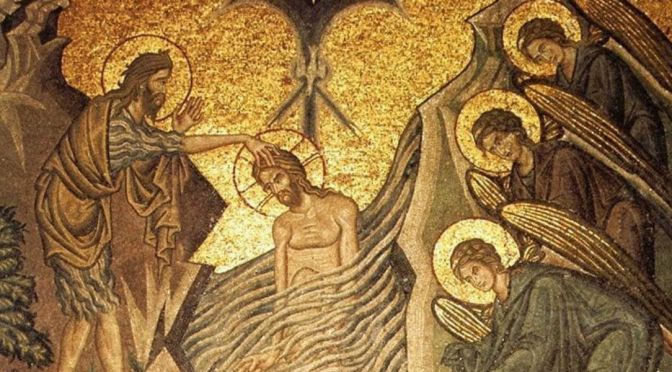
Today we pick up speed and fast forward 30 years, we float down the river Jordan where Jesus is baptized by John. Jesus’ baptism is an unusual story, an uncomfortable scene for Christians. Why does Jesus need to be baptized? For forgiveness of sins? Repentance? What does it say about John as he baptizes instead of being baptized? In many ways the story of Jesus’ baptism invites more questions as we hear it again. 

In Advent, we heard John’s preaching on the river bank. His stiff condemnation of the crowds and his warnings of the Messiah. This time, Jesus shows up at the end of the sermon. The spirit of God descends upon him and along with John, the crowds witness an incredible thing. 

But John and the crowds do not see what is going on. They are full of expectation. They are wondering if John is the one they are waiting for. They looking for a fixes to their problems, for hope and salvation. They are hoping for a powerful Messiah. A warrior who will end injustice and who will remove foreign powers from control in Israel, but Jesus is not those things. It is the beginning of the problems that John, the disciples, the crowds, the Pharisees, scribes and temple authorities will have with Jesus. Some will want an ally, some will want a powerful warlord, some will want Jesus to go away. But Jesus simply refuses to fit their categories. Jesus is going to show us God in ways that don’t see… that we can’t see… that we refuse to see. 

Remember the feeling of standing in the water, feeling the cool fresh flow around our legs? Well the further we float, the more the current picks up. The gentleness is replaced by force and weight. The water doesn’t smoothly pass by. It pushes and grabs, it pulls and drags. The cool gentle stream that cooled our feet now pulls us in and drag us along. The power of the river is more than we could have ever imagined. 

Like the crowds who gathered along the banks of the Jordan, we gather to wait also. We are waiting for the world to get better. But it doesn’t. We are full of expectation, searching for hope and promise, looking for fixes to problems and an end to struggles. 

As we hoped for a more normal Christmas, the pandemic kept rolling on. Plans were dashed and changed in a hurry. And then many became sick, maybe even friends and family sent those texts or made those phone calls, ‘I tested positive.” And worry and anxiety ensued,  It has all felt like a great setback. 

Our world hasn’t changed all that much since John and Jesus met in the river. Sure, we drive cars, live in heated houses and can talk to anyone on the other side of the planet instantly. But, we are no different than those crowds standing on the rive bank, full of expectation, wanting our world to be different, wanting our problems to disappear. 

The weight of all of this threatens to drown us in the inability to care any more. We hear the reports, read the news articles and it is too much to take, too much to grieve for. Not only is it hard to see what is going on as Jesus is baptized by John, it is hard to see where God is at all. 

Today, it might feel like the cool refreshing water of the river has pulled us in and dragged us under. The current is churning and spins us about. We bounce in all directions, sputtering for air, aimed over the cliff, over the waterfall. 

This is not what the river journey begun in Advent is supposed to be like. 

This is not what God is supposed to allow to happen in the world.

We are not supposed to drown in the waters of grief and apathy.

(Pause)

And a voice pierces the chaos.

“You are my beloved. With you I am well pleased”. 

Words of promise, words of hope. 

As John dunks Jesus down into and then brings him up out of the water, as breath and air flood back into empty lungs, God speaks. God speaks in a way that hasn’t been heard since the beginning of creation. God speaks and the world is transformed. 

We tumble over the waterfall, we plunge into the deep pool at the bottom. We are squeezed and crushed under the weight, we can’t tell which direction is up. Death under the waters seems imminent. 

And then all of a sudden, while we are tossed about in the churn, not knowing which direction is up or down, we pop up and out of the water. Air rushes back into our lungs. This is where God’s action begins. In drowning, in death. This is as strange a place as we can imagine God to be working. And yet, God speaks as Jesus comes out of the water “You are my beloved children and with you I am well pleased”. What a weird and wonderful God who can push us below the surface in order to make us His own. In order to give us new names as child of God, as Christian, as beloved. 

This is why John doesn’t know what is going on when Jesus asks to be baptized. This is why we cannot see God working in the world. It is too radical, too unbelievable. 

And yet, this is promise that was made to us in the waters of Baptism, and it is the promise that is renewed each day and remembered each time we witness another child being drowned AND raised in these waters of life. It is a promise made that in the place we lease expect it, in death God is showing us something new, something life filled, something surprising. Something that can come only from a God like ours. 

A God who comes into the world as baby born to a unwed teenage mother, 

a God who lives a poor carpenter in 1st century Israel, 

a God who died on a Roman cross as a common criminal, 

a God who was raised from the dead and who in turn calls us to be drowned and then raised, 

New life can only come from a God who does not act like we believe God should.

The radical God of water and Baptism comes to us in ways that are so unimaginable and so crazy, that we can hardly make them out. The journey that God is promises is not easy or gentle. The results of God’s work in the world is rarely what we imagine or hope for. Yet, as this unexpected God meets us in our world, and on our terms, we cannot help but be drawn in to this unexpected God whose story has become our story. Whose story we tell over and over again. 

As we float down the river of Advent and Christmas, as we pass by Jesus and John in the river, we see again and anew the marvel of God’s love for us. We see a God who not only pushes us below the water to die, but who pulls us out again so that we may rise into new life. And today, we hear a God who speaks through chaos

“You are my beloved Children. With you I am well pleased.”

Amen. 

Advent 4 Sermon – The Messiness of Advent

Luke 1:39-45(46-55)
In those days Mary set out and went with haste to a Judean town in the hill country, where she entered the house of Zechariah and greeted Elizabeth. When Elizabeth heard Mary’s greeting, the child leaped in her womb. And Elizabeth was filled with the Holy Spirit and exclaimed with a loud cry, “Blessed are you among women, and blessed is the fruit of your womb. And why has this happened to me, that the mother of my Lord comes to me? For as soon as I heard the sound of your greeting, the child in my womb leaped for joy. And blessed is she who believed that there would be a fulfillment of what was spoken to her by the Lord.”

We have come to the end of Advent. Advent has been rough this year. We have endured talk of the end times and John the Baptist’s fiery preaching from the river banks.

Finally today, on this last Sunday of Advent things start to sound a little more Christmasy. Elizabeth, a woman thought to be too old to conceive and barren, is pregnant with John. Mary, a virgin still only engaged to be married, is pregnant with the Messiah. 

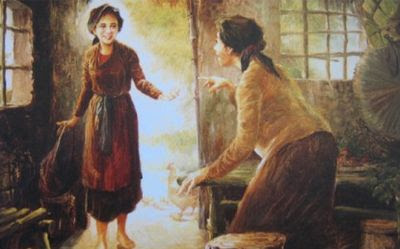
Today’s story sounds beautiful and picturesque. It is easy for us to imagine two delightfully pregnant women greeting one another lovingly; a scene that makes us smile.

But we forget to consider the struggles these two women are facing. Elizabeth is older than a pregnant woman should be. She and Zechariah will be raising a child in their old age, more like grandparents who have unexpectedly found themselves raising children again. While Mary is a young unmarried teen girl, and her fiancé is not the father of her child. Joseph could call off the marriage off at best… maybe forcing Mary to a life of begging on streets, with a child to care for. At worst, both she and her unborn child could be stoned for adultery. For both women in their day, child birth was dangerous and all too often women would not survive the birth experience without some luck. There is probably more relief than joy while the women greet one another, as Mary has gone with haste to see her cousin, to avoid the judgement of her hometown family and friends.

The story of Mary and Elizabeth is not one of those Christmas movies. Rather it is story full of fear and danger, one that stands in contrast to the Christmas image we generally try to present. Mary and Elizabeth challenge the notion that we usually hold about Christmas: shopping, baking, decorating and hosting. Mary and Elizabeth introduce things we don’t want to talk about this time of year. Fear, danger, shame and uncertainty. 

(Pause)

Marlena’s mind was wandering, thinking about Christmas things. Father Angelo’s voice snapped her back to attention, “These two reveal to us the ways in which the spirit is pregnant with possibilities among us.” Marlena was sitting in the pews at St. David’s, listening to the sermon on the last Sunday before Christmas. 

With her was her husband Jim and to two kids, Lizzie and David. The world had been slowly finding a new equilibrium. Even with masks in church, showing their vaccine passports, sitting one household to a pew… simply being at church with other people was such an improvement over the year before. 

As she began scanning the congregation scattered throughout the amphitheatre style seating, she caught the eyes of a good friend Miriam. Miriam and her family had become quite close to Marlena’s family this past year. Miriam was holding a bouncing one year old girl in her lap while keeping a precocious 4 year old busy in the pew below her. 

Marlena smiled, though she knew that smiling happened mostly with the eyes while wearing a mask. Miriam seemed to be smiling back, but she couldn’t help but look tired. Marlena was too. They all were. 

(Pause)

The real story of Mary discovering that she is pregnant unravels and upsets our vision of the Christmas story. We don’t want Christmas to be like real life, it supposed to something different, or least that is what we hope to create. The perfect and ideal vision of the perfect family preparing for a new baby. This was supposed to be the Christmas that we have been desperately hoping for after our zoom Christmas last year. Yet, once again our plans are disrupted and real life will not come close to matching our expectations, our hopes and dreams. We easily imagine calm and peaceful expectant mothers, Mary and Elizabeth, as if they this is the way the planned to have children all along. 

Just as we imagine our own family gatherings, Christmas parties, and holidays traditions that we used know. But that is our version of Christmas. NOT necessarily God’s. 

God is telling a different story at this time of year. God is telling a real story, about real people. About people who have big problems, and no easy way out. It is about poverty, about unmarried parents, about unwanted babies, about couples too old to raise a child, about judgment and the threat of death. It is about tiresome pandemics, exhausted poeple, a longing for our trials tribulations to be over. And it is about how God’s people respond to fear and danger. 

(Pause)

After church Marlena and Miriam met in the in parking lot. The kids were playing on the windrows that surrounded the cars. Jim and Miriams’ husband Jesse were chatting about work. Marlena looked to her friend. 

“Have you heard from your family yet?:” Marlena asked. 

“They aren’t going to make it.”

“What about Jesse’s family?

“They can’t either.” Said Miriam. 

The two friends looked at each other. 

“Well, then it is settled.” Marlena declared. “You all will come us to the lakehouse.”

“I feel like we are imposing on your family Christmas, we have done that enough already.” Responded Miriam. 

“Nonsense. You are family. Christmas without you would hardly be Christmas.”

(Pause)

Sometimes the real world can get in the way of Christmas. While we try to create perfect memories with seemingly perfect families, God is discarding the rules about pregnancy before marriage in order to send us a messiah. As we stress and worry and prepare for the perfect Christmas, God is sending divine messengers to an old woman and unwed teen mom living in poverty.

God does not wait for the everything to be perfect or to fall into place in order to begin the work of the incarnation. God does not come only when it is safe and there is nothing to fear. God’s activity of taking on our flesh and becoming like us starts now. God comes to us, whether we want God to or not. 

Mary’s and Elizabeth’s real life shoves aside our idyllic nativity scenes, visions of perfect Christmases. Mary and Elizabeth show us a real story about real people. A story about shame, and danger and betrayal. But also a story about mercy, and compassion and grace.

(pause)

Miriam looked at her friend Marlena. 

“Why do you keep taking care of us?” Miriam asked. “Aren’t you tired of us yet? Aren’t we more work than we are worth?”

Marlena laughed. “Ridiculous. We aren’t the ones stuck with you, you are the ones stuck with us. Ever since that roadside motel, when I got to hold newborn Christopher in my arms, when I see the way my kids and Jim come alive with you all. Your family is special to us. I see hope and joy and promise when we are together.”

Miriam sighed. “The spirit pregnant with possibilities, just like Father Angelo said, I guess.” 

The two friends smiled and laughed, and this time they could see each others’ faces. 

(pause)

For when Mary gets past the shame of pregnancy before marriage, when she get spast the fear of death for adultery, she with her husband to be Joseph, with her elderly cousins Elizabeth and Zechariah, they all become guardians of God’s promise, bearers of the Good News made flesh. 

And it is the same for us, when our fears and worries get out in the way, when we can’t see what God is up to. God comes anyways.  And God bears grace and mercy for the world in us. God makes us the messengers of the Good News of God’s love and compassion for all. God sends Messiah to frightened world.  

And because of what God is doing, with Mary, we can sing:

“My soul magnifies the Lord,

and my spirit rejoices in God my Savior,

for he has looked with favor on the lowliness of his servant.”