Category Archives: Sermon

The Church is no longer invited to the Party

Luke 14:1, 7-14

But when you are invited, go and sit down at the lowest place, so that when your host comes, he may say to you, `Friend, move up higher’; then you will be honored in the presence of all who sit at the table with you. For all who exalt themselves will be humbled, and those who humble themselves will be exalted.” (Read the Whole Passage)

Sermon

For most of the summer, we have been hearing the stories of Jesus ministry, dropping in on scenes from his travels, hearing parables and other teachings. Stories like Mary and Martha, the Lord’s Prayer and the Good Samaritan. Last week we heard about the women who was bent over or stopped for 18 years. All Jesus had to do was reach out to touch her and she stood up straight, she was liberated from her condition by Jesus’ compassion.

Today, Jesus in invited by some big whig pharisees to a dinner party. An invite that only important people get. And with all eyes on him, Jesus is sounding a lot like Martha Stewart. Jesus is giving dinner party advice. About where to sit and how to avoid giving offense or being embarrassed. Don’t sit too high so that you aren’t asked to move to a lesser seat. Imagine that drunken and sleazy wedding guest trying to cozy up to the one of the bridesmaids at the head table of a wedding banquet. Not cool, Jesus says. Instead sit below your station. Find a table at the back of the banquet hall, and the bride’s father will come and move you closer to the front, and everyone will see how important you are! You can almost see the headline across a house and home magazine: “Where should you sit at the party?” find out pg. 23.

The only problem with this kind of dinner party advice is that it sounds opportunistic or faux humble coming from Jesus. And isn’t Jesus supposed to promote authentic humility? Sitting low to move high is not humble. Shouldn’t Jesus tell us to sit low and stay low?

These days, proper dinner party etiquette is mostly a niche interest, a vanity for the kind of people who worry about centrepieces, dinnerware settings and chair covers. But 2000 years ago in Hebrew culture, social standing was extremely important and it came to play anytime people gathered together. Each guest would sit according to the station in the community and knowing where you sat at a dinner party was about knowing how to rank yourself in society. And everyone knew where they belonged, on top, on the bottom or in between. And where you stood was a sign how important you were, how much respect you commanded, how you stood in the eyes of the powerful, and even where you stood with God. In fact, your social standing had a lot to do with where you stood with God. The more important you were socially, the more you had earned God’s favour. But perhaps most crucially to today’s story is the effect of honour and shame in Jesus’ world. To be moved down to a lesser place would bring shame upon yourself, and shame would lessen your social standing, and therefore lessen your favour with God. But for a host to seat you below your standing would be shame for the host, so it would be essential for the host to make sure that each guest was given the proper respect and honour due their standing. To be moved into the place of honour, was like being ushered a little closer to the gates of heaven.

The world that Jesus lived in was a little more Downton Abbey than we are used to… We just aren’t as hyper attentive to who are most and least important people in the room.

Still, in many ways our world is full of the same kind of concern for where we stand, and the same ranking of who is in and who is out, who is on the top and who is on the bottom.

Last week, Pastor Stan spoke to us of how the image of this woman bent over, unable to see anyone’s face but only their feet, that this was an image for the church. We are feeling bent over and burdened like this woman. It is a surprising turn for us, for the church. We used to occupying a place a of power and privilege in the world, we used to be seated at the places of honour. We used to host the influential and the powerful in our buildings and communities. Yet, these days we feel like we have been left off the guest-list by the world, or if we are invited to the party, it is to be the court jester. And when it comes to our table, we feel like there are more than enough places, that the few guests who are here, can choose any seat because you can’t offend an empty chair. Our tables feel empty.

However, there is more to Jesus’ dinner party advice than just knowing where to sit. We should realize that we have been guilty of exactly the things he names. When we had the power, we were often guilty of sending people down the table. We made sure that people knew they weren’t good enough for the seats of honour, and we saved the best spots for ourselves. And when people stopped coming to fill the cheap seats, we blamed them for not knowing their place and fulfilling their duty.

And now… now, we have been sent down the table. The world has told the church that we were sitting too high for our station. People are choosing sports, shopping, recreation, or sleeping in, rather than being at church on Sunday mornings. It has been happening for decades. And now as the baby boomers enter retirement, they would rather golf or go the cabin or travel than be in church. Generation Xers don’t trust institutions like us, and would rather build their own communities and their own families. Millennials are tired of the church trying to attract them in with loud music and flashy services, they want a church that wants to honestly deal with their doubts instead of shushing their questions.

Jesus’ advice to us about dinner parties is a lot more than it seems indeed.

But it is Jesus’ next piece of advice that should really get our attention. Dont’ invite those who can repay the favour… instead invite those who cannot.

For as much as the church is guilty of sending people up and down the table, we have also  been generous, we have welcomed strangers like the refugee family that arrived this summer. We have fed the hungry, cared for the sick, and opened our doors to our community. We have been a curious mix of generous and concerned with status, we have helped those in need even as we let them know their place was down the table.

But with Jesus’ last piece of advice, he names the thing that we have forgotten. Jesus reminds us that the table is not ours. The food, the chairs, the drinks, the invitations. They were never ours to control.

The table is God’s. And God has invited us to it. God has not invited friends and brothers and relative and rich neighbours. God has invited the poor, the crippled, the lame, and the blind. God has invited us. We are the ones who cannot repay the invitation, we have no table, no place, no welcome good enough for God… and yet God’s table, Jesus’ table is always open to us.

And at God’s table each place is the place of honour. There is no moving up or moving down. There is no sitting higher with the risk of being sent down. There is no sitting lower to work our way up. All the places are the same, all are the best, all are open for us. With God, there is simply a place at God’s table. A place for us, each and every one of us.

Jesus’ dinner party advice is more than it seems. And even though the church has not always been the best guest or host, we have a God who is the ultimate host. God is the one who always has a place for us. God is the one who welcomes us to the place of honour. God is the one to whom the table belongs.

So when it seemed like we as a church sat at the place of honour in the glory days, or now when it feels like have been left off the guest list… neither has been the truth. For we have always had a spot at God’s able, a spot no better, and no worse than anyone else.

God’s table has always been open, set and ready for all. Ready for us.

Who said it? Jesus or Donald Trump: Olympics Edition

Luke 12:49-56

Jesus said, “…Do you think that I have come to bring peace to the earth? No, I tell you, but rather division! From now on five in one household will be divided, three against two and two against three; they will be divided: (Read the whole passage)

Wow… Jesus is on a roll today. We have been making our way through the teachings, parables and ministry of Jesus for a number of weeks now, and so far we have heard familiar stories like Mary and Martha, the Lord’s Prayer, the Good Samaritan.

Last week things took a turn for the less familiar, but at least Jesus seemed much nicer, ‘Have no fear little flock, for it is your Father’s good pleasure to give you the Kingdom.’

But today we get some of the harshest words Jesus has in the gospel of Luke.

And yes, they make us uncomfortable. Jesus isn’t supposed to speak this way, Jesus is about uniting and bringing people together right? Not about setting people against each other. Jesus sounds almost like Donald Trump with all these talk about division and doom. 

And the difficulty with this passage from Luke is that there isn’t some neat trick of context that explains what Jesus means. It isn’t like the verses before or after explain what Jesus is really talking about. This passage on division comes in a chapter where we are given quote after quote strung together will no real details or information connecting them to each other.

I don’t know about you, but when some gun toting christian on some cable news show quotes this passage as justification for hate, violence, intolerance, and yes, division, it makes me want to curl up and hide under a rock. It is one of those passages from the bible that you almost wish wasn’t there. But it is, and it get used as justification for some Christians to be jerks. “Do you think that I have to bring peace? No, but rather division.” And a lot of embarrassing blowhards claiming to speak on behalf of all Christians say this passage shows that Jesus would be an assault rifle carrying bigot were he to come to today.

And so the question becomes, what do we make of this divisive Jesus? Where does he fit with the loving, compassionate, and caring Jesus that we know?

Of all the places and people who could perhaps offer and explanation to these strong words from Jesus today, it was a late night talk show host talking about the opening ceremonies of the Olympic games that provided me some insight.

In HBO’s John Oliver’s recap of the opening ceremonies, he showed a portion of IOC president Thomas Bach’s speech where he said, ‘In this Olympic world, there is one universal law for everybody. In this Olympic world, we are all equal.”

Sounds like the usual lofty speeches that get made at Olympic games.

But John Oliver, who was having none of it, replied,

“Okay, that is simply not true. If that were the case, you wouldn’t need to have an olympics. The whole reason we do this is to find out, who is better than everyone else, so that we can make them stand higher [cue photo of athletes on a medal podium] than the other people who are not as good as them. Because the point of the games is not to celebrate equality, but individual’s excellence.”

(Language warning)

Cheeky, but he isn’t wrong.

As I have been watching my fair share of olympics this week, I haven’t been spending much time cheering on the athletes destined to come in last. It is the ones who win medals, who come in first, who defeat the rest of the competition who are the focus. Everyone knows who Penny Oleksiak is the week, but does anyone know the name of the Canadians who didn’t place in archery, or shooting, or judo, or race walking, or discus or other sports where our country isn’t competitive?

The Olympics in some measure are a safe way for nations to go to war with other nations without dropping bombs or sending soldiers, they are hardly about equality.

And this is where the Olympics and John Oliver gives us insight into what Jesus says today. 

Sometimes our rhetoric, the fancy words and ideals that people throw about in the name of unity and equality don’t really express or name reality.

The reality is that we are human beings are compelled by conflict. We live to fight, it is in our biology – the reptilian parts of our brains are primed to override rational thought in order to Fight, Flight or Freeze when the opportunity aries. And Jesus know this. Jesus knows that sunshine and roses is not what the world is about. Rather that our world is full to conflict and division and sin and suffering and death. And these things are what catch our attention, these are the things that are the foundation of our established orders, these are the things we use to categorize and understand ourselves and our world.

And so when Jesus, God in flesh, comes to meet humanity on our turf, it has to be in the midst of division, because that is where we live as human beings. You will notice that Jesus doesn’t say that he has come to CAUSE division, but simply that he BRINGS it. Division will follow Jesus wherever he goes, because Jesus is going into the human world.

And Jesus is coming into our world, with a message. A message about God, and God’s love for us, and how God is turning our world upside down.

And Jesus represents a threat. A threat to the established orders, to the conflict and division that we love so much, a threat to making people stand higher than those who are not as good as they are. Because in God’s world everyone is equal, and there wouldn’t be an olympics because the medals and podiums would be not be for the first, but for the last. And those in first would be about as interesting to us as those in last are in our world.

And so today Jesus brings division. And yes it sounds terrible and probably makes us uncomfortable… but it is also what we know. And we are uncomfortable because we realize that Jesus really does know us, and knows that conflict and division is where we live.

But Jesus’ words also make us uncomfortable because they aren’t plastering over our conflict and division, our olympic battles with lofty rhetoric about equality and unity. Jesus words instead tell us that  God is coming into our world, to find us, and this will cause real division. Because God is going to change everything. God is going to change us. Change us with love and compassion, with true equality and true unity. 

God is coming to change us with the good news of Jesus in our world, division and all.

Amen. 

Do Not Be Afraid… of Discipleship

Luke 12:32-40

Jesus said to his disciples, “Do not be afraid, little flock, for it is your Father’s good pleasure to give you the kingdom. Sell your possessions, and give alms. Make purses for yourselves that do not wear out, an unfailing treasure in heaven, where no thief comes near and no moth destroys. For where your treasure is, there your heart will be also.(Read the rest of the passage)


We are getting into those long summer days now, where finding a nice patio to sit on, or a shady tree to sit under with a cold drink, a good book and lots of sunlight and gentle summer breezes is about as good as life can get. As Canadians know, we like to put life on hold in the summer as much as we can, to enjoy the warm weather. School, sports, work, hobbies, and other activities are suspended as much as possible while we do whatever summery things we can fit in to life.

So when Jesus offers advice about being prepared and on guard… it is hard to get into the spirit. He gives us different images: Give away your possessions. Pull up your sleeves. Attend to your house for the coming of the Son of Man. Keep watch and wait… These aren’t normal summer activities. They don’t really fit our summer schedule of afternoon naps and long evening sunsets.

While we don’t read this today, Peter follows up Jesus’ commands with a question. He says out loud what many of us are thinking,  ‘Lord, are you telling this parable for us or for everyone?’ Like a good Canadian in summer, Peter is hoping that these commands to be diligent are not specifically for him, but more of a general warning, a take it or leave it kind of idea.

Peter makes a good point. Are these commands really for us? Is it even possible to do fulfill all of these demands? Giving away all our possessions just isn’t realistic in today’s economy. Waiting up all night for the master to return from a wedding banquet… well that image is outdated because none of us are slaves. And protecting our house from the thief is what locks, guard dogs and alarm systems are for. It is like Peter is saying, “Come on Jesus, the Olympics are on. Can we we just give the discipleship talk a rest for a few days?”

Jesus throws so many images at us that its easy to get lost in them. They are overwhelming and sorting through the meaning of each one may or may not provide answers. To figure this out we need to step back, take a breath and consider what the big picture is.

When it comes to faith and sorting out how all this God stuff applies to us, we are quick to look for the tasks that we think we need to do to make God happy. What do we need to get out of the way, so that we can get on with life, so that we can get to the real business of summer? This is at the root of Peter’s, and our question. If all these demands really do apply to us, what is the fastest and easiest way we can get them finished. How many times do we need to come to church? How many prayers do we need to pray?  How much money should we give? What else do we need to do to make Jesus happy?

We hope that completing the assigned tasks will satisfy Jesus, but that isn’t really what he is getting at today. Its not about the details, is not about breaking down faith into tasks and to do lists. The impossible demands that Jesus lists are just that — impossible. Faith is not something that can be reduced to simple instructions that we follow. Rather, faith is that relationship that finds us and grabs on to us. Faith comes from our gracious God who claims us and marks us in baptism. God pulls out of the details and our need to just complete the tasks that make God happy, and God does it with the first words that Jesus speaks today.

Do not be afraid. Words that echo throughout the bible. Words that always come before the announcement of the good news.

Do not be afraid. And we are standing with Sarah and Abraham as God calls them to be the mother and father of a nation.

Do not be afraid. And we are standing with Daniel as God promises to be with him in a foreign land and even in a den of lions.

Do not be afraid. And we are standing with Mary as she is told that she is pregnant with the Messiah, and that he will be Emmanuel — God with us.

Do not be afraid. And we are standing with the disciples in the upper room hiding in fear, and Jesus appears among us bringing peace, showing the holes in his hands and the mark in his side.

Do not be afraid. And we are standing here, and Jesus is telling St. John, that it is the Father’s pleasure to give us the Kingdom of God.

Its easy to overlook these first few words at the beginning. Its easy to get stuck with the details, stuck with trying to figure what exactly it is that Jesus is telling us to do.

Do not be afraid, these words, always accompany God’s promise. Do not be afraid. They come to us in big moments, important moments of faith. Moments when God is going to change the world. When God turns everything we know on its head. Do not be afraid, God speaks these words to us in moments that are confusing and terrifying, moments that give hope in the darkness. Moments when all seems lost and destroyed. Moments of promise that remind us first and foremost that God is doing something amazing in our world. Do not be afraid.

With these words, Jesus’ impossible demands to give ALL we have to the poor, to be ALWAYS on guard and ALWAYS watching for the return of the master, and to be CONSTANTLY alert for the unexpected coming of the Son of Man… with these words, Do not be afraid, Jesus reminds us that all those instructions coming next have less to do us and more to do with God.

And even more we hear today in this place that it is God’s good pleasure to give us the kingdom… whether we are ready or not. God gives us a treasure more valuable than any and all possessions: Grace and forgiveness… whether we are diligent or not. God comes from the heavenly banquet to bless and serve us with water, with bread and wine… whether we are watchful or not. As the Son of Man, God is breaking into our world, into our lives… whether we are waiting or not.

God pulls us out from all these impossible details. And in the midst of sunny days and olympics, Jesus says yes, these words are for you. Do not be afraid, for it is our Father’s good pleasure to give us the kingdom!

Amen. 

Bigger Barns, Rich Fools and Refugees

Luke 12:13-21

And he said to them, “Take care! Be on your guard against all kinds of greed; for one’s life does not consist in the abundance of possessions.” (Read the whole passage)

We have been hitting a highlight reel of the gospel of Luke lately. We have heard very well known and familiar stories like the story of the Geresene Demoniac and Jesus exorcizing the demon called legion. We have heard the parable of the Good Samaritan. We stopped in for dinner at Mary and Martha’s. We learned the Lord’s Prayer along with the disciples who wanted to know how to pray.

But today, we step off the highlight reel to touch on a much more taboo topic. No, not sex. Not even politics, despite all the news about Donald Trump and Hillary Clinton.

Today, Luke has laid upon us the issue of money and how we value it. The way we understand money and wealth in the Church has a varied history. Some have said that wealth is a sign of God’s blessing. Others would say wealth that is not used to help the poor is one of the greatest sins imaginable. Either way, money and its place in our lives and world elicits strong feelings for all of us. We know that money holds power over us, and we also know that putting money in its place is something we struggle with.

Jesus is standing in a crowd teaching his disciples when two brothers come forward and ask Jesus the teacher to settle a dispute over inheritance. Inheritance was a complicated issue in the ancient world, like it is now. The eldest son of the family received a double portion of the wealth, compared to other sons. And the assets, the land, the buildings, the servants would belong more the clan or tribe than the particular  landowner.

But what passes us by quickly, is that most people wouldn’t be landowners in Jesus’ day. Most people were day labourers, or might have been lucky enough to have the skill to make something to sell. Landowners were wealthy, and often they were the economic drivers of a community. Their land produced food, jobs, provided places to live. They were responsible for their communities.

So when these two brothers are seeking to divide their inheritance, it is possible that they will be dividing a whole community. The estate that they look after together might not be able to adequately provide for their community once divided. But the two brothers, aren’t thinking about that. They are probably thinking about controlling their wealth themselves.

And so Jesus will have none of it. He refuses to arbitrate their dispute as a respected teacher.

Instead, he offers a scathing parable about greed.

Often in Biblical parables, the rich are portrayed as having acquired their wealth in unethical, even illegal ways. But the farmer in today’s parable has done nothing wrong. He does not steal, or cheat, or break the law. He simply is the owner of land that produces abundantly.

In fact, the farmer’s wealth is not at issue in the parable. It is what the farmer says that seems to be the problem. Listen to his words: “I do, I have, my crops, I will do, I will pull down, my barns, my grain, my goods, I will say, my soul, Soul you have ample”. In the short 3 sentences that this farmer speaks, he makes reference to himself 10 times. It is easy to see that this farmer is rather self-centered, and that he sees the land and grain as belonging to him.

Yet, the land would truly belong to his family. His wealth would then belong to his community and all of his relatives that would be working the fields along with him. But our farmer only considers storing his grain — his wealth. He does not consider other options like providing for the poor, giving his workers a bonus or sharing with relatives whose land did produce as well.

The farmer in this parable is a caricature. He is the extreme version of our human instinct to create security for ourselves.

We know very well the thought process that is being outlined in this parable. In times where there is even a small amount of extra, saving it for when there is not enough is important. Today’s farmers could use some harvests with extra, some years when next year’s crop wasn’t already being used to pay this year’s.

It isn’t the actions of the farmer in this parable that are brought into question. Rather, as God demands the life of this wealthy farmer today, the issue is about the proper place of money in the world. It isn’t just that those big grain barns won’t do this farmer any good once he is dead. But more importantly, that storing all this grain, all this wealth hasn’t done anyone any good.

Who is remembered at a funeral for the size of their grain bins? Or house? Or wardrobe? Or bank account? Or car collection?

Jesus is making a point not just about the next life, but about this one. This absurd farmer and all his wealth has missed an opportunity to build something far more valuable than money and wealth. The farmer has missed what it means to build relationships with people.

People are more valuable than any amount money. Full grain bins mean nothing when there are people starving next door. And yet our world routinely chooses wealth ahead of people. Our world is full of overflowing grain bins and starving people.

This week, our church and our community was blessed with a powerful reminder of how easily people can be forgotten in our world, and how the economic systems, and political systems around us often put money and the things money represents – power, influence, security, – ahead of people.

On Wednesday night, the Red River Churches Refugee Team welcomed 7 people to our community. 7 people whose earthy possessions and wealth could fit into one small suitcase, not each, but for all 7. Even my daughter who not even a month old, has more stuff than can fit in one suitcase.

And yet, these 7 sudanese refugees represent more than a reminder of how people are easily forgotten for the sake of money and wealth. They also show us what it looks like when we do put people first. They remind us that bigger bins for our grain, for our stuff is not what we need or the world needs. They remind us instead of how God sees us.

When Jesus scolds these two brothers for wanting to divide their inheritance, it is because when he looks arounds his world is full of people just like our new refugee family. People whom have been left behind by the world in our struggle to have more money and wealth. People who are forgotten by those with riches. People who could benefit from some of that extra and abundant grain.

But it isn’t just that Jesus reminds these brothers and us that those with more than enough can afford to share with those with not enough. But Jesus reminds us that ultimately, on the night when our life is demanded of us, that we too are refugees with nothing. All the wealth and money and power and security in the world means nothing in the face of death.

And how lucky are we, when we forget the proper place of money and the value of people, that God does not. That God places people above money, wealth, power and security. That God is willing to give up all those things for our sake. How lucky are we that God is into refugee sponsorship in a big way? That God welcomes and provides for us, for us with nothing to offer, with nothing of true value to our names. God gives us the most valuable name of all – beloved child.

And if we were to retell the parable that Jesus tells today, but with God as the main character instead of an absurdly rich landowner, it would sound very different:

Then [Jesus] told them a parable: “The land of God produced abundantly. And God thought to Godself, `What should I do, for I have no place to store my crops?’ Then God said, `I will do this: I will pull down my barns and instead of building larger ones, I will give my grain and my goods to those who are hungry, to those who are in need. And [then] I will say to my soul, `Soul, you have ample goods to feed all who are hungry and all who are thirsty; relax, eat, drink, be merry.’ But then sinful humanity said to God, `You fool! This very night you will be betrayed’ And God said, “Then take my life, take my body broken for you. Take my blood shed for you.”

And then Jesus explaining this new parable said, “So it is with those who store up treasures for themselves but are not rich toward God, for God does not store up treasures for Godself, but has been poured out for you, and is rich towards all.

Amen.

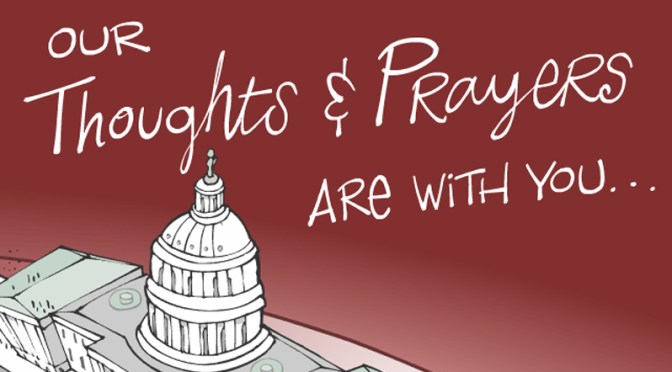
Why ‘Thoughts and Prayers’ Don’t seem to Work

Luke 11:1-13

Jesus was praying in a certain place, and after he had finished, one of his disciples said to him, “Lord, teach us to pray, as John taught his disciples.”(read the whole passage)

Sermon

For every prayer that is offered around the world today, there must be an equal amount of opinions and ideas, rules of thumb and conventions, that tell us how prayer works. Ask, seek, knock. Ask and keep asking. Seek and keep seeking. Knock and keep knocking. Pray boldly and you will receive. You need more faith to pray. You need to pray more. You need to pray for God’s will. You didn’t pray enough and you were punished with illness, suffering or death. Prayer brings us closer to God. Prayer doesn’t do anything. Prayer is for us, so that we know our needs. God hears the prayers of holy people more, especially pastors. God hears all prayers. God only gives us what we need. God will give you what you ask for. There are three answers to pray, yes, no and maybe later. Prayer is like meditation. God speaks to us in prayer. You have to pray from the heart, you need to pray with words that have been prayed by the faithful for centuries.

Lost and confused yet?

Prayer is a key aspect of Christian life. We pray together each Sunday, we pray alone.  We pray for many things here: for rain and sunshine. For Justice and peace. For those who are ill, who are grieving and in distress.

And still prayer can be a very frustrating aspect of Christian life. We want to know the hows, and the whens and the whys. Prayer carries with such expectation that it has the power to make things happen, and yet… we have prayed for and with those for whom prayers have not been answered. We have all had prayers that are not answered. And it begs us to wonder what use is prayer, and perhaps more painfully, why God does not hear us.

The disciples ask Jesus how to pray. And he gives them a mouthful.

Father, hallowed be your name.

Your kingdom come.

Give us each day our daily bread.

And forgive us our sins,

for we ourselves forgive everyone indebted to us.

And do not bring us to the time of trial.”

It sounds familiar, but not quite. Of course it’s the Lord’s prayer, but not quite the one we remember. There is no earthly will of God mentioned in Luke’s version, but it is an earthy prayer that gives us a foundation. The Lord’s Prayer has grounded Christians for 2000 years. Daily bread, forgiveness of sins and salvation from trial and temptation.

This prayer is so engrained in us that we pray it without needing to think… like breathing. It becomes part of the most basic aspects of our living. Its a prayer that goes with us through life from beginning to end. A prayer prayed at baptisms and prayed at funerals.

Yet, the disciples surely were not hoping for a prayer like this. They maybe wanted one of the cool ones like Jesus would pray. When Jesus would look to heaven and bread and fish would multiply, or dead children would be raised, or demons would scatter, or the sick, blind and lame would be healed, or when a man who had been a corpse for four days would rise up from a sealed tomb. The disciples, 70 of them, had been just sent out and had been healing and casting out demons in Jesus name. Yet, like us, they probably wanted to control such power, not for it just to happen without really knowing why. They want to know the trick, the formula to prayer.

We want prayer to be the same as rubbing a magic lantern. We hope that prayer can gives us wealth and happiness. We hope that it will save us from harm and heal everyone who is sick. Or at the very least, we all wish that prayer and its effects would be something we can measure simply and easily. But it isn’t… Jesus doesn’t do simple and easy.

With yet more shootings in Baton Rouge, Miami and Munich this week, we have heard politicians and other leaders stand up and offer ‘Thoughts and Prayers’ for victims and families. It is starting to feel like an empty phrase. Every time there is yet another horrendous act of violence, thoughts and prayers abound, but nothing seems to change. It makes us wonder, if all this praying is doing anything at all. It makes us wonder if there is a point to praying at all.

When the disciples ask Jesus how to pray, it may seem like they are looking for some angle on power, on the ability to get stuff from God. They might be looking for what so many TV prosperity gospel preachers are offering.

But they might also be more like us and how we feel about prayer. They might be asking Jesus how to pray, because for them, prayer feels empty and powerless.

And so Jesus offers them a place to start, a beginning. Jesus give the disciples instructions on how to achieve great things in prayer, but how to start and begin.

Daily Bread, Forgiveness, Salvation from Trial.

God’s Kingdom come.

Jesus shows them that prayer doesn’t achieve the results but begins the process.

Praying for Daily Bread doesn’t feed all who are hungry.

Praying for Forgiveness doesn’t reconcile all peoples.

Praying for salvation from times of trial, doesn’t alleviate all suffering and pain.

Praying begins those things. Prayer is the starting place.

To put it another away, what would it look like if we didn’t pray the church, the world and those in need.

How many refugees would find new homes if we didn’t pray for displaced persons week after week? None. Yet ELCIC congregations, including ours, have helped to sponsor over 250 refugees just in the past year.

How many congregations would run food banks, serve at soup kitchens or offer meal programs if we didn’t pray for the hungry week after week? None! Yet, churches and people of faith have been the primary feet on the ground for feeding the hungry for years, decades, centuries!

Would we will be able to offer forgiveness if we didn’t pray that God would help us forgive? No we wouldn’t. Yet, as we ask for forgiveness, God shows us how to give forgiveness.

Where would we turn in times of trial, if we didn’t pray that God would save us week after week? We don’t know. Yet, as we pray that God would deliver us, God reminds us that we do not face the trials of our world on our own, but together as the Body of Christ.

Prayer is the beginning. In Prayer God reveals to us all the places where God’s Kingdom comes into world. In prayer, when we pray for daily bread, for forgiveness, for salvation from time of trial, we see that God’s Kingdom is breaking into the world with food for the hungry, with mercy and forgiveness for sinners like us, with salvation for those suffering under the shadow of death.

But even more than that, God gives a way to speak about the needs of the world in prayer. God gives us words in prayer to speak about the hungry, the poor, the suffering, the dying without it sound like a depressing new report. Instead, prayer allows us to see where God is already at work meeting the needs of the world, and God gives us words to express this reality in prayer.

Prayer is a starting place, when we so often treat it like the end point. Prayer helps us to see where God is at work in the world, where God’s Kingdom is coming.  Prayer helps give us the language to talk about the needs of the world without being overwhelmed and depressed like we are watching the news.

And so when we wonder with the disciples about whether prayer has any meaning or purpose, Jesus shows us that prayer is the starting place. The starting place to see God in our world. When another politician or leader or Facebook post offers “Thoughts and prayers” for something and we wonder if that does anything to help… Jesus shows us how to begin in prayer, how to begin with daily bread, with forignvess and salvation from trial.

Jesus shows us that in prayer God’s Kingdom begins to come.

Amen.