Category Archives: Sermon

Adjusting to the darkness of Advent

Matthew 24:36-44

Keep awake therefore, for you do not know on what day your Lord is coming. (Read the whole passage)

It is time to begin again. Advent is here. The wreath is set out, the colour blue adorns the sanctuary, we are dusting off the advent portion of the hymnbook and we are settling in for 4 weeks of waiting and watching, of “keeping awake” as Jesus would say, for the coming of Messiah. But Advent is not an annoying countdown for Christmas invented by pastors to keep people from singing Christmas Carols in December (although we might be tired of Joy to the World and Silent Night by Christmas Eve if we did).

Advent is a complete idea or season unto itself. Advent reminds us of where we began as Christians, as God’s people waiting for salvation in a dark world. And it is not about what comes at the end of the waiting, but about what waiting means for us. About how waiting for that which is not here, waiting for justice and peace in the world compels us to strive for those things. Advent is about how we wait for God to come to rescue us, and it is about how God is waiting for our eyes adjust to the darkness so that we can see that God is, in fact, bringing light and hope into our world.

Today, we are reseting the church’s cycle of telling the story of Jesus. A cycle that has been continuing in some form or another for nearly 2000 years. And in the 3 year cycle of readings that we follow Sunday after Sunday, today is beginning of year A, the first year of the cycle. Which means, that today we have heard the first 4 readings of the first Sunday of the first year of the cycle.

And isn’t it strange that the first words chosen for us to hear from the bible are passages about the end of time?

Last week on Christ the King Sunday, we ended the church year by going to the middle of the story, the crucifixion. And today, on the first Sunday of the New Year, we start by going to end. Sometimes the church can do things a little backwards.

But there is a reason to start at the end… or at least, as Jesus tells his disciples that no one knows the day nor the hour when the Son of Man will come but the Father, Jesus is trying to get us to see something important. Jesus is trying to tell us something about what it means to be ready for the end of all things.

Now, given that we are in the season of Advent, the season of preparation, the notion that no one knows the day or hour of coming of the son Man has always seemed more of technicality to me. Sure we don’t have the moment marked down in the calendar, but we are ready just the same. Jesus wants us to be prepared, right? The issue here seems to be one about knowing and not knowing the time.

Well, not so fast.

The examples that Jesus gives of unreadiness are more than just about failing to live up to the boy scout motto. It isn’t just that people didn’t know the exact moment of the return of the son of man. The people of Noah’s day had no idea what was coming. The two working in the field were oblivious, otherwise they probably wouldn’t have been working in the fields. The same for the women grinding meal. The owner of the house is robbed because he wasn’t awake.

Jesus doesn’t say be ready because you don’t know the day or hour.

Jesus says keep awake

Or in other words, maybe all of our Advent preparations are not actually not what Jesus is talking about. Maybe as we are about to put a lot of our attention and focus into trips to the mall for gift buying, putting up lights and baking Christmas cookies, filling our calendars with Christmas parties and concerts, getting ready for Messiah by getting ready for the holidays… maybe Jesus is talking about something different.

Keeping awake.

Keeping awake to the world around us is more than a matter of not knowing the exact moment. It is about awareness, about being attentive to the world around us. Letting our eyes adjust to dark places, to the people and circumstances around us who really need light and hope and salvation. Because keeping awake might mean paying attention to the hard stuff, to the suffering of our neighbours. Keeping awake might be opening our eyes to the crisis of fentanyl overdoses that has landed in our province this fall. Keeping awake to the plight of Indigenous people protesting for their water rights at Standing Rock. Keeping awake to the increase in racism, sexism and bigotry and accompanying violence that has erupted in the US and Canada since the election. Keeping awake to the plight of the Syrians living with daily bullets and bombs, children and families with no safe place to go. The more we open our eyes, the farther out into the world we see more suffering.

Keeping awake is hard and painful. We would much rather watch Christmas movies and drink egg nog. It is much easier to be distracted and on auto-pilot with Christmas preparations than it is to sit, rest and be awake in Advent.

Still as Jesus implores us to be awake, the examples he uses are ones where people are still sleeping. The people around Noah did not see the flood coming. The ones working in the field, the ones grinding meal did not know the time was coming. The owner of the house wasn’t expecting to be robbed. They were not awake. They were sleeping at the wheel.

And each time, the Son of Man came anyways.

For you see, Jesus might tell us to keep awake with the disciples and to watch for the coming of Messiah into our world, but Messiah’s coming doesn’t depend on our wakefulness.

In fact, Jesus knows that we will almost certainly be asleep when Messiah comes.

Yet,

Messiah comes because the world needs Messiah.
Messiah comes because we are waiting for salvation.
Messiah comes because we need hope.

Keeping awake isn’t about making Messiah come, but about seeing where Messiah already is.
Keeping awake isn’t just about seeing the bad stuff, but letting us see the light.
Keeping awake is letting our eyes adjust to the dark, so that we begin to see that there is light.

Messiah’s light is appearing as communities rally together to support those affected by addictions.
Messiah’s light grows as people all over the world begin standing with Standing Rock.
Messiah’s light multiplies as friends and neighbours stand up and speak out against racism, sexism, violence and hate.
Messiah’s light shows up wearing white hats in Syria, running to the danger and working to recuse and save victims wherever possible.

And Messiah’s light is born here among us, as we gather to tell the story of Jesus, to pray and sing, to share a meal and to fellowship. As we strive for justice and peace in our communities and the world around us.

The end is coming, the son of man arrives at an unexpected day and hour.

And Jesus says, Keep Awake.

Keep awake for Advent.
Keep awake in a dark world.
Keep awake even though it is hard.

And even though we are sleeping, Messiah comes.

And here in our dark world,

Messiah’s light is born.
Messiah’s light grows.
Messiah’s light is here.

Messiah is the story of Advent, the story that we are beginning over again today. Messiah is the one who is that small light in a dark world, the light that is hard to see until our eyes adjust, but that is there, pushing back the darkness, allowing us to see a glimpse of the Kingdom of God.

Keep Awake, Jesus says,

because you do not know on what day your Lord is coming,
but you do know that Messiah in on the way.

The world has been forever changed in the past two weeks

Luke 23:33-43

The people stood by, watching Jesus on the cross; but the leaders scoffed at him, saying, “He saved others; let him save himself if he is the Messiah of God, his chosen one!” The soldiers also mocked him, coming up and offering him sour wine, and saying, “If you are the King of the Jews, save yourself!” There was also an inscription over him, “This is the King of the Jews.” (Read the whole passage)

So… the world is very different place than it was two weeks ago…

Today, is Chris the King Sunday, the day on which we name and celebrate the fact that Jesus is our King, the one in control over all things, who holds us and all creation in his hands.

Christ the King is also the last Sunday of the church or liturgical year, kind of like New Year’s Eve. In many ways, Christ the King Sunday stands between two worlds. The world of the past and the world of the future. The world of the past that we are leaving behind began last Advent we began a journey that took us from the announcement of the coming of Messiah, to the birth of Christ in a Manger, to the visit of the magi at Epiphany. We kept on moving into Ash Wednesday and the path of Lent, the path to the cross. We were surprised by an empty tomb on Easter morning, and yet again by the coming of the Holy Spirit in tongues of fire at Pentecost. After that we heard the teachings of Jesus again and anew.  Just a few weeks ago we remembered the reformation and how it shapes who we are, and we remembered loved ones who have died on All Saints Sunday. Along side all of that, we baptized new Christians, we confirmed young adults, we witnessed weddings, we celebrated anniversaries and we grieved at grave sides.

The world of the future begins in much the same way that last year began. We will begin the story of Advent, with waiting for Messiah to come.

And yet, Christ the King is not just a flip of the calendar page from one year to the next. Things don’t just continue on in the cycles and patterns of life that we are used to. Christ the King is no ordinary year end. Christ the King also carries with it a view of the end of all things, the big ending that our world is headed towards.

In many ways, the world has been preparing us to glimpse the grand scale of Christ the King. This year our world feels like it is teetering on the edge of chaos, we have seen terror attacks, we have seen mass migrations of people fleeing war and violence. We have seen whole nations grow in discontent, with fear and anxieties rising, with division and strife popping up right on our door steps. We have seen people reject the ruling class in favour of populist leaders and outcomes.

And all of a sudden the part of Christ the King Sunday that harkens to the end of time doesn’t seem so far off. What is coming next for us in our little part of the world and for all peoples of the earth feels uncertain and foggy at best, ominous and terrifying at worst. Our world feels like it is standing in a doorway… we are leaving a way of being that was comfortable and familiar, and we are about to enter a new space, a new more dangerous and unknown world. Christ the King is a doorway of sorts, a space between, neither fully in one space or the other.

And so perhaps oddly or fittingly, we don’t hear a gospel passage that is about the beginning or the end, but a story that is in the middle of Jesus’ story.

Today, we return to the cross.

We turn to a moment when Jesus is named as King, but in the least King-like of circumstances. It is an odd moment from Jesus’ story to choose to remember when we are celebrating Christ as our King. Yes, technically Jesus is talked about as a King, but only in the most mocking and sarcastic way.

(And as an aside: If there is any lesson to those who are our leaders and rulers, it that those who promise great change to devoted legions of followers looking for someone to turn their suffering around, it is that you can be hailed and worshipped as a King on Sunday only to be tried and crucified by the same crowds by Friday).

And so the moment of the cross is not really a Kingly moment, and neither is it the beginning or the end of the story.

But the cross IS a doorway moment.

The cross is moment between two worlds.

A moment where all creation stands between two worlds.

Everything that leads to the cross… from creation, to God’s covenant with the people of Israel, to the birth and ministry of Jesus was all shadowed by the reality of the Garden of Eden. That sin and death had taken hold of humanity and creation, and that no matter how much God had called us and creation to repent and return… we did not.

And so the threshold, the doorway of the cross was that Jesus along with all creation stood between the power of death and the power of the God of life.

And everything that was upside-down about the world was exposed to us. That humanity believed that power comes from the ability to control and to kill. That the one who was our king was who we were putting to death. That we suffered in a world that was more dark than light. The cross exposed all those things to us, while showing us what was to come. That true power is found in love and compassion, in the ability to make alive. That the one we were putting to death is the one who would save us all. That the world was about to be flooded with light that would overcome the darkness.

And this is the moment that we stand at today still.

Christ the King is the same threshold moment of the cross.

Our world feels like is spiralling out of control. Division and conflict seems to have won. Fear and judgement and hate seems to be growing. Terror, violence and war feels nearby and out of control. Our world feels so much different than it did just two weeks ago, just one year ago, just a decade ago.

And yet, precisely at the moment when we feel as though we are about to be swallowed up by all the darkness… Precisely at this doorway moment of Christ the King where we are about to step out of one world into the next…

This is precisely the moment when God will turn our world right side up.

God will turn us around to begin the story of life all over again.

And God will begin quietly in the stories of Advent. In the story of God coming into the world, like a match being lit in a dark room, God will remind us again and again and again that just when the world feels the most lost, the most hopeless, the most dark it can be… that light is being born in the most unexpected places.

Light that comes not from Kings or Presidents, not in bold and brash and loud and overwhelming ways.

But light birthed to teenage mothers and old carpenters, in stables and forgotten places.

Christ the King is a doorway to that world. To a world where the light is being born. Christ our King is the one who comes to us as the light of our dark world, who comes to us again and again each Advent… each time we think the darkness is about to win.

Today, God is pulling us through the threshold, through the doorway found on the cross. Christ the King Sunday is how we end one year and begin another. But Christ our King is the one in whom our God meets us on a cross, in a stable, in the dark of the world.

And today, God takes from cross to empty tomb, from stable to lavish feast around the throne, from darkness into light, from death into life.

See, the world is very different place than it was few weeks ago… because today is the doorway into God’s world.

Amen

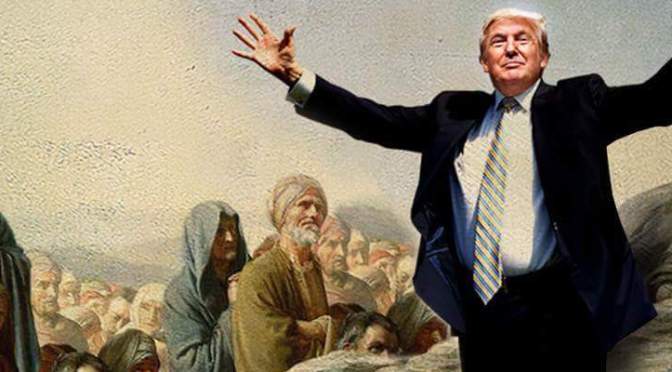
The Beatitudes According to Trump

Luke 6:20-31

Jesus looked up at his disciples and said:

“Blessed are you who are poor,for yours is the kingdom of God. (Read the whole passage)

We find ourselves coming near the end of church year. All Saints Sunday is a herald of the closing year and the coming of Advent. In only two weeks, comes Christ the King Sunday, the final Sunday of this church cycle. And so in this regard, All Saints takes us to places of beginnings and ends, birth and old age, life and death.

In the past two weeks, we have already marked the occasion of All Saints as we laid to rest members of our community. And today, we will broaden the occasion. We will remember both with joy and grief, those saints who have gone before us, those loved ones who have died. But it is not just the saints whom we have buried in the ground, but also those whom we have drowned in the waters of baptism this past year that we remember and pray for as well.

Saints, so to speak, can be a fairly broad category. The Church of Rome, has compiled their list of saints under strictly maintained standards. Other protestant churches often avoid saint talk all together. Lutherans have a favourite phrase to identify ourselves: ‘ Sinner and Saint’.

All these different definitions of who and what saints are, muddy our understanding of what a saint is. But probably we could agree that a saint is someone holy, or in other words a blessed person. And blessings is what Jesus is talking about today.

For All Saints Sunday, we hear Jesus’ famous Sermon on the Plain. It is a sermon that is well known and often quoted. Blessings and Woes. And these are not the heavenly minded blessings of Matthew’s Sermon on the Mount which reads: Blessed are the poor in spirit.  Luke is concrete and direct. Blessed are you who are poor, for yours is the Kingdom of God. These are concrete blessings that have to do with rich and poor, hungry and filled, laughing and weeping, hate and respect. And more specifically, they have to do with you… and me, and us… they are not about some abstract group of people.

The thing is, that lately, the version of the blessings and woes that we have been hearing in our world are quiet different than Jesus’. As the US elections looms over the entire world, we all know the version of blessings and woes that one particular candidate seems to be preaching. But just for fun, maybe we could imagine them going something like this:

“The poor are a bunch of losers,
for they deserve to be poor. Get a job! Which I alone can give.

“The hungry, what a bunch of lazy bums,
just get some food, I mean c’mon.

“Sad people, the worst, the worst,
sad poeple haven’t done anything for the world, let me tell you.”

“But rich people, I love rich people,tremendous.
I love just ‘em. I am really rich, by the way.

“And people with lots to eat,We gotta protect people with lots to eat.
We gotta do something for them.

“And happy people, happy people are the best
I will be the greatest president for happy people. No one else will be a better president for happy people”

“Now listen, we are going to make things great again, trust me.”

The beatitudes according to today.

But before we feel too smug because we would never preach this version, this perspective on what it means to be blessed and cursed is one that we all have the capacity to believe. The old sinner within each of, the part of us that carries our fears and anxieties and desire for security and control, that part of us want to hold on to what we have, even if that means those around us go without. The part of us is controlled by fear and anxiety worries that sharing with others who don’t have as much might make us miss out.

And yet, the world’s version of the beatitudes are held up to us like a mirror,  and we start to see how destructive they truly are. We begin to see that a world that operates according to this version is not a world we want to live in.

And so when Jesus offers his version of blessings and curses, it challenges this accepted version of things that exists in our world. It challenges the idea that the rich and happy are blessed, while the poor and persecuted are cursed. So what are we to do Jesus’ version?

Unlike the world’s version of the beatitudes which tell us what should try for – try to be rich and avoid being poor.

Jesus’ beatitudes are not a prescription on how to be blessed. Rather they are descriptive. They are poetic words about life. They are a painting of joy and suffering. They are music that speaks to our hearts and minds. They are reminders of where God is through the blessings and woes of life.

When Jesus talked about blessing, he is naming God’s presence. Jesus is telling where God shows up in life.

We can hear what it means to be blessed in the words that are proclaimed at the end of every service:

The Lord bless you and keep you.
The Lord’s face shine upon you with grace and mercy.
The Lord look upon you with favour and give you peace.

We bless each other to say that God is with us. We pronounce blessings at baptisms, confirmations, weddings, funerals, on normal green Sundays, on Christmas Eve and Easter Morning, at the beginning and end of the day. We bless each other in times of joy and sadness, in times of celebration and grief. Because God goes with us at all these times.

Yet, God does not stop there. God does not simply promise to be with us. God shows us the way through the blessings and woes of life. God, through Jesus, comes down from heaven and into flesh to be blessed by us. To bring us close to the divine. As Jesus preaches blessings and woes, he points to the cross. He points to the cross, as he foreshadows the weeping and mourning and persecution to come. The cross is where Jesus earns our sainthood. Our sainthood is earned in Christ’s death and resurrection.

On the cross, Christ declares us saints. Because to be saints, is not really about being holy as far as God is concerned. It is not about being rich or full or happy. It is not about security and power and control. Because one of the truths about the world’s beatitudes is that the longer and louder they are preached, the more obvious it becomes that no amount of wealth, power and security will actually make us feel blessed enough. And in fact, it becomes clear that we all belong to the cursed group. We all need to be blessed, we all need something, someone bigger than ourselves to bring us real hope and real grace and mercy.

The truth of the Beatitudes is that they are are not about blessings as we usually think of them. To be blessed by God, is to be loved. And it is divine love that we discover on the cross. It is the Crucified God who blesses us and claims us as his own. The poor, the hungry, the weeping, the persecuted… they are blessed because God is with them. God is with us.

The beatitudes of Jesus that we read today are the true hope of All Saints Sunday. As we remember, and as we continue to grieve all those who have died, God blesses us and keeps us. As we struggle with being poor or being rich, with being blessed or being cursed, God shines his face upon us with grace and mercy. As we search for peace in a troubled world, God looks upon us with favour.  And God promises peace that will carry us and all the saints until the end.


Header Image: https://onehundredbillionsuns.com/2016/08/05/the-beatitudes-by-donald-trump/

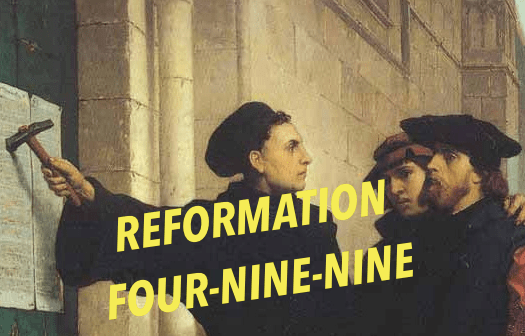
Reformation Four Nine-Nine

John 8:31–36

Then Jesus said to the Jews who had believed in him, “If you continue in my word, you are truly my disciples; 32and you will know the truth, and the truth will make you free.” 33They answered him, “We are descendants of Abraham and have never been slaves to anyone. What do you mean by saying, ‘You will be made free’?”

34Jesus answered them, “Very truly, I tell you, everyone who commits sin is a slave to sin. 35The slave does not have a permanent place in the household; the son has a place there forever. 36So if the Son makes you free, you will be free indeed.

Sermon

So confirmands, today you are lucky enough to share this day with the 499th anniversary of the reformation. Now don’t worry if you aren’t entirely sure what “The Reformation” is all about, your parents and families probably aren’t entirely sure either. But today, as you affirm your faith in front the congregation you are standing on the shoulders of a community of people that have gone before you for almost 500 years – The Lutheran community (and Anglican one for some). And Lutherans and Anglicans are just one part of a larger Christian family that has been around for 200 years.

Now the words and promises that you will hear today have already been spoken and made to you in your baptism. But you probably don’t remember your baptism, so we remind you of those promises again today, when you are at an age when you will remember. So you can hear and remember the promises that God has made just to you.

And those promises are the same ones that the reformation was all about.

Reform. Change. Reformation. Change for the better.

Our world talks about change and reform a lot. Political reform, economic reform, environmental reform, social reform – you name it, we are talking about changing it. When we listen to the message around us and to what we as individuals want, change and reform are common themes.

The call for reform and change is not just for change’s sake. The desire for reform comes from a deep need within ourselves. A need to make things better, to make things right. We desire a better life, better circumstances. And at the same time the scariest thing about reform and change, is the fear of loss.

As Lutherans we stand on change, we try to embrace ongoing reform. There are 87 million of us in the world, nearly 3 times the population of Canada. And today, the Lutherans around the world remember that big Reformation from where we began and started.

Four hundred and ninety-nine years ago on October 31st, 1517. A young monk, priest and university lecturer, published 95 theses about change, about religious reform. Martin Luther hoped that his ideas could be discussed by friends and colleagues in a civil manner. Instead, Luther’s writing expressed the growing dissent among the people and pushed into the light issues that had been simmering for decades, which hit Christianity in Europe like a hurricane.

For you see, Luther hit a chord. He connected to that deep desire for change. He identified the issues of oppression in the church and of abuse by the clergy. People were tired of being exploited by the church who made them fear death, hell and purgatory nor did they not want to be continually controlled by the nobility who made them fear soldiers and prisons. As Luther identified these issues, he diagnosed the illness that existed in medieval church.

Figuring out he problem is the easy part though. We are good at diagnosing our problems and knowing that we need and want something different. Luther looked around and saw the suffering of the people and he saw the need for reform.

When we look around at ourselves, we see problems too. We long for change. Here we see a shrinking church membership and at the same time an aging membership. We have heard about financial short comings. And many of us are tired as we give more of ourselves to the church, of our time our money, and of our energy.

And so while Identifying the problem is the easy part, actual Reformation is hard.

When the followers of the Jesus are faced with the prospect of freedom, they balk at the idea. They know their problems too. They struggle under the government of the Romans. And they struggle under the religious rule by the temple priests. But when change and freedom stares them in the face, they would rather stick to what they know. They would rather be oppressed by the Romans and the Jerusalem Temple.

When Luther began proposing reforms to the Church of his day, they were rejected. Even though the Vatican was in debt because of never ending wars and had been bankrupted by the enormous building project of St. Peter’s Basilica, they wanted to stay on the same path rather than actually change.

And the difficulties that christianity faces today in North America are so frightening to some, that congregations are deciding simply to slowly die. To make sure all the surviving members are cared for in the last years of their lives. It is easier and safer to stay the same, even when we can clearly see the problems around us.

And so here we stand. On this Reformation Sunday, on this Sunday of change, we know that we have a problem, we know that we need to reform too.

As Jesus talks to his followers today he reminds them of two simple realities. The truth will make you free. The Son will make you free.

It is the same truth that Luther discovered, the truth that prompted him to begin writing about change in the church.

And it is the same truth that will carry our congregation and our larger Christian family through our problems.

Jesus will set us free.

The reality of our need for change, our desire for reform, is that we cannot do it on our own and and we cannot get it right. As St. Paul writes in Romans, “For all have sinned and fall short of the glory of God”.  We know that things could be different, we know that life could be better, but we also know that no matter how hard we try, we cannot keep from hurting others or being hurt, or from causing others to suffer or suffering ourselves, from causing grief or being grieved, or from killing or dying.

And while most people would give up in the face of this news. Luther heard something different. Luther heard the promise that Jesus makes:

So if the Son makes you free, you will be free indeed

We are all sinners, and we all fall short. Yet, God’s promise is in Christ. As Jesus comes  into our world, as Jesus joins us in falling short and being unable to make things better, Jesus offers freedom.

The Reformation started with this idea, that we cannot really change things, but instead, God is doing the changing. Even though we sin, and fall short, even though we cannot change our world to be the place we know it could be, God is there loving and caring for us. Christ is there, living with, dying and rising again with us.

And God’s grand plan for changing the world, began in the smallest way. A baby born in a stable. A baby like no other. A baby that was divine and human. But God wasn’t done there. God’s next reform was to the idea God loved some and not others, and that God’s love was for those who could earn it. As Jesus preached and taught, he told people, he tells us, that God’s love is for all people. And finally God’s biggest change was in the shape of the cross. On Good Friday, Jesus endured death, yet the surprise of Easter morning was God’s undoing of death’s power over life, God had made a new promise that new life will go on.

It is on these changes and reforms, these promises by God that the Reformation began. And it is on the shoulders of the Reformation that we stand. As Lutherans, we have been given a gift. A gift that came at great cost, a gift that came out of division, conflict and strife. A gift that reminds us that the most important thing the church can do is tell people of God’s love.

And by God’s love, we are set free. We are set free from sin and death. We are set free from our own failures and fears.

Reformation Sunday is about remembering what happened 499 years ago, about remembering and commemorating where we came from. But it also about the reformation that is happening now. The Reformation and transformation that God has been up to this whole time – God has been changing the world, changing us by setting us free.

Amen. 

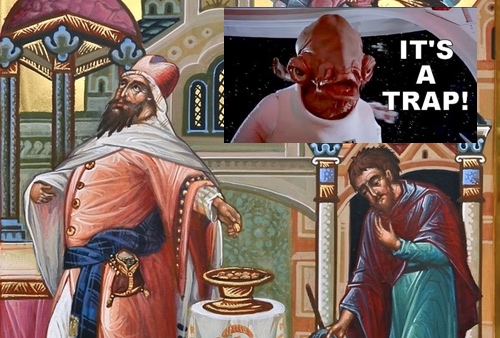
The parable of the Pharisee and Tax Collector – It’s a Trap

Luke 18:9-14

The Pharisee, standing by himself, was praying thus, `God, I thank you that I am not like other people: thieves, rogues, adulterers, or even like this tax collector. I fast twice a week; I give a tenth of all my income.’ But the tax collector, standing far off, would not even look up to heaven, but was beating his breast and saying, `God, be merciful to me, a sinner!’

“God, I thank you that I am not like other people: proud, haughty, self-righteous, or even like that on-fire-for-Jesus Christian. I bow my head when I pray silently, and I cover the amount on my envelope with my thumb when I slip it into the offering plate”.

Have you ever prayed that prayer? Or had those thoughts?

“God, how could you love someone like me. I am not like those other people who have it all together, who give more than I do, who volunteer more than I do, who are better people than I am. Have mercy on me, because that’s all I have”

What about this prayer and these thoughts?

It is easy to hear this parable and think that it is a lesson about the value of humility. There is the Pharisee, incorrectly dividing the world into categories. Thankfully we are not like him. And there is the tax collector. He knows what this is about, he is a good Lutheran. All sin. The only hope he has is for God’s mercy.

To modern listeners, the details of this parable go by so quickly. We don’t know what it was like to stand in the temple of Jerusalem. The term Pharisee is derogatory today. It can seem easy to identify the villain here because we have not heard the standard prayers of the Hebrew faith.

But understanding the context, as always, is very important. The temple of Jerusalem would have been grand sight to behold. It was big and it had rules. The people believed that it was where God lived – in the inner sanctum, the holy of holies. The temple was the place where you had to earn every inch of God’s favour. Whether you were a Pharisee or tax collector, you knew where you stood in the eyes of God when you were inside the temple.

The Pharisee knows that he is righteous. He prays a Benediction that every Jewish man was to pray each day. Thank you God that I am not a Gentile, a sinner, or a woman. The Pharisee modifies the prayer, but the point is still the same. He is genuinely thankful for who he is. The pharisees see those around him and looks down on them.

The tax collector, on the other hand, knows that he cannot expect anything from God. His job requires him to break the rules of Judaism. To charge interest, to handle money with graven images on it, even to steal or assault. He is not righteous and his only hope is God’s mercy. The tax collector is so wrapped up in himself, that he doesn’t see the world around him.

The Pharisee and the Tax Collector are both quick to divide people into categories and be judge on God’s behalf. The Pharisees judges himself righteous, the tax collector judges himself unrighteous. And we are often guilty of the same.

Whether we are thanking God for not being thieves, rogues, adulterers or tax collectors, or whether we are thanking God because we are not arrogant, self-righteous, or prideful, the issue is the same. We divide humanity into categories, justified or unjustified, saved or unsaved, loved or unloved.

Human beings are constantly looking for the ways that we can identify who is in and who is out. We might not be standing on the street corner, boldly thanking God in prayer for our certain salvation. But have we looked down on others, the homeless, those in financial trouble, those who struggle with addiction, those who come from broken families, even those who are sick, and we thank God that we are not them. “Therefore by the grace of God, go I”. Or how often have we been the ones thinking that we are worthless compared to those around us. That we unworthy, while everyone else seems so perfect. Whether we are intentional about it, or whether we do not know that we are doing it, we too place ourselves in the same categories that the Pharisees and the Tax Collector do.

Now, here is the thing about that kind of thinking. It is a trap.

And so it the parable today.

The parable that Jesus tells today is a trap that makes us identify ourselves with either the Pharisee or the tax collector. But this parable is not about pride or humility, and it is just as much not about pharisees or tax collectors.

The parable is about the storyteller.

The parable is about Jesus.

While we are busy trying to make things about us, God is reminding us that it is God alone who justifies. God alone decides who is good enough for the Kingdom.

According to the law, the Pharisee came into the temple righteous, and left the temple righteous. But Jesus says something about the tax collector that should grab our attention,

“I… tell… you,  this man went down to his home justified”.

There is nothing that the tax collector did, rather it is Jesus who says that the man is justified. It is Jesus who decides.

In the world of the Jerusalem temple, there were those were in and those were out. But everything changes with Jesus.

Through birth, life, death and resurrection, Jesus comes to tear down the categories we try to build. Whenever we try to make categories, God will stand on the other side, because God wants all to be included, all to receive grace, all to be loved. God has only one category for all of us. We belong to God and God alone.

Now, to the confirmands who shared their faith statements. If there was one thing I hope you take away from the past two years, it this. That we are not good enough to save ourselves, and nor are we too bad to be loved by God. God is the one who decides who is in and who is out, and God says, you are in.

The parable that Jesus tells is not a parable on how to act, or who to be like or how to pray. This is a parable about God. A parable that shows us God’s motives and shows us the way that God chooses to act in the world. That shows us that God wants to be with and care for the least, the lost, the sinners and the alone. God wants to care for us… because  we are the least, the lost, the sinners and the alone.

Neither the Pharisee, nor the tax collector, nor us, want to see or admit, that being justified, that being saved is something that God does for us. Yet, that is what is told to us today.  The trap is laid that we try to divide humanity into saved and not saved. And it is God who alone who knows the way out. Through love and mercy God chooses humanity. God who chooses those who truly cannot be righteous on our own, God comes to us as Christ who lives and dies, with us, with imperfect and flawed human beings, God sends us the Holy Spirit to bring us into the resurrection and into new life.

Perhaps our prayer today should be:

“God, we thank you that we ARE like other people: Pharisees and tax collectors, sinners and saints.  We are justified by your righteousness; we are saved by your love.”

Amen.