Category Archives: Pastor Thoughts

How can we know the way? – Pastor Thoughts

“How can we know the way?”

This is the question that is asked of Jesus this week in the gospel lesson. 

When I was little, maybe four or five, my mother took me to the University of Alberta (UofA) for “an appointment.” We met a kind woman there who took my mother, sister and me on what felt like a long walk through the UofA campus. At one point, she just stopped and looked at me and asked, “Erik, do you think you can find your way back to the office?”

So I started leading our little posse back to the office where we had first met this nice woman. I know that I made a few wrong turns along the way, but I eventually figured out our way back to the office. All along the way, I remember the woman asking me questions about why I had chosen the path I was taking, landmarks I was using, my sense of direction, etc….

Years later when I recalled the experience to my mother, she told me that I was part of a study about directional sense in children. There were three groups. The first group was told they were going for a walk and would need to find their way back. They’re also given help and hints as they led their way back. The second group was told about the walk and the need to navigate their way back, but were given no help once they started to lead the way. The third group – the group I was in – were not given any notice about the task nor given any help finding our way back. 

I think both the kind researcher and my mother were surprised that I found my way back to the starting place. And in fact, my whole life I have been blessed with a pretty good sense of direction. I can find my way in new cities, find my way between towns out in the country, and navigate airports, malls or other large buildings pretty well. I even had a better sense of the horse trails around Wilderness Ranch (in the foothills of Southern Alberta) after a few weeks than some other staff who had been riding them for years. 

My good directional sense has been a blessing in other areas of my life, giving me the confidence to trust that most of my decisions will get me to where I am trying to go, whether it is personally, in my family life or in ministry. 

Now, my point here isn’t to brag. And in fact, my good directional sense has limits. Most cities I have figured out in a few days, but Winnipeg has felt like it has taken years to get straight (unnumbered streets that are named seemingly randomly, few roads that actually run true North-South/East-West, big thoroughfares that just end, streets that just change names, quaint little side streets that are actually main traffic arteries….) Don’t get me started on Winnipeg’s utterly confusing city design! 

But rather, my point is that we are like the disciples, who are asking Jesus “How can we know the way?” We wish that the path to find our way through ministry as a church, and in life in general, had a kind researcher reminding us to make note of landmarks as we travel, and gently correcting us when we make a wrong turn. Yet, we usually encounter the other experiences of not even knowing that we are getting lost or not knowing where we are going until someone turns to us and says, “Do you think you can find your way back from here?”

And when we are navigating blind, we don’t really know if we have taken the right paths and made the right choices until we get to where we are going. Providing a map, or turn-by-turn directions, or a guide we can hold onto, is not what Jesus is about though. Instead, Jesus has a very different idea of what it means to navigate our way down life’s paths and what it means for us to know the way. 

So… “How can we know the way?”

What that is, is something you will have to come on Sunday to hear more about. I hope to see you there. 

Following the call to be a Shepherd – Pastor Thoughts

Christ is Risen! Alleluia!

The 4th Sunday of Easter is the middle Sunday of the seven weeks of Easter. And for the past 50 or so years, it has been the Sunday we observe Christ, the Good Shepherd. 

Good Shepherd Sunday has a centuries-long history of being a Sunday to talk, not just about how Christ is our Shepherd, but about the call to ordained ministry, as well. 

In the ELCIC we are calling it Vocational Sunday, a Sunday to reflect on the ways in which all the Baptized are called to the ministry of God’s Kingdom. And also to lift up the particular call to ordained ministry. 

The idea of Call carries with it some sense of the holy or mysterious. I get asked quite a bit how it was that I felt called to be a pastor. I sometimes get the feeling that the expected answer is a story such as that of Martin Luther. The legend goes that Luther was out travelling in a lightning storm when a bolt struck near by. Sorely afraid for his life, he prayed to God that if he survived he would switch from law school to theological school and become a monk. Of course, many historians wonder if this might have been a story Luther concocted because he didn’t want to become a lawyer, and his father had saved money to pay for law school! 

Nevertheless, my own call story is not nearly as dramatic. I grew up in a family that already had some pastors in it. We went to church most Sundays and often to other programs during the week. My parents made sure to remind me that being a pastor was a true and viable career option. Then in university, I discovered that I really liked my history and theology courses. There were no desperate prayers to God, no voices from heaven, no signs that I should follow a certain path. 

I know that there are some with those kinds of call stories among my colleagues. But there are many others who have similarly mundane stories like mine. 

However, there is one thing that I think is often missed. Because pastors are almost always called from outside the congregation, there is a sense that we come from some special place. 

Here is the secret: We normally come from other ordinary congregations, where we were usually just ordinary people in the pews. Often those who become pastors were quite involved and leaders in their home congregations, but not always. The important thing is that pastors are raised up from the baptized, from the ordinary folks who sit in the pews, usher, sing in the choir, go to youth group (a key place!), work at bible camp, serve on council, etc…. 

But, most importantly, pastors and deacons and all clergy were most often encouraged and identified by other discerning lay folks as people with a potential call to serve. Maybe it is a confirmation student who actually takes interest in the material. Maybe it is someone who gets involved with leading music, reading the lessons, ushering or other parts of worship. Maybe it is a wise and thoughtful person who has been asked to serve on council. Maybe it is someone that there is just a hunch about (a feeling that might be from the Holy Spirit). 

As we take the time this Sunday to consider Jesus, the Good Shepherd, I encourage you to think about folks you know in our congregation and beyond who might be called to ordained ministry – and if you are comfortable, let them know. And maybe it is you!

Emmaus and Hockey Night in Canada – Pastor Thoughts

Hello Canada and Hockey fans in the United States and Newfoundland.

I am not anywhere close to old enough to have heard Forster Hewitt utter that iconic phrase live, but I have heard the recordings. As many of us turn our attention to the NHL playoffs this week, (to watch the Jets, Oilers and Maple Leafs), it is easy to think back and remember stories of hockey games past and the Canadian cultural ritual that is watching hockey together on Hockey Night in Canada (HNIC).

I remember the old HNIC Theme Song – the one written by Delores Claman that ran from 1968 to 2008. (TSN owns it now, maybe you still hear it if you watch the Jets regularly). Click here to listen: Hockey Night In Canada Theme Song Original – YouTube. Those first few notes of the low brass fanfare that swells into the full band always remind me of watching Oilers’ playoff games in the 90s. (I am a little too young to remember the Gretzky dynasty years very well.) 

When I was going to the University of Alberta, I played in the Cosmopolitan Community Band. One year for a Christmas concert we played the HNIC Theme Song. It was so cool to play that iconic song and for it to sound almost exactly like it did on TV. 

Whenever I hear that song, it immediately stops me from whatever I am doing. I am transported back to Saturday nights watching hockey with family and friends. It feels like Canada’s second national anthem, or at least it did. It has the power of connecting you to all the other people humming along from wherever they are watching the game.

For a whole host of reasons, that song will always hold a special place in my heart and mind. And whenever I hear it, it will immediately bring back cherished memories and feelings. Maybe you aren’t a big hockey fan, but we all have songs or sounds, foods or smells, books or movies that, whenever we see them or hear them or taste them or smell them, transport us back to another place and another time. Memories that hold on to us as much as we hold onto them. 

This week, we hear one of my favourite stories from all Scripture, The Road to Emmaus story. The climactic moment of the story is kind of like my HNIC Theme Song moment. The disciples are pre-occupied with all that has gone on, trying to understand their new world. And then Jesus takes some bread and begins to bless it. 

For the disciples, it was as if the HNIC Theme Song started playing. A memory that held them as much as they held it. A memory that woke them up from all their preoccupations. And they were transported back to that moment when their teacher and friend was sitting with them, reminding them of who they were – who God had declared them to be. 

For us as people of faith, each time we gather for worship, we are surrounded by the sights and sounds, smells and tastes, words, songs and actions that break us free from all those pre-occupations that take up our focus. Memories, symbols and images that hold us. And in those things, God reminds us who we are and who God has declared us to be. 

So as we sit down to watch hockey this week or hear the story of the Road to Emmaus, remember that God is there, finding ways to cut through the noise of our lives and break through into our hearts and minds. Breaking through and transforming us into Easter people.  

Christ is Risen Indeed! Alleluia!

Holy Saturday and Vigils – Pastor Thoughts

We are nearly through Holy Week. 

We have gathered at the Lord’s Table on Maundy Thursday.

We have worshipped at the foot of the cross of Good Friday.

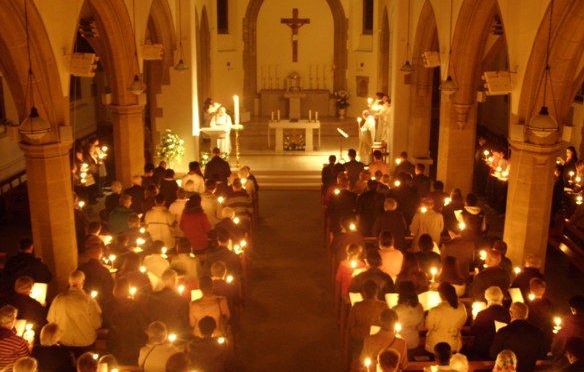
On Holy Saturday the Church has traditionally gathered at the Great Vigil of Easter – considered the most important time of worship in the whole calendar. 

In the 20th century the Vigil fell out of favour with Lutherans, mostly for being too Roman Catholic. But the Vigil, for the better part of 2000 years, has been when Christians have gathered together to tell all the stories of faith at once. 

On the evening of Holy Saturday, the vigil begins around the new fire, where the new Paschal (or Easter) Candle is blessed for the coming year (the big candle that we have at the front of the sanctuary. The candle is blessed and the year is imprinted in wax on the side. And then a deacon sings the Exultet, the an extended litany extolling God’s praises, welcoming the assembly into the keeping of the Vigil. 

This is followed by 12 readings from across the Old Testament, with 12 accompanying psalms. The readings span from Creation, to Noah’s Ark, to the Burning Bush, to King David and the Prophets. Stories are read and sung, reminding us of how God has walked with God’s people throughout the ages. This is the part of the service that gives the Vigil its name – since it often took all night to do in the early church. Though modern Vigils are usually only one to two hours.

Once the stories of God’s people have been told, those assembly remembers their baptism (or anyone needing baptism is baptized) as the presider sprinkles water on worshippers with green boughs dipped in the font. 

Then follows the Resurrection Gospel and often the ancient Easter Sermon of St. John of Chrysostom. Then the Eucharist blends into a great feast that lasts until morning. This is where the tradition of the Easter Breakfast comes from. 

And then everyone goes home to sleep.

Easter Vigils have started making a comeback among some Lutherans, and are much more common among Anglicans and Catholics. 

But sometimes just knowing the story of the Easter Vigil is enough to understand the drama of the three days – Maundy Thursday, Good Friday, Easter Vigil. 

This year the MNO Synod is inviting anyone who wants to attend an Easter Vigil to go to the one at St. John’s College, 92 Dysart Road, University of Manitoba, at 4:30 pm on Saturday. If you haven’t experienced an Easter Vigil at least once, it is definitely worth it. 

But of course we will also be having our usual Easter Worship service on Sunday at 10:30am, where we will gather to announce the Resurrection and hear the Good News of the Empty Tomb together. 

Taking time for Holy Week – Pastor Thoughts

We have just about made it through our long wilderness journey in Lent. With Holy Week nearly upon us, our Lenten pathway has not been easy nor straightforward. Instead, Lent is a season where we are challenged to offload our baggage, to re-think our assumptions and prepare to be changed. 

There is a lot about life in the Church that has Lenten vibes these days and it is NOT just since the pandemic. If I am honest, I can see the “Lentiness” all the way back to the beginning of my time in ministry. Things have felt scarce. There has been a sense that something is lost. In my first call interview in 2009, people were talking about “getting people back” and returning to what the Church once was. These refrains have only gotten louder over the 14 years following. It is the perspective of a community knowing that they have entered a spiritual wilderness and are looking to go back to where they came from. 

The thing is, we need this wilderness time. We need the wilderness journey. We need to let a lot of our baggage go. We need to learn how to trust that God is leading even if we cannot see the way. We need to be reshaped for the Kingdom again, as we have had a habit of falling out of shape for that work. 

Now that we complete our Lenten journey for this year, we still have to walk the walk of Holy Week. Lent doesn’t land on Christmas Day the way Holy Week lands on Easter Sunday. Instead Lent arrives at the most important week of the year for Christians, and the most difficult. 

The Holy Week story is hard and long and tiring, but it is necessary. We tend to compress the story into short phrases most of the year: “Christ has died. Christ is risen. Christ will come again.”

But Holy Week takes the time to live the narrative. 

We stand along the road waving palms as Jesus rides into Jerusalem. 

We hear the Passion According To Matthew, Mark or Luke to begin the week. 

We gather with the disciples at the table of the of the Last Supper, with feet washed, and bread and wine shared. 

We try to stay awake through the night of betrayal and we go with Jesus as he is arrested, tried and sentenced. 

We help to carry the cross to Golgatha and we weep with mother and son as Jesus breathes his last. 

We hear the Passion According To John on Good Friday and wait for the first day of the week to go with the women to the tomb. 

We do this to remember the long story during all those other weeks of the year. We take our time so that, when we worship a crucified God, that we know what that means. So that we know who washes us at the baptismal font, and who feeds us at the Lord’s Supper. We linger in the stories so that they come to mind when we skim through the details in the Creed, or the Pastor references them in a sermon some time in November, or when we are sitting in Bible study trying to unpack just what God’s promises are rooted in. 

Holy Week imprints the story of the Passion into our bones. It becomes a part of us and we of it. So that when we become Easter people on that First Day of the Week at the empty tomb, we know how we got there. It wasn’t easy and it wasn’t quick. But Lent and Holy Week do transform us – each year – into the Body of Resurrection that we are called to be. 

Pastor Erik+