Category Archives: Doctor of Ministry

It takes a community to raise a church – Pastor Thoughts

This week I am able to gratefully breathe a huge sigh of relief. Only a few hours ago, I hit send on an email with my finished research paper for the course associated with my trip to Germany in May. 

After 8000 words and 30 pages of delving into the deeper reaches of Martin Luther’s thinking about the gospel, the church and ordained ministry in the church, my brain is swimming back and forth between the 16th and 21st centuries. 

Considering that I often speak about the church moving out of the 20th century and into the 21st century, and yet I am spending so much time going back to the 1500s to look at what was happening in the church during that time. 

It isn’t that I have anything, in particular, against the 20th century.  Rather our circumstances today might have more in common than with the world 500 years ago than the world 50 years ago. 

At the time of the Reformation, most of Europe had been in the medieval era for 700 years. However, an important new invention called the printing press was making the spread of information possible in ways that people only a few decades prior could not imagine. 

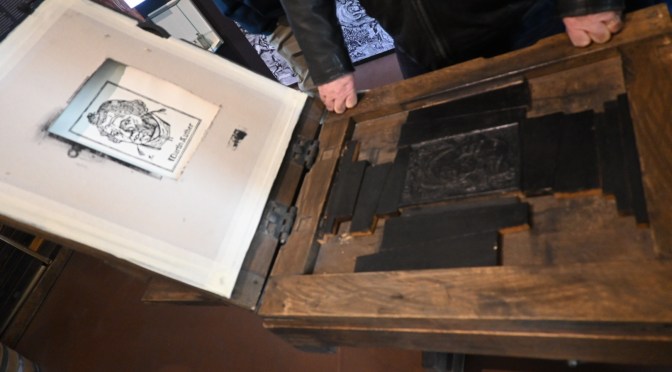
I have seen printing presses before, but while in Wittenberg, we visited the museum of Lucas Cranach’s print shop. Lucas Cranach was the court artist for Prince Frederick the Elector (Frederick was one of seven German princes who together elected the Emperor). Cranach was a good friend of Luther. His print shop was just down the street from Luther’s house, and Cranach was often responsible for spreading Luther’s writings by re-printing them along with being the most prolific art house of its time. 

The striking thing about this is when you walk the streets of  Wittenberg, the print shop, Luther’s house, the town church, the prince’s castle, the university all within a few blocks of each other. These people doing these things all lived together. They were deeply intertwined in the community. 

Now, we are living in a time when communities are growing more fragmented in some ways, and while our capacity to be connected in other ways has grown leaps and bounds. 

I suspect that Wittenberg felt less like the slower-paced, deep-connection communities of 50 years ago and more like the fast-paced but fragmented community that we are today. 

In that world, Luther spent a lot of his time and energy thinking and writing about the importance of community. Something that I didn’t really even know until I began this research because Luther wrote so much!

It is a strong reminder in a time when there are realities in the world that pull us apart more than bring us together, that community needs to happen on purpose because it rarely happens by accident. Being connected and able to share information more freely doesn’t necessarily mean naturally created bonds that allow us to care more deeply. 

Rather, Luther saw that care for the neighbour in and through the gospel, the good of forgiveness, life and salvation allows us to love our neighbour freely. And those things happen on purpose. 

PS Photo(s) from my trip to Germany: A replica of Cranach’s printing press, with a picture of Luther ready to be printed. And two photos of his logo, a serpent with wings. The serpent was thought to be a symbol common to printers at the time.

The Gimli Glider and Leading the Church

Throughout the summer, I intend to share some of my reflections on my trip to Germany and reformation sites. However, I promise I won’t write about Luther and Germany every week. 

Rather, this week I have some thoughts about the clergy study conference that I attended in Gimli, Manitoba this week. For folks of a certain age, there is one thing above all else that Gimli is well known for. No, it is not the Crown Royal Distillery, not the big Viking statue. No, Gimli is known for the Gimli Glider. 

Our keynote presenter, Rev. Dr. Kyle Schiefelbein-Guerrero, Professor at Lutheran Theological Seminary in Saskatoon (AND my Doctor of Ministry thesis advisor!) began his keynote by talking about his love of plane crash documentaries. What a happy accident that our conference was in Gimli and our hotel even contained the official Gimli Glider museum!

But it wasn’t just for the sake of coincidence that Dr. KSG (as his students often call him) shared with us the fact that he has seen several documentaries about the Gimli Glider, it was to note that there is something important to learn from plane crashes. Something important for leaders in the church. 

Now that isn’t to say that the church, in its current state, is akin to a plane about to crash. But in these days of struggle and challenge, the church isn’t totally unlike a plane headed for disaster. 

Rather, two factors contribute the most to how serious plane crashes end up being. The first is “crew resource management” which is how well the crew can organize in a crisis. The second is “plan continuation bias.” This is the ability of leadership to adapt in the face of changing circumstances around them.

And certainly, there is something in those two factors that feels true about those things for the church in this moment. We can easily think of moments when churches have failed to organize and tend to the community they serve. And we can easily think of churches that have stuck to the plan at all costs, even when they were headed for doom. 

But in the converse, we see what things help us navigate the crisis moment – tending and caring for community while adapting to changing circumstances and innovating new pathways into the future. 

In the case of the Gimli Glider, the crew assured the passengers while preparing them for what was about to happen, while the pilot and co-pilot prepared to fly a plane like a glider while landing on a long-forgotten RCAF runway. 

In the case of the church, we have yet to fully prepare ourselves for what is happening. New pathways or alternate plans are still being worked out. Yet, even in free fall, God’s call to us is to continue sharing the gospel in word, sacrament and in our care for one another. Maybe we will be surprised with a landing as surprising and miraculous as the Gimli Glider’s. 

Learning from our past – Pastor Thoughts

This week has been a big week for my Doctor of Ministry studies. For a good chunk of the winter, I have been working on a course on the Gospel of Mark, a lot of learning which I incorporated into my preaching (and will continue to) and into our Lenten study. I handed in the paper for that course early (something the 22 to 26-year-old me never achieved in Seminary). Our class cohort was also informed of our thesis project advisors, which is a big deal. My project advisor is the professor who will be walking with me through the development of my fully formed research question and proposal, through actual research and into the writing phase. All of that starts this fall and will take me through to the winter of 2026. So, very exciting indeed! 

This week I completed another smaller paper on the ‘Invocavit’ Sermons of Martin Luther, the most famous of his sermons during the Reformation. This paper was the first for a class where the bulk of the “class time” will happen in Germany for two weeks in May. I will be travelling on a study tour with world-renowned Luther scholar Rev. Dr. Gordon Jensen, who was also a much-beloved seminary professor of mine. We will visit Wittenberg primarily, the town where Martin Luther lived when he was doing much of his Reformation writing. We will also see several other Reformation places and other sights in East Germany. 

We will get to do things like see (and maybe hold) Martin Luther’s very own Bible, see the church he preached in, and the university he taught at. We will also go to Leipzig to see one of the places where Johann Sebastian Bach lived and worked.  It is all very exciting for this history nerd. 

As I was preparing the first paper for this class, I was surprised (even after studying Luther in seminary) to learn about Luther’s approach to dealing with change. His ‘Invocavit’ sermons were eight sermons he preached in eight days to the people of Wittenberg after months of unrest and conflict over how to go about making changes together to their lives of faith. They were arguing over how to worship and what church rules they ought to follow. 

It all sounded so very familiar. We are still negotiating and sometimes arguing over very similar things today. Ironically, it also sounds like what we will read in The Book of Acts about the early Church as the new Christians sorted out how they would be a community, too. 

Luther’s message to the people of Wittenberg amid all the chaos was to remain committed to the Gospel. Like the folk then, we have challenges and difficult waters to navigate ahead. Also like the folk then, I think Luther’s message applies to us. Whatever challenges come, we too, are called to remember the Gospel, that the whole reason we are doing all this church stuff, the reason we are being a community together, is because of our call to proclaim the Gospel to one another, to our siblings in faith and to our neighbours and the world around us.

It sounds like a good lesson to learn from our own history.