Category Archives: Doctor of Ministry

The weird and surprising history of 10 Commandments Monuments

On Thursday last week, I got a call from a CBC staff reporter asking for my opinion on a news story that I hadn’t heard of until that very moment. She asked what my thoughts were on removing the 10 Commandments Monument from Assiniboine Park – 5 years ago. The monument had been removed and placed in storage in order for The Leaf to be built in the same location. 

I stammered out some thoughts about religious freedom in Canada, meaning that public spaces shouldn’t play host to objects that promote one religion over another. The removal of the monument didn’t seem like a big deal, so if the city wanted to put it in storage or return it to whoever donated it to the city in the first place seemed like a good idea to me. I mentioned that history is much better studied in books and museums, as evidenced by my doctoral work. Whatever thoughts I cobbled together seemed of enough interest to CBC that they asked if I would be willing to be interviewed on the afternoon radio show, which I agreed to. 

But something was twigging me about this story. A lot of religious symbols and images on buildings and public spaces in Canada come from an earlier colonial era. As we know, there was a long period when the church and government were working together on various projects. Many Anglican and Roman Catholic Church buildings, in particular stone ones in the middle of cities and towns, were built with government funding because churches at the time were believed to be central to the public good of communities – that is, if you were Anglican in English Canada or French in French Canada. The other thing the church and government collaborated on at that time was Indian Residential Schools. Something which we are still learning and unpacking the traumatic effects of today. 

My initial thought about this monument of the 10 Commandments was that it likely came from that colonial era, but I wasn’t sure. One fact that bothered me was that in Germany, I hadn’t seen a single Ten Commandments monument, and nor could I remember one in any church I have ever been to anywhere. I needed to know more. 

So, in the time between that first phone call and the later afternoon interview, I did some real research rather than hypothesizing. I guess doing doctoral work is training me to do the research and uncover the real story. 

I jumped into the rabbit hole that is the history of 10 Commandments monuments in North America and discovered some interesting facts. Beginning in 1951, a member of the Fraternal Order of the Eagles (essentially a social club that did some charity like the Lions or Kiwanis), a Judge in Minnesota sentenced a youth convicted of stealing a car to learn the commandments with a pastor, rather than jail time. He believed that learning morals might turn wayward youths around. He expanded this vision to posting copies of the 10 Commandments in Juvenile Courthouses across North America. A few years after this, a certain Hollywood movie director heard of this campaign by the Order of the Eagles and saw an opportunity – a marketing opportunity. This director had a movie coming out in 1956, also called The Ten Commandments. The director was none other than Cecil B. DeMille. So DeMille got in touch with the Judge and helped the Order of the Eagles to place stone monuments in parks, courthouses and city halls across North America. The campaign kept on going for ten years, which is the time when Assiniboine Park got its 10 Commandments monument. In 1965, no one objected to the idea. But as early as the 1970s, objections began to arise on the grounds of the separation of church and state. 

CBC interview:
https://www.cbc.ca/listen/live-radio/1-111-up-to-speed/clip/16095755-reverend-says-ten-commandments-monument-put-back

Follow up: https://www.cbc.ca/listen/live-radio/1-29-information-radio-mb/clip/16096976-a-religious-monument-removed-assiniboine-park-hopefully-displayed

Certainly, the monument here in Winnipeg is not the first to have a debate around its appropriateness in a public space. Debates around these monuments have been in the news for years. As you will recall, last week, my eNews article spoke to the idea of being surrounded by the symbols and images of a given religion and not being a vehicle for knowing the faith, even when those things have a deep historical connection to a place. 

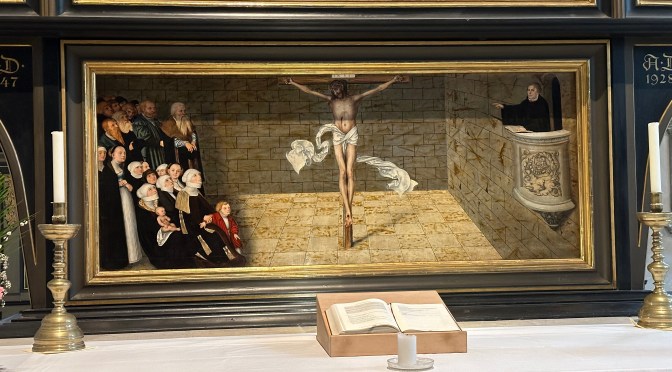
In fact, during the Reformation, the topic of statues, paintings and art was a hot topic. Many thought they were graven images. While Martin Luther admitted that people did not have to venerate crucifixes or statues of Mary, he did say that these art and symbols could be helpful for people in their faith journey by communicating the gospel. 

However, Luther was clear that the gospel was not about telling people what to do, and nor was faith a matter of living morally. In fact, he didn’t see the 10 Commandments as primarily about morals at all. While they did have this basic function of drawing the line between right and wrong, their real function was to show us – human beings – our sinfulness. The commandments reveal to us the ways in which we do not put God first but rather try to be God in God’s place. They also reveal the myriad of ways in which we harm our neighbour by failing to care for those around us. The Commandments show us our sinfulness and need for salvation – but they are not in and of themselves the gospel. Rather, the gospel is Christ. Christ given for the sake of sinners. God’s love, mercy, forgiveness and life given through Christ for sinful humanity. 

So, to me, our 10 Commandments monument doesn’t speak to our history in Manitoba, even if it is a weird quirk of Hollywood marketing history. Nor do they represent the essential proclamation of our faith, the good news. In fact, they tell us the bad news. Bad news alone. But as I wrote about last week, learning our faith and learning the good news happens in conversation. The gospel is proclaimed in the things we communicate to the world, and Luther would add in how we love and care for our neighbour. 

Sources:

https://religionsmn.carleton.edu/exhibits/show/tencommand/tencommandhistory

https://news.minnesota.publicradio.org/features/200109/10_schmitzr_laxten-m/

Yes, we can learn from our past.

The summer has passed us by quickly this year. It felt like just yesterday the school year had ended and we were making plans for what our family would do in the first week of July. In just the blink of an eye, we are now into the first week of a new school year. 

This summer my family traveled between BC and Alberta. During that time, spent a week at Camp Kuriakos on Sylvan Lake, Alberta just outside of Red Deer. There, Pastor Courtenay and I served as resource people along with a good friend and seminary classmate. 

I took on the role of facilitating the Adult Study portion of the week, using material from my recent research paper on Martin Luther and photos from my trip to Germany in May. I named my study sessions, “Death, Life and Community: Martin Luther’s Thoughts That Changed His World.” 

As I advertised the topic on the first night of camp, a few folks commented on not knowing too much about that “history stuff” or jokingly wondered if we were going back to school. Certainly, not everyone is of the mindset to be a historian, but I also think that these comments revealed a common mindset that these “academic” topics are beyond most folks. A sentiment with which I strongly disagree with. 

While our family drove across Western Canada these past weeks, we also listened to podcasts, about history, scams, and the science of reading (literacy education). Amazingly, our kids were just as interested in these podcasts as they were in Disney movies on their iPads. The Science of Reading podcast ( Sold a Story) is one they have asked to listen to again, as it is about how reading is taught in the early grades. One of the points in the podcast is that children love learning history or science. Greeking Out, a podcast about Greek mythology is a hit in our house right now. It is usually teachers or adults] who believe that certain topics are uninteresting… yet children often love learning science or history which allows them to feel like experts on a particular topic.

Similarly, the stories about Martin Luther and his ideas are easily understood by anyone, even those who haven’t learned anything about him previously. All that is required is a little imagination about what 16th-century Europe might have been like.

We live in a world that is often oblivious to history or even afraid to think about it.  Some claim history is “too boring.” They may actually be hiding a feeling of inadequacy or of not knowing enough. Often when we discover we don’t know something about a certain topic, it can easily feel as though we unintelligent or somehow inadequate. We can fell as though we could never learn more either. 

Of course, the opposite is true. The stories of our past can be easily understood and learning them anew at any age only helps us to understand the world better. Knowing our history also helps us to understand our circumstances of the present. Our stories of the past provide insight into our present story. Learning the stories of our faith from the past, and understanding where we have been only serves to deepen our faith today. 

Photo: Wartburg Castle Mosaic of St. Elisabeth of Thuringia who lived in the 13th century,

Crying out to be seen – surrounded by community

One of the paintings that I saw in Wittenberg has been returning to my mind as of late. It is a rather unremarkable painting on the back side of the altarpieces at St. Mary’s church in Wittenberg. St. Mary’s is the congregation that Luther served as pastor. 

The panel I am thinking of is the one unrestored panel on the bottom. The most notable thing about it is not really the artwork, but the fact that 16th-century confirmands used to clandestinely try and etch their names into it. One prominent name stands out: H. Luther. Hans Luther was Martin Luther’s son. 

Over these past couple of weeks, I have thought about that painting a few times as my family has journeyed through my own father’s death in July. 

I am sure it was not easy being Martin Luther’s child, as Luther was one of the most significant people in Europe by the time Hans came into the world. Martin Luther had a lot going on in his life. By all accounts, he was a good and devoted parent, but I am sure there were times when Hans felt it hard to gain his attention with all that Martin was attending to. I am also sure that Hans did not anticipate that his deep etching would stand out for centuries and become perhaps the most memorable aspect of the panel! 

Martin himself had sought his father’s attention, but not in the way he expected. His father had planned for Martin to attend law school. But Martin had theology in mind for his studies. 

In moments of grief and change, transition and endings, whether it is the death of a parent, marriage, divorce, job change or retirement, we are forced to evaluate our lives (or at least it is a good idea if we want to manage grief and other emotions). We are forced to contemplate what was and what now will be. Though I have often said the same about churches and congregations facing change, it served as a reminder this year, when I was faced with the death of my grandmother and now my father, that the emotions and grieving process don’t always give you the bandwidth for a lot of good self-reflection. We have also been engaging in this work of facing grief and change as people of faith, and we know that communities and congregations around us are also working through their experiences of grief and change. Nothing is straightforward, through all of this, nor is it easy.

When I think of little Hans Luther etching his name on the altar painting, I also think of all the art and symbols that surround his cry for recognition. Images of baptism, communion, preaching – Word and Sacrament, the tangible promises that God gives to communities of faith. These are the things that help us navigate difficult times and changes in significant relationships. 

Even among timeless pieces of art such as those that adorn St. Mary’s Church in Wittenberg, there is room for the pastor’s son to leave his mark and to be remembered by history. Perhaps reminding us that even in these imperfect and complicated parts of life, God makes room and holds us in God’s promises.

15 years – Pastor Thoughts

This week we observed those two beginning of summer milestones: Canada Day and American Independence Day. While both days have muted observations in Canada (the 4th of July for obvious reasons and July 1st for colonial ones), these two statutory holidays are signs of the beginning of summer.

The 4th of July is of particular significance to me for personal reasons – I was ordained to the ministry of Word and Sacrament on a hot and muggy day in Edmonton, Alberta in 2009. I was 26 years old, having just completed my Master of Divinity from Lutheran Theological Seminary in Saskatoon, and my Bachelor of Arts in History and Theology prior to that. It had been eight years of post-secondary schooling and I was ready to join the working world full-time. 

It was hard to believe that I was about to go from years as a long-time student to being given charge of the care of a congregation all by myself. As a student, my biggest responsibilities were getting assigned readings done, writing papers on time, and trying not to spend all of my student loans before the end of the term. In those first years of ministry, I certainly wasn’t the only person who was taken aback by someone so “young” serving as a pastor. I didn’t fit the usual stereotype of a grey-haired near retirement-age man that many expect pastors to be.

Now, I am fifteen years into this life of ordained ministry. While I know the joke is often that congregations think the ideal pastor is 30 years old with twenty-nine years of experience, at 41 years old and 15 years of experience, I have seen my fair share of things. I have served open country, small town, and urban/suburban congregations, big and small churches, across two different Synods in the ELCIC. Still, along with Pastor Courtenay, we are the youngest actively serving pastors in the MNO Synod. 

When I think back to that time before being ordained, I had begun my theological education at a Roman Catholic faculty at the University of Alberta. Studying theology in a non-Lutheran environment forced me to consistently research the Lutheran perspective – my perspective. Shifting to the seminary environment meant that my wondering evolved into what it means to be a Lutheran Pastor. 

That question has remained with me since. Many of you know that the heart of my Doctor of Ministry research is asking the same question. 

A few weeks ago, I wrote about how travelling to the places where Martin Luther lived and served brought a new perspective. Understanding what Luther did and wrote takes on a fresh new meaning when you go and walk the streets of Wittenberg, imagining Luther walking the same streets, dropping in on friends for a talk, gathering guests around his dining room table, preaching in the Town Church of St. Mary’s. 

Similarly, 15 years on the frontlines of ministry offers a perspective that you cannot get elsewhere. So much of what I learned prior to ordination has new meaning now when I imagine the communities, people and relationships that I have encountered serving. For some, this might feel like seminary doesn’t provide the right kind of learning for parish ministry, that it isn’t practical enough.  I think I see things differently. Just because things make better sense with some experience under your belt doesn’t mean you throw out the theoretical knowledge that you learn beforehand, rather it provides a deeper and richer understanding. 

At this 15-year mark, my hope is to keep learning from all that I experience AND from further studies. Just as understanding Luther by being where he lived AND reading what he wrote goes hand in hand, so does experience and study, 

We will see where this takes me and us, in 5,10 and 15 years from now.

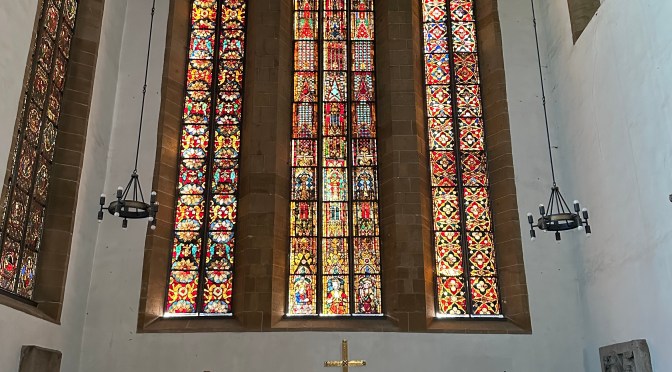
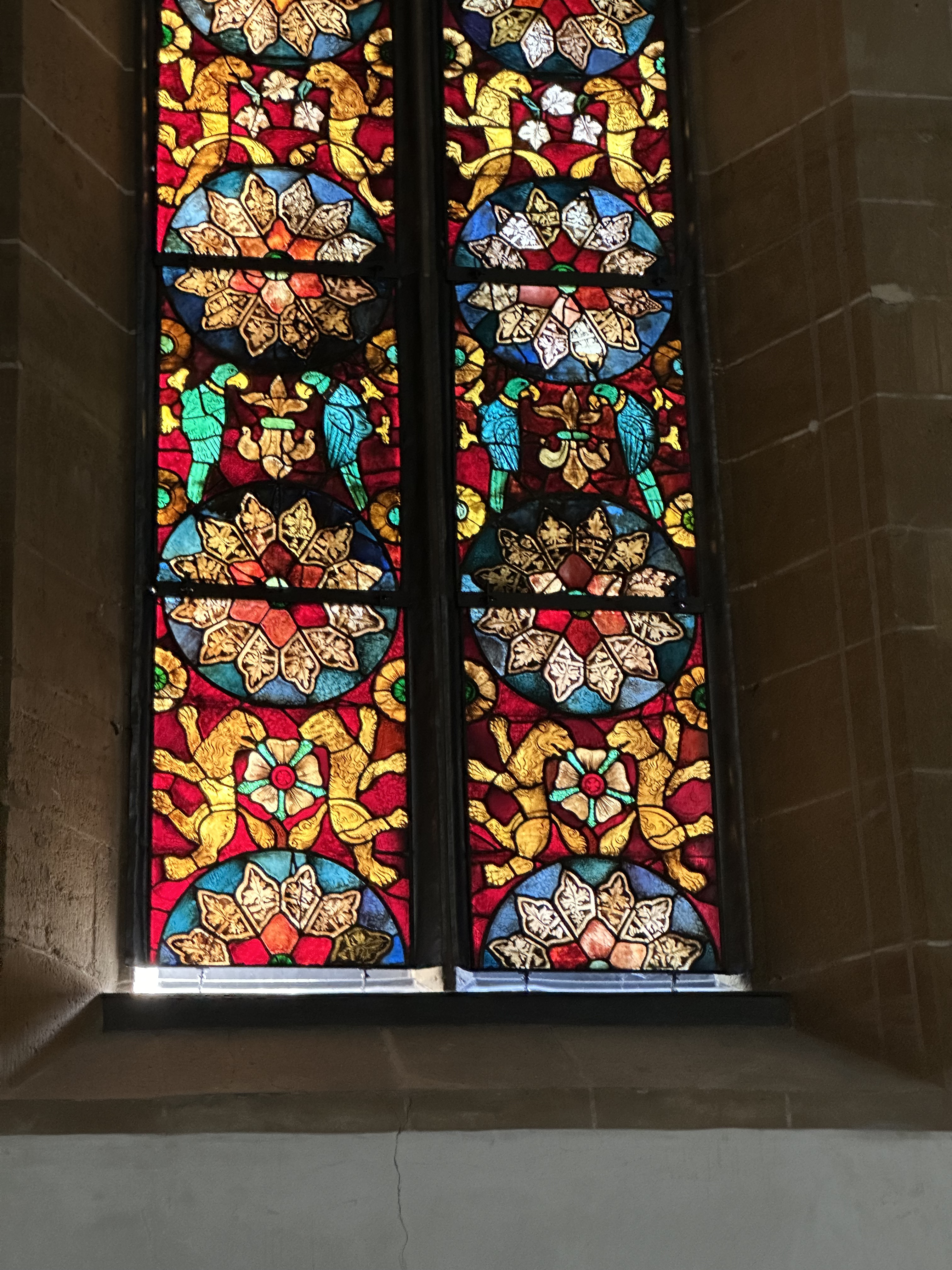
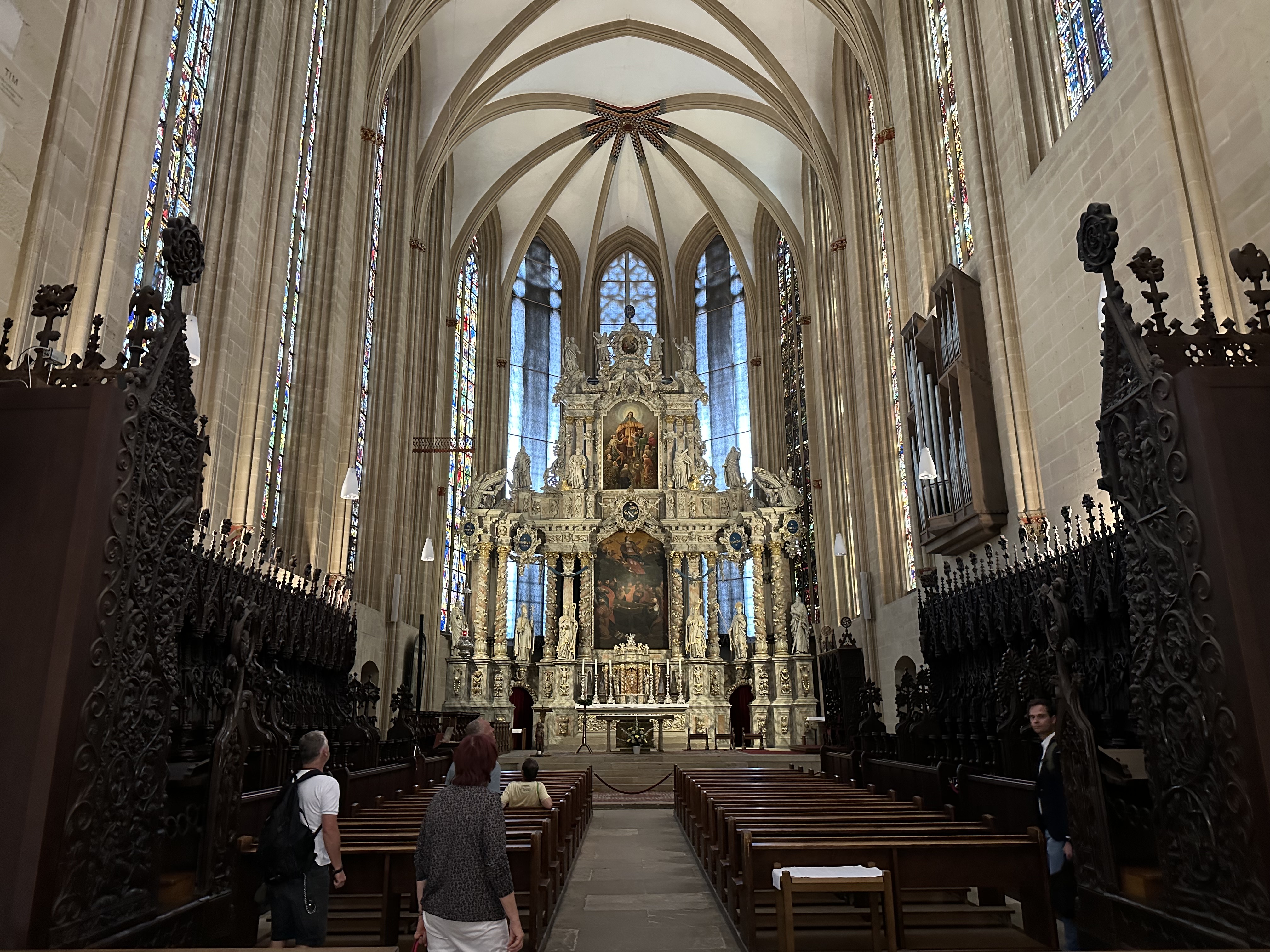
PS Photo(s) from my trip to Germany: [Above] The monastery chapel at Erfurt where Luther would have worshipped as a Monk. [Below] The stained glass was his inspiration for the Luther rose. The Cathedral in Erfurt where Luther would have been ordained a priest. My own ordination in 2009 and posing in a Luther cutout in Wittenberg.

Standing on History Unawares – Pastor Thoughts

This week the school year ended for school kids across the land. The crew of parents that typically meets at the bus stop for our street each morning for 8:08 AM pick-up has been counting the days until no more school lunches need to be made, no more rousing sleepy kids for breakfast and no more needing to climb the rest of the getting-ready-for-school mountain each day. I joked that we would all regret wanting an end to the school year in about 10 days when we start counting the days until school starts again! 

Of course, for now, it is nice to have a break in routine and some down time. 

Yet, with my mind still swimming between the 16th Century and today, I couldn’t help but remind myself that the real reason we are all trudging to this bus stop each day is… you guessed it… Martin Luther.

One of the things that we were reminded of frequently in Germany is Martin Luther’s influence on public life, not just on the Church. His translation of the Bible from Hebrew and Greek into German became the foundation of a lot of present-day written German or High German. Luther also introduced the concept of the public chest, as a means for communities to care for those in need. In addition, Luther advocated for public education funded by the State for all, including girls, which was radical at the time. He believed it was the state’s responsibility to provide education for all, as Luther scholar Franklin Painter describes it:

 1. In his writings he laid the foundation of an educational system which begins with the popular school and ends with the university.

2. He exhibited the necessity of schools both for the Church and the State, and emphasized the dignity and worth of the teacher’s vocation.

3. He set up as the noble ideal of education a Christian [person], fitted through instruction and discipline to discharge the duties of every relation of life.

4. He impressed on parents, ministers, and civil officers their obligation to educate the young.

5. He brought about a reorganization of schools, introducing graded instruction, an improved course of study and rational methods.

6. In his appreciation of nature and child-life, he laid the foundation for education science.

7. He made great improvements in method; he sought to adapt instruction to the capacity of children, to make learning pleasant, to awaken mind through skillful questioning, to study things as well as words, and to temper discipline with love.

8. He advocated compulsory education on the part of the State.

It is astounding to consider that many of the ways we simply organize ourselves in our common life, including sending our kids to grade school, were imagined first by Luther. 

On the day that we went to the Castle Church (Schlosskirche) in Wittenberg, there were also several school groups on field trips (similar to how school groups here might go to The Forks or the Museum for Human Rights). The Castle Church is also where Luther is buried. As we stood around Luther’s grave plaque, some of the students approached us to ask us a question. They were doing a scavenger hunt of sorts, looking for the answers to a set of questions. They were trying to figure out when the Castle Church had been built. They, of course, didn’t really understand that they were asking a group of Canadian pastors and students, including a world-renowned Luther scholar this question, as we all stood around the grave of the man who essentially invented public school! Our professor, Gordon Jensen, answered at the top of his head, and we all had a good chuckle. 

All of this to say that, as the school year comes to an end or as communities of faith like the one in Wittenberg or like ours here in Winnipeg, Canada, North America or wherever we are strive to live faithfully in the world, we seldom fully grasp all that it took to bring us to where we are today, or how the decisions we make today will impact generations to come. 

Somewhere in all of that is the working of the Spirit, sometimes hardly noticed or seen, but walking with us, nudging us in the directions of God’s call to live lives of faith, caring for our neighbour. 

Pastor Erik+

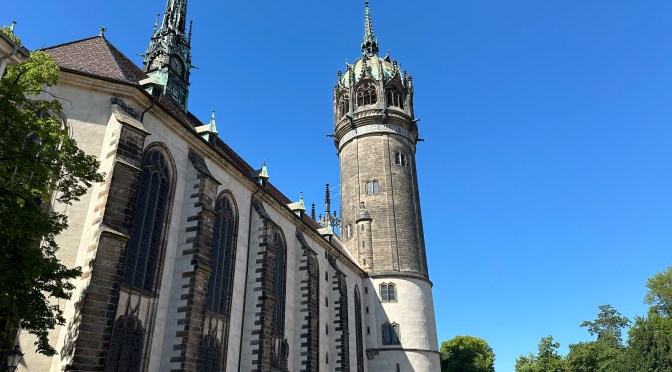
P.S. Photos from my trip to Germany: The outside of the Castle Church in Wittenberg and Martin Luther’s grave plaque, just under the pulpit in the Castle Church. 


1 Franklin V.N. Painter, Luther on Education (Philadelphia: Lutheran Publication Society, 1889, no copyright) 166-168.