
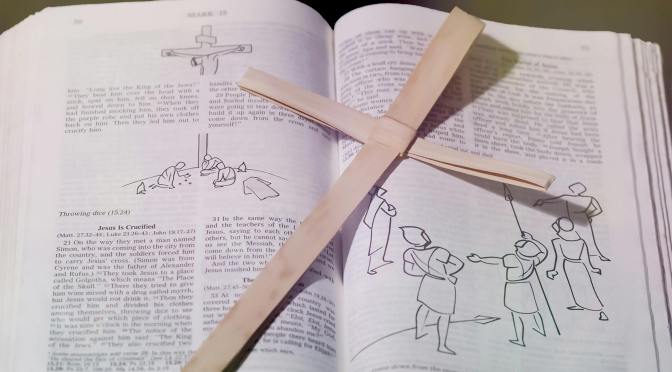
The first Palm Sunday I can remember I was six or seven. A Sunday school teacher shoved a palm branch into my hands and told me to be happy; we were going to welcome Jesus. The Sunday school and adult choir paraded into the sanctuary singing a happy song as the congregation watched. I remember not being sure what was going on. But I knew that happy people were laying down their coats and palm branches to make a welcome mat for Jesus, who was parading into town.
Palm Sunday is an odd event seen through this lens. Why is there a party for Jesus at the end of Lent and before Maundy Thursday and Good Friday? And it is not just my home congregation that bought into the party idea. The celebratory emphasis of Palm Sunday is a theme that can be seen in artwork, music and many passion plays throughout history.
But Palm Sunday wasn’t a party or celebration, not really. Jesus’ ride into Jerusalem was something else.
This year, many congregations in the United States are including protest signs in their Palm Sunday processions, as a way to protest their current government. Seeing Palm Sunday as a protest is probably closer to what the moment represented, but not quite.
Processions are important social symbols in our world as they were 2000 years ago. We might not think about it much, but processions occur in a lot of places. A celebratory parade is an obvious one. But processions occur also at weddings, funerals, graduations, political and state ceremonies, military ceremonies, and in religious practice. Though it is understated, our worship begins with a procession and ends with a recession every week. From a practical standpoint, it is a matter of getting the people who have a role to play in worship into and out of the space. But, symbolically, processions draw attention and focus. They help to communicate that something important is about to happen.
This is what the procession of the triumphal entry was about. In the gospels, prior to the triumphal entry, much of Jesus’ ministry resulted in conflict with the religious authorities, the political authorities and the demonic authorities⎯the Kingdoms of Religion, Politics and Satan. The purpose of Jesus’ ride into Jerusalem was to draw attention and focus to the in-breaking of the Kingdom of God.
Palm Sunday is the event where the Holy Messiah, God-In-Flesh, arrives to meet human centres of power. The Temple at the heart of Jerusalem was the symbol of power for the Kingdoms of Religion, Power, and Satan⎯the Kingdoms opposed to the Kingdom of God. The crowds shouting “Hosanna!” believed that Jesus was coming as a conquering king⎯more like that scene from the movie Gladiator where Caesar rides into Rome as a war hero or like the Allied troops marching into a liberated Holland in World War II. The conflicts in both cases were not resolved, but only beginning.
At the end of the triumphal entry, Jesus presents himself at the temple, preaching and teaching that God’s Kingdom had arrived, calling humanity to repent and to return to God. In that moment, the response to Jesus’ arrival was silence.
On Palm Sunday, the kingdoms at odds had yet to collide. That collision comes later in the week, during the Great Three Days from Maundy Thursday to Easter morning.
 The Millennial Pastor