
The arc of Advent can be frustrating to those who see Advent as a countdown or barrier to the season of Christmas—four weeks of doing things that are Christmas adjacent but decidedly not Christmas. At church, we don’t tend to sing Christmas music; we decorate with hints of what is come, and we tell Apocalyptic stories different from the familiar Christmas ones. Only on this Fourth Sunday of Advent, when we are introduced to Mary, do we finally meet a familiar character from the Christmas story.
Advent in the Church can feel like a counter-example to Christmas. In public, we notice the Christmas muzzak blaring on radios and store speakers from November onward, the ubiquitous Christ decor, Christmas menus, Christmas concerts and parties. Advent in the Church is slower, quieter, more reverent and expectant. Christmas is all about joy and celebration.
Yet, is a Christmas that starts November 1st all that different from Advent? Even with weeks and weeks of “Christmas stuff” going on, there is still a secular understanding that Christmas does not truly come until December 25. Even though we try to have two months of Christmas, it is more like two months of stressed consumerism, extra cooking, baking, cleaning, hosting, socializing and preparation. It is almost like all the worst parts of Advent—a mountain of preparation for something that we are trying to convince ourselves has arrived already.
That is why, even though we meet Mary and her cousin Elizabeth this week, they piercingly represent a different kind of Advent. This isn’t pregnant Mary bouncing down the road to Bethlehem on the back of a donkey; this is Mary at the beginning of her pregnancy. Pregnancy is one of the most Advent experiences of all, where preparing for a new child involves a complete transformation of the self—physically, psychologically and spiritually. I pregnancy there is nothing that can be done to hurry the process along, instead, we live by the adage that “things happen when they happen.”
When we let our human desires and fears guide our approach to Christmas, we try to jump to the ending right away. Instead, we create two months of stress and extra chores for ourselves. Because we can feel like we are in control of that version of Christmas, at least we are the ones choosing what we do and when we do it. But the version of Christmas that needs Advent to come first forces us to admit that we are not in control, that we do not get to decide when the apocalyptic in-breaking of God in incarnate flesh happens. Rather, Advent is a process of letting go of our control, and the Spirit opening us up to the revealing of Emmanuel—God with us.
As we come to the end of Advent, Mary models for us that experience of letting go. Certainly, her encounter with the Angel Gabriel and the news that she would bear Emmanuel was life-altering—in both good and terrible ways. Her recourse is to let go, for her to receive the gift of faith in the Spirit and to know that God’s intention for her and for us is mercy and goodness. This is something she would have heard about over and over again in her faith community and from her ancestors—just as her song declares. One almost wonders if she believes it herself yet; but that, too, is part of the process. Mary prays back to God the Word of Promise that a faithful God has first given to all of us, so that we continually hear the Gospel.
In this way, Advent, Annunciation and Apocalypse are intertwined. In our waiting, God’s promises are revealed. God breaks into human history, breaks into our lives, and delivers news that changes our reality. God in flesh is coming, in the space of the love between unexpectedly pregnant cousins and the space of a child growing in a mother’s womb, preparing to enter our world.
*** I am grateful to daughter/father podcasting team, of theologians Sarah Hinlicky-Wilson and Paul Hinlikcy for there articluation of Apocalypse (which of coruse, they would attribute ultimately to Paul!) Check out their podcast here: https://www.queenofthesciences.com ***
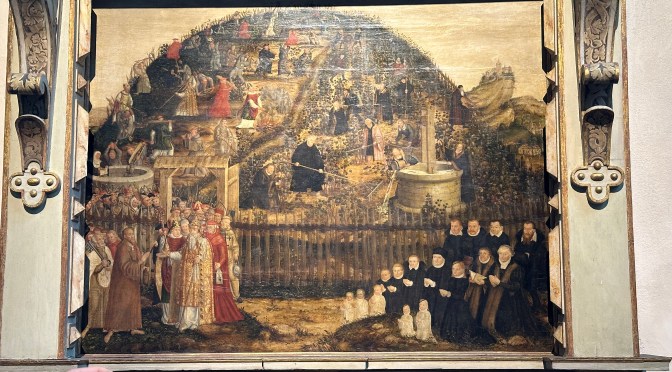
Photo: “The Vineyard of the Lord” from St. Mary’s Church in Wittenberg
 The Millennial Pastor