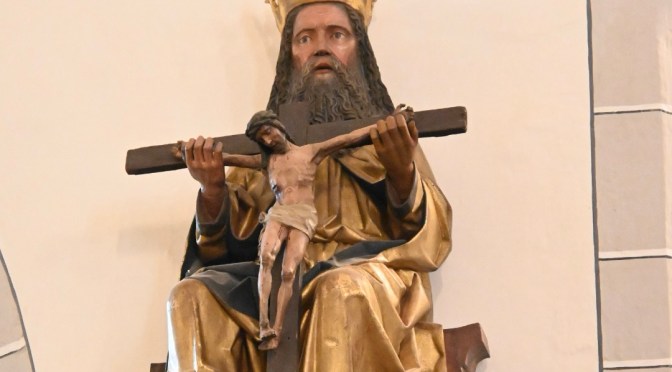
Waiting for the Apocalyptic Kingdom

We have arrived at Christ the King Sunday. This is the end of the liturgical year, which means we have made our way through the stories of Jesus’ birth, journey to Jerusalem, death and resurrection as told by the season of Advent through Easter. We have also made it through Jesus’ teaching and ministry as told by the Gospel of Mark. 

Altogether, these two parts of the liturgical year serve to create a narrative that takes us through the story of Jesus each year. 

There is another piece to this journey, however. This liturgical move is more than one that moves us from one year to the next. The move we make in our calendars and in our Sunday worship shows us a glimpse of the much larger scale movement that is happening all around us. 

Christ the King Sunday, or perhaps more accurately, the Reign of Christ Sunday, lifts the Apocalyptic veil on our world. No, not an apocalypse like the movies imagine with zombies, nuclear war, environmental catastrophe, or exorcist priests fighting demons.

Rather, the Apocalypse as the Biblical Narrative imagines it, the one that we have had in the background in this year of reading Mark, and perhaps in the background of pandemics, wars in Ukraine and Gaza, the election of populist leaders that are tracking to fascism. Apocalypse hardly seems like the thing of movies and novels these days, it is out there in the world. 

The Apocalypse that the Bible imagines is one that is rooted in the conflict between the Kingdom of God and the Kingdom of Sin, Death and the Devil. On Christ the King Sunday we are equally concerned with the fact that the Kingdom of God has entered the battle plains of this world with the intention of striving against those forces that would defy the One who holds all creation and us within God as we are with Christ’s Kingship. 

This is the work of God’s Kingdom in the world, to push back against all those forces that cause suffering and death, the forces of systematic sin and evil that cause oppression and enslave us.

But God’s Kingdom’s work is not the one of military might or political and economic power.  Rather, it is accomplished on the cross, in the one who takes our sin and death to the grave while exchanging with us the gifts of forgiveness, righteousness and life. The Kingdom’s work is to meet the powers of this world with the reconciling mercy of God, with true Kingdom power that can transform this world for the better. 

On the Christ the King Sunday, we prepare for the Apocalypse of Biblical proportions to come – for it to flip us over into the Advent of God’s new world, where we will be new creations. 

That familiar feeling of dread

Sometime in the evening on Tuesday night last week, a familiar feeling returned. It’s one that I thought we had finally been able to lay down and move on from sometime in late January of 2021–a burdensome feeling, full of dread and uncertainty. 

If I am honest, I would admit that that feeling has been lingering in the shadows of my mind for months now. I think we all have wanted to move on, to think that the chaotic years from 2016 to 2020 were some kind of fluke or accident of history, that Donald Trump, by pure dumb luck, had somehow gotten himself elected as President of the United States of America. Once that presidency ended in 2020, it was easiest to think we could just return to not having that feeling anymore. 

Since Tuesday night, when it started to become clear that the election was going the way it was going and that feeling of dread was surfacing again, I tried to analyze how things are different this time around.

In 2016, it was so shocking to think that this absurd candidate actually would become the President, and no one knew what would happen. This time, none of it is shocking, and I think we all have a pretty good idea of what is coming. I think about all those whose lives will be qualitatively worse: immigrants and asylum seekers, LGBTQ2SIA+ persons, women, people of colour, people who practice a faith other than the ones that support Trump, people who believe this is new totalitarian administration or anyone who invokes the ire of the new wanna-be “tyrant king.”

I also think this result is not surprising for many reasons, most of all since many of our political leaders around the globe appear to have been too long in the pockets of the ultra rich. Our politics might technically be democratic, but our economics look a lot like feudalism. We live in a world where a small privileged few control just about everything, and the vast majority of people are left to fight over the scraps. But this time around, the kings and privileged few are better at hiding our slavery from us. Instead of making us slaves, having us till the land which we do not own and grow food which we aren’t allowed to eat, the small group of billionaires have given us just enough distraction to make us think we are free –smartphones, crumbling hospitals and schools, endless entertainment like the gladiator games, but delivered to phones, tablets and TVs–and the illusion that the people we vote for are stark and different choices when instead they are more or less the same choice no matter what. 

Kamala Harris represented an interminably broken system that will not fix itself, while Trump represented change. That is change in the form of total destruction of the system, but change nonetheless. Given the choice between interminable brokenness and change through destruction, I am not surprised that so many opted for change. It is the same instinct that has led to every revolution and the overthrow of kingdoms, empires, regimes or other oppressive systems. 

Now, not being surprised by what happened is not the only difference this time around. 

Lately, I hear Martin Luther in the back of my head a lot. He lived in a time of oppressive and evil rulers, too. Popes and Emperors wanted him dead. Jesus also lived in that kind of world. That has been the normal state of the world for much of human history. We have been fortunate to have lived so long in a world where we (privileged North Americans) could sleep comfortably at night without wondering if some tyrant was going make life worse tomorrow. 

In the face of this kind of world, Luther would tell us to turn to God and God’s promises. The Gospel is the only hope that we truly have. This Gospel includes God’s forgiveness of sinners, Christ’s salvation enacted on the cross and Christ’s resurrection from the dead. There is no human effort that will save us and no political power, no king or queen, emperor or empress, no president or prime minister that can bring about our salvation or reconciliation. 

Yes, the world feels heavy and full of dread this week. But our hope and salvation remain what they have always been – the One who does the thing that we cannot do ourselves, the One in whom we die to sin and death and are raised to new life. 

Photo: The last bits of Berlin Wall. On November 9th, was the 35th anniversary of its fall. The movement that led to it being knocked down was begun by a group holding prayer meetings in St. Nikolai’s Church in Leipzig by pastors who were heavily influenced by Martin Luther’s writing The Freedom of a Christian. Within weeks, the meeting grew to be silent, candle-held protests of hundreds of thousands, which led to the wall coming down.

A reminder that tyranny can be resisted and overcome…

All Saints and Communal Grief

All Saints Sunday is usually one of my favourite Sundays of the year. It comes near the end of the liturgical year, as we have been making our way through the teaching and parables part of the Gospels. There is often a feeling of being taken somewhere and getting to the destination after three to four months of dwelling in either Matthew, Mark or Luke’s Ordinary Time texts. All Saints Sunday arrives with a view of what is to come afterwards. It points us to Advent and it paints a picture of God’s promises coming true at the end of time–two versions of what is coming next for us. 

This year, however, All Saints is hitting me a little differently. I haven’t been looking forward to it or thinking about it in the same way. It might be that I have been thinking a lot more about the Reformation  and Martin Luther in my studies. (Those are certainly a big part of it). 

But there is another piece of All Saints Sunday that I have been both pushing out of my thoughts in some moments and desperately longing for in the next. One of the primary images of All Saints is of the great multitude of the faithful gathered before the throne of God. It is a Revelation image, one that we often allude to in our liturgical music, particularly the Hymn of Praise or the Gloria. We believe that when we sing these songs we are not just worshipping God here on earth. We are also joining in the continuous heavenly worship of the saints. We are literally singing with the great multitude of the faithful.

Much of the artwork and images of the great multitude depict it as a large and faceless gathering, where the size and cosmic nature of the scene is the point. And yet, the longer I have served in ministry and the older I get as a person, more and more that faceless crowd starts to add to it faces that I know. Faces that I have known and served and buried. This year, it  the multitude of Revelation, the great cloud of witnesses at All Saints, also includes my grandmother and my father. 

I have always imagined that All Saints Sunday had the capacity to raise feelings and experiences of grief… but this year I know that it does. I wrote in the summer that there is a profound loneliness that goes along with death–of being the one to walk the journey of dying or of going on it as far as you can when the dying person is someone close to you. Now, I don’t mean lonely in the sense of being sad, but more descriptive loneliness, like isolation. As the one who is dying, there is a journey taken that you know you will have to complete alone. As the loved one who is left behind, there comes a place where journeys diverge, almost like one experiences in airport security–a place where you can go no further. Only the one actually headed for the new destination can keep going through. 

Even though so many of us have taken that journey as far as we can with loved ones, each journey is unique. Each experience of loneliness and isolation is its own to contend with. Letting go is a place and process that we arrive at, each in our own way. I think that is why sudden and tragic deaths can be so painful. The journey and process of letting go happens in an instant with no time to prepare oneself; the letting go process becomes one of tearing away. 

Now, before I dwell on the grief experience too long, there is this thing that All Saints does. It reminds us of that dying journey and of the grief. That is the part I have been pushing out of my mind as I think about Luther (even if he had a way to address death with the hope of the Gospel). 

But there is this other thing that All Saints does. It gathers together all these lonely and isolating journeys of death and grief and stitches them together. It takes individual experiences and turns them into a communal one. We bring our individual grief to All Saints, where we sing, we pray, we light candles, and we commune as one body, one multitude of the saints. We rehearse the hymns that we will sing before the throne of God. And somehow this restores us to Community and begins to undo the isolating power of death. 

This restoration is the side of All Saints that I am longing for and needing this year, as I am sure many of us are. Through restoring our Community, God brings us back into the Body of Christ, the great multitude of the faithful. All those faces that we know there welcome us home, with open arms.