A Reformed Reformation Sunday?

With October coming to an end, we prepare for that big occasion on October 31st… no, not the one with kids in costumes, candy and scary decorations in many front yards. That other occasion that is important to Lutherans and those who study 16th-century history – Reformation Day. 

This Reformation Day, it is hard to believe that we have been talking about Luther and thinking about his life for months now. Yes, I know it has been me coming back to his story and sharing photos from my trip to Reformation sites this year. When I started looking at and considering doctoral programs a few years ago, I looked at studying history with a focus on the Reformation. When I settled on the Doctor of Ministry program at Lutheran Theological Seminary in Saskatoon, I didn’t do so thinking that Luther would be central to my program of study. My research topic wondering what Lutherans think and believe about the role of clergy has morphed into what Martin Luther thought and wrote about the role of clergy in congregations and communities. 

Yet, here we are. I have travelled to Germany, walked where Luther lived and worked. I have read many, many books, written papers, lectured to a variety of groups and discovered a richness in knowing Luther’s life and work more now than I ever expected to. I was teased often in Seminary for caring about Luther too much; but now I remember the teasing from my classmates with pride. The place that Martin Luther occupies in our history as Lutherans, and among all Protestants, is hard to describe at times. 

With Martin Luther now a central part of my doctoral studies, and considering my research, Reformation Day arrives with a very different air about it. Even as someone who loved history, loved Lutheran history in particular and got teased for loving it too much, I always wanted to make sure that Reformation Sunday wasn’t a time to just celebrate Luther and forget about the Gospel. So I have been cautious on past Reformation Sundays not to talk about Luther too much. 

This year, I am less worried about that. Not because Luther should overshadow the Gospel we usually proclaim on Sunday mornings, but because when you dive into Luther’s life, his ideas and thoughts, his writing and story, it becomes clear that nearly everything he did was with the intention of focusing people on the Gospel. He was obsessed with making sure that the people around him would hear the Gospel. He spoke out when he saw the abuses of the church. He sought to encourage the people he served to live lives of faith, caring for one another rather than trying to earn salvation. And, he was pretty certain of his own flawed and infallible nature. 

As Lutherans, we do not worship Luther. We don’t believe that the things he did would save us from sin and death. But in hearing about the things that Luther did, the things he wrote, and his witness to the gospel, we can hear the Gospel of Christ in a new way and hope that we, too, can live lives of faith and service as Luther did.
Discipleship as Power?

We are in the final weeks of hearing from Mark’s Gospel. Way back in Advent through Easter, we heard all the dramatic stories of Jesus’ life and ministry. Since June, we have been wrestling with the middle chapters of the gospel book, working out with the disciples what Discipleship means. What it means to follow Jesus as he goes about bringing the Kingdom of God near. It sounds relatively simple if we don’t think about it much and stick to a Sunday-school-surface reading. 

Of course, Mark, Jesus and the Disciples don’t give us much of a chance to make that choice. This week, James and John ask Jesus to sit at his right and at his left. (It almost sounds like my children, who are often very keen to manage whom they sit next to at mealtime.) Yet, this is not just about children trying to get seated next to the teacher, or popular kid, or favourite grandparents at dinnertime. 

James and John are opening up a complicated and layered issue that Christians continue to deal with today. What does it mean to be associated with Jesus and what do we get out of it? We don’t have to look much further than the various elections going on around us to see the ways in which politicians use proximity or distance from Jesus, Christianity, the Church and Faith to gain votes and power. We also don’t have to think very far back to the ways that the Church has used Jesus as a means to wield power over other Christians, over our neighbours, and over Creation. 

On Sunday morning, we will discover that James and John don’t really understand what they are asking. They don’t yet see that Discipleship, as Power, is not what Jesus is offering. Discipleship as Service or Sacrifice might be more like it. Jesus also has some harsh words about the problems of trying to gain individual power on offer. 

Before we get to unpack what reversal and work of transformation Jesus is up to with us, we might have to sit and stew over these hard questions. What does it mean to belong to a religion that has had such a complicated relationship with power? How do we each fit within the relationship and experience of power?

By now you might be able to guess that some of these questions are part of what I am currently working on in my doctoral courses. As we try to understand just where we sit as people of faith in 2024, there is work to be done to understand how Christianity arrived here. 

However, I won’t dig too deep into issues of power, colonialism, white-euro-centric Christian supremacy and more right now. 

Instead, as we go back to Jesus and the disciples in the Gospel of Mark, we are reminded that even in the mess of power that they and we find ourselves in, Jesus has come to flip and overturn the established orders. Christ’s power is to serve, sacrifice and give. Christ gives Godself fully and completely to power-seeking people like James, John and the rest of us. And in that giving of Godself, somehow Jesus shows us the way to new life. 

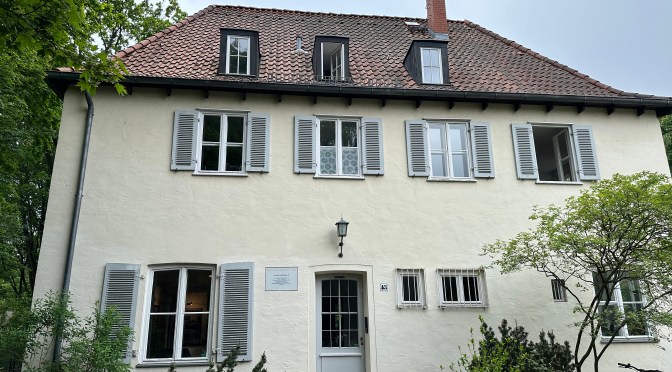
Photo: Dietrich Bonhoeffer’s House… and we know his ideas on the cost of discipleship.

Giving thanks over the years – Pastor Thoughts

I don’t think I could have ever imagined feeling this way, but I could have used a little more September this year. Between the program year ramping up, my foolishness in agreeing to a few too many things, the kid’s school year and activities starting and my coursework ramping up, it has felt like a busy few weeks. Thanksgiving should not be here this soon; I thought there was more time! 

When I was a kid, Thanksgiving felt like it was deep into the school year. Summer was already a distant memory, while Halloween was still three weeks away! Now, all that feels like it passes in the blink of an eye. 

Thanksgiving, like all holidays or holy days, comes at us differently at different times in our lives. When I was young, Thanksgiving weekend often felt like a great long break to eat lots of turkey and have an extra glorious day off from school before the snow arrived. For those with grandkids and large extended families, these important holiday events feel like touchstones yet provide fleeting opportunities to spend time with loved ones, chances to make memories, and opportunities to invest in what matters. For those of us in middle age, millennials are now middle-aged! – these holidays feel frantic managing kids, work schedules, social calendars, volunteer responsibilities and extended family obligations. Of course, there are those for whom Thanksgiving may be lonely or difficult and might be grief-filled with a notable spot at the table now empty. 

Ever since seminary, when in the course of learning theology, biblical studies, biblical Greek, and liturgy, we were taught that the word Eucharist means ‘thanksgiving,’ my brain always conflates the Great Thanksgiving that is a part of each worship service with communion and the holiday of Thanksgiving. I have started to see Thanksgiving weekend in Eucharistic terms – imagining this weekend around the second Monday in October as a time when Canadians practice Eucharist in our homes with family, friends and community. Thanksgiving tables aren’t necessarily the same as the Lord’s table that we gather around in worship. They are not public tables of welcome where we encounter the true presence of Christ as the Lord’s table is. But they are gatherings with a Eucharistic quality where often a motley collection of people gather together to share a meal and wind up somehow bound together into a new community in the process. The yearly gatherings are small reminders of the kind of community that we joined each Sunday around the Lord’s supper. 

So pay attention to who you eat with this weekend, know that you are joined to a new community of Eucharist and Thanksgiving. 

Redefining ministry in 2024 – Pastor Thoughts

This week (for Sunday October 6th), the gospel of Mark covers an uncomfortable passage about divorce, where Jesus gives no reason that makes divorce palatable. The passage certainly feels like divine judgment hurled on something pretty common in our world (if you want to know why Jesus’ comments on divorce meant something very different than we may think, see this sermon from 2021). Whatever Jesus might actually be saying about divorce, the bigger question might be about the place of faith and religion in our world. There is the general question about the secularity of our North American culture but also the place and input that our faith has in our lives. 

It is a question that I have been circling for the past month or so. Topics that have to do with faith in society and the church in the world include colonialism, Christian identity, how we talk among ourselves and others about the Church and so on. The question at the heart of my doctoral research is grounded in how we understand the role of Christian ministry in our lives.

On the surface, my research is asking about how people understand the work of clergy and the expectations out there that are placed on clergy. Deeper down, this is about exploring the place of Christian ministry in the world, as the work of clergy is done, along with, and equipping lay folks to be the hands and feet of the Church in the world. This, in turn, means digging into how contemporary Christians understand ministry and our collective work of ministry as the Church. 

Perhaps more simply put, asking people what they think the job of a pastor is has to do with how we understand all of our roles in the work of ministry. 

Answering this question is interconnected with another question facing many churches, including Sherwood Park, these days: What is our place and purpose in the world around us?

Like my research question, discerning our place and purpose in the world is a multifaceted question. There are lots of ways to begin answering it and lots of pieces that impact how we answer. What are we called to do and be as a community of faith in this time and place? Do we have the resources we need to carry out this ministry? Are there possible ministry partners around us with whom we can do more together than alone? What would happen if we didn’t carry out this ministry here? What would be lost? How can we change to faithfully entrust the legacy of our ministry to the next generation and into the future?

These questions take time to sort out. To answer them well as congregations requires us to put on the hats of researchers exploring all avenues of wondering, not knowing what answers might be out there. It isn’t easy to ask these questions because we aren’t used to the circumstances that we are in. Even if the Church has taken a few decades to slide into this situation, it feels new and uncertain and nothing like the version of being church that we know. All the things that we are talking about these days are not the things that pastors and church folks talked about in the past… at least that is not what I remember. 

But on the longer time scale of the history of Christianity, questions about our place and purpose in the world are not new. The Apostle Paul addresses these questions frequently in his letters. The early Church had to deal with similar questions as it navigated living in the Roman Empire. The Reformers had to reinterpret the Church’s place in the world during the Reformation. Today, we are being called into another moment to ask this question – What is our place and purpose in the world?

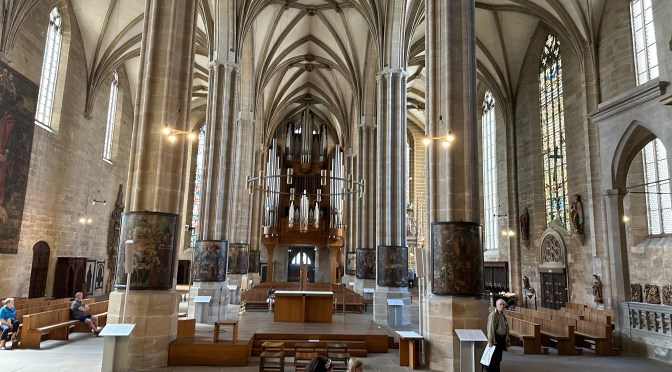
Photo: The modern chancel set into St. Mary Cathedral in Erfurt, Germany founded in 724 CE.