
On Thursday last week, I got a call from a CBC staff reporter asking for my opinion on a news story that I hadn’t heard of until that very moment. She asked what my thoughts were on removing the 10 Commandments Monument from Assiniboine Park – 5 years ago. The monument had been removed and placed in storage in order for The Leaf to be built in the same location.
I stammered out some thoughts about religious freedom in Canada, meaning that public spaces shouldn’t play host to objects that promote one religion over another. The removal of the monument didn’t seem like a big deal, so if the city wanted to put it in storage or return it to whoever donated it to the city in the first place seemed like a good idea to me. I mentioned that history is much better studied in books and museums, as evidenced by my doctoral work. Whatever thoughts I cobbled together seemed of enough interest to CBC that they asked if I would be willing to be interviewed on the afternoon radio show, which I agreed to.
But something was twigging me about this story. A lot of religious symbols and images on buildings and public spaces in Canada come from an earlier colonial era. As we know, there was a long period when the church and government were working together on various projects. Many Anglican and Roman Catholic Church buildings, in particular stone ones in the middle of cities and towns, were built with government funding because churches at the time were believed to be central to the public good of communities – that is, if you were Anglican in English Canada or French in French Canada. The other thing the church and government collaborated on at that time was Indian Residential Schools. Something which we are still learning and unpacking the traumatic effects of today.
My initial thought about this monument of the 10 Commandments was that it likely came from that colonial era, but I wasn’t sure. One fact that bothered me was that in Germany, I hadn’t seen a single Ten Commandments monument, and nor could I remember one in any church I have ever been to anywhere. I needed to know more.
So, in the time between that first phone call and the later afternoon interview, I did some real research rather than hypothesizing. I guess doing doctoral work is training me to do the research and uncover the real story.
I jumped into the rabbit hole that is the history of 10 Commandments monuments in North America and discovered some interesting facts. Beginning in 1951, a member of the Fraternal Order of the Eagles (essentially a social club that did some charity like the Lions or Kiwanis), a Judge in Minnesota sentenced a youth convicted of stealing a car to learn the commandments with a pastor, rather than jail time. He believed that learning morals might turn wayward youths around. He expanded this vision to posting copies of the 10 Commandments in Juvenile Courthouses across North America. A few years after this, a certain Hollywood movie director heard of this campaign by the Order of the Eagles and saw an opportunity – a marketing opportunity. This director had a movie coming out in 1956, also called The Ten Commandments. The director was none other than Cecil B. DeMille. So DeMille got in touch with the Judge and helped the Order of the Eagles to place stone monuments in parks, courthouses and city halls across North America. The campaign kept on going for ten years, which is the time when Assiniboine Park got its 10 Commandments monument. In 1965, no one objected to the idea. But as early as the 1970s, objections began to arise on the grounds of the separation of church and state.
CBC interview:
https://www.cbc.ca/listen/live-radio/1-111-up-to-speed/clip/16095755-reverend-says-ten-commandments-monument-put-back
Certainly, the monument here in Winnipeg is not the first to have a debate around its appropriateness in a public space. Debates around these monuments have been in the news for years. As you will recall, last week, my eNews article spoke to the idea of being surrounded by the symbols and images of a given religion and not being a vehicle for knowing the faith, even when those things have a deep historical connection to a place.
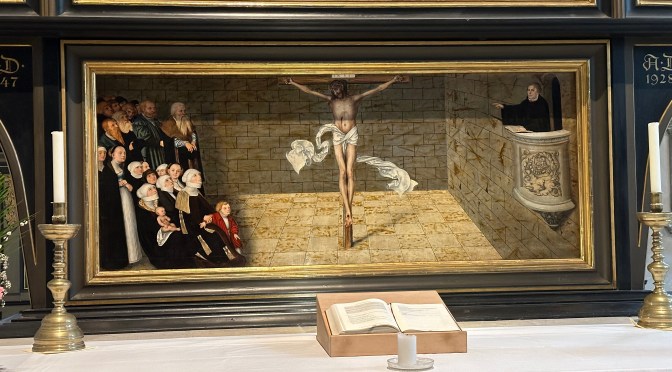
In fact, during the Reformation, the topic of statues, paintings and art was a hot topic. Many thought they were graven images. While Martin Luther admitted that people did not have to venerate crucifixes or statues of Mary, he did say that these art and symbols could be helpful for people in their faith journey by communicating the gospel.
However, Luther was clear that the gospel was not about telling people what to do, and nor was faith a matter of living morally. In fact, he didn’t see the 10 Commandments as primarily about morals at all. While they did have this basic function of drawing the line between right and wrong, their real function was to show us – human beings – our sinfulness. The commandments reveal to us the ways in which we do not put God first but rather try to be God in God’s place. They also reveal the myriad of ways in which we harm our neighbour by failing to care for those around us. The Commandments show us our sinfulness and need for salvation – but they are not in and of themselves the gospel. Rather, the gospel is Christ. Christ given for the sake of sinners. God’s love, mercy, forgiveness and life given through Christ for sinful humanity.
So, to me, our 10 Commandments monument doesn’t speak to our history in Manitoba, even if it is a weird quirk of Hollywood marketing history. Nor do they represent the essential proclamation of our faith, the good news. In fact, they tell us the bad news. Bad news alone. But as I wrote about last week, learning our faith and learning the good news happens in conversation. The gospel is proclaimed in the things we communicate to the world, and Luther would add in how we love and care for our neighbour.
Sources:
https://religionsmn.carleton.edu/exhibits/show/tencommand/tencommandhistory
https://news.minnesota.publicradio.org/features/200109/10_schmitzr_laxten-m/
 The Millennial Pastor