Canadian Lutherans and Colonialism – Pastor Thoughts

Monday, September 30th was the National Day for Truth and Reconciliation, where we remember those Indigenous children and families who were victims of and affected by Canada’s Indian Residential School system. This year, there were orange shirts around that weekend, as September 30th is also called “Orange Shirt Day.” 

As Lutherans, we are a church body whose origins are European; we carry with us a connection to the history of colonialism. Yet, as ELCIC Lutherans in Canada, we also carry with us a history distinct from that of other White-European churches, such as the Anglican, Roman Catholics and United Churches. While Lutherans have had a presence in parts of North America since the 16th Century, they were mostly in the US’s original thirteen colonies. Martin Luther came onto the scene decades after Columbus sailed the ocean blue, meaning there weren’t enough Lutherans to start spreading around until the 1600s. 

In the case of most churches and congregations that belong to the ELCIC, our oldest congregations are relatively young, started by our grandparents or great-grandparents in the last one hundred to one hundred fifty years. In the case of Canada’s residential school period, most Lutherans were considered immigrants and outsiders by the church bodies (Anglican, Roman Catholic, United) that were running the schools. 

So what is our connection to colonialism? We were not necessarily part of the institutions that were the core of the colonial project in Canada (the British and French empires), but we are part of the White European ethos by proxy. In the height of the colonial era (the late 1700s through 1800s), Europeans were colonizing all over the world, bringing their ways of life, culture and beliefs to nearly every corner of the globe. Europeans engaged in colonialism in Africa, the Middle East, Asia, North and South America during this time. This was the time when that saying, “the sun never sets on the British Empire” came into being.

At the core, colonialism was based on the idea that White European ways of life, culture and spirituality were the right and best ways for humans to live. This idea continues to propagate itself even as we now try to reconcile our colonial history. 

Colonialism is why Canada had “Indian Residential Schools” to ostensibly “remove the savage from the child.” It is why we forced our religious practices and culture on indigenous peoples and often declared that other ways of living, other cultures, and other ways of believing in God were inferior and wrong. 

As Lutherans in Canada, we have kind of sneaked into the back door of colonialism, going from being seen as immigrants considered outsiders for a lot of the last century and a half to trying to lump ourselves in with other White European descent church bodies at precisely at the wrong time. We didn’t have an institutional stake in colonialism, yet we are somewhat a part of the group that colonialism declared to be the right way – as long as we seemed, in Canada’s case, European, White and Christian enough. 

In this week’s gospel, the disciples are worried about others who are healing in Jesus’ name. They are worried that these “others” are not doing things the right way. Jesus reminds them that the work of the Kingdom of God happens in so many more ways than they can imagine. 

Unfortunately, that message didn’t get through to colonial empires. But, as we seek to dismantle and reconcile the structures and worldviews of colonialism that still exist in our world today, we can remember this message: God might be at work in places and ways we have not conceived of yet. We are called as people of faith to the important work of truth and reconciliation, even from our unusual position as Lutherans in Canada. 
The weird and surprising history of 10 Commandments Monuments

On Thursday last week, I got a call from a CBC staff reporter asking for my opinion on a news story that I hadn’t heard of until that very moment. She asked what my thoughts were on removing the 10 Commandments Monument from Assiniboine Park – 5 years ago. The monument had been removed and placed in storage in order for The Leaf to be built in the same location. 

I stammered out some thoughts about religious freedom in Canada, meaning that public spaces shouldn’t play host to objects that promote one religion over another. The removal of the monument didn’t seem like a big deal, so if the city wanted to put it in storage or return it to whoever donated it to the city in the first place seemed like a good idea to me. I mentioned that history is much better studied in books and museums, as evidenced by my doctoral work. Whatever thoughts I cobbled together seemed of enough interest to CBC that they asked if I would be willing to be interviewed on the afternoon radio show, which I agreed to. 

But something was twigging me about this story. A lot of religious symbols and images on buildings and public spaces in Canada come from an earlier colonial era. As we know, there was a long period when the church and government were working together on various projects. Many Anglican and Roman Catholic Church buildings, in particular stone ones in the middle of cities and towns, were built with government funding because churches at the time were believed to be central to the public good of communities – that is, if you were Anglican in English Canada or French in French Canada. The other thing the church and government collaborated on at that time was Indian Residential Schools. Something which we are still learning and unpacking the traumatic effects of today. 

My initial thought about this monument of the 10 Commandments was that it likely came from that colonial era, but I wasn’t sure. One fact that bothered me was that in Germany, I hadn’t seen a single Ten Commandments monument, and nor could I remember one in any church I have ever been to anywhere. I needed to know more. 

So, in the time between that first phone call and the later afternoon interview, I did some real research rather than hypothesizing. I guess doing doctoral work is training me to do the research and uncover the real story. 

I jumped into the rabbit hole that is the history of 10 Commandments monuments in North America and discovered some interesting facts. Beginning in 1951, a member of the Fraternal Order of the Eagles (essentially a social club that did some charity like the Lions or Kiwanis), a Judge in Minnesota sentenced a youth convicted of stealing a car to learn the commandments with a pastor, rather than jail time. He believed that learning morals might turn wayward youths around. He expanded this vision to posting copies of the 10 Commandments in Juvenile Courthouses across North America. A few years after this, a certain Hollywood movie director heard of this campaign by the Order of the Eagles and saw an opportunity – a marketing opportunity. This director had a movie coming out in 1956, also called The Ten Commandments. The director was none other than Cecil B. DeMille. So DeMille got in touch with the Judge and helped the Order of the Eagles to place stone monuments in parks, courthouses and city halls across North America. The campaign kept on going for ten years, which is the time when Assiniboine Park got its 10 Commandments monument. In 1965, no one objected to the idea. But as early as the 1970s, objections began to arise on the grounds of the separation of church and state. 

CBC interview:
https://www.cbc.ca/listen/live-radio/1-111-up-to-speed/clip/16095755-reverend-says-ten-commandments-monument-put-back

Follow up: https://www.cbc.ca/listen/live-radio/1-29-information-radio-mb/clip/16096976-a-religious-monument-removed-assiniboine-park-hopefully-displayed

Certainly, the monument here in Winnipeg is not the first to have a debate around its appropriateness in a public space. Debates around these monuments have been in the news for years. As you will recall, last week, my eNews article spoke to the idea of being surrounded by the symbols and images of a given religion and not being a vehicle for knowing the faith, even when those things have a deep historical connection to a place. 

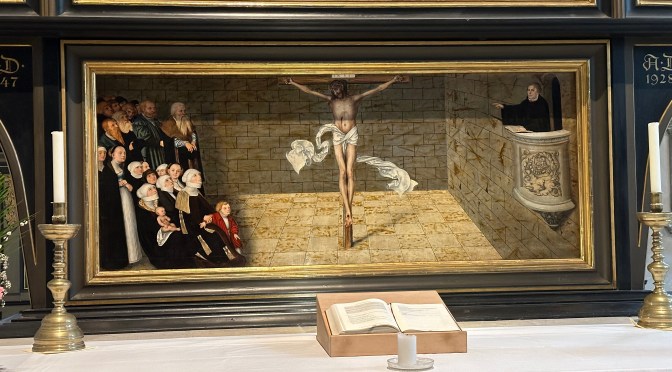
In fact, during the Reformation, the topic of statues, paintings and art was a hot topic. Many thought they were graven images. While Martin Luther admitted that people did not have to venerate crucifixes or statues of Mary, he did say that these art and symbols could be helpful for people in their faith journey by communicating the gospel. 

However, Luther was clear that the gospel was not about telling people what to do, and nor was faith a matter of living morally. In fact, he didn’t see the 10 Commandments as primarily about morals at all. While they did have this basic function of drawing the line between right and wrong, their real function was to show us – human beings – our sinfulness. The commandments reveal to us the ways in which we do not put God first but rather try to be God in God’s place. They also reveal the myriad of ways in which we harm our neighbour by failing to care for those around us. The Commandments show us our sinfulness and need for salvation – but they are not in and of themselves the gospel. Rather, the gospel is Christ. Christ given for the sake of sinners. God’s love, mercy, forgiveness and life given through Christ for sinful humanity. 

So, to me, our 10 Commandments monument doesn’t speak to our history in Manitoba, even if it is a weird quirk of Hollywood marketing history. Nor do they represent the essential proclamation of our faith, the good news. In fact, they tell us the bad news. Bad news alone. But as I wrote about last week, learning our faith and learning the good news happens in conversation. The gospel is proclaimed in the things we communicate to the world, and Luther would add in how we love and care for our neighbour. 

Sources:

https://religionsmn.carleton.edu/exhibits/show/tencommand/tencommandhistory

https://news.minnesota.publicradio.org/features/200109/10_schmitzr_laxten-m/

Who do we say that we are? – Pastor Thoughts

“Who do people say that I am?”

Jesus poses this question to his disciples this week in the Gospel of Mark. It marks a significant transition in Jesus’ ministry. After this moment, Jesus stops wandering around the Galilean countryside and begins more intentionally moving toward confrontation in Jerusalem which eventually lands him on the cross. 

You could argue that this moment’s narrative significance becomes what the Gospel of Mark is about. In fact, you could say that Mark’s gospel is about revealing to the reader who Jesus truly is. 

Amazingly, the essence of this question remains as puzzling today among Christians and followers of Jesus as it was to the disciples in the 1st century. It isn’t that they didn’t know, it is that they had several answers and perhaps weren’t totally certain which one was the right one. Among colleagues, versions of this question keep coming up when we gather in ministerial meetings. Who do we say Jesus is? Who are we as communities of faith? What is the difference between a church, a country club and a museum? 

Certainly, much of the current state that Christianity finds itself in today has to do with being unable to address this question in recent decades. Not that many church leaders have been shy about loudly telling people who they think Jesus is. Rather, the thing we haven’t done well is what Jesus does in the passage of Mark. He invites conversation. He opens up space for the disciples to consider the many, many answers that were swirling around them and to settle in on a response that comes with a more solid grounding. The church has not been very good at doing that, inviting conversations, making space for honest wonderings and questions, for half-baked ideas and partially formed thoughts. 

We haven’t been good at simply talking about who Jesus is. Talking about what church and faith are all about. Talking about why we keep showing up to worship, for choir practice and bible study, for council meetings and confirmation class etc… 

Who do people say that I am?

As I walked around Wittenberg this May, along with many of the other cities we travelled to, I was reminded how just omnipresent Christianity is in the fabric of European society. Large church buildings dominate cityscapes, reliefs and frescos plastering many walls, music and art with biblical imagery all around, and church bells that toll the hour day and night. We may think we have beautiful churches and cities, but they are nothing compared to centuries-old church buildings that are ubiquitous in Europe. 

One evening, we had dinner with some folks local to Wittenberg who were active members at St. Mary’s Town Church – the congregation that Martin Luther served. I asked the Wittenbergers felt tension with Lutherans from all over the world showing up and acting like their home belonged to us too. The answer surprised me: No. Most Germans know very little about Martin Luther. Most Wittenbengers only know Luther vaguely as a historical figure, if at all. Surrounded by the symbols, history and artifacts of Christianity, the church there has done no better a job at talking about who Jesus is than we have here.

In fact, our habit of not talking about the faith may have come from across the ocean (but that is a topic for another day). 

Now, I am not sure I know what the solution is to our habit of not talking about the faith and not articulating who Jesus is through conversation and wondering. Being surrounded by Christian stuff doesn’t seem to help, nor does observing more Christian holidays either. 

I don’t know the solution… except to start doing it. To start making a point of not just assuming that we know who Jesus is, or why we come to church, or why church is different than a museum or club, but to talk about it openly. 

We need to practice making space for questions and wonderings, to allow that we might be coming from different perspectives and experiences, yet arriving in the same place to follow Jesus and to do it together. 

Memories that blindside – Pastor Thoughts

About a week ago, we toured our son’s new middle school. While Grade 5 isn’t technically middle school or junior high, moving grade 5 students to the middle school was the solution to overcrowding at the French Immersion elementary school l in our neighbourhood. 

I don’t remember the last time I was inside of a middle school, probably about 20 years ago when I played Basketball on an adult recreation team. But certainly, the last time I really explored a middle school, poking around classrooms, the music room, art room, cafeteria, drama stage, computer lab etc… well, I think it might have been since I was last in middle school. That’s about 30 years ago to my math. 

And yet, it was amazing how quickly all the memories of my own experiences starting Junior High School came flooding back. There is a certain formative freedom to that age, where you go from the hands-on nature of elementary school to being responsible for getting yourself to from class to class, navigating the complex social dynamics of teenage years and learning that with new freedom comes responsibility. 

There was something about walking down the locker-filled hallways, looking into classrooms filled with desks, imagining the hustle of in-between class periods movement. It almost felt like I was the one back starting at a new school, getting ready for a new school year. 

What struck me was how powerful the memory of those emotions was, the emotions and feelings of middle school: the stress and anxiety around fitting in, the uncertainty about the future, and the complexity of the transition from childhood to adolescence. 

Memories and emotions from significant and formative experiences often blindside us at unexpected times. 

It is an experience that I think might happen more often than I think at church, and that I frequently miss, whether it is long-time active members being in church buildings filled with a lifetime of significant and formative memories, or folks returning after being away and having all the memories come flooding back of earlier life experiences. Like a teacher whose relationship and experience of school change through the experience of teaching, as a pastor, my relationship with the church has been changed through the experience of ministry. 

The other thing I noted on my tour of the middle school, was that not everything was the same as I remember middle school. There was new technology (with lots of posters about the school cell phone ban), but also signs of a changing world with an emphasis on inclusion and diversity, care for the climate and efforts to teach kids how to be caring and responsible community members. 

Though certainly churches have changed too, with new technology and updated ways of working together, I wonder if someone who hadn’t been in a church in 30 years would find similar new and relevant cultural emphasis as well? I am not sure, and I am genuinely curious to find out. 

Either way, the signs of change and new things are coming – in fact God just may be placing them right before our eyes. Even as we remember the past, God is doing a new thing with us.

Yes, we can learn from our past.

The summer has passed us by quickly this year. It felt like just yesterday the school year had ended and we were making plans for what our family would do in the first week of July. In just the blink of an eye, we are now into the first week of a new school year. 

This summer my family traveled between BC and Alberta. During that time, spent a week at Camp Kuriakos on Sylvan Lake, Alberta just outside of Red Deer. There, Pastor Courtenay and I served as resource people along with a good friend and seminary classmate. 

I took on the role of facilitating the Adult Study portion of the week, using material from my recent research paper on Martin Luther and photos from my trip to Germany in May. I named my study sessions, “Death, Life and Community: Martin Luther’s Thoughts That Changed His World.” 

As I advertised the topic on the first night of camp, a few folks commented on not knowing too much about that “history stuff” or jokingly wondered if we were going back to school. Certainly, not everyone is of the mindset to be a historian, but I also think that these comments revealed a common mindset that these “academic” topics are beyond most folks. A sentiment with which I strongly disagree with. 

While our family drove across Western Canada these past weeks, we also listened to podcasts, about history, scams, and the science of reading (literacy education). Amazingly, our kids were just as interested in these podcasts as they were in Disney movies on their iPads. The Science of Reading podcast ( Sold a Story) is one they have asked to listen to again, as it is about how reading is taught in the early grades. One of the points in the podcast is that children love learning history or science. Greeking Out, a podcast about Greek mythology is a hit in our house right now. It is usually teachers or adults] who believe that certain topics are uninteresting… yet children often love learning science or history which allows them to feel like experts on a particular topic.

Similarly, the stories about Martin Luther and his ideas are easily understood by anyone, even those who haven’t learned anything about him previously. All that is required is a little imagination about what 16th-century Europe might have been like.

We live in a world that is often oblivious to history or even afraid to think about it.  Some claim history is “too boring.” They may actually be hiding a feeling of inadequacy or of not knowing enough. Often when we discover we don’t know something about a certain topic, it can easily feel as though we unintelligent or somehow inadequate. We can fell as though we could never learn more either. 

Of course, the opposite is true. The stories of our past can be easily understood and learning them anew at any age only helps us to understand the world better. Knowing our history also helps us to understand our circumstances of the present. Our stories of the past provide insight into our present story. Learning the stories of our faith from the past, and understanding where we have been only serves to deepen our faith today. 

Photo: Wartburg Castle Mosaic of St. Elisabeth of Thuringia who lived in the 13th century,