
This week I am able to gratefully breathe a huge sigh of relief. Only a few hours ago, I hit send on an email with my finished research paper for the course associated with my trip to Germany in May.
After 8000 words and 30 pages of delving into the deeper reaches of Martin Luther’s thinking about the gospel, the church and ordained ministry in the church, my brain is swimming back and forth between the 16th and 21st centuries.
Considering that I often speak about the church moving out of the 20th century and into the 21st century, and yet I am spending so much time going back to the 1500s to look at what was happening in the church during that time.
It isn’t that I have anything, in particular, against the 20th century. Rather our circumstances today might have more in common than with the world 500 years ago than the world 50 years ago.
At the time of the Reformation, most of Europe had been in the medieval era for 700 years. However, an important new invention called the printing press was making the spread of information possible in ways that people only a few decades prior could not imagine.
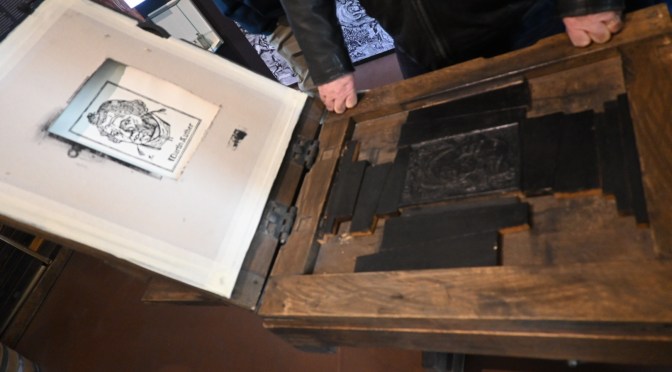
I have seen printing presses before, but while in Wittenberg, we visited the museum of Lucas Cranach’s print shop. Lucas Cranach was the court artist for Prince Frederick the Elector (Frederick was one of seven German princes who together elected the Emperor). Cranach was a good friend of Luther. His print shop was just down the street from Luther’s house, and Cranach was often responsible for spreading Luther’s writings by re-printing them along with being the most prolific art house of its time.
The striking thing about this is when you walk the streets of Wittenberg, the print shop, Luther’s house, the town church, the prince’s castle, the university all within a few blocks of each other. These people doing these things all lived together. They were deeply intertwined in the community.
Now, we are living in a time when communities are growing more fragmented in some ways, and while our capacity to be connected in other ways has grown leaps and bounds.
I suspect that Wittenberg felt less like the slower-paced, deep-connection communities of 50 years ago and more like the fast-paced but fragmented community that we are today.
In that world, Luther spent a lot of his time and energy thinking and writing about the importance of community. Something that I didn’t really even know until I began this research because Luther wrote so much!
It is a strong reminder in a time when there are realities in the world that pull us apart more than bring us together, that community needs to happen on purpose because it rarely happens by accident. Being connected and able to share information more freely doesn’t necessarily mean naturally created bonds that allow us to care more deeply.
Rather, Luther saw that care for the neighbour in and through the gospel, the good of forgiveness, life and salvation allows us to love our neighbour freely. And those things happen on purpose.
PS Photo(s) from my trip to Germany: A replica of Cranach’s printing press, with a picture of Luther ready to be printed. And two photos of his logo, a serpent with wings. The serpent was thought to be a symbol common to printers at the time.


 The Millennial Pastor