Standing on History Unawares – Pastor Thoughts

This week the school year ended for school kids across the land. The crew of parents that typically meets at the bus stop for our street each morning for 8:08 AM pick-up has been counting the days until no more school lunches need to be made, no more rousing sleepy kids for breakfast and no more needing to climb the rest of the getting-ready-for-school mountain each day. I joked that we would all regret wanting an end to the school year in about 10 days when we start counting the days until school starts again! 

Of course, for now, it is nice to have a break in routine and some down time. 

Yet, with my mind still swimming between the 16th Century and today, I couldn’t help but remind myself that the real reason we are all trudging to this bus stop each day is… you guessed it… Martin Luther.

One of the things that we were reminded of frequently in Germany is Martin Luther’s influence on public life, not just on the Church. His translation of the Bible from Hebrew and Greek into German became the foundation of a lot of present-day written German or High German. Luther also introduced the concept of the public chest, as a means for communities to care for those in need. In addition, Luther advocated for public education funded by the State for all, including girls, which was radical at the time. He believed it was the state’s responsibility to provide education for all, as Luther scholar Franklin Painter describes it:

 1. In his writings he laid the foundation of an educational system which begins with the popular school and ends with the university.

2. He exhibited the necessity of schools both for the Church and the State, and emphasized the dignity and worth of the teacher’s vocation.

3. He set up as the noble ideal of education a Christian [person], fitted through instruction and discipline to discharge the duties of every relation of life.

4. He impressed on parents, ministers, and civil officers their obligation to educate the young.

5. He brought about a reorganization of schools, introducing graded instruction, an improved course of study and rational methods.

6. In his appreciation of nature and child-life, he laid the foundation for education science.

7. He made great improvements in method; he sought to adapt instruction to the capacity of children, to make learning pleasant, to awaken mind through skillful questioning, to study things as well as words, and to temper discipline with love.

8. He advocated compulsory education on the part of the State.

It is astounding to consider that many of the ways we simply organize ourselves in our common life, including sending our kids to grade school, were imagined first by Luther. 

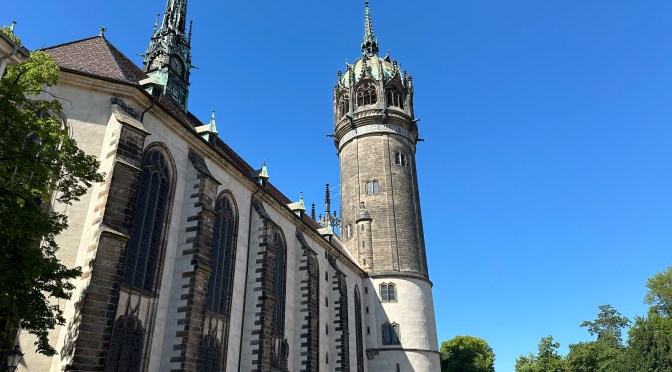
On the day that we went to the Castle Church (Schlosskirche) in Wittenberg, there were also several school groups on field trips (similar to how school groups here might go to The Forks or the Museum for Human Rights). The Castle Church is also where Luther is buried. As we stood around Luther’s grave plaque, some of the students approached us to ask us a question. They were doing a scavenger hunt of sorts, looking for the answers to a set of questions. They were trying to figure out when the Castle Church had been built. They, of course, didn’t really understand that they were asking a group of Canadian pastors and students, including a world-renowned Luther scholar this question, as we all stood around the grave of the man who essentially invented public school! Our professor, Gordon Jensen, answered at the top of his head, and we all had a good chuckle. 

All of this to say that, as the school year comes to an end or as communities of faith like the one in Wittenberg or like ours here in Winnipeg, Canada, North America or wherever we are strive to live faithfully in the world, we seldom fully grasp all that it took to bring us to where we are today, or how the decisions we make today will impact generations to come. 

Somewhere in all of that is the working of the Spirit, sometimes hardly noticed or seen, but walking with us, nudging us in the directions of God’s call to live lives of faith, caring for our neighbour. 

Pastor Erik+

P.S. Photos from my trip to Germany: The outside of the Castle Church in Wittenberg and Martin Luther’s grave plaque, just under the pulpit in the Castle Church. 


1 Franklin V.N. Painter, Luther on Education (Philadelphia: Lutheran Publication Society, 1889, no copyright) 166-168.
It takes a community to raise a church – Pastor Thoughts

This week I am able to gratefully breathe a huge sigh of relief. Only a few hours ago, I hit send on an email with my finished research paper for the course associated with my trip to Germany in May. 

After 8000 words and 30 pages of delving into the deeper reaches of Martin Luther’s thinking about the gospel, the church and ordained ministry in the church, my brain is swimming back and forth between the 16th and 21st centuries. 

Considering that I often speak about the church moving out of the 20th century and into the 21st century, and yet I am spending so much time going back to the 1500s to look at what was happening in the church during that time. 

It isn’t that I have anything, in particular, against the 20th century.  Rather our circumstances today might have more in common than with the world 500 years ago than the world 50 years ago. 

At the time of the Reformation, most of Europe had been in the medieval era for 700 years. However, an important new invention called the printing press was making the spread of information possible in ways that people only a few decades prior could not imagine. 

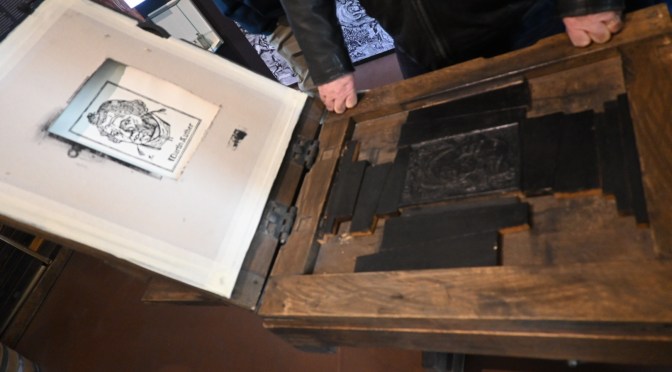
I have seen printing presses before, but while in Wittenberg, we visited the museum of Lucas Cranach’s print shop. Lucas Cranach was the court artist for Prince Frederick the Elector (Frederick was one of seven German princes who together elected the Emperor). Cranach was a good friend of Luther. His print shop was just down the street from Luther’s house, and Cranach was often responsible for spreading Luther’s writings by re-printing them along with being the most prolific art house of its time. 

The striking thing about this is when you walk the streets of  Wittenberg, the print shop, Luther’s house, the town church, the prince’s castle, the university all within a few blocks of each other. These people doing these things all lived together. They were deeply intertwined in the community. 

Now, we are living in a time when communities are growing more fragmented in some ways, and while our capacity to be connected in other ways has grown leaps and bounds. 

I suspect that Wittenberg felt less like the slower-paced, deep-connection communities of 50 years ago and more like the fast-paced but fragmented community that we are today. 

In that world, Luther spent a lot of his time and energy thinking and writing about the importance of community. Something that I didn’t really even know until I began this research because Luther wrote so much!

It is a strong reminder in a time when there are realities in the world that pull us apart more than bring us together, that community needs to happen on purpose because it rarely happens by accident. Being connected and able to share information more freely doesn’t necessarily mean naturally created bonds that allow us to care more deeply. 

Rather, Luther saw that care for the neighbour in and through the gospel, the good of forgiveness, life and salvation allows us to love our neighbour freely. And those things happen on purpose. 

PS Photo(s) from my trip to Germany: A replica of Cranach’s printing press, with a picture of Luther ready to be printed. And two photos of his logo, a serpent with wings. The serpent was thought to be a symbol common to printers at the time.

The Gimli Glider and Leading the Church

Throughout the summer, I intend to share some of my reflections on my trip to Germany and reformation sites. However, I promise I won’t write about Luther and Germany every week. 

Rather, this week I have some thoughts about the clergy study conference that I attended in Gimli, Manitoba this week. For folks of a certain age, there is one thing above all else that Gimli is well known for. No, it is not the Crown Royal Distillery, not the big Viking statue. No, Gimli is known for the Gimli Glider. 

Our keynote presenter, Rev. Dr. Kyle Schiefelbein-Guerrero, Professor at Lutheran Theological Seminary in Saskatoon (AND my Doctor of Ministry thesis advisor!) began his keynote by talking about his love of plane crash documentaries. What a happy accident that our conference was in Gimli and our hotel even contained the official Gimli Glider museum!

But it wasn’t just for the sake of coincidence that Dr. KSG (as his students often call him) shared with us the fact that he has seen several documentaries about the Gimli Glider, it was to note that there is something important to learn from plane crashes. Something important for leaders in the church. 

Now that isn’t to say that the church, in its current state, is akin to a plane about to crash. But in these days of struggle and challenge, the church isn’t totally unlike a plane headed for disaster. 

Rather, two factors contribute the most to how serious plane crashes end up being. The first is “crew resource management” which is how well the crew can organize in a crisis. The second is “plan continuation bias.” This is the ability of leadership to adapt in the face of changing circumstances around them.

And certainly, there is something in those two factors that feels true about those things for the church in this moment. We can easily think of moments when churches have failed to organize and tend to the community they serve. And we can easily think of churches that have stuck to the plan at all costs, even when they were headed for doom. 

But in the converse, we see what things help us navigate the crisis moment – tending and caring for community while adapting to changing circumstances and innovating new pathways into the future. 

In the case of the Gimli Glider, the crew assured the passengers while preparing them for what was about to happen, while the pilot and co-pilot prepared to fly a plane like a glider while landing on a long-forgotten RCAF runway. 

In the case of the church, we have yet to fully prepare ourselves for what is happening. New pathways or alternate plans are still being worked out. Yet, even in free fall, God’s call to us is to continue sharing the gospel in word, sacrament and in our care for one another. Maybe we will be surprised with a landing as surprising and miraculous as the Gimli Glider’s. 

A home I didn’t know I had – Pastor Thoughts

It has been almost 3 weeks since I returned from the Reformation Study Tour to Germany that I was on in the first half of May. 

While I have told a few stories of my trip here and there and many photos of the trip were posted to Facebook, I am still processing and unpacking all that I had the chance to see and experience.  I had a busy few weeks immediately after my return, and it has only been the past few days that have had some time to reflect and ponder. 

I have been fortunate enough to travel some in my life. I have been lucky to be able to explore a fair bit of western Canada, to travel to the US for school, family holidays and work conferences. But it is my two high school band trips to Europe and my seminary cross-cultural trip to Peru that stand out. They were chances to be immersed in rich cultures, languages and histories different than my own (to a degree). 

There was something different about this trip to Germany, particularly to many of the important sites of the Reformation and to Martin Luther’s life. Even though I don’t have an ounce of German heritage, there was something familiar, something known that felt like I was connected to these places. 

After three connecting flights and three connecting trains, as we walked from the train station into the town of old Wittenberg, our tour leader and professor kept exclaiming, “I feel like I am home!”

Wittenberg is just a small town of 44,000 people, smaller than Brandon, Manitoba. Other than in 2017, it certainly isn’t the most sought-after tourist destination. Like so much of Europe, when you walk into the town, the buildings and architecture span the centuries in ways that we usually don’t see as Canadians. Buildings that are five, six or seven hundred years old might be right next to other structures built only in recent decades. 

But Old Wittenberg is much more of a time warp. Within five minutes of leaving the very modern train station, it feels like you step into the 16th century. Within moments our tour leader was pointing out various sites: Luther’s house, the University of Wittenberg where Luther was a professor, St. Marien’s Church where Luther was the pastor, etc…

We finally wound up at the Colleg Wittenberg, a dorm-style residence across the alley from the Lutheran World Federation office in Wittenberg. Two fairly unassuming buildings just around the corner from St. Marien’s and across the street from a donair shop.

It all felt so surreal. 

The history and origin story that is so central to my Lutheran identity, yet for me that had always been one found in books, lecture halls, church basements and in my imagination, was now real. The history and theology that have been so central to my academic, vocational and professional life for the past 20 years came alive in a way I did not anticipate. I was standing where Luther had lived. I was walking the streets where he walked, looking in on the church he served, just like he was an old seminary friend that I had come to visit. 

I couldn’t help but feel, just like the professor leading the trip, that this place was home too. A home that I didn’t know that I had until now. 

PS Here are photos from Germany: Some of the paintings of Lucas Cranach the Elder, who was the court painter of Fredrich the Elector of Saxony and a good friend of Luther’s. He was the most prolific artist of his day, credited with doing much to promote the Reformation through his art and art house which mass-produced his work.

Cranach’s art