
This week, many of you might have seen or heard Bishop Mariann Edgar Budde’s sermon from Washington National Cathedral, which was a part of the inauguration events for President Donald Trump.
In the sermon, Bishop Budde (the Episcopal Bishop of Washington) preaches about unity, using the themes of humility and mercy. Near the end, she addressed President Trump directly, imploring him to have mercy on “scared kids.” The sermon is readily available on YouTube here: https://www.youtube.com/watch?v=xwwaEuDeqM8&t=1s
It was a compelling moment for partisans on all sides, both positive and negative. Predictably, the President and his supporters did not like this and condemned Bishop Budde. Unfortunately, they have mostly succeeded in turning a sermon with Biblical foundations and moral clarity into a partisan issue, more about scoring points for or against Donald Trump.
However, the sermon wasn’t a partisan act. As Lutherans, we know this because of Martin Luther’s Two Kingdoms Doctrine. Bishop Budde did precisely what we as Lutherans believe is the correct role of the church in relation to politics and the civil realm.
In Luther’s Two Kingdoms Doctrine, Luther (using St. Augustine as a foundation) describes two Kingdoms: The Kingdom or realm of the Church and the Kingdom or realm of Civil Authorities (Kings, Emperors, Democracies etc…).
The role of civil authorities is to protect society from outside threats, from non-Chrisians or those who would do evil, and, most importantly, to care for the vulnerable and needy in society.
The role of the Church is to proclaim the gospel and to promote faith formation. In other words, to help shape and create people of faith.
When the church steps outside of its realm, when it tries to claim more power than it should (such as how the Roman Catholic church of the 16th century was deeply involved in politics and wars), civil authorities step in to prevent the church from trying to be more than human, from trying to be God in God’s place.
When civil authorities fail in their role and people are treated as less than human, it is the church’s responsibility to hold the civil authorities to account and to advocate that all are treated with dignity and humanity.
This, of course, is the role that the prophets and Jesus took on in scripture by holding kings, rulers and political authorities to account when they were not caring for the vulnerable and needy. It is the prophetic function of the church.
This function is rooted in our Baptismal calling and the calls given to deacons, pastors and bishops. As we are the church in the world, we do not belong to the world. Rather, we know that we belong to God. It is God who gives authority to both the civil realm and the church realm… and it is to God that we are all accountable to love and care for our neighbour.
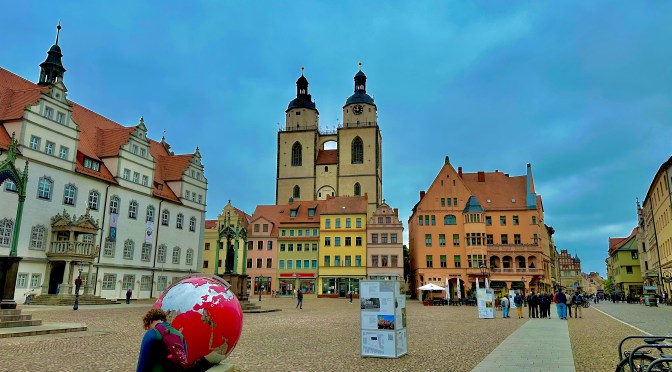
Photo: The town square and city hall in Wittenberg from where you can see the spires of St. Mary’s Church. Two Kingdoms side by side.
 The Millennial Pastor