Tag Archives: Sermon

Voices Piercing the Chaos – A Sermon for the Baptism of our Lord

GOSPEL: Luke 3:15-17, 21-22
As the people were filled with expectation, and all were questioning in their hearts concerning John, whether he might be the Messiah, 16John answered all of them by saying, “I baptize you with water; but one who is more powerful than I is coming; I am not worthy to untie the thong of his sandals. He will baptize you with the Holy Spirit and fire. 17His winnowing fork is in his hand, to clear his threshing floor and to gather the wheat into his granary; but the chaff he will burn with unquenchable fire.”
21Now when all the people were baptized, and when Jesus also had been baptized and was praying, the heaven was opened, 22and the Holy Spirit descended upon him in bodily form like a dove. And a voice came from heaven, “You are my Son, the Beloved; with you I am well pleased.”

Imagine with me for moment. That we are far away from the cold winter, and in a warmer place with more comfortable weather. We step down into knee deep water, a gentle stream rolling by. The water swirls around our feet. It is cool, and refreshing. The movement is gentle and easy. It feels good to be in the water. 

We have been floating down the river for a while now. Each year, we hop into the boat together and start the trip all over again in Advent. We float towards Christmas and through Epiphany. It is a journey that is familiar yet also new each time we take it. It is a Journey that begins with end times, that stops to hear John’s sermons and questions. Then it makes its way, with Mary and Joseph to the stable manger. We hear Simeon and Anna’s song of promise upon seeing the Messiah they waited a life time for. Then we see the magi follow the star to the child. 

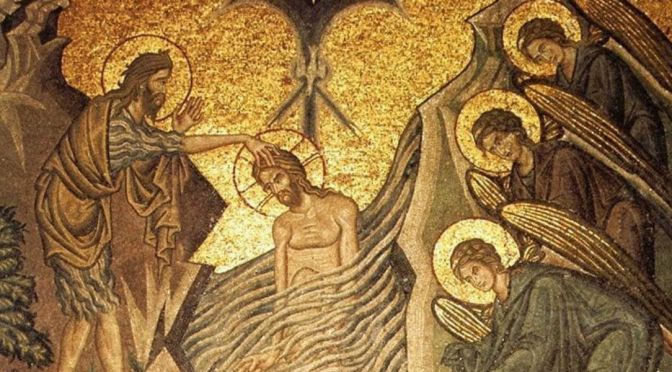
Today we pick up speed and fast forward 30 years, we float down the river Jordan where Jesus is baptized by John. Jesus’ baptism is an unusual story, an uncomfortable scene for Christians. Why does Jesus need to be baptized? For forgiveness of sins? Repentance? What does it say about John as he baptizes instead of being baptized? In many ways the story of Jesus’ baptism invites more questions as we hear it again. 

In Advent, we heard John’s preaching on the river bank. His stiff condemnation of the crowds and his warnings of the Messiah. This time, Jesus shows up at the end of the sermon. The spirit of God descends upon him and along with John, the crowds witness an incredible thing. 

But John and the crowds do not see what is going on. They are full of expectation. They are wondering if John is the one they are waiting for. They looking for a fixes to their problems, for hope and salvation. They are hoping for a powerful Messiah. A warrior who will end injustice and who will remove foreign powers from control in Israel, but Jesus is not those things. It is the beginning of the problems that John, the disciples, the crowds, the Pharisees, scribes and temple authorities will have with Jesus. Some will want an ally, some will want a powerful warlord, some will want Jesus to go away. But Jesus simply refuses to fit their categories. Jesus is going to show us God in ways that don’t see… that we can’t see… that we refuse to see. 

Remember the feeling of standing in the water, feeling the cool fresh flow around our legs? Well the further we float, the more the current picks up. The gentleness is replaced by force and weight. The water doesn’t smoothly pass by. It pushes and grabs, it pulls and drags. The cool gentle stream that cooled our feet now pulls us in and drag us along. The power of the river is more than we could have ever imagined. 

Like the crowds who gathered along the banks of the Jordan, we gather to wait also. We are waiting for the world to get better. But it doesn’t. We are full of expectation, searching for hope and promise, looking for fixes to problems and an end to struggles. 

As we hoped for a more normal Christmas, the pandemic kept rolling on. Plans were dashed and changed in a hurry. And then many became sick, maybe even friends and family sent those texts or made those phone calls, ‘I tested positive.” And worry and anxiety ensued,  It has all felt like a great setback. 

Our world hasn’t changed all that much since John and Jesus met in the river. Sure, we drive cars, live in heated houses and can talk to anyone on the other side of the planet instantly. But, we are no different than those crowds standing on the rive bank, full of expectation, wanting our world to be different, wanting our problems to disappear. 

The weight of all of this threatens to drown us in the inability to care any more. We hear the reports, read the news articles and it is too much to take, too much to grieve for. Not only is it hard to see what is going on as Jesus is baptized by John, it is hard to see where God is at all. 

Today, it might feel like the cool refreshing water of the river has pulled us in and dragged us under. The current is churning and spins us about. We bounce in all directions, sputtering for air, aimed over the cliff, over the waterfall. 

This is not what the river journey begun in Advent is supposed to be like. 

This is not what God is supposed to allow to happen in the world.

We are not supposed to drown in the waters of grief and apathy.

(Pause)

And a voice pierces the chaos.

“You are my beloved. With you I am well pleased”. 

Words of promise, words of hope. 

As John dunks Jesus down into and then brings him up out of the water, as breath and air flood back into empty lungs, God speaks. God speaks in a way that hasn’t been heard since the beginning of creation. God speaks and the world is transformed. 

We tumble over the waterfall, we plunge into the deep pool at the bottom. We are squeezed and crushed under the weight, we can’t tell which direction is up. Death under the waters seems imminent. 

And then all of a sudden, while we are tossed about in the churn, not knowing which direction is up or down, we pop up and out of the water. Air rushes back into our lungs. This is where God’s action begins. In drowning, in death. This is as strange a place as we can imagine God to be working. And yet, God speaks as Jesus comes out of the water “You are my beloved children and with you I am well pleased”. What a weird and wonderful God who can push us below the surface in order to make us His own. In order to give us new names as child of God, as Christian, as beloved. 

This is why John doesn’t know what is going on when Jesus asks to be baptized. This is why we cannot see God working in the world. It is too radical, too unbelievable. 

And yet, this is promise that was made to us in the waters of Baptism, and it is the promise that is renewed each day and remembered each time we witness another child being drowned AND raised in these waters of life. It is a promise made that in the place we lease expect it, in death God is showing us something new, something life filled, something surprising. Something that can come only from a God like ours. 

A God who comes into the world as baby born to a unwed teenage mother, 

a God who lives a poor carpenter in 1st century Israel, 

a God who died on a Roman cross as a common criminal, 

a God who was raised from the dead and who in turn calls us to be drowned and then raised, 

New life can only come from a God who does not act like we believe God should.

The radical God of water and Baptism comes to us in ways that are so unimaginable and so crazy, that we can hardly make them out. The journey that God is promises is not easy or gentle. The results of God’s work in the world is rarely what we imagine or hope for. Yet, as this unexpected God meets us in our world, and on our terms, we cannot help but be drawn in to this unexpected God whose story has become our story. Whose story we tell over and over again. 

As we float down the river of Advent and Christmas, as we pass by Jesus and John in the river, we see again and anew the marvel of God’s love for us. We see a God who not only pushes us below the water to die, but who pulls us out again so that we may rise into new life. And today, we hear a God who speaks through chaos

“You are my beloved Children. With you I am well pleased.”

Amen. 

Christmas Sermon: Christmas Eve at the Lake House – a St. David’s Story

The Gospel according to Luke, the 2nd chapter (2:1-7)

It was December 23rd. Marlena stared out the window at the passing scenery, as the van made its way down the highway. Next to her was her husband Jim. In the back of the van her kids Lizzie, 13 and David, 11. They were watching movies or listening to music or playing video games on their devices. In the middle of that van were family friends Miriam and Jesse, between them was an infant car seat and behind them their 4 year old had nodded off in his carseat. 

There was also a mountain of luggage, groceries and Christmas presents in the cargo area of the van. 

As they zipped down the highway, Marlena spied a very familiar motel. 

“Look Jim! Miriam! Jesse! There it is!”

It was 5 years ago that Marlena and her family had met Jesse and Miriam at a roadside motel in  a Christmas snow storm. 4 year old Christopher had been born on Christmas Eve. Marlena had helped Miriam through the birth while they waited for the ambulance to arrive. The rest of the guests had put together an impromptu Christmas dinner. It was quite the experience. 

Still, they had lost contact after that extraordinary time. But last Christmas, they found each other again, when Jim and and Marlena wound up delivering a Christmas hamper to Jesse and Miriam. After the two families reconnect, Jim gave Jesse a job at his food supplier business and the two families had grown close over the past year. 

Jesse and Miriam weren’t going to have any relatives over the Holidays, so Marlena insisted that they come along for Christmas at the lake house. 

Unlike the blizzard 5 years ago, this year as they drove down the highway, the skies were bright and sunny, the highways clear of ice and snow.

When they pulled up to the lake house, Marlena’s parents met the van in the driveway. The house was more like a large rustic bed and breakfast than small summer cabin. There were rooms for everyone and great room big enough to spread out in, with spacious kitchen and dinning.

Marlena’s parents quickly welcomed Jesse and Miriam, and began fawning over 4 year old Christopher and 1 year old Lilly. The whole crew unpacked the van and settled in to their Christmas abode. 

The next day, the kids played out in the snow, and the adults puttered around the house baking and cooking, wrapping presents, chopping firewood and taking many coffee breaks. Soon they would be ready for Christmas Eve Dinner and church. Marlena’s dad kept the kids entertained with all kinds of grandfatherly antics. Everyone seemed to be settling in for a cozy evening. 

As the sun began to set, the group grazed over a Christmas Eve buffet supper. Jim set up the projector from work and connected his phone, so that they could stream the Christmas Eve Service from St. David’s. Everyone found comfy spots on couches and easy chairs, the kids in Christmas PJs and wrapped in blankets. Jesse lit a roaring fire in the fireplace, and everyone had their own candle (or glow stick depending on age), for the service. 

The procession began at St. David’s. The sanctuary glowed with candles and Christmas garland, with tree lights and gathered congregation. The processional party looked like Angels floating down the aisle, carrying torches and candles. They joined in singing O Come all Ye Faithful with the congregation. After all they had been through in the past 2 years, it finally seemed like a normal, peaceful moment. 

Then all of a sudden the screen and all the lights in the house went dark. There was loud sound outside followed by something that looked like fireworks going off outside. Baby Lily started crying, Christopher rushed to his dad, Marlena’s mom gasped. 

Jim rushed to the front door. 

“The power poll down the street is sparking.” 

Jim and Jesse put on their boots and coats to go out and get a closer look. As they hurried down the road, the air was crisp, the night sky was dark with no clouds, and the snow crunched under their feet. 

They came upon the flashing lights of a power company truck, and they could hear a loud electrical buzz and something that sounded like whip. 

When the truck came into view, they saw the bucket lift was halfway down the ground, and a severed electrical line was sparking and whipping the road. And right in the middle of all was a man in an orange reflective jumpsuit, laying on the ground. 

As Jim stepped closer, he felt a hand on his shoulder.

“That’s a live wire. You need to stay back. Phone 911.” Jesse said seriously.

Jim pulled out his phone and dialled. 

As Jim connected to the 911 operator ,he saw Jesse dart past him into the ditch. Jesse was collecting dead wood and rocks. He found the biggest logs or rock he could carry, and took them over to the far side of the live wire. Began throwing on the back side of the wire to see if could pin it down. He slowly made his way down the wire, until he had most of it trapped like an angry snow snake. 

Then Jesse rushed over to the man laying on the ground. Jim could hear the man moaning. Jesse quickly but carefully checked for broken bones and then hauled the man off the ground and over his shoulder. He carried the power company worker over to Jim. 

Jim and Jesse then carried the man in the orange jump suit between them back to the house, assuring him that an ambulance was on the way. 

Once back at the house, they wrapped him in a blanket and gave him a chair to sit on. 

Jim waited outside and before long the familiar red flashing lights of an ambulance arrived. A couple of burly EMTs knocked on the door. 

One went to check the power company worker, the other one checked in with Jim. 

“Whoever went and covered that power line with logs and rocks was really stupid.” He said. 

“But also brave, because you probably saved this guy’s life,” he said gesturing to the worker. 

Then the EMT furrowed his brow. “Hold on a second, do I know you?” 

Jim looked the name tag on the EMT’s coat – John Shepherd. 

John looked around the house. 

“You are the people from the motel 5 years ago!” 

“And you were the one who made it through the blizzard to take Jesse and Miriam and baby Christopher to the hospital!” Jim said. 

The group greeted and welcomed John Shepherd, reminiscing about the miracle birth in the blizzard 5 years ago, and they all shared where they now. Christopher stood proud and tall, showing how much he had grown. 

“I don’t know if you folks should be together on Christmas anymore “John Shepherd joked. “This is twice that it has brought me trouble.”

They all laughed. 

Soon the EMTs were gone with the worker, and another power company truck was out restoring power. 

Jim grabbed his portable power bank, hooked up the projector and got the Christmas Eve service running again. The fire place kept them more than warm. They picked up with the usual Christmas Eve readings. 

“The people who walked in darkness have seen a great light.”

The listened to the Christmas story that began “In those days, a decree went out from Emperor Caesar Augustus” 

Father Angelo, the priest at St. David’s, reminded them that despite all they had been through in the past two years, that God was still sending light and hope into the world. The same Light and hope that came into the world in the Messiah, the baby born in a manger. 

Finally, it came time to light the candles for Silent Night. As the lights were dimmed in the church, the small flames of candle light began to spread and glow across the sanctuary. The group at the lake house also lit their candles. 

The congregation began singing Silent Night. 

As the families joined in, Miriam helped Christopher hold his candle. Lizzie and David sat with their grandparents, singing intently. Jesse held a sleeping Lily in his arms. 

Marlena and Jim were snuggled next to one another. Marlena leaned back to her husband. 

“Our Christmas night hasn’t been that silent, has it?” She whispered. 

Jim shook his head and smiled. “Something tells me that the first Christmas wasn’t all that silent either, with the manger stalls, travellers in the city, Shepherd from the field, angels singing in the heavens.”

“Maybe the bright lights and drama under the starry night, the unexpected Shepherds and miracles are more like the first Christmas than we really know.” Marlena mused. 

As the service neared its conclusion, Father Angelo gave the blessing:

“May the Christmas Star illuminate your path and show you the light.

May the Miracle Messiah, born this night, reveal God’s grace and mercy given for you. 

May the the incarnate love of God found in the Christ, move us to see the divine in our neighbour. 

And may the Father, Son and Holy Spirit, bless you on this Holy and Joyous night of the Angel’s song and forever more. 

Advent 4 Sermon – The Messiness of Advent

Luke 1:39-45(46-55)
In those days Mary set out and went with haste to a Judean town in the hill country, where she entered the house of Zechariah and greeted Elizabeth. When Elizabeth heard Mary’s greeting, the child leaped in her womb. And Elizabeth was filled with the Holy Spirit and exclaimed with a loud cry, “Blessed are you among women, and blessed is the fruit of your womb. And why has this happened to me, that the mother of my Lord comes to me? For as soon as I heard the sound of your greeting, the child in my womb leaped for joy. And blessed is she who believed that there would be a fulfillment of what was spoken to her by the Lord.”

We have come to the end of Advent. Advent has been rough this year. We have endured talk of the end times and John the Baptist’s fiery preaching from the river banks.

Finally today, on this last Sunday of Advent things start to sound a little more Christmasy. Elizabeth, a woman thought to be too old to conceive and barren, is pregnant with John. Mary, a virgin still only engaged to be married, is pregnant with the Messiah. 

Today’s story sounds beautiful and picturesque. It is easy for us to imagine two delightfully pregnant women greeting one another lovingly; a scene that makes us smile.

But we forget to consider the struggles these two women are facing. Elizabeth is older than a pregnant woman should be. She and Zechariah will be raising a child in their old age, more like grandparents who have unexpectedly found themselves raising children again. While Mary is a young unmarried teen girl, and her fiancé is not the father of her child. Joseph could call off the marriage off at best… maybe forcing Mary to a life of begging on streets, with a child to care for. At worst, both she and her unborn child could be stoned for adultery. For both women in their day, child birth was dangerous and all too often women would not survive the birth experience without some luck. There is probably more relief than joy while the women greet one another, as Mary has gone with haste to see her cousin, to avoid the judgement of her hometown family and friends.

The story of Mary and Elizabeth is not one of those Christmas movies. Rather it is story full of fear and danger, one that stands in contrast to the Christmas image we generally try to present. Mary and Elizabeth challenge the notion that we usually hold about Christmas: shopping, baking, decorating and hosting. Mary and Elizabeth introduce things we don’t want to talk about this time of year. Fear, danger, shame and uncertainty. 

(Pause)

Marlena’s mind was wandering, thinking about Christmas things. Father Angelo’s voice snapped her back to attention, “These two reveal to us the ways in which the spirit is pregnant with possibilities among us.” Marlena was sitting in the pews at St. David’s, listening to the sermon on the last Sunday before Christmas. 

With her was her husband Jim and to two kids, Lizzie and David. The world had been slowly finding a new equilibrium. Even with masks in church, showing their vaccine passports, sitting one household to a pew… simply being at church with other people was such an improvement over the year before. 

As she began scanning the congregation scattered throughout the amphitheatre style seating, she caught the eyes of a good friend Miriam. Miriam and her family had become quite close to Marlena’s family this past year. Miriam was holding a bouncing one year old girl in her lap while keeping a precocious 4 year old busy in the pew below her. 

Marlena smiled, though she knew that smiling happened mostly with the eyes while wearing a mask. Miriam seemed to be smiling back, but she couldn’t help but look tired. Marlena was too. They all were. 

(Pause)

The real story of Mary discovering that she is pregnant unravels and upsets our vision of the Christmas story. We don’t want Christmas to be like real life, it supposed to something different, or least that is what we hope to create. The perfect and ideal vision of the perfect family preparing for a new baby. This was supposed to be the Christmas that we have been desperately hoping for after our zoom Christmas last year. Yet, once again our plans are disrupted and real life will not come close to matching our expectations, our hopes and dreams. We easily imagine calm and peaceful expectant mothers, Mary and Elizabeth, as if they this is the way the planned to have children all along. 

Just as we imagine our own family gatherings, Christmas parties, and holidays traditions that we used know. But that is our version of Christmas. NOT necessarily God’s. 

God is telling a different story at this time of year. God is telling a real story, about real people. About people who have big problems, and no easy way out. It is about poverty, about unmarried parents, about unwanted babies, about couples too old to raise a child, about judgment and the threat of death. It is about tiresome pandemics, exhausted poeple, a longing for our trials tribulations to be over. And it is about how God’s people respond to fear and danger. 

(Pause)

After church Marlena and Miriam met in the in parking lot. The kids were playing on the windrows that surrounded the cars. Jim and Miriams’ husband Jesse were chatting about work. Marlena looked to her friend. 

“Have you heard from your family yet?:” Marlena asked. 

“They aren’t going to make it.”

“What about Jesse’s family?

“They can’t either.” Said Miriam. 

The two friends looked at each other. 

“Well, then it is settled.” Marlena declared. “You all will come us to the lakehouse.”

“I feel like we are imposing on your family Christmas, we have done that enough already.” Responded Miriam. 

“Nonsense. You are family. Christmas without you would hardly be Christmas.”

(Pause)

Sometimes the real world can get in the way of Christmas. While we try to create perfect memories with seemingly perfect families, God is discarding the rules about pregnancy before marriage in order to send us a messiah. As we stress and worry and prepare for the perfect Christmas, God is sending divine messengers to an old woman and unwed teen mom living in poverty.

God does not wait for the everything to be perfect or to fall into place in order to begin the work of the incarnation. God does not come only when it is safe and there is nothing to fear. God’s activity of taking on our flesh and becoming like us starts now. God comes to us, whether we want God to or not. 

Mary’s and Elizabeth’s real life shoves aside our idyllic nativity scenes, visions of perfect Christmases. Mary and Elizabeth show us a real story about real people. A story about shame, and danger and betrayal. But also a story about mercy, and compassion and grace.

(pause)

Miriam looked at her friend Marlena. 

“Why do you keep taking care of us?” Miriam asked. “Aren’t you tired of us yet? Aren’t we more work than we are worth?”

Marlena laughed. “Ridiculous. We aren’t the ones stuck with you, you are the ones stuck with us. Ever since that roadside motel, when I got to hold newborn Christopher in my arms, when I see the way my kids and Jim come alive with you all. Your family is special to us. I see hope and joy and promise when we are together.”

Miriam sighed. “The spirit pregnant with possibilities, just like Father Angelo said, I guess.” 

The two friends smiled and laughed, and this time they could see each others’ faces. 

(pause)

For when Mary gets past the shame of pregnancy before marriage, when she get spast the fear of death for adultery, she with her husband to be Joseph, with her elderly cousins Elizabeth and Zechariah, they all become guardians of God’s promise, bearers of the Good News made flesh. 

And it is the same for us, when our fears and worries get out in the way, when we can’t see what God is up to. God comes anyways.  And God bears grace and mercy for the world in us. God makes us the messengers of the Good News of God’s love and compassion for all. God sends Messiah to frightened world.  

And because of what God is doing, with Mary, we can sing:

“My soul magnifies the Lord,

and my spirit rejoices in God my Savior,

for he has looked with favor on the lowliness of his servant.”

Preparing for Messiah is not fun…

GOSPEL: Luke 3:1-6
….the word of God came to John son of Zechariah in the wilderness. 3He went into all the region around the Jordan, proclaiming a baptism of repentance for the forgiveness of sins, 4as it is written in the book of the words of the prophet Isaiah, 
“The voice of one crying out in the wilderness:
‘Prepare the way of the Lord,
make his paths straight.

Some of the moments that stick out the most from my childhood were the boredom and impatience of getting ready for a special day or event. Whether it was putting on fancy and uncomfortable church clothes, packing for family vacation, cleaning the house when company was on the way over… these were all moments when the world became painfully slow and uninteresting, with lots of wondering why we we had to do this thing in the first place. 

Now as an adult and parent myself… I see the stress and pain from the other side. Frantic clean-ups as those anticipated guests arrived a little too early. Getting kids dressed, packed and out the door taking all the willpower in my body. And packing for holidays begins with mental checklists long before a suitcase is pulled out from the back of the closet. 

Getting ready. Waiting to be ready. Living in that liminal time, that in-between time of anticipation is hard, no matter how we experience it. 

Today is the second week of Advent, the Sunday that always introduces us to John the Baptist and his message preached in the wilderness. His message of preparation and getting ready for what is coming next. 

It is probably not too difficult to recall our own moments of board waiting or frantic making ready for that anticipated and special moment. 

But for the people of Israel, the people listening to John’s message, their anticipating was more than boredom or frantic last minute chores. 

John’s audience was a desperate one. They were a people waiting for something different, people looking for hope. They were living under oppression by a powerful foreign empire in the Romans. They were people taxed to the gills by every level of government, often by corrupt tax collectors also skimming off the top for themselves. They were constricted by a religious system that demanded a kind of expensive and burdensome faithfulness that few could afford, and therefore salvation and mercy were just out of reach. 

And there was no escaping any of it. No United Nations refugee programs or social media resistance movements. There were no relatives waiting to welcome them in prosperous nations on the other side of oceans, no kind church groups wanting to sponsor new lives elsewhere.  There was virtually no hope for a better life found anywhere, not even in risky options like fleeing their homeland for a the chance of a better life in a new land. 

The people coming to hear John were desperate for some kind of hope, something at all. And so they flocked out into the wilderness to hear the wild prophet, to hear about this coming Messiah that John was preaching about, to have something to hold onto in the midst of their struggle and hardship filled world. 

John’s words weren’t exactly good news in and of themselves. There wasn’t mention of God’s love, there wasn’t a kingdom coming near, there wasn’t the welcome of the Heavenly Father. But John was talking about something important. 

Our world is desperate to hold on too these days. In the Advents of the before time, letting in those thoughts that reminded us that there is still suffering in the world somewhere, was an interruption to our Holiday Season making ready. But these past two years we have been experiencing a desperation much more similar to the people of 1st century Israel. 

Even this week, as the world seemed to be inching towards equilibrium and finding its way to something new, this seemingly never ending crisis hit us again with Omicron. Travel bans and increased restrictions immediately followed. Booster shots for privileged nations that can afford them and fewer vaccines for peoples that cannot. And of course volatile stock market reactions ensued. Not to mention the devastating floods that have book ended our country, forcing people to flee their homes and livelihoods, stranding several and even causing the loss of life. Restoring roads, rebuilding bridges and homes, re-creating supply chains are reminders that this world has changed under our feet. 

We arrive at this second Sunday of Advent desperate for good news, wanting something to hold onto, seeking out hope. 

With John it is easy to get focused on the preparing, the slow waiting for the new thing to arrive or the frantic activity of making ready for a world struck by change. The realization that there is no escape, no leaving these crises behind, no waiting for the news cycle to move on or burying our heads in the sand to pretend it isn’t happening. 

The people of first century Israel were constantly reminded of the things that made their lives a struggle: the Roman coins in their pockets, the tax collectors on every street corner, and the religious laws that governed nearly every aspect of life.  

And we are constantly reminded of the things that are making our lives a struggle: the masks in our pockets, and the news alerts on our phones, and the careful consideration needed to navigate every sojourn outside of our homes,. 

John declares that the paths will be made straight, the valleys filled in, the mountains levelled, rough ways made smooth which sound like fixes to problems… yet these things are not quite the good news because John implores us to do the work. Prepare the way of the Lord, he says.

John isn’t describing the good news, but rather pointing to it. 

Or pointing to the one who will bring the good news. 

Like a frantic parent stressed about cleaning the house for company and getting angry at toys still left on the floor… John is focused on the moment of preparation. Something that we can be guilty of too… holding on to the preparations that are before hope and salvation. 

But still John points, John makes ready, John precedes the one that we truly need. 

It isn’t John’s words that are central, but who John is and what John is doing. The people of Israel don’t hear the hope of Messiah, but see it when they come out to John. They are reminded of the song that John’s father, Zechariah, a priest of the temple, sang after John’s birth. They see another miracle child promised by God, they see one called by the most high to herald the Messiah, the see a prophet who presence in and of itself is a sign of Messiah’s imminent arrival… like a servant announcing the arrival of royal, seeing John means that Messiah is right around the corner. 

John’s presence means Messiah is close. 

Our desperation wants to know what the fixes to our problems will look like, but John points to the one who will do the fixing. 

And the promised Messiah… well, it is not John but Zechariah who tells us what Messiah is going to. As Zechariah looked at his newborn son John, he sang the song we sung this morning, he sang of God’s promised Messiah: 

Messiah will save God’s people. 

Messiah will save us from our enemies. 

Messiah will show mercy. 

Messiah will free us and make us God’s children. 

And it is this Messiah that John will be a herald of. 

John the Baptist’s message for us is not about how our problems will be fixed, John isn’t the one who knows God’s plans for God’s people. But John points us to the one who does. John helps us to make ourselves ready, but it is Messiah who brings good news to our desperate world. 

And John’s strange and curious desert preaching announces for us the imminence of Messiah here too. As we seek something or someone to give us hope, Messiah comes to us again. 

Again in the gathering of God’s people, 

in siblings in faith sitting next to one another in the pew, 

commenting next to one another in the comment section. 

Messiah comes in the waters of new life that we are washed with, 

in the confessions of hearts, 

in the words of forgiveness and mercy that we hear, 

in absolution and blessing that we receive.

Messiah comes in the bread and the wine, 

in the body and blood of Christ that we share. 

The body of Christ we receive transforms us into the Body of Christ to which we belong. 

Messiah comes in the Word of promise, 

the Advent word that tells the story of God’s coming into our world, 

in the prophetic word spoken by a wildness preacher long ago. 

For people desperately waiting for the good news to arrive, today, we receive a sign that Messiah is around the corner. John the Baptist telling to us to “Prepare!” means that Messiah is nearly here. 

And on this 2nd Sunday of Advent,  as we seek salvation in our struggling and suffering world, seeing and hearing John the Baptist again is the sign we need,

to know that our salvation is on the way. 

“See, I am making all things news” – a Sermon for All Saints

John 11:32-44
When Mary came where Jesus was and saw him, she knelt at his feet and said to him, “Lord, if you had been here, my brother would not have died.” When Jesus saw her weeping, and the Jews who came with her also weeping, he was greatly disturbed in spirit and deeply moved. He said, “Where have you laid him?” They said to him, “Lord, come and see.” Jesus began to weep. So the Jews said, “See how he loved him!” But some of them said, “Could not he who opened the eyes of the blind man have kept this man from dying?”

At our house, we are still working on our haul of Halloween Candy. Even as the stores switch from the Halloween decorations and music of October,  to the Christmas displays of November (?). The costumed masses or few, depending on where you live, that roamed the streets last Sunday have been lingering this week. Modern trick or treating has a lot to do with the practice of medieval Christians making pilgrimage for All Saints. Dressing up, lighting candles, journeying on the road was all part of the belief that spirits would often wander the earth until All Saints Day, and the costumes would be to scare away vengeful haunting spirits, and the candles, often lit in each room in a house or door way that would guide good spirits home. 

As the end of the middle ages saw the Reformation, our forebears sought to reshape the feast of All Saints. Rather than praying to the Saints on November 1st and then praying for all souls still in purgatory on All Souls Day November 2nd, Lutherans and other protestants have mashed the two together, recognizing that saints are not special or holy people. But that all those who have died in faith are made Saints by God’s Holiness poured out for us. 

On All Saints Sunday, we gather to pray in thanksgiving for those who have gone before us in faith, and we pray to God that we too may join the saints and heavenly hosts in the always ongoing great high feast. We recognize today, that our worship is not something that we create, but rather something we are invited to join with the heavenly hosts. We are like thirsty pilgrims who approach the always flowing river of heavenly worship and we wade into the water again and again, week after week, briefly pulling back the veil between heaven and earth until one day we too will be swept up into the great worship of all the saints and we too will join the heavenly hosts.

And yet today is not all sweet visions of heavenly worship and dreams of joining those beloved saints who have gone before us. 

Today, we also face the reality death. Like Jesus on the road to Bethany, we are confronted with the real, messy, emotional and overpowering experience of grief. This year, perhaps more than most years, our experience with death and grieving has been more complicated. Perhaps our spirits are disturbed like Jesus’ is. Maybe we are churning and twisting deep in our beings with Mary. Maybe we are like Martha and the crowds, still reconciling and trying to make sense of all that happened over the course of the past year, over the course of the past 20 months. 

As Jesus makes his way to Bethany to mourn the death of his friend Lazarus, we are not meant to see a doctor calling a time of death, nor a pastor leading prayers at a funeral, nor a funeral director guiding a grieving family through grief. Jesus is going to Bethany as a friend, a brother to Lazarus, family to Mary and Martha. 

On this grieving journey to Bethany, Jesus meets a desperate Mary. “Lord, if you have been here my brother would not have died” she pleads. And Jesus is disturbed, Jesus is moved. The greek points to a deep churning passion, even anger within Jesus. He doesn’t just recognize and acknowledge the grief in the Mary like a therapist would. But Jesus feels it too, but Jesus loves Mary, Martha and Lazarus. Even knowing what he is about to do, Jesus feels the depths of grief too. 

The kind of grief that we all know. The kind of grief that always comes with death. And yet even  that difficult yet predictable and known experiment of grief has been altered this year. 

Funerals delayed, grieving done in insolation and from afar. Private gravesides, zoom funerals, or even simply nothing to help us navigate the strangeness of our grief. Like everything else in our world, this Pandemic has fundamentally changed the way we experience the death of loved ones and death within our community.

In the before time, we knew how to attend to those last things. We knew the rituals around death. We knew how to make the phone calls, send the cards, leave the casseroles on doorsteps. We knew to read the obituaries, to show up 45 minutes early to a funeral to make sure we get a seat, how to appropriate greet a grieving friend at a funeral lunch. 

But those rituals have been taken away, but our grief for those who have died has not. 

The grief that Jesus feels today is the same personal, raw, churning grief that we know in our lives. And while grief makes death feels so personal and lonely, death is also transcendent, cosmic, universal. It is found on the road between two friends grieving a dead brother and it also the great darkness hanging over all creation:

See, the house of God is far from mortals

Death hovers over them as their master;

they will all suffer the same fate

and death will spare not one;

Life will be no more;

there is nothing but mourning and crying and pain,

for the first things reign over all. 

This is the old heaven and the old earth, this is what All Saints pilgrims carried with them on their journey, this is the personal grief that we bring today for loved ones. 

This is death. 

This is death, and Jesus stands in front of the tomb, tears running down his face and defiantly says, “Take away the stone.”

And grief, personal and cosmic says, “But Lord there will be a stench” because death is too strong, too powerful, too overwhelming. 

Except for God. 

Except for the God who created something from nothing. 

Except for the God who is creating a new heaven and a new earth. 

And out walks a dead man, out walks Lazarus alive again.

The very last thing that Mary or Martha expects is to see their brother alive. Grief cannot imagine that there is an answer to death. That is why Jesus meets Mary and Martha in their grief. That is why God’s spirit churns with anger, that is why God grieves with us on the road to the tomb, that is why God, even knowing that the stone is about to be rolled away, weeps along with us. 

And there walking out of the tomb, the personal and cosmic realities of death collide into the personal and cosmic promises of God. The reality of stinking rotting dead flesh that we know too well suddenly smashes into the loving, heart-pounding, passionate love of God for all creation. 

As Jesus stands at the tomb, calling for the stone to be rolled away, beckoning forth a beloved brother and friend, Mary and Martha finally see the the reality of Jesus’ promise, of dreams and visions of Revelation made tangible:

“See, the home of God is among mortals.

He will dwell with them as their God;

they will be his peoples,

and God himself will be with them;

he will wipe every tear from their eyes.

Death will be no more;

mourning and crying and pain will be no more,

for the first things have passed away.”

And the one who was seated on the throne said, “See, I am making all things new.”

Our All Saints pilgrimage this morning is the same mixture of personal and transcendent grief. We acknowledge that death comes for our loved ones and us, death comes for all.

But with Mary, Martha and Lazarus, we discover that in our grief, God in Christ meets us on the road. God in Christ churns with anger and grief, with sorrow and sadness weeping with us just as if death had the last word. 

Yet, Jesus has also come to meet us with that great Revelation promise, 

“See, I am making all things new.”

As Jesus stands there, tears running down his face, disturbed in spirit… He commands the stones be rolled away from all of our tombs. Jesus enacts the cosmic and transcendent promise of resurrection, Jesus declares that God has come to live with mortals. Jesus declares that death is not the end for those whose names we will read today, not the end for those whom light candles for… Jesus declares that death is not the end because,

“See, I am making all things new.”

As we gather on All Saints, with hearts full of both grief and thanks, of joy and sorrow, we discover a God who is deeply and powerfully and intimately involved in the affairs of mortals, who sheds real tears for Mary, Martha and Lazarus out of love.

We discover a God who cannot help but love us. A God who cannot help but love us in our grief and a God who cannot  help but make all things new in our world.

Today on All Saints we confront grief and death, we confront the personal and cosmic and we make pilgrimage to tombs and grace, sealed shut forever.  But then we see a passionate and loving God, weeping with us AND calling us out of our graves into new life.  And all of a sudden, those great promises of resurrection, those promises of a new heaven and a new earth collide with us. 

They collide with us when the creator of all things stands before us and our stones of grief and says to us, 

“See, I am making all things new – including you”

  • Header Image – Public Domain