Tag Archives: minsitry

Being Threatened by Jesus

Luke 13:31-35

King Herod was not a well liked King.

He was a puppet King for the Romans… who probably didn’t really care about who was King over the backwater province of the empire, Judea. The people of Israel didn’t care for Herod, knowing that he was all about power. But like most people in power, Herod made the right allegiances. With Rome and with the religious authorities.

So when the Pharisees come to Jesus with a Message, he knows they too are puppet authorities, doing the puppet King’s dirty work in order to hold on to their own power and privilege.

Today, on the second Sunday of Lent we continue with Jesus who can’t help but be confronted by people who think they have power. Last week it was the Devil tempting Jesus to misuse the power of incarnation, the power that comes along with being God, and being God in flesh. The Devil’s temptations set the stage for the recurring theme that Luke’s gospel holds up for us this Lenten season. The Devil tries to offer Jesus power. And now the Pharisees come to Jesus with a warning. They sound sympathetic, maybe even concerned for Jesus. Herod is out to get you, they warn. And it just so happens that getting rid of Jesus might also be convenient for them too.

Herod, the unpopular King and the righteous yet conspiring Pharisees, are concerned about their power. They are concerned about Jesus’s impact on their power and privilege. They have worked to build alliances, with their unpalatable overlord Romans, and with each other. Their power is tenuously held and only maintained by fear and division. With soldiers who intimidate, with control over money, over the temple, over the city of Jerusalem.

Yet, no matter their work to maintain their power, they cannot gain the confidence and support of the people. Yet, Jesus who doesn’t seem to be looking for any power, is wandering the countryside, living off the generosity of others. Jesus is popular and therefore powerful in the eyes of Herod and the Pharisees. And while he hasn’t made a play for their power yer, they know it will come. And so they conspire. They will frighten Jesus off. Just as they frighten the people with soldiers or unrighteousness. They only see Jesus as a threat who must be dealt with.

Power in our time looks much different. It is not so much based in the ability to control God’s forgiveness like the Pharisees did, nor is it based in political allegiances with foreign occupiers. Politicians and corporations don’t rule over us, but pander to us. The days of religion holding damnation and judgement over the head of society may be recent enough to remember, but fewer and fewer people seem to care. And even those of us who who still do participate in organized religion, probably feel like religious leaders have little power to dictate the terms of our salvation.

Yet, there is something we do hold in common with Herod and the Pharisees.

Feeling threatened by Jesus.

There is a something inside of all of us that gets anxious and concerned when Jesus starts talking about what God wants for us. For those who have been coming to adult study, you will recognize the language of the tangled, twisted thing inside of us. That thought in the back our minds, that feeling that makes our blood pressure rise. It is the thing inside of us that makes us fearful of our different skinned neighbours. It it the thing that makes us resentful of the poorest and most vulnerable in our communities for being dependant on government welfare. It is the thing that inside of us that closes us off to people who think differently than we do. The twisted tangled thing makes us want to hoard more and more for ourself, makes us fear difference, makes us angry when we think we haven’t received our fair share.

The twisted, tangled thing is what Martin Luther called the Old Adam, the Old Sinner.

It is sin.

And the sinner inside of us bristles when Jesus starts talking about the first being last, and losing our lives to save them. The sinner doesn’t like the idea that God’s forgiveness isn’t earned, but instead given away freely.

The twisted tangled sinner is the part of us that thinks power will save us. That controlling the world around us will keep us from being hurt. That protecting ourselves from anyone different from us is the way to be safe.

And when Jesus starts talking about giving up power, the old sinner feels threatened. And when Jesus starts talking about prophets being stoned and hinting at crucifixion, the old sinner will have none of it. Like the Devil who thought power was the purpose last week, the old sinner thinks power is our salvation.

The pharisees warn Jesus that Herod is willing to kill Jesus for the sake of power.

Herod is worried that his power could be taken by the popular preacher Jesus.

How wrong can Herod and the Pharisees be?

How completely off the mark can the twisted, tangled sinner inside of us get?

Jesus has come in weakness, not power.

Jesus has come to be open, not closed off.

Jesus has come to be vulnerable, not fearful.

Jesus has come to show love.

Love that will change us.

Love that will undo the twisted, tangled thing inside of us.

Love that risks being hurt, being unsafe, being weak in order to come close and near. Love that gathers and holds us together under its wings.

Love that couldn’t care less for power.

Herod and the Pharisees don’t live in a world of love. They don’t know how to let go of the little power that they have. They can’t see that Jesus hasn’t come for power, they cannot see how Jesus is trying to show God’s love to the world.

And Jesus knows this. Jesus knows that the same crowds will chant “Blessed is He who comes in the same of the Lord” on Sunday, will shout crucify by Friday because they want a King of power, not a King of love.

Jesus knows that the Pharisees who are warning him to get away will cry to Pilate to do their dirty work.

Jesus knows that the King Herod will defer to the power of Rome to finally rid his Kingdom of this popular preacher.

Jesus knows that their desire for power will lead to death.

It is the way of the Old Sinner.

Herod and the Pharisees don’t know that Jesus is willingness to die for the sake of love, will save the world.

But we do.

And still this Jesus who saves the world, who endures our greatest power of death to show love, still threatens us.

Because the old sinner within us who pushes us to fear, to resent, to be closed off, to hoard and to control… this old sinner, this twisted and tangled thing knows that the love of Jesus will change us. That love will untwist and untangle. That love will forgive and show grace.

And Jesus knows that love makes us anxious, that old sinner, the twisted and tangled thing doesn’t want to be loved. Jesus knows that loving us will transform us. Jesus knows that loving us will make us care less about ourselves and more about others. Jesus knows that love will make us less afraid, less closed off, hoard less, control less, worry less. Jesus knows love will makes us let go of power…

Herod wasn’t a well-liked King and the Pharisees weren’t well-liked religious rulers. We are people threatened by love.

And Jesus isn’t either of these things either. Not puppet King, nor religious overlord, nor symbol of power and influence.

Jesus is a mother hen with nothing but love to give. Love for sinners who feel threatened. Love for tangled and twisted people who get anxious.

And just like stubborn chicks who need their mother hen, Jesus love will gather and change us too.


*Thanks to Nadia Bolz-Weber for the “twisted-tangled” language for sin
Annual Meeting Season: What church budgets say about ministry (It’s not good.)

As we begin the new year, most churches are entering Annual Meeting season. Budgets will be proposed and approved. Reports on how the past year’s ministry has gone will be presented. Plans for the year will be laid out.

For a lot of church people, annual meetings are a necessary evil. Boring meetings about boring things. But annual meetings have a significant effect on ministry. If you really want to know what a congregation values, look at the budget. If you want to know what a denomination focuses on, look at the budget.

Churches might put things like “All are Welcome” on signs, but have nothing in the budget for hospitality ministry.

Churches might have mission statements about growing in faith or serving the poor, but have no budget lines for educational resources or funds directed to outreach.

While what churches have failed to budget for or invest in is interesting, what they do put their time, energy and money towards is even more interesting. And so often churches invest in things that simply make no sense and make one wonder what is actually trying to be accomplished. In fact, churches often invest in or put their resources into ventures that have little chance of yielding fruit. 

Let me explain with some examples:

Lutherans in Canada have been primarily rural during our history. Most of our congregations are in rural communities. This made sense as it has been only in the past decade or so that the shift in Canadian society has been from a majority rural to majority urban population.

Generally urban congregations tend to be larger with more resources. Rural congregations tend to be smaller with fewer resources. So seeing struggling rural congregations, church leadership tends to invest in places where the church is struggling. Our seminary has developed an entire institute devoted to rural ministry offering a Doctor of Ministry degree in rural ministry. Multi-point and regional parish ministry is being explored and developed to help a few pastors serve many congregations in a team setting. Rural congregations are often given travel subsidies for church events. Skype and other video conferencing technology is being used to include rural folk.

This is all good and rural congregations deserve good ministry.

Yet, all our efforts are fighting against the demographic realities of shrinking rural communities. There are fewer and fewer people to minister to in rural contexts. We are putting disproportionate resources towards smaller groups of people.

At the same time, because urban congregations are perceived as large and self-sufficient, we leave them be. Yet, they are shrinking too and it is not related to demographics. In fact, there are more people than ever who have no church affiliation living down the street, within blocks, driving by urban churches every day. Shrinking urban churches are the result of changing culture, mission-drift, a lack of evangelism and failed education systems in churches. 

Yet, there is little energy, time, resources or even concern going into helping urban churches understand the people that live next door to them.

Many urban churches are now at a place where they simply cannot communicate or connect with 21st century culture. This isn’t about phones and projector screens in church, but about understanding that most people 70 and under engage community differently – through smart phones and social media. People understand their real life world through an online lens, from scheduling birthday parties, to finding restaurants to eat at, to getting their news, to listening to music or watching TV etc…

And another example:

Churches will bend over backwards to keep nearly comatose Sunday School programs alive. They will long for the youth to come and “get involved.” They want young adults to “come back” to church in order to get take up the jobs that older people want to give up. Precious volunteer energy and resources are spent on doomed to disappoint ministries. Yet, the things that they are asking of kids (to attend regular faith education programs) and youth (to fill most leadership roles in worship), adults are mostly unwilling to do themselves. They expect young people to want to do things that older people want to stop doing… it makes no sense.

But perhaps more importantly, we have hit another demographic tipping point where there are more over 50-year-olds in Canada than under 50-year-olds. That means at best, a church can hope for 1 family of 4 for every 2 empty nest couples in church. If you have 30 couples over 50 in church, you will only have about 15 families. Of course it will seem like the young people aren’t around… but that is because they don’t exist.

Churches long for young adults and young families thinking that they will have the time, energy and money to keep congregations going. Yet increasingly, young adults and young families are under-employed, highly indebted people with precious discretionary time on their hands and who are trying to make it through a high cost time of their lives.

Yet the Baby Boomers, the richest generation in history, are reaching the end of their careers. The largest group of retired people ever is about to have loads of time and money on their hands. Why don’t we have Sunday School for them? Retiree workers instead of youth workers? Why don’t we want 65-year-olds putting on an alb and lighting the candles in worship?

Many churches spend a lot of angst on young people, who (demographically speaking) don’t even exist. But the people who do exist, a glut of boomers, are largely ignored. 

Why do congregations, church bodies and leaders so often see their hope and future in unrealistic visions of church? Why do we invest in ministries and activities that have little chance of yielding fruit for us?

I don’t know if there is one answer. I think it has to do with fear of disappointing those led us into faith in the first place by doing things differently than they did. It has to do with longing for a return to the glory days of the past. It has to do with a fear of change, and our world is full of change these days.

Now, I wish this was the part of the blog post where I explained the magic bullet to turning this poor investment strategy, this poor ministry culture around. But I don’t know the answer.

Well, let me rephrase. I do know the answer… and so do you.

But the answer is hard work.

Churches need to look around ask what faithful ministry looks like in their context. Find out who our neighbours are. Find out what the needs of our communities are. Ask what opportunities is God putting before us. Discern who God is calling us to serve. Be willing to let go our expectations and vision for ourselves, and ask who God is calling us to be.

Strive to be faithful in our investments and ministry planning rather than successful. 

This Annual Meeting season instead of seeing long boring meetings about boring reports and boring talks, consider it an opportunity to discover where God is leading our congregations and communities.

Who knew Annual Meetings could be that?


What does your church invest in? How can you see where your priorities are? Do you love Annual Meetings? Share in the comments, or on the Facebook Page: The Millennial Pastor or on Twitter: @ParkerErik

Sheep Without a Shepherd

Mark 6:30-34, 53-56

As he went ashore, he saw a great crowd; and he had compassion for them, because they were like sheep without a shepherd; and he began to teach them many things.(Read the whole passage here)

The crowds are unavoidable today. Throughout the gospel of Mark, Jesus has been growing in popularity with the common people, the crowds. Jesus has debated and argued with the pharisees about the undivided house, he has surprised and terrified the disciples by calming the storm, he has broken down barriers by healing both rich and powerful Jairus’s daughter and the poor outcast woman who had been bleeding for 12 years. But today, it is the crowds who finally get what they want — and they want Jesus.

The crowds are too much. They are chaotic and unrelenting. They are grabbing at Jesus and his disciples. They want more and more and more. There is almost too much to do, too many sick people to heal, too many exorcisms to perform, too many needs and too little time.

The crowds are clamouring for healing… they are demanding something from an exhausted Jesus and his disciples. The disciples have just returned from the mission that Jesus sent them on two weeks ago. They are excited with stories of exorcisms and healing, but they are also tired. And they have gotten into the boat with Jesus to find a quiet place. Yet, the crowds still follow them along the shore.

The crowds have one thing in mind. Miracles.

They are looking for a miracle from Jesus, as if he was a heavenly vending machine.

The vending machine God in the sky is an image for God that still persists today. In TV and movies, people turn to God when they need something. They offer up desperate prayers like quarters being dropped in a slot. Prayers prefaced by some admittance like, “If you are out there God, I don’t pray much, but I really need something now, so if you can just…” (fill in the blank).

This is certainly a prevailing image of God in today’s world. And while as people of faith, we would like to think we are beyond such simplistic and self-centred approaches to God… we can get narrowly focused on God too.

We can get bogged down by our need for healing, for an end to our suffering, for a fix for our brokenness. Our prayers can become self-centred and our relationship with God can become focused on relief and release from our problems. We look to God as individuals and as communities as the great band-aid dispenser in the sky.

As the crowds are desperate for Jesus today, Mark tells us that Jesus has compassion for them.

Compassion.

A word that evokes images of kindness and tender heartedness.

Compassion.

A word that is more then gentleness and caring, but that truly means to suffer with.

Jesus has compassion for them. But not for their woes and hurts and pains. It isn’t their blindness, or lameness, or sickness that moved Jesus.

Jesus has compassion for them, because they are like sheep without a shepherd.

And his response is to teach them many things.

To teach them that same message he has been preaching since first few verses of Mark’s Gospel. The oldest words that we know of that are attributed to Jesus:

The Kingdom of God is near to you. Be transformed in heart and mind and believe.

Jesus does not respond in the way the crowds were hoping. And Jesus doesn’t respond to our cries for healing in the way we hope either.

Instead, Jesus sees our individual sufferings and needs as part of a larger problem. Jesus sees how we are all weighed down by sin and death. How the blindness of one is the same as the lameness of the other. And there simply isn’t enough to heal each one. And healing in itself isn’t enough. Even the ones healed by Jesus are dead now.

Jesus’s compassion for us does not exclude a concern for our pain and suffering… but it is rooted in the fact that we are lost. We are shepherd-less. We need so much more than to be healed.

As Jesus sees the crowds pressing in on him, as tired as he is, he has compassion on them. They are like sheep without a shepherd.

They are focused on coming to God with our specific expectations. Their specific demands. Their need to be healed. Their need to be helped. Their desire to be fixed.

They can’t see Jesus beyond their problems.

And some days we can’t see Jesus beyond our problems. We aren’t just like the crowds. We are the crowds pressing in. We need a shepherd… and Jesus has compassion for us.

And that means Jesus has come to give us what we need and not what we want.

And what we need is a Shepherd who will gather us together. What we need us someone to teach us, to tell us of the Good News of God coming into our world. What we need is the intimacy and love of community. We don’t need our suffering to be taken away… because we know that it can never fully taken away. What we need is to know that we are not alone, that our suffering is shared.

And that is what Jesus’s compassion is all about. It is not a magical cure for our problems, it is a not a televangelist bopping us on the head proclaiming that we are healed.

God’s compassion is the word that cuts through our loneliness to join us to community.

God’s compassion is the water of baptism that washes, cleans and clothes us with Christ. The water that gives us new life, new life found in the community of sheep who also bear the scars and healed over wounds of life.

God’s compassion is the bread and wine of life, the meal that nourishes us for the Kingdom. The food that can only be shared in community, that is served at the Shepherd’s table for hungry sheep.

God’s compassion for the crowds and for us, even as we press in on a tired Jesus, is about reminding us that the Good News is that we are loved. That we are forgiven, reconciled, and made whole in the One Body of Christ.

As we press in on a tired Jesus today, God’s compassion means that we are no longer sheep without a Shepherd.

Amen.

Praise Bands are the New Medieval Priests

You don’t have to spend much time in a mainline congregation to overhear someone bemoaning our traditional worship and pointing to those huge evangelical churches that get all the kids to come because of their hip and cool worship. When we see Praise Bands, a lot of us get a little church envy. Over the past few months, I have had the opportunity to be around Praise Bands and Evangelical style worship, which leads me to a secret about Mainliners: we all get a little envious of mega church praise and worship.

That being said, my experience with Praise Bands has become increasingly one of alienation. I just can’t access Praise music anymore, I don’t hear Praise songs as the music of worship. I find myself wondering why I am just standing there, in the midst of a group of people who are also not singing. As the Praise band performs song after song, I am consistently lost as to how the music goes, what verses will come next, how to follow the melody, when to start and stop singing, or when a random guitar solo will be thrown in right when I thought I had figured out when the next verse starts. Even some Praise Bands folks recognize themselves just how alienating their shtick can be:

My alienation with Praise music isn’t because I am not musical or don’t know what is going on in worship. I am a pastor after all, I have been in worship LOTS. I play a number of instruments. I had played in music ensembles, secular and church, I have even played in Praise Bands. I can sing well enough to chant, most melodies are easy enough to pick up and I prefer singing parts from sheet music.

So if I am standing there feeling alienated by Praise music because I can’t follow along, what about most other people? What about those who didn’t spend a significant portion of their childhood being musically educated and playing music in church?

Lots of Praise Bands are full of talented musicians. They often perform very well, better than some professional artists who mostly lip sync. Some of the Praise Bands I have heard could easily be found in local bars or pubs playing for young adult hipsters and no one would bat an eyelash.

Most recently, as I stood listening to a Praise band overwhelm my senses with their loud music (crap… I sound old), the lead singer’s beautiful interpretations of song melodies, and the random guitar solos, I looked around at the people in the pews with me. Most were just standing there too, not singing, not really being a part of the music at all. We are all just bystanders to the moment, we were being played at, rather than played with.

As a Lutheran, I am rooted in a tradition that advocates for the role of folks in the pews. In Medieval worship, the people had become unnecessary for worship. The priests spoke Latin, and the people didn’t. The priests had stuff to say and pray, the people just stood there. The priests often faced away from the people to the altar, ignoring the people. The priests even whispered secret prayers to themselves, and only served themselves the wine at communion, because the people might spill the blood of Christ. Sometimes priests said mass all by themselves, people weren’t even necessary for worship to happen. The priests had all special knowledge and privilege, they basically performed worship at the people.

Martin Luther, the key dude of the Reformation didn’t like this at all. He translated the bible into the language of the people. AND he also translated worship into the language of the people. Liturgy (which means ‘work of the people’, but also refers to those rote prayers, litanies, responses, music etc…) was changed so that the people could be included. No more secret prayers, no more facing away from the people, priests spoke in the language that most people understood, and worship was about participation and designed to be for the people. Worship was so that the people could hear the Gospel, instead of be bystanders to the hocus-pocus magic. The assembly, all the people gathered for worship, were now considered necessary.

Now 500 years later, despite all lessons of the Reformation that Protestants –  Mainliners and even Evangelicals – have been teaching, we are going back to non-participatory, secret language, performance worship. Just like priests who lead worship in a language that few spoke, Praise Bands are incompatible with a worship that is done by the community. Rock Bands are by design meant to overwhelm the audience with sound. They are a performative medium, not a participatory one.

Worship Bands have become new ‘Medieval Priests’. It is becoming more and more clear to me that we are unnecessary bystanders to most of what Praise Bands do. They play so loud that our singing is unnecessary, so we don’t sing. They sing in such highly interpretative ways, that we can’t follow melodies. They use screens with words intended to be easy to read, but that mean we can’t see what is coming and half the time, the screens are wrong, even in the most mega of mega churches.

What happened? When did we forget the lessons that our forebearers fought to teach us? 

I suspect it has something to do with over-emphasis on the individual in North American Christianity, particularly Evangelicalism. We don’t often worship as communities any more, we worship as a group of individuals. More like the folks in a movie theatre, than the folks playing a team sport. I also think it has something to do with our suspicion of history, of tradition, or anything old or ancient, we are obsessed by what is new.

Praise Bands have lost the worship plot. They are more about performance and than facilitation of worship. Praise Bands at their best completely exclude the Body gathered to worship.

OLYMPUS DIGITAL CAMERAFull disclosure: I am fully aware that when I lead worship in my ancient vestments and with ancient liturgies, many can feel alienated. But Liturgy as its best is meant to include and to reconcile. Liturgy is a team sport, where each is given a role, and where no individual can go it alone. Just like any team sport, it takes learning and practice to know what is going on and to play well.

Liturgical worship has stood the test of time, it has been around for 2000 years. You can see our liturgical roots in the writings of the early Christian church. Liturgical worship will remain as long as Christ’s church does. I don’t know if the same can be said for Praise Bands. Praise Bands just may go the way of the Medieval priest saying mass to himself in the dusty corner of a cathedral. Praise Bands are likely to become an obscure historical footnote, remembered only by those wishing to take up the ancient priestly performance.

So, are Praise Bands excluding people from worship? What is our way forward? Share in the comments, on Facebook: The Millennial Pastor Page or on Twitter: @ParkerErik

UPDATE: There has been a lot of thoughtful conversation here in the comments , on Facebook and on Twitter. I written a followup post that hopefully addresses some of the comments which you can find here: I want Mumford & Sons to Play at My Church

Bill Nye and Ken Ham: Why the Bible convinced me Young Earth Creationism isn’t science

So there is this big ‘debate’ coming up. Bill Nye is debating Ken Ham. Bill Nye the Science Guy I watched and loved as a kid, I even watched him on Stargate: Atlantis and The Big Bang Theory (yes, I am that big of a nerd). Ken Ham is a big Young Earth Creationist… from what the internet tells me. I haven’t watched anything with Ken Ham in it.

The two are going to debate evolution or something like that.

Now, I am a nerd, but no science whiz. If science tells me that I flip the switch and light turns on – great! If the science dudes say evolution is how it works – awesome! Well, okay, maybe I am not that unaware, but I trust the scientists to be the scientists.

There is a reason, however, that I know that Young Earth Creationism isn’t scientific. Nor is Day Age theory, nor Progressive Creation, nor Intelligent Design.

That reason is the Bible.

You see, the creation that the bible actually describes happens very differently than the Young Earth Creationist version.

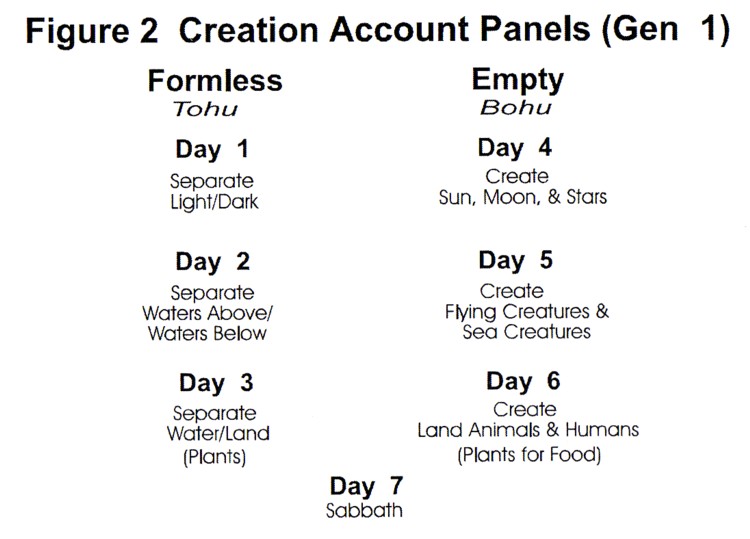
First of all creation happens twice. Genesis 1 and Genesis 2 are different stories, they are not one unified entity. Read them again. Draw what you see. They will look different. Even more than that, the two accounts are written with different style and genre, they have different qualities and different ways of describing God, EvCr1and most importantly they describe a 3-tiered universe (see picture).

They are poetic stories from the oral tradition. The ancient people who told them and then wrote them down never wanted them to be understood as science.

Genesis 1 uses Hebrew poetry to both help tell the story and help EvCr2the teller remember the sequence of events. Days 1,2,3 the space for the stuff of creation is made. Days 4,5,6 the things that go in the space is created. You only need to remember the order to 3 things.

Now there is a lot of textual, literary, historical, aspects of the scholarship that I won’t get into, but I think you get the point: Genesis 1 and 2 are not science text books and nor were they ever meant to be.

When I was in university, I took classes on science and religion from Prof. Denis Lamoureux. He is an evolutionary biologist and a theologian. His courses were designed for science students and fundamentalists alike to better understand the “Science vs. Religion” debate. But the thing that most students didn’t know, he was actually using the science stuff to teach basic introductory hermeneutics and biblical scholarship.

I took two classes with Denis. The second was a seminar where we had guest speakers representing different views on creation. One class he invited the president of the Alberta Young Earth Creation society to speak to the class. She was a woman with a PhD in botany. She came and presented all kinds of the same kind of “scientific” ideas that Answers in Genesis does. Of the 15 of us in the class, I was the only humanities/theology student. My classmates were all science majors. During the Q&A time, they debated the science, they asked questions of genetic expression, geological record, quantum physics and offered smart evolutionary evidence. This woman had answers for all of it.

Then I asked my question. I asked her what she thought about canonical development, and how that affected divine inspiration. I wanted her to explain how those early church councils determined what they accepted or rejected as the canonical books of the bible. I wanted her to explain how divine inspiration worked with books written 300 to a 1000 years previously.

She had no answer for me. In fact, she entered into what seemed to be a state of cognitive dissonance and told me over and over again that my question was “silly.”

She was the president of the Alberta Young Earth Creation society and she couldn’t answer a basic question of biblical scholarship.

This is the Achilles heel of Young Earth Creationists and their kin. I am surprised that those who debate these folks don’t use biblical scholarship against them more often. I am surprised that atheists like Richard Dawkins don’t do some homework on real biblical scholarship to use against the fundamentalists he is so fond of debating.

Creation pseudo science will always sound convincing enough for fundamentalists. They aren’t looking for real answers, they are looking for evidence that will support their biblical claims. If I were to talk to a Young Earth Creationist I would deal only with what the bible actually says, in Greek and Hebrew, in context, and with an understanding of ancient cosmology. I would make them deal with what serious biblical scholars have been talking about for centuries.

If I was Bill Nye, I wouldn’t even bother talking science with Ken Ham. I wouldn’t legitimize his pseudo-science by making it seem debatable. Ham will have an answer for everything, and that is the only foothold he needs to sound plausible – to have Nye, a real scientist acting as if Ham is worth debating. Evolution is still a big puzzle being put together, even if we can now tell what the picture looks like. Creation science is a neat little set of pseudo theories and logical fallacies meant to prop up poor biblical understanding.

If I was Bill Nye I would ask questions like my canonical development question. I would ask why  St. Augustine wouldn’t convert to Christianity until Bishop Gregory told him that much of the bible was allegorical. I would ask why Roman Catholic Priest and Physicist Georges Lemaitre could propose the Big Bang Theory and still be a faithful Christian. I would ask why Genesis and all of scripture is pretty clear about a 3-tired universe. I would ask about Hebrew poetry and oral tradition.

And then I would ask, why most biblical scholars, theologians and mainline denominations accept evolution with no problem at all.

Bill Nye could challenge Ken Ham with questions like these. Bill Nye could really make a statement about what Young Earth Creationism and biblical literalism is about. Bill Nye could pop Young Earth Creationism’s intellectual bubble and challenge the idea that the bible is a science text book.

Most christians who study the bible seriously  figured out centuries ago that Genesis is not science. We figured out that Genesis is not making a scientific point, but a theological one. Genesis is not telling us how creation happened or what it happened with.

Genesis is telling something though. Genesis is telling us who created it all (God) and why (out of love). Genesis is reminding the faithful of the most important things to know about creation… about why we are here at all.

Many christians have known this truth about Genesis for a long time. Many christians have understood that an allegorical Genesis is not a threat to our faith, even though Young Earth Creationists are ready to stake their faith in Jesus on whether Adam (the mud creature) was a real dude 6000 years ago. And creationists do this because it is intellectually easier.

Understanding the truth about Genesis would mean doing a lot less pseudo science, and instead doing some scary biblical scholarship and asking some scary questions about God and Christian History. It would mean revising stances on gender issues, sexuality issues, economic issues, and theological ones. It is really inconvenient to revise one’s theology like that, and to be prepared to do it often. But the Church hasn’t crumbled with its greatest theological minds being totally okay with an allegorical Genesis, and we won’t be crumbling any time soon.

Most importantly, we haven’t crumbled because many of us have understood the bigger issue at stake here:

You can take the bible literally.

You can take the bible seriously.

But you cannot do both.

So what would you say to Bill Nye or Ken Ham or me? Share in the comments, on twitter: @ParkerErik or on Facebook