Tag Archives: Jesus

Voices Piercing the Chaos – A Sermon for the Baptism of our Lord

GOSPEL: Luke 3:15-17, 21-22
As the people were filled with expectation, and all were questioning in their hearts concerning John, whether he might be the Messiah, 16John answered all of them by saying, “I baptize you with water; but one who is more powerful than I is coming; I am not worthy to untie the thong of his sandals. He will baptize you with the Holy Spirit and fire. 17His winnowing fork is in his hand, to clear his threshing floor and to gather the wheat into his granary; but the chaff he will burn with unquenchable fire.”
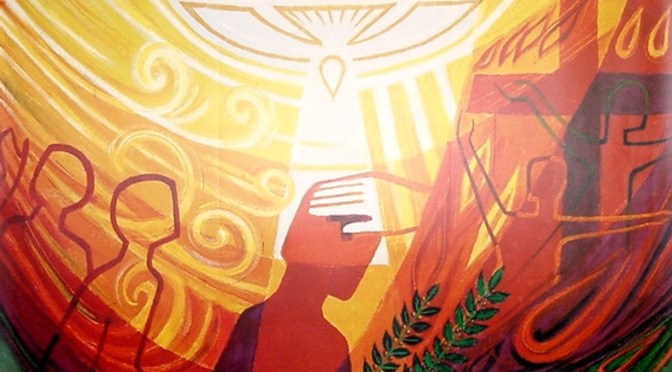
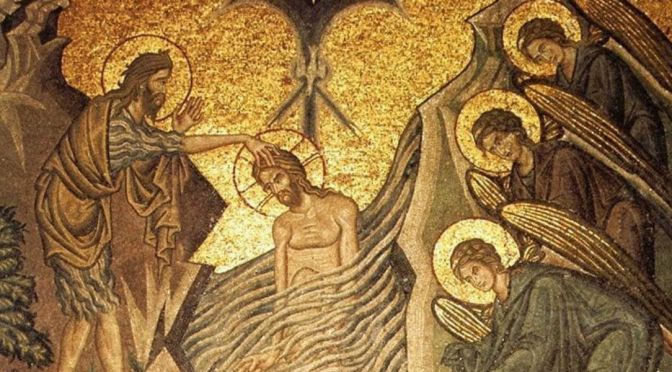
21Now when all the people were baptized, and when Jesus also had been baptized and was praying, the heaven was opened, 22and the Holy Spirit descended upon him in bodily form like a dove. And a voice came from heaven, “You are my Son, the Beloved; with you I am well pleased.”

Imagine with me for moment. That we are far away from the cold winter, and in a warmer place with more comfortable weather. We step down into knee deep water, a gentle stream rolling by. The water swirls around our feet. It is cool, and refreshing. The movement is gentle and easy. It feels good to be in the water. 

We have been floating down the river for a while now. Each year, we hop into the boat together and start the trip all over again in Advent. We float towards Christmas and through Epiphany. It is a journey that is familiar yet also new each time we take it. It is a Journey that begins with end times, that stops to hear John’s sermons and questions. Then it makes its way, with Mary and Joseph to the stable manger. We hear Simeon and Anna’s song of promise upon seeing the Messiah they waited a life time for. Then we see the magi follow the star to the child. 

Today we pick up speed and fast forward 30 years, we float down the river Jordan where Jesus is baptized by John. Jesus’ baptism is an unusual story, an uncomfortable scene for Christians. Why does Jesus need to be baptized? For forgiveness of sins? Repentance? What does it say about John as he baptizes instead of being baptized? In many ways the story of Jesus’ baptism invites more questions as we hear it again. 

In Advent, we heard John’s preaching on the river bank. His stiff condemnation of the crowds and his warnings of the Messiah. This time, Jesus shows up at the end of the sermon. The spirit of God descends upon him and along with John, the crowds witness an incredible thing. 

But John and the crowds do not see what is going on. They are full of expectation. They are wondering if John is the one they are waiting for. They looking for a fixes to their problems, for hope and salvation. They are hoping for a powerful Messiah. A warrior who will end injustice and who will remove foreign powers from control in Israel, but Jesus is not those things. It is the beginning of the problems that John, the disciples, the crowds, the Pharisees, scribes and temple authorities will have with Jesus. Some will want an ally, some will want a powerful warlord, some will want Jesus to go away. But Jesus simply refuses to fit their categories. Jesus is going to show us God in ways that don’t see… that we can’t see… that we refuse to see. 

Remember the feeling of standing in the water, feeling the cool fresh flow around our legs? Well the further we float, the more the current picks up. The gentleness is replaced by force and weight. The water doesn’t smoothly pass by. It pushes and grabs, it pulls and drags. The cool gentle stream that cooled our feet now pulls us in and drag us along. The power of the river is more than we could have ever imagined. 

Like the crowds who gathered along the banks of the Jordan, we gather to wait also. We are waiting for the world to get better. But it doesn’t. We are full of expectation, searching for hope and promise, looking for fixes to problems and an end to struggles. 

As we hoped for a more normal Christmas, the pandemic kept rolling on. Plans were dashed and changed in a hurry. And then many became sick, maybe even friends and family sent those texts or made those phone calls, ‘I tested positive.” And worry and anxiety ensued,  It has all felt like a great setback. 

Our world hasn’t changed all that much since John and Jesus met in the river. Sure, we drive cars, live in heated houses and can talk to anyone on the other side of the planet instantly. But, we are no different than those crowds standing on the rive bank, full of expectation, wanting our world to be different, wanting our problems to disappear. 

The weight of all of this threatens to drown us in the inability to care any more. We hear the reports, read the news articles and it is too much to take, too much to grieve for. Not only is it hard to see what is going on as Jesus is baptized by John, it is hard to see where God is at all. 

Today, it might feel like the cool refreshing water of the river has pulled us in and dragged us under. The current is churning and spins us about. We bounce in all directions, sputtering for air, aimed over the cliff, over the waterfall. 

This is not what the river journey begun in Advent is supposed to be like. 

This is not what God is supposed to allow to happen in the world.

We are not supposed to drown in the waters of grief and apathy.

(Pause)

And a voice pierces the chaos.

“You are my beloved. With you I am well pleased”. 

Words of promise, words of hope. 

As John dunks Jesus down into and then brings him up out of the water, as breath and air flood back into empty lungs, God speaks. God speaks in a way that hasn’t been heard since the beginning of creation. God speaks and the world is transformed. 

We tumble over the waterfall, we plunge into the deep pool at the bottom. We are squeezed and crushed under the weight, we can’t tell which direction is up. Death under the waters seems imminent. 

And then all of a sudden, while we are tossed about in the churn, not knowing which direction is up or down, we pop up and out of the water. Air rushes back into our lungs. This is where God’s action begins. In drowning, in death. This is as strange a place as we can imagine God to be working. And yet, God speaks as Jesus comes out of the water “You are my beloved children and with you I am well pleased”. What a weird and wonderful God who can push us below the surface in order to make us His own. In order to give us new names as child of God, as Christian, as beloved. 

This is why John doesn’t know what is going on when Jesus asks to be baptized. This is why we cannot see God working in the world. It is too radical, too unbelievable. 

And yet, this is promise that was made to us in the waters of Baptism, and it is the promise that is renewed each day and remembered each time we witness another child being drowned AND raised in these waters of life. It is a promise made that in the place we lease expect it, in death God is showing us something new, something life filled, something surprising. Something that can come only from a God like ours. 

A God who comes into the world as baby born to a unwed teenage mother, 

a God who lives a poor carpenter in 1st century Israel, 

a God who died on a Roman cross as a common criminal, 

a God who was raised from the dead and who in turn calls us to be drowned and then raised, 

New life can only come from a God who does not act like we believe God should.

The radical God of water and Baptism comes to us in ways that are so unimaginable and so crazy, that we can hardly make them out. The journey that God is promises is not easy or gentle. The results of God’s work in the world is rarely what we imagine or hope for. Yet, as this unexpected God meets us in our world, and on our terms, we cannot help but be drawn in to this unexpected God whose story has become our story. Whose story we tell over and over again. 

As we float down the river of Advent and Christmas, as we pass by Jesus and John in the river, we see again and anew the marvel of God’s love for us. We see a God who not only pushes us below the water to die, but who pulls us out again so that we may rise into new life. And today, we hear a God who speaks through chaos

“You are my beloved Children. With you I am well pleased.”

Amen. 

The Days are Surely Coming, say the Lord – a Sermon for Advent 1

Luke 21:25-36
Jesus said, “There will be signs in the sun, the moon, and the stars, and on the earth distress among nations confused by the roaring of the sea and the waves. People will faint from fear and foreboding of what is coming upon the world, for the powers of the heavens will be shaken. Then they will see ‘the Son of Man coming in a cloud’ with power and great glory. Now when these things begin to take place, stand up and raise your heads, because your redemption is drawing near.”

The days are surely coming, says the Lord. 

The first words of the season of Advent begin with Jeremiah, speaking words from the mouth of God to the people of Israel facing destruction by Babylon. An oracle that begins us immediately with the promise of God to a people who feels as though they are surrounded by oppression, suffering and darkness. 

We have flipped the calendar today, and are about to begin a new season of the church year. Advent might be the only time the church is ahead of the rest of the world… and even then, we don’t really do this time of year the way most do. We begin by talking about the end, we begin by pausing and stopping and waiting for what comes next. In Advent, as in the Church, beginnings and endings often go hand-in-hand. 

Advent is a peculiar season. The church decorates with blue or purples, we generally hold off on singing Christmas Carols (although it is sometimes hard to resist), we patiently and almost quietly count down the days until Advent ends on Dec 24th… all while wondering about what all these stories of John the Baptist and a pregnant virgin actually mean for us. 

But on the first Sunday of Advent, we don’t quite get into those stories just yet. We begin instead with the end. On this first Sunday of the church year we begin with visions and promises of the end, the great reconciling of all creation that God promises to God’s people. 

For the people of Jeremiahs’ day, their world was surrounded by war and destruction, the Babylonians were threatening to conquer much of the Middle East. And Jeremiah prophesied the coming destruction, the people of Israel awaiting what was to come next for them as warring nations around them sought control of the region. 

And for the people of Thessaloniki, St. Paul writes to them hoping they are well in the midst of trials and tribulations because the Romans around this small fledgling Christian community are blaming them for upsetting the social order. 

Two communities who are wondering what comes next for them, what will happen to them in the midst of tension, chaos and uncertainty in the world.

And then we hear from Jesus as he preaches to his disciples about the end. Visions and signs of the coming Son of Man. Words from Jesus spoken to his disciples in the middle of Jerusalem during a time of great tension and uncertainty – during the days between Palm Sunday and Good Friday. 

The tension and the uncertainty sounds oh so familiar to us doesn’t it?

Whether it is this ongoing and lingering pandemic, and it is restrictions and surprises, its struggles and effects of isolating us from each other. Or fears about the economy and inflation, the cost of groceries, gas and rent or housing. 

Whether it is the regular reminders that our society has yet to reconcile with our colonial and racist history, that we still struggle to care for the least among us, the poor, those struggling with addition and homelessness, those living on the margins. 

Whether it is this present reality that church is dealing with decline, with a future that we are not sure of, and now has to figure out where we stand in the midst of and following a global pandemic that sent us all home for longer than we every imagined we wouldn’t be gathering in-person together. 

We know what it means to live under a cloud of uncertainty and to wonder what comes next for us… even if we would rather not think about it. Even as we foolishly and misguidedly try to get back to normal with Black Friday shopping lists, baking and decorating and all the other things that come with the holiday season… here we are as the church, starting a new church year and forcing ourselves to pause and sit with this hard question of what comes next for us. 

And here is the thing about Advent, here is the thing about Jesus and all his talk of signs and visions of the end… there is no answer for what comes for us. That is not the answer we get to today, nor really any day in Advent. 

Instead, Advent arrives with an answer to a different question. And it answers it with the very first words of the season. 

The days are surely coming, says the Lord. 

Advent’s answer for us is not to tell us what comes next, but who. 

Messiah. 

Messiah is coming. 

The righteous branch of Jesse to save all of Judah. 

The one sent by our God and Father, the Lord Jesus

The Son of Man coming in a could. 

The Messiah. 

And no, the promise of the Messiah’s coming did not stop the Babylonians coming to destroy the Jerusalem and exiling its most important citizens. 

And no, the promise of Messiah’s coming did not stop the persecution of Christians in the Roman Empire. 

And no, the promise of Messiah did not prevent the ugly ending of Holy Week with a public execution on a cross…

But God’s promise of the Messiah was that none of these thing would not be end. Not the end of people of Israel and nor the people of Thessaloniki. 

And the cross… well the cross was no ending at all, but rather the beginning. The beginning of God’s new reality for creation, the beginning of God’s new promise of Resurrection and New Life come to fruition for us all. 

And then after the cross, that Son of Man coming in the clouds also walked out of the tomb. But that story is not for Advent to tell. 

Instead, Advent points us again to the promise of Messiah coming also for us. This Messiah whose coming means that all the things of our world which bring tension and uncertainty, conflict and suffering, sin and death… they will not be the end of us. Rather the Messiah’s coming means that we are not alone, not forgotten, not abandoned to the present nor to the future. Messiah’s promised coming means that our world is already transformed now, because a world with the Messiah on the way is a world designed for salvation, rather than a world destined for destruction. And that changes everything. 

And as the Messiah is coming, the Messiah also walks along side us. No matter the outcomes of all those things that cause us tension and uncertainty, no matter the outcomes of things that feel too big to control and too much to bare. No matter the uncertainty of pandemic and inflation, no matter the struggles of families, neighbours and community… Advent points us to the Messiah who shows us that God’s new world is right around the corner, coming into view, breaking through into our world right before our eyes. 

Breaking through to us in the things that have always been before us, that have always been the signs of God’s love and mercy for us here in this place. 

And so even as the world continues to be a place full of tension and uncertainty, Messiah is coming to us bringing God’s new world. 

Coming to us in word, water, bread and wine. 

Coming to us in the gathering of this community, a sign of the Body of Christ. 

Coming to us with the promises of God, made and fulfilled. 

Messiah is coming and Messiah is here. This is the story of Advent, the story that begins today, even the in the midst of all of uncertainty and endings about what comes next. 

The days are surely coming, says the Lord. 

Reformation 504 – God is still God, We are Still God’s People

Jeremiah, the 31st chapter (31-34)
31The days are surely coming, says the Lord, when I will make a new covenant with the house of Israel and the house of Judah. 32It will not be like the covenant that I made with their ancestors when I took them by the hand to bring them out of the land of Egypt—a covenant that they broke, though I was their husband, says the Lord. 33But this is the covenant that I will make with the house of Israel after those days, says the Lord: I will put my law within them, and I will write it on their hearts; and I will be their God, and they shall be my people. 34No longer shall they teach one another, or say to each other, “Know the Lord,” for they shall all know me, from the least of them to the greatest, says the Lord; for I will forgive their iniquity, and remember their sin no more.

Today is Reformation 504.

504 years since Martin Luther nailed his 95 theses to the church door in Wittenberg, on October 31st, the eve of All Saints Day or All Hallows Eve. This simple act sparked a transformation of christians and the church that still reverberates to this day. 

As we consider the Reformation today, we must also admit that the past 20 months have been another reformation of a kind for us, with everything we are used to doing and being together as a church being upended and changed. 

There is a theory among some scholars of religion, particularly Christians, that there is a major transformation or reformation every 500 to 700 years. Five hundred years ago it was Martin Luther. Seven hundred years before that is was the split between East and West, creating the Roman Catholic and Eastern Orthodox Churches. 400 or so years before that it was the codification of Christian belief at council of Nicea – out of which came the Nicene Creed. 

And each of these moments were, in some way or another, about re-imagining the ways in which Christians understand and proclaim the gospel. The Reformation was precisely about this issue, about the right proclamation of the gospel in community. Martin Luther’s reasons for speaking up and speaking out as he did were pastoral, he was concerned for the well-being of the people he served. He wanted to make sure they clearly heard the good news of God’s free gift of grace given for them, rather than the exploitative message of the church, using fear to get people to pay their way into heaven. 

Luther always wanted to turn us back to the gospel, to turn us back to the good news of Christ’s death and resurrection that saves us from sin and death. 

20 months into this 21st century pandemic, we need to hear that gospel promise from the 16th century. Though the world is more normal than last year, we are only slowly passing through this pandemic. It is hard to know whether we are nearing the end or still at the beginning. Good news is hard to come by and normal seems like an ancient dream. 

And so in the midst of darkness, in order to do our best to follow Luther’s desire for gospel clarity, we hear again the same foundational texts of the Reformation. Romans 3, the part of St. Paul’s writings that sparked Luther’s imagination towards God’s radical gift of grace. And John’s declaration that the Son sets us free, the promise of freedom in the gospel. And of course, Psalm 46, the basis for the most famous of Luther’s hymns – A Mighty Fortress. 

But what about Jeremiah, the somewhat familiar but often overlooked reading of the bunch?

Jeremiah’s prophetic words were written for the people of Israel during the violent times of the Babylonian exile. Words about the covenant with Abraham and Sarah… the covenant that goes all the way back to the beginning: the promise of land, descendants and a relationship with God. And while usually a covenant is an agreement that places conditions on both parities, all the people of Israel had to do was not refuse. All the promises were coming from God, none from Abraham and Sarah and their descendants. 

Still, the people consistently turned away. It’s not surprising that they turned away as it is hard to believe in God in the midst of violence and oppression. 

Most of what comes before this passage in Jeremiah is a lot of God’s ranting and raving about the failings of the people. Eventually God decides that a new course is needed for God’s people. And so God makes a promise. A promise that rang true in the Reformation and a promise that rings true for us today. 

So no, Jeremiah is the least famous of the Reformation readings, but it is none-the-less foundational. There is no radical gift of grace in Romans, no freedom in the Son of God in John, no A Mighty Fortress without Jeremiah. 

The problem and struggle of the people of Israel and in Martin Luther’s day is the same as it ever was. A problem that stemmed back to the garden of Eden, and problem that we too bear. 

As God tries and tries to draw us back to God, we continue to turn away. For the people of Israel, God’s promise of land, descendants and relationship first given to Sarah and Abraham was always too unbelievable and also never enough. Whether it was Abraham’s own fear that God’s promises wouldn’t come true, or the people of Israel longing for Egypt and slavery as they wandered in desert, or the Israelites losing faith during the Babylonian exile. 

During the Reformation it was a church that wanted to control God’s promises, to make mercy a commodity rather than a promised gift. 

And today? We too struggle with covenant. It is too hard to trust, even in the midst of chaos and change, in the lonely and fearful world of the pandemic, in this world it is hard to accept that God’s promises are indeed for us too. The promised land seems to unreal, descendants to follow us in faith and carry the torch feels laughable. A God who loves sinners like us? Preposterous. A God who is relevant in a world that has mostly forgotten or doesn’t care anymore? Unimaginable.

It’s no wonder that God might be frustrated with us. We just don’t want to get it.  

And so God does a different thing. 

God starts all over again. 

God brings us to the foundation. 

God decides that a new covenant is needed. A simpler covenant. A simple relationship. 

When in scripture, a prophet – such as Jeremiah – utters the words “Thus says the Lord” biblical scholars call it an oracle. A message of the divine, a direct speech from God. And so it behooves us to listen, to open our ears and hear what God is about say:

But this is the covenant that I will make with the house of Israel after those days, says the Lord: I will put my law within them, and I will write it on their hearts; and I will be their God, and they shall be my people. 

I will be their God, and they shall be my people. 

And with that, a new covenant comes into being. One that even the fickle Israelites cannot break. Or the people of 16th century Europe, or 21st century pandemic peoples.

A covenant made manifest in incarnation. In the God who becomes flesh, the God in Christ who comes to bring the Kingdom near to us. The God whom we try to put to death, and the God who rises again on the third day. 

This new covenant, this new promise is now unbreakable. It is the promise of mercy, the promise of radical grace and forgiveness, the promise that sin, suffering and death will no longer control us. 

Because God is our God… we cannot be God in God’s place. 

And we are God’s people, we have no other identity, nothing else lays claim to who we are, not  the world, not ourselves, criss or tribulation, not sin… not even death. 

We are God’s people, we belong to the one who has chosen mercy and love for us. 

And God reminds us of this truth each and every day, week after week, season after season. 

God reminds us that we are God’s in the mercy and forgiveness that we hear proclaimed. 

We are God’s in the Word announced in this assembly and in places of worship all over the world. 

We are God’s in the Baptism that washes and renews us for life as God’s children. 

We are God’s in the bread and wine, given so that we become the Body of Christ for the world.

Thus says the Lord, I will be your God, and you will be my people. 

This is the foundation of the truth proclaimed anew in the Reformation, just as it became the new covenant with the people of the Israel. 

And this is the precisely what God intends for us to hear on the 504th anniversary of the Reformation, during our pandemic exile and our zoom reformation, that we 21st people of faith still belong to the God of Abraham and Sarah and Martin Luther. 

That even when we try to turn away, that God’s promise is unbreakable. 

Thus says the Lord, I will be your God, and you will be my people. 

Blind Bartimaeus the Preacher and Confirmation is not what we think it is

GOSPEL: Mark 10:46-52
As [Jesus] and his disciples and a large crowd were leaving Jericho, Bartimaeus son of Timaeus, a blind beggar, was sitting by the roadside. 47When he heard that it was Jesus of Nazareth, he began to shout out and say, “Jesus, Son of David, have mercy on me!” 48Many sternly ordered him to be quiet, but he cried out even more loudly, “Son of David, have mercy on me!” 49Jesus stood still and said, “Call him here.” And they called the blind man, saying to him, “Take heart; get up, he is calling you.” 50So throwing off his cloak, he sprang up and came to Jesus. 51Then Jesus said to him, “What do you want me to do for you?” The blind man said to him, “My teacher, let me see again.” 52Jesus said to him, “Go; your faith has made you well.” Immediately he regained his sight and followed him on the way.

If we are honest with ourselves, Confirmation is kind of weird. Most of us know what is involved in Confirmation. We think of teenagers sitting in stuffy church board rooms, listening to pastors drone on about the small catechism. Or terrified confirmands having to answer questions from the pastor in front of the whole congregation. Parents dragging reluctant kids with unhelpful lines like, “I suffered through confirmation when I was your age, and you can suffer through it too.”

More recently, we tend imagine a rite of passage provided by caring mentors, families and teachers for youth coming of age in the church. We picture something graduation-esque, complete with corsages and gowns that kind of look like academic robes. 

We can describe all kinds of aspects of and events surrounding confirmation, and yet, I am pretty sure that very few of us, if pressed, could actually describe or say what conformation is. Like what does confirmation mean and what is it actually. We know that baptism is the pouring of water on someone’s head, even if we attach parties, pictures and candles. We know that communion is receiving bread and wine, even if we devise complicated ways to distribute and receive it. 

But with confirmation… often we can only describe the things we attach to it and not the core element of it.  We aren’t quite sure what it actually is and that makes it a bit of an oddity. 

Deep down, we know that confirmation isn’t actually about making teenagers uncomfortable or sweat through very public knowledge tests. It shouldn’t be something to suffer through. But it also isn’t really a right of passage per se, it isn’t graduation from or to something. 

In fact, confirmation is actually something altogether different. 

The story of Jesus that we hear today kind of starts to get at what confirmation is really about, even if in a roundabout way. We begin with blind Bartimaeus begging on the roadside, when he hears that Jesus is coming by. He begins to make a scene, calling out and bothering the people around him. The more folks tell him to be quiet, the more of a scene he makes. Until finally Jesus notices him. 

I am sure we can easily imagine the embarrassment of the moment. We are people who tend to avoid making scenes, we avoid causing or enduring discomfort. 

And yet, making the scene, causing the annoyance and embarrassment is important. Bartimaeus isn’t just asking for help. Bartimaeus is proclaiming the gospel. His sermon is the same at the Kyrie we sing most week, Lord have mercy, Christ have mercy. He isn’t telling those around him that they need help, he is setting the example by going first, by showing the world what Gospel can for him, by making public the healing and reconciliation that Jesus provides. 

Bartimaeus shows us that on some level, making a scene for Jesus is what Christian faith is about. All these strange things that we do, the hymns and prayers, the baptisms and communion, strange robes and old books, the flowery ancient language and unusual rituals… all of it is so different than what we see on TV or hear in our EarPods or spend time doing when we are out with polite company. Maybe there was a time 60 or 70 years ago when flowery prayers, funny robes, and solemn rituals were a part of service clubs, government meetings, civic observances and even seen often on TV. But not today, Christianity is as foreign to the majority as speaking another language. Openly displaying Christian practices, openly discussing our faith can be embarrassing. Being associated with Christians who have been making other scenes and getting noticed for their misbehaviour during the pandemic is not something we want. 

Yet, living our faith out in the world, sharing our faith with neighbour, passing our faith on to successive generations is something we do want, or least should want to do. 

And in this way, Christian faith is a strange experience of joining together with other people of faith to make a scene for Jesus, to hear and then re-tell the gospel through Word, Water, Bread and Wine, through hymns, prayers and worship. And inviting others into that shared experiences and community. 

Confirmation then is rooted in being  officially welcomed to that scene making community of faith called the church. 

Now technically, confirmation has historically been the laying on of hands by the bishop that follows baptism. As the early church grew, it took Bishops longer and longer to get around to confirm all the baptisms, to lay on hands in blessing and prayer. And so confirmation was combined with catechesis, the intentional teaching of the faith to new Christians who waited for the bishop to come by every few years to confirm all those newly baptized into the faith. As Lutherans we technically include confirmation with baptism, so Katie, you have actually been confirmed for a long time.

But at its core, confirmation tied to baptism is the final blessing that joins us to the Body of Christ, that group of followers that makes a scene for Jesus.

Confirmation is a final sign of our welcome into the body of Christ, into this weird group of faithful folks who do things that are so different than everything else we see in world, that loudly proclaim God’s promises even if it is weird and strange to our ears. 

And like Blind Bartimaeus who called out for mercy until Jesus heard him, being confirmed finally connects to this group of Jesus’s followers who loudly proclaim the good news of God’s love, mercy and forgiveness for all those who would listen, even if it makes a scene and a bother. And again like Blind Bartimaeus who makes this scene, Jesus comes and meets us too. Jesus meets us in the middle of our loud bother and Jesus confirms the good news of our faith, the Good News that God’s love has indeed been given for us. In the Word of Faith, in the waters of new life, in the bread and wine that nourishes our faith, Jesus meets us with love, mercy, and salvation. 

So yeah, confirmation is weird. And even when it is explained, it is still kind of weird. 

And being confirmed is about being joined to a community of faith that does weird things together, often making a scene… but also a community of faith that is inspired together to proclaim the good news to the whole world. 

So welcome into this faith that we all share, even if it is a little bit strange. 

Letting go of what we cannot do, because God does what only God can do.

Mark 10:17-31
As Jesus was setting out on a journey, a man ran up and knelt before him, and asked him, “Good Teacher, what must I do to inherit eternal life?” Jesus said to him, “Why do you call me good? No one is good but God alone….

Here we are at yet another unusual Thanksgiving weekend. Compared to last year when we were encouraged by Public Health Officials to keep Thanksgiving to our own households, vaccines have changed what is possible. Yet, the pandemic situation in Manitoba is remarkably similar to last year, I am sure many of us are remaining cautious without Thanksgiving activities. 

Thanksgiving is not a Christian holiday. Rather it is rooted in the celebration of the harvest for the gifts and bounty of the land provided to us for the year. Harvest festivals are as old as human beings cultivating the land, and certainly thankfulness and gratitude are connected to our faith. 

And thanksgiving is a moment to step back the consider the bigger picture of our lives and communities. This year that might prove to be a difficult task. We have been living small for a year and half now, with things to both bring us hope for an end to pandemic but also realities that have not lived up to expectations. Our journey out of this crisis is going to be neither short nor straightforward. 

As we have been hearing for a number of weeks from Mark’s gospel, Jesus again encounters someone who is struggling to get it. But it isn’t Jesus’ followers or disciples, and nor it is Jesus chief antagonists the Pharisees and Scribes. Instead a curious and wondering rich man comes to Jesus with a big question. You could also say that he was having a Thanksgiving moment. A moment when he is considering the big picture of his life and asking some pretty questions. 

The man comes to Jesus right to point, ““Good Teacher, what must I do to inherit eternal life?”

Right away Jesus starts challenging the Rich man’s assumptions. Good? Why do you call me good? Only God alone is good. And lest we hear the Santa Claus version of the question, “Have you been a good by this year Timmy?” “Good”in this case is surely connected to the idea of righteousness. Being good and righteous with God is more than just following the rules of being nice, it is justified and righteous down to the very core of one’s being. Jesus is undermining the Rich man’s assumption that goodness or righteousness is something to be achieved. 

And then Jesus continues. He starts to list the commandments. In fact he lists six of them. Commandments intended for us to keep good relationships with our neighbour. But it is noteworthy the commandments that Jesus omits… all the commands that have to do with our relationship to God. Having one God, taking the Lord’s name in vain and keeping the sabbath. 

But still the rich man doesn’t hear any of Jesus’ clues in his answer. Like so many who are used to being in control, he sees inheriting eternal life as a problem to fix, a puzzle to solve. He claims that he has kept all the commandments. You can sense that the rich man is getting ready to declare victory on the whole eternal life thing. So Jesus gets ready to throw a curve ball. But first Jesus looks at the man with love. He wants this man to understand what he is asking, he wants this rich man to understand the nature of the mission that he is on, the Mission of the Messiah to bring the Kingdom of God near. 

Jesus says, “You have to give it all up. All the money, wealth, power, security, comfort and control. All of it. And then follow me.”

But the rich man can’t. Of course he can’t. Jesus knew that wouldn’t be able to do it. 

The rich man cannot let go of all the things. He cannot let go of all the things that form his identity, his understanding of the world, his certainty and foundation. 

Letting go is hard to do. We have always known it is hard, but during the past 18 months we have learned lessons how much we hold on to those things that bring us certainty and security, those safety blankets and supports around us that give us our sense of self, our foundations and strength. 

All the things that have been put to the test during this time of crisis. In fact, almost certainly we have held on even tighter. Whether it is family or our jobs or our wealth or our hobbies and passions. Even our faith and faith communities. Our convictions and opinions, our politics and biases. 

We have been holding on, hoping that if we hold tight enough to those things that we can make it through the storms around us. We have hoped that we can use those security blankets, the things we think we control, to fix our problems and solve our puzzles. And yet know that that hasn’t exactly been going well. 

With all the drama around pandemic restrictions and now vaccinations, we see people holding on to things that are making it harder. 

With revelations about our history of racism, sexism, colonization, economic inequality we have learned that holding onto our past or the status quo isn’t working. 

With this struggles being faced by churches, volunteers groups, charities and nearly every public institution, that holding on, hoping to return to the past will not fix the problems. 

We have discovered over and over again that we don’t have the solutions we wish we had. 

Jesus hammers the point home with a now famous passage saying, “Children, how hard it is to enter the kingdom of God! It is easier for a camel to go through the eye of a needle than for someone who is rich to enter the kingdom of God.” 

Jesus isn’t talking about cramming a camel through the eye of the needle. He is talking about the challenge of trying to get a notorious stubborn animal who is hard to get to do the simplest of tasks when dig their heels in and comparing that to how even more stubborn human beings can be. The rich man just cannot let go in order to see what Jesus is telling him. 

And that is Jesus’ point. 

The rich man wants to know how he can inherit eternal life, and Jesus response is to first divert him from notions that there is something he can do and refocus him on caring for his neighbour. And when that doesn’t work, Jesus suggest something impossible. 

But not because eternal life is impossibly hard. But because getting there, earning our salvation by our own merit is impossible. 

Jesus message from the start has not been about how to get into the Kingdom, but how the Kingdom of God is coming near to humanity, coming near to us. The rich man is focused on himself. The rich man cannot hear what God is doing. 

The disciples ask the question that the rich man could bear to hang around and ask. They were greatly astounded and said to one another, “Then who can be saved?” Jesus looked at them and said, “For mortals it is impossible, but not for God; for God all things are possible.”

God is the one doing the saving. 

God is the one who saves. 

God does the work and gives us eternal life. 

We do not earn it, we do not achieve it, we don’t problem solve ourselves into it, we don’t hold onto our power, control, and security in order to find our way to it. 

God does the work. 

And that is so hard to hear. 

It is hard to hear that there is nothing we can do, because we desperately want to do something, we want some measure of power and control. 

It is why holding onto our faith and having faith are often two different things, it is why the rich man cannot do the impossible and give up his wealth. 

It is why we are so divided as a society, why we struggle to get on the same page about things, we just cannot trust those in authority or those who vote for the other guys. 

It is why we have been holding on so tight to our own personal security blankets during this crisis, whatever they may be. 

Because hearing that God is the one doing the work of saving us is unsettling to the core. 

And yet, even as grip our own power and control and security as tightly as we can… God finds a way. 

The christ enters into created life, meets with sinners, and tells them the good news anyways. 

The Messiah walks the path of salvation, even when that path goes through death. 

Jesus steps out of the tomb and into new life bringing with him dumbfounded disciples who somehow carryon that message around the globe. 

The church, despite all our flaws and imperfections, our mistakes and divisions and conflicts, still has managed to proclaim the good news for 2000 years.

We though holding on tightly to whatever we can in have still been gathered here, gathered together as community to hear the promise of the Word, to be washed in Holy Baths, to be fed by Holy Meals despite all the odds. 

No we cannot save ourselves, no matte how hard we try, no matter the power and control wield. And yet we are forgiven, granted new life and salvation, none the less. 

[Because] Jesus looks at us and says], “For mortals it is impossible, but not for God; for God all things are possible.”