Tag Archives: covid-19

There Is No Going Back To Normal Or the Glory Days – This is the Beginning

GOSPEL: John 17:1-11
1After Jesus had spoken these words [to his disciples], he looked up to heaven and said, “Father, the hour has come; glorify your Son so that the Son may glorify you… 11And now I am no longer in the world, but they are in the world, and I am coming to you. Holy Father, protect them in your name that you have given me, so that they may be one, as we are one.” (Read the whole passage)

Today, we arrive at the seventh and final Sunday in the season of Easter. Easter 2020 must be, without a doubt, the most memorable Easter in our memories. “We are living through history” has been an oft’ repeated phrase of the pandemic era. And our Easter journey as people of faith has not been that far off from our lived reality. Hiding out in locked rooms for fear of the outside world is an essential Easter experience. Having no frame of reference, no experienced story to tell that makes sense of our new world is an essential Easter experience. And being prepared as disciples of Jesus for an unknown future is an essential Easter experience. 

As we prepare to the flip the page on Easter with Pentecost Sunday next week, we slide between Easter realities. In John’s gospel we slide back to Holy Week where Jesus prays for his followers just as he is about to go the cross. In Acts, we hear Jesus and the disciples having a conversation about what happens next to this fledging Easter community. 

The disciples come to Jesus with a request to go back, to return the Kingdom of Israel.  To a specific dream of the“glory days.” A vision that requires a deep dive into the history of Israel.  A specific moment in time, after Moses, after the promise land, beginning with King David but before foreign nations began threatening their borders and before they were exiled and occupied by the Romans. And of course not during the reign of one of the bad or mediocre Kings, but one of the greats! Of course they forget that even during the best of times, God was still sending prophets into their midst telling them to repent and get their act together. 

After all the disciples had seen, from following the call of Jesus from their fishing boats to witnessing the resurrected Christ appear behind locked doors, and their burning question is “are we going back?”

Sound at all familiar?

If you have spent any time reading, watching or listening to the news, you know that the world is wondering when things are going to reopen: from sports to shopping to public spaces – including places of worship. In fact, in many cases, Christians have been at the forefront of the demand to for political and public health leaders to loosen restrictions on gatherings. 

And you would think of all the people demanding that things go back to the way they used to be, we would know better. 

Because we have been longing to go back to what we remember as the glory days, long before this pandemic hit the world. But of course, nailing down what we think we want to go back to is not as easy or straightforward as we think. It was only a matter of weeks ago that we were concerned with declining resources and aging populations and shrinking congregations. Is that what we want to return to? Or is there a more specific place we want to go backwards towards? Do we want to go back to the days of church buildings full of worshippers and bursting Sunday Schools? To a time when women, people of colour and LGBTQ2SIA+ people were prevented from holding positions of leadership in the church? To the time when many churches were homogenous cultural enclaves? To the time when pastors were paid in the chickens and made pastoral visits in order to shame members into handing over their offering?

Our desire may be to go back to the good old days, but which good old days might be hard to answer. 

It is normal to lament what was. Especially when we don’t know what is or what will be. But we have to admit it is strange to long for something that most of us can agree wasn’t that good… something that, if we’re really being honest needed change?

So when the disciples ask their question, Jesus not so gently tells the disciples that they have no clue what is coming next for them, and it isn’t their job to know. That is up to the Father. Instead they are just along for the ride, they are simply witnesses to the activity and plans of God in the world. 

The disciples had no clue that they were about to preach the gospel in all kinds of languages to all kinds of people baptizing them by the thousands. Nor did they know that most of the early church communities would small groups of 12 or 25 people spread throughout the Roman Empire and would be ministered to by a former Pharisee and murderer of Christians who liked to write letters. They did not know their little group of followers would spawn generations upon generations of faith communities proclaiming the gospel to all the ends of the earth.

They had no idea what their path would be as Jesus ascended to the Father. 

Yet as John describes to us, Jesus knows that his followers don’t have a clue what is in store for them. They are dreaming of the return of rose-coloured glory days, of going back to some imagined time of greatness that is certainly better in their imaginations than the real thing. 

They cannot help but look back with nostalgia and hope for the glory days again. 

And yet as Jesus prays, he names the ways in which his disciples belong to each other, that their life together is a reflection of Christ, peek into the Trinity, the relationship between Father, Son and Holy Spirit. All along Jesus has been stitching this rag tag group together, shaping and moulding them for the next phase, the next chapter. Transforming them into this newly birthed community of the gospel. A community defined by the life of Christ, a community tied into the very death and resurrection of the One sent to save. 

That even as they have no idea where they are about to end up, Jesus has been preparing them to be what God needs them to be. 

A community of faith, 
of imperfect and flawed people 
who may not know where they are going, 
but who proclaim that the risen Christ 
is their way, their life and their truth. 
That the cross and empty tomb have changed them 
and all creation 
for the kingdom that has God envisioned. 

And so here today, what does this mean for us? 

We who long to return to normal, even as we begin to recognize that life as we knew it will not, cannot to be the same as it was. We come to the end of Easter, in the midst of this time of global uncertainty longing for comfort of the past. 

And we too are just as clueless about what comes next for us as the disciples were. No matter our desire to go back to normal, to go back to the glory days, to restore the kingdoms of our imaginings… there is no going back. And more importantly, we aren’t the one steering the ship anyways. 

Yet, Jesus’ reminds us today, with Pentecost on the horizon, that our future is known by God. And that we too are being prepared for what comes next for us. 

That Jesus is sticking us together into One Body, 
preparing us yet again to be new communities of faith, 
birthed into the story of Christ’s death and resurrection. 
That the cross and empty tomb redefine us, 
even in a world of declining churches, 
even in a world of pandemic closures… 
God is transforming us into the very body 
that will proclaim the Good News to the world, 
through whom God will proclaim 
forgiveness of sins and salvation in the waters, 
in whom God feeds the world with God’s own Body – the Body of Christ given for us. 

And so yes on this 7th Sunday of the most memorable Easter we have known, we are reminded again that God has the regular habit of setting us off in new directions when we least expect it. And that the destination is not for us to know, nor what things will look like when we get there. But only that God is the one leading us, that we belong to one another in Christ and that the sprit goes with us. And that Christ has been preparing us for this moment long before we even had a clue.

The season of Easter may be coming to an end…

but Christ promises us that this new resurrected life in this Easter community is only beginning. 

Amen. 

Unexpected Shepherds and the Good Shepherd

GOSPEL: John 10:1-10
Jesus said:] 1“Very truly, I tell you, anyone who does not enter the sheepfold by the gate but climbs in by another way is a thief and a bandit. 2The one who enters by the gate is the shepherd of the sheep. 3The gatekeeper opens the gate for him, and the sheep hear his voice. He calls his own sheep by name and leads them out… (Read the whole passage)

The early church understood the 7 week season of Easter to be like one great day of celebration. Time kind of gets mushy in Easter, unlike other seasons of the church year where we are so often counting the weeks as they go by. And while many comparisons to our pandemic isolation have been to the season of Lent, there have been also similarities to Easter. Disciples hiding out in upper rooms, sticking to small groups and avoiding crowds, time becoming mushy and hard to keep track of. We just might be living the most authentic Easter season of our lives. 

Today, we are four weeks into the season of Easter, nearly a month since first hearing about the women going to the tomb early on the first day of the week. And yet, today is the first time that we are moving on from that first day. We divert somewhat to familiar images of the pastoral Jesus. Psalm 23, and John 10. Shepherds and sheep. Comforting images of the love and care of God, poured out for us. 

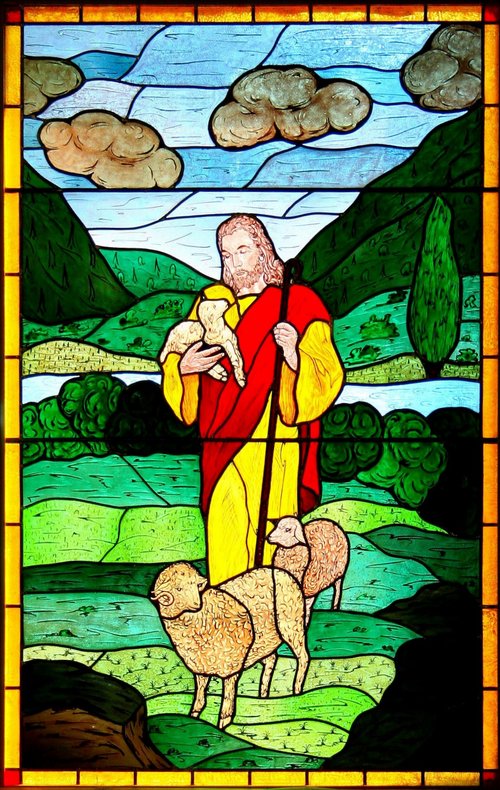
The church that I grew up in had a stained glass window of Jesus the Good Shepherd, a blonde hair blued-eyed Shepherd lovingly gazing at the lamb he is holding in his arms. An imagine imprinted on my mind, that often surfaces on this fourth Sunday of Easter, or when I hear psalm 23. 

And there is a certain amount of comfort and safety that we imagine into the image of the Good Shepherd, especially in times of struggle and hardship… such as in this moment in time. 

In John’s Gospel, Jesus gives us another comforting image of the Shepherd, who is known by the sheep. The Shepherd who lays down as the gate to the pen to provide protection for the sheep. 

Yet, Jesus isn’t talking his disciples or the hungry crowds about the Shepherd, but rather the  Pharisees. The Pharisees who have just criticized him for healing the Blind man… a story that we heard only a few weeks in Lent. Jesus is speaking to those who bear responsibility for caring for the sheep, caring for the community. To the religious and community leaders who are balking at any change to the social order, even if it comes in the form of  healing a blind beggar in their midst.

As Jesus describes the familiar voice of the shepherd, he also describes the voice and motives of the thieves, bandits and strangers… labels he is applying to the religious leaders. Jesus suggests that not everyone charged with the care of the community is tending to that charge as they should. They are instead more concerned with the status quo, with keeping the power and control in their own hands and out of the hands of others…. Whether it is Jesus wantonly offering God’s love and care, or a blind man becoming self-sufficient. These are voices and leaders who are calling the sheep into danger for their own gain, their own selfish purposes. 

Does this sound at all familiar?

As we enter into week 8 of lockdown and staying at home, the calls to #OpenforBusiness are starting to get louder and louder. Here in Manitoba, we are beginning the slow yet still ambitious move of opening up some businesses tomorrow – hair cuts and restaurant patios and select other businesses will be aloud to open. Even as public health officers tell us it is isn’t exactly safe yet.

This pandemic moment has taught us a lot about the voices that we listen to, the voices who call us sheep to follow. And what is clear is that there are those in our world too, charged with caring for our communities who might not have our best interests in mind. 

And while Jesus declares that the sheep know the voice of the Shepherd, I am not so sure that it is easy for us to recognize. In fact, perhaps what is clear is that most of the voices out there are seeking something from us other than our wellbeing. Our votes, our dollars, our consumption, our attention, our productivity and labour… even our willingness to be sacrificed for the sake of profit and maintaining social order. And all with promises fo green pastures, still waters, prepared tables, and cups running over. 

Knowing the shepherd’s voice is one thing, hearing the shepherd’s voice at all is another. And if the Pandemic has made something clear, it’s that shepherds and their voices are not heard as often as they should be. 

So as Jesus declares that the sheep know the shepherd’s voice, we might be asking, do we really know it?

_______

We always hear Psalm 23 on Good Shepherd Sunday, but there is of course a reason far more common for us to hear this most familiar of psalms. 

Over the years, as I have presided at many funerals, I have often read Psalm 23 as I lead mourners into worship. Pall bearers and casket, followed by grieving family. And in that moment, we enact that what the familiar psalm describes. We walk together into the valley of the shadow of death.

You see the Good Shepherd does not promise us that everything is green pastures, still waters, and abundant tables and cups. Rather, the Good Shepherd is honest about the world, about the dangers and risks. The Good Shepherd tells us that the there are dark valleys ahead, there is the shadow of death in store. And there is no going back, no staying in the green pastures. There is only forward into our future.  

However, the Good Shepherd also promises to lead us through the valley of the shadow of death. 

Jesus promises that the sheep know the Shepherd’s voice not because the sheep are good sheep, but because the Shepherd is a Good Shepherd. The Good Shepherd whose only concern is the well being and care of the sheep. The Good Shepherd who knows the sheep. The Good Shepherd who gathers and collects the confused and lost sheep, wherever we are going – green pastures or dark valleys. 

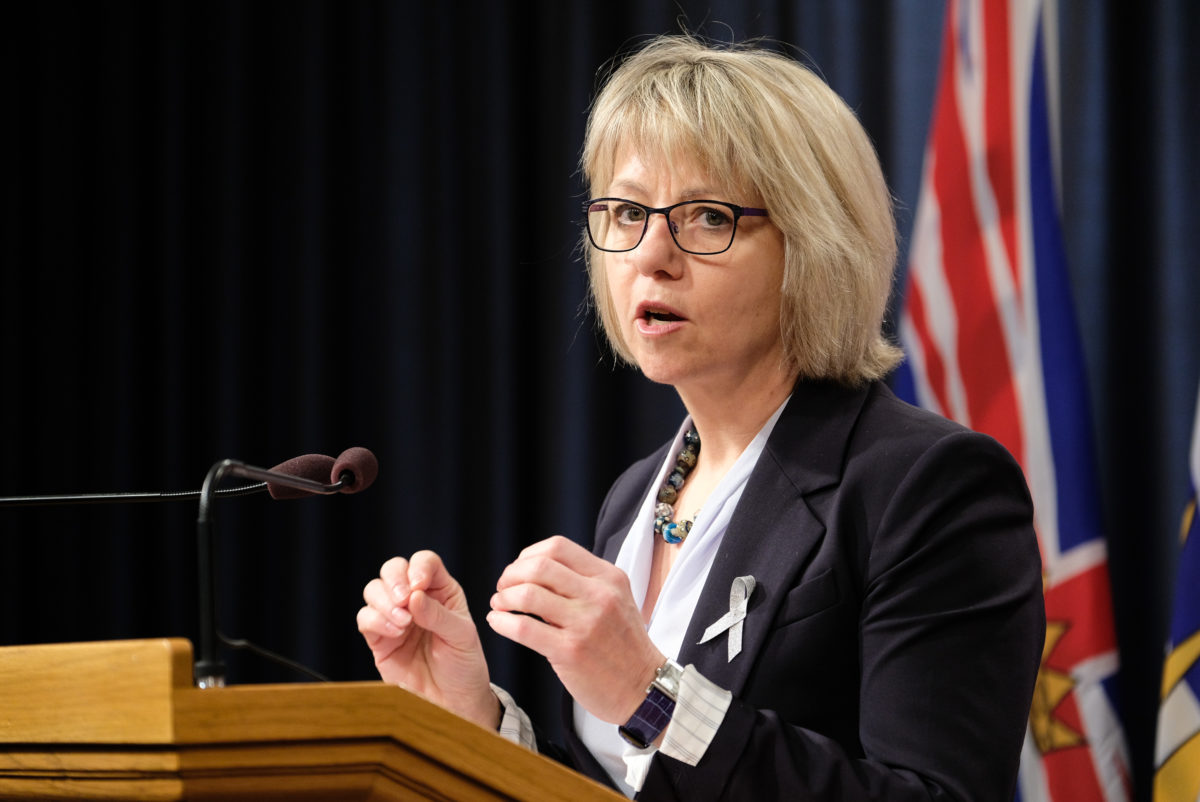
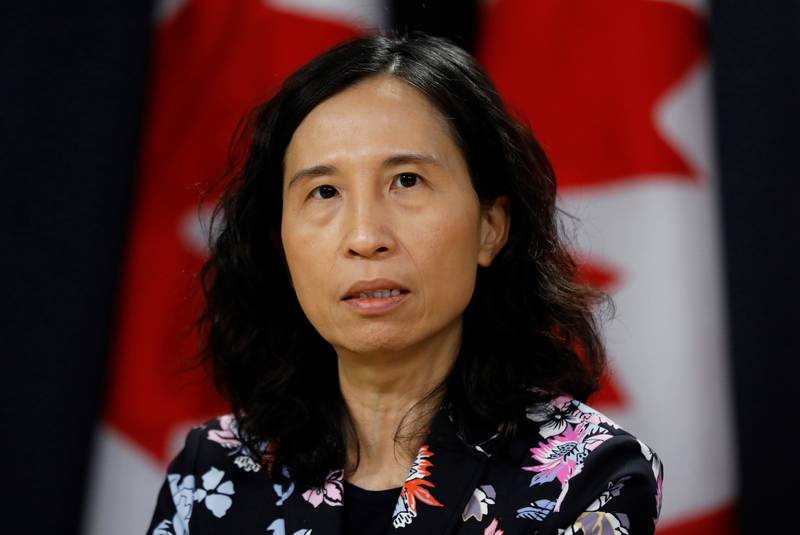
And as we navigate this shadow valley of pandemic, there have been voices emerging from the fray, voices whose only concern has been our health and well being. Shepherds who didn’t know they were shepherds only a few months ago. 

Often in this pandemic the voices of Chief Public Health Officers have cut through the fray of the voices out there calling us to follow. And these unexpected shepherds have surprised us by being singularly focused on our health and well-being…  voices that are seldom heard among the leaders of our world. Shepherds that tell us the truth, that do not promise all green pastures and still waters, but who warn of the valley of the shadows of death ahead. 

But Shepherd voices who also promise to lead us through. 

To lead us through the dark valleys to whatever lies in wait for us on the other side. 

To go with us all together. 

And this promise is of course the promise of the Good Shepherd. 

In this pandemic moment, our whole world feels as though it is gathered at the back of a church about to walk into the dark valley. Yet today, the Good Shepherd promises that we do not go alone, that the Good Shepherd will see us through, that the shadows of death will not be the end of our story, that there is life on the other side.  

This is the only voice, the only promise that really matters. 

And so on this fourth Sunday of Easter that on the surface it feels like we have moved on from Easter morning, the promise of the Good Shepherd takes us right back to the empty tomb, right back to glimpse of the other side of the shadow of death. 

The Good Shepherd comes to us in the middle of Easter because the Good Shepherd is an Easter Shepherd, a shepherd whose voice knows the sheep, whose voices knows us and knows what we need, a shepherd who has been through the valley of the shadow of death and promises us see us through, to the other side and into New Life. 

Not Knowing Our Own Easter Story on the Way to Emmaus

GOSPEL: Luke 24:13-35
Now on that same day [when Jesus had appeared to Mary Magdalene,] two [disciples] were going to a village called Emmaus, about seven miles from Jerusalem, 14and talking with each other about all these things that had happened. 15While they were talking and discussing, Jesus himself came near and went with them, 16but their eyes were kept from recognizing him… (read the whole passage)

Even before the Pandemic, I was a pretty voracious reader of news. Local, national, international, political news, as well as articles and opinion. And of course as a pastor and blogger, I have been reading and writing about the issues facing Christianity and the church today as well.  

A lot of us these days are news junkies, I am sure, consuming as much as can about every bit of news. And so as this pandemic lockdown extends longer and longer, we know that the question of when and how things are going to start opening up is starting to bubble to the surface. Even as case numbers increase in some jurisdictions, in those experiencing any kind of plateau, the question of returning to “normal” life is front of mind, whether is it governments, business, schools, leisure and of course churches. There are countless articles to read about opening the world back up, not post, but mid-COVID-19.

Yet, plans to re-open while there is no treatment of vaccine for COVID-19 involve slow, socially transformative steps. Everything about the way we interact will be on the table, from how many of us can be together, where we can be together, and how we will need to adjust some of the basic things we long took for granted like handshakes. 

As we arrive on the 3rd Sunday of Easter, I cannot help but feel like we have been hearing a similar story in the gospels. The story of a community that experiences a traumatic, life-changing event – the death and resurrection of Jesus. And this event requires the slow yet undeniable transformation of a community, there is no going back to normal for the disciples and followers of Jesus. Rather, the Easter season story is one of a community transformed by the Holy Spirit for the new reality of an an Easter World. 

For the 3rd Sunday of Easter, we go back again to that first Easter Day, the day of the empty tomb. 

After the women had gone to the tomb and Jesus met the disciples behind locked doors, two disciples are on their way to Emmaus, a town near to Jerusalem. 

On the way, these two are met by another traveller. This travelling companion seems not to know about what has just happened over the past week in Jerusalem, yet then proceeds to explain to them how the events of holy week fit into the Scriptures. These two disciples don’t recognize that the one travelling with them is Jesus. 

It seems a bit absurd that these two wouldn’t be to recognize their teacher and master. Was Jesus wearing a disguise? Were they blinded by their grief? Did God close their eyes to seeing?

I think there might be another explanation, one that relates to us and this moment in time. 

Human beings tell stories, in fact stories are how we understand the world. Stories and narrative help us construct meaning. Stories are the vehicles for us to make sense of things. It is why we go back a rehearse in our mind the events of an experience that we cannot make sense of, it is why we rely on eye witness testimony so heavily, it is why we are enraptured by good movies, books, tv shows, songs, artwork or a good story teller. 

So these two disciples on the road to Emmaus didn’t recognize Jesus because they didn’t understand the story of Holy Week yet, they couldn’t see Jesus because they didn’t know or understand the story of how he could be walking with them. 

Not understanding our story yet is the reality that we are living too. As this Pandemic unfolds it has thrown us for a loop because we simply don’t have a story to understand it by. Even as unspeakable tragedy has occurred in Nova Scotia this week, this pandemic story has changed the way we understand that story too. Usually and unfortunately we know the story of mass shootings, and we know how to respond too well. But in a physically distancing world, we cannot follow the same narratives, road side shrines, prayer vigils, neighbours and communities coming together. 

COVID-19 is story that we haven’t figured out how to tell yet. And if Jesus were to try and walk with disciples sorting it out here, he would only find mostly empty streets, empty churches, empty public spaces. This pandemic has given us more questions than answers, even as we are in the middle of living through it. 

As the disciples walk the road the Emmaus, they too have more questions than answers. But rather than just coming out with who he is, Jesus takes the disciples back to the beginning, back to the stories they do know. The stories of God’s people. To the scriptures, the stories of faith. Stories told to children from the moment they are born. Stories told in homes and in the synagogue, stories that help to mark the passage of the days and the years, stories that gave frames of meaning, symbols, images and metaphors that helped them to understand their lives and their world. 

And just as the prophets foretold the coming of Messiah, just as John the Baptist preached out the wilderness, just as Jesus himself preached in the towns and countryside while doing miracles, Jesus begins with the stories they know already. And then Jesus interprets the stories in light of the promised Messiah. 

Yet, still the disciples don’t recognize Jesus. 

So finally when they reach Emmaus, Jesus takes the disciples back to Maundy Thursday. To the breaking and blessing of bread, where Jesus had been revealed to his disciples anew in the ancient familiar meal of faith – the passover meal.  

And all of sudden, these two disciples have a story to tell. They have seen this moment before. They have seen this One breaking the bread before. They know this stranger, they recognize the Christ. The Christ who has come to give them a new story of faith to tell. A story that begins at the Last Supper, that descends to arrest, trial and crucifixion and seemingly ends on cross. But now a story that continues on the Third Day with empty tombs, appearances behind locked doors, and revelations in the breaking of bread. 

Jesus has tied all the events of the last week to their familiar stories of faith, and Jesus has given these disciples a new story to tell, a story that makes sense and meaning of crucifixion, death, resurrection and new life. Just as Jesus brought the two stories of his crucified body and resurrected body into one in front of Thomas last week, Jesus brings together the ancient stories of faith to the story of the crucified and risen Messiah.

The story of faith that we have been telling for 2000 years since: Christ has died, Christ is Risen, Christ will come again. 

The story that Jesus is taking us back to in this moment, even in the midst of our crisis, our inability to make sense of things and to understand this moment. 

The story of faith that is grafted onto our bones from the moment we are born and then reborn in baptism. The story that is told in homes and at church. The story that helps us mark the passage of days and years. The story that gives us the frames of meaning, symbols, images, and metaphors that help us understand our world. 

And Jesus reminds us that this story of faith has room for us and our pandemic uncertainty. 

The story of the Messiah includes disciples locked away in their homes, fearful of the outside world, unsure of how recent events will change our communities forever. We might not have been here before, but the Christ who meets us on this journey has. 

Jesus walks along side us in our confusion and uncertainty, reminding us that our familiar stories of faith still have room for our unknown stories of our present. And Jesus promises to see us through, to see us all the way to the new reality that awaits us on the other side of this pandemic. 

And Jesus takes us back to our beginnings, to the familiar story of breaking bread that we know so well, that reminds us that Jesus is present and known to us, even when we don’t fully understand what is happening to us and where we are going. 

And so as we search for our story to tell, for the story that will tell us how we move on and move out of lockdown, Jesus reminds that there is a story that we already know. It begins with the breaking of bread, and continues through suffering and death, but surprises us again and again with an empty tomb, new life and a risen Christ. 

A risen Christ who met those struggling disciples on the road.  

A Risen Christ who comes and meets us today. 

Not Easter as we are used to anyways

*This sermon is a collaboration with my partner in life and ministry, the Rev. Courtenay Reedman Parker. You can find her on twitter @ReedmanParker*

GOSPEL: Matthew 28:1-10

1After the sabbath, as the first day of the week was dawning, Mary Magdalene and the other Mary went to see the tomb.(Read the whole passage)

While it was still dark.
While it was still night.
While she could not see.
While she thought death held sway.
While she grieved.
While she wept.
While it was still dark, resurrection began


While It Was Still Dark by Jan Richardson

I imagine Mary Magdalene, and the other Mary, walking together to the tomb where Jesus had been placed just days earlier. These were not mere acquaintances of Jesus. These were not even his disciples. These were his friends, his family. 

And they were leaving their homes, leaving their loved ones. Leaving in spite of a lockdown to go to the tomb. To complete the burial rite. 

Many of us have walked that walk. To the resting places of our loved ones: public visitations at funeral homes or in the intimacy of someone’s home. It wasn’t that long ago that it was commonplace to hold a wake, a time to offer prayers, to gather in community to mourn our collective loss, and to offer support to one another in our grief. 

For those of us who have walked that walk know the precarious nature of grief. We know that a loved one has died. We know that life will never be the same. That our day-to-day existence, our relationships have all changed. There is an emptiness in the space between where our loved one was, and is no longer. In the liminal time when when we’ve become aware that death has happened, but before the wave of emotion hits us like a tsunami.

This is how I imagine Mary Magdalene and the other Mary leaving their physically isolated homes to go to the tomb where Jesus lay. 

We know that life has changed. We know that life will never be the same again. But we don’t know how… we don’t know the specifics. All we know is that there was then… and there is now… and somehow, someway, there will be a future we can’t yet see or imagine.

This is not how we usually do this.” 

A phrase that we have been repeating over and over again in the past days and weeks. A month into physical distancing measures and the Coronavirus has taken over our lives, even if we are not infected. 

And yet, we have been practicing for this moment as the church, practicing being disrupted by change, practicing muddling along with unfamiliar technology, unwanted changes, disruptions to our tried and true ways to going about our life as a community. 

But today acceptance of these changes has been forced and accelerated.

Because we are forced to stay home, forced to use the 21st century technology that we have been resisting, forced to re-imagine what it means to be community. 

And so there is also something familiar, or maybe original and authentic about this Easter morning. 

The family gatherings and traditions, the easter egg hunts, and roast hams, the colourful spring dresses and ties, the long weekend outdoors… they weren’t part of the first Easter. 

Hiding out in homes, behind locked doors and fearful of the outside world. That is original Easter. 

On the morning of that third day, the disciples were in hiding. After Good Friday, after the crucifixion of their teacher and friend at the hands of empire and religion, they went into lockdown. 

But it isn’t the disciples, the male disciples that we usually think of who at the heart of the easter story. 

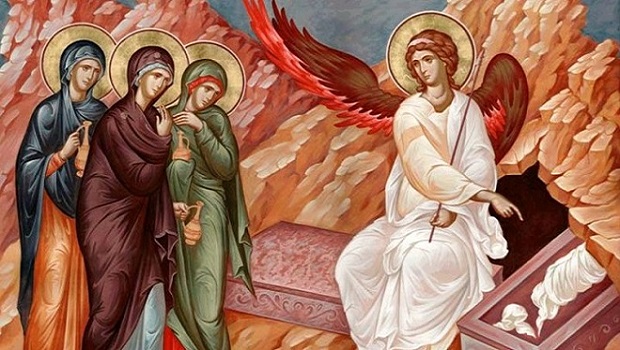
It is the women. 

Mary Magdalene and the other Mary. 

The disciples are hiding away, but the women go out into the early morning darkness. They go out because they must. Their friend has died and there is no one but them to tend to his body.

They are essential workers. 

The orderlies and respiratory therapists and radiologists who make their way to hospitals in the early morning darkness because they must. 

They are the childcare providers and animal rescue workers and tow truck drivers who are still on the job every day to keep just enough of the world functioning to fight pandemic. 

They are the researchers and epidemiologists and hockey equipment turned PPE manufacturers working round the clock to save lives, flatten curves and keep us safe. 

They are the grocery store mangers, and civic water filtration engineers and steel distributers making sure the systems that need to function keep functioning so as not to add any other crisis to our collective plates in this moment. 

They are the caretakers of ritual and dignity, the ones who make sure that Jesus doesn’t become just another number on a Roman crucifixion accounting ledger, but is still treated as a person, a human being, even in death. 

The women go because they must. 

And so unsure and afraid, they come to the tomb.

I imagine that if there was anything that they knew from Good Friday, if there was anything they could be sure of, it was the expectation of finding Jesus’ body, even if they didn’t quite know how they Ould gain access into the tomb.

These women, like us, didn’t know what the peak crisis moment would be, they didn’t know that you needed to be on the other side to understand. 

They didn’t know what we already know, they found that Good Friday had something new and unexpected to declare. 

Instead of the body of their dear and beloved friend, they find something, someone else entirely. 

A messenger.
A divine messenger.
“Do not be afraid,” the Angel says. 

How is fear not possible in this moment? When nothing is as it should be? When nothing and no one is the same.

“He has been raise from the dead,” The divine messenger declares.

How can this still be the same world that women live in?

“Go quickly and tell his disciples… you will see him.”

How can this be where Good Friday has taken them? Where the cross has taken them?

Where this empty tomb has taken them?

This divine messenger, this angel has changed their world, changed their understanding of everything that came before. 

But still the old world remains.

There is still empire and oppression.
There are still paranoid Kings and cruel imperial governors.
There are still soldiers in the streets and police at the ready.
There is still danger and persecution
There are still locked doors.
There are still incredulous disciples hardly willing to believe the word of a woman. 

Empty tombs, and Angels from heaven and shocking news of resurrection don’t make those things go away. 

Not then.
And not today.

On this Easter morning:
There are still news conferences with case numbers and death tolls.
There are still politicians playing games with our lives.
There are still deniers in the streets and anxious shoppers waiting in line.
There is still fear and anxiety and uncertainty.
There are still our locked doors, and lonely easter meals coupled with seemingly empty hearts.
There are still the empty feelings of our lives, the emotional and spiritual cost that physical distance demands.
There is still the thought of when things go back to normal… back to the before time.

Empty tombs, and Angels from heaven and shocking news of resurrection don’t make those things go away either. 

Sin and suffering and death don’t just go away. 

“Do not be afraid” the Angel said, even in the midst of all these things. 

And if empty tombs, and Angels streaming down from heaven were not enough, 

Jesus greets the women too. 

“Do not be afraid,” Jesus says. 

Because the things of this old world that remain, do not have the final say.
Because the empty tomb changes our world.
Because resurrection transforms all things.
Because new life found is where should only be death
Because the risen Christ has the final say.

Empires and oppression, news conferences and death tolls; cannot put down the Risen One.
Paranoid kings, cruel imperial governors, game playing politicians cannot control New Life
Soldiers and pandemic deniers in the streets cannot keep Jesus from us.
Danger and fear, persecution and anxiety are not more powerful than empty tombs.
Locked doors and lonely meals do not limit Christ’s access.
Unbelieving disciples and the emptiness within are not the story that Christ writes for us.

Today is still Easter, even if the women weren’t expecting it, even if we don’t feel like it.

Not Easter as we are used to anyways. 

Yet, today is the day of Resurrection, the day of New Life, the day of New Beginnings that we need. 

The Easter that the Risen Christ brings to us today. 

Amen. 

Good Friday, Pandemic and the Cross

GOSPEL: John 18:1–19:42

The passion of our Lord Jesus Christ according to John. (read the passion gospel)

Sermon

The shadow of cross is dark and wide today. 

The presence of death feels closer than ever. 

The cross that is so often depicted standing behind mangers and stables at Advent,

stands tall above beds for the dying rather than for infants

and different makeshift shelters today. 

The cross is spoken of with words that we didn’t even know a few weeks or months ago. 

Novel Coronavirus, Covid-19. 

The cross is revealed with words that we really didn’t understand, and still have yet to grasp. 

Pandemic. 

The cross looms high and mighty over hospitals and temporary field units. 

The cross’s darkness has forced the world forced to stay home. 

The cross disrupts the work of governments, schools, businesses, public services and more. 

The cross demands the sacrifice of those who serve on front lines to risk health and safety.  

The cross is changing the world with numbers. Number that grow arbitrarily, numbers that terrify, numbers that signify entire lives ending while still in the middle of living, families unable to grieve, communities forced to adapt their care and support from afar.

The cross has arrived in a way that it hasn’t arrived in a long time, in a way that few alive today understand or comprehend. 

And Jesus has been nailed to it, left to struggle for breath, left to suffocate unable to bring air into his lungs out of exhaustion. 

Jesus has been nailed to it, unjustly, cruelly and for the gain of those in power, so that human greed and contempt can keep its grip on Godlike power. 

Jesus has been nailed to it at young age, as someone who shouldn’t receive a death sentence, as someone who simply got mixed up in political games beyond his control. 

Jesus has been nailed to the cross today, and it feels like just one more to add to the list of deaths, the list that we know has only begun being written. 

The shadow of the cross is indeed dark and wide. 

But it is not just pandemic and illness that makes the cross seem taller. 

The cross is still our moment of shame, our moment of attempted power, our moment of trying to put ourselves before God. 

The cross is still our human effort to put God to death, even as God keeps coming to us in life. 

We want power, we want security, we want safety. We want to control our world, especially as it spins out of control beyond us. 

We deny the danger, we forget to care for others, we put ourselves first, we try to use the power of death for our own gain. 

Even still the cross has existed in God’s heart since the beginning of creation.  

Even still Jesus goes to the cross knowing that it is God’s beloved creation putting him there. 

Even still God is willing to die because we demand it, because our sin and pride demand it, because our selfishness demands it. 

Yet today is the cross’s final day of power. 

And yet, the cross will become more than our death symbol looming large. 

And yet, the cross is God’s means to change our course and set creation on a new path. 

What has been there since the beginning, Christ bring to its end. 

Today Christ completes the journey towards creation. 

Today Christ completes the journey towards us.

Today Christ joins creation and creator together in fullness, 

undoing the damage of the fall, 

undoing the separation endured since, 

reconciling what was broken between us. 

What has always been the end, Christ now begins as something new. 

Today, Jesus goes where none of us can go and does what none but God can do.  

Jesus goes to all the places where cross is found. 

Jesus goes the hospitals and field units. 

Jesus goes to empty streets and quiet neighbourhoods. 

Jesus goes to the front lines at testings centres, and grocery stores, and public health offices, and nursing home windows, and emergency rooms and intensive care units.

Jesus goes to lonely quarantined people.

Jesus goes to temporary isolation housing for health workers. 

Jesus goes to stressed out, cooped up families. 

Jesus goes to hungry seniors waiting for food drop offs

Jesus goes to worried and anxious people whose hearts can find little peace.

Jesus goes to the grieving and the separated and the brokenhearted. 

Jesus goes to every place where the cross looms large.

Jesus goes to every corner touched by the shadow of the cross.

Jesus goes to death itself. 

And on the cross Jesus will take on our darkness,

take on our shadows and sin,

take on our suffering and trials and tribulations

take on our our illness and disease.

Jesus will take our death and make it God’s. 

And then Jesus will take us and make us God’s own. 

And Jesus will make the ending the beginning.

And Jesus will shake off our power of sin, our power of death, our power of the cross. 

And Jesus will start a new thing. 

A new thing on the cross, a new thing where we thought there was only death. 

Today in the dark and wide shadow, 

Today as the cross seems to stand above hospital beds and quarantine rooms.

Today when we use new words and forgotten words to describe death. 

Today Christ does a new thing.

Christ hangs on the cross, without breath in his lungs, with pandemic in the air

And prepares the world 

For New Life 

Amen.