Tag Archives: Church

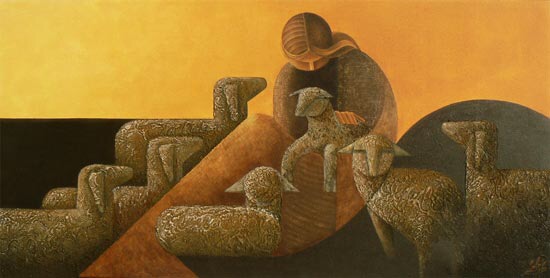
The Good Shepherd or Good Sheep?

John 10:1-10Jesus said, “… He calls his own sheep by name and leads them out. When he has brought out all his own, he goes ahead of them, and the sheep follow him because they know his voice. They will not follow a stranger, but they will run from him because they do not know the voice of strangers.” (Read the whole passage

Even, far away from the fields and pastures of first century palestine, far away from the shepherds and sheep that Jesus spoke of, the image resonates with us still. The promise of a shepherd who is with in the valley of the shadow of death, the shepherd who searches for the lost one in the 99, the shepherd who guards the gate. Somehow we know what it is to be gathered and care for, protected and loved. Or at least we like the idea…

Shepherding hasn’t changed much in 2000 years. Then, and in many parts of the world now, tending to flocks is done in the same way. When Shepherds come to town for supplies, they put their sheep in pens, guarded by a gatekeeper. After they purchase supplies, they return to the pen and call their sheep. The sheep know their shepherd and follow him or her out to pasture again. 

Out in the wild, Shepherds will gather bushes and rocks to build temporary pens at night. In the opening, the shepherds will sleep, using their own body as gate. This way the predators must pass over them to get to the sheep.

For the disciples, shepherds should have been common place, and the image of God as Shepherd was familiar. The psalms would have been well known by most people in Jesus day. 

And somehow, despite the fact that they know the psalms and shepherds, they do not know what on earth Jesus is talking about. 

The part that the disciples don’t understand isn’t the shepherds, or the sheep gate or the sheep pen. The problem is the sheep. The problem is that Jesus doesn’t tell the disciples how to be good sheep. 

For nearly 2000 years, Christians have called God the Shepherd, have called the church the sheepfold and have called ourselves the sheep.Yet, we don’t have to look much past ourselves to know why the disciples couldn’t understand Jesus. We like the idea of a Shepherd that lovingly chases after us and cares for us. But we want to go into the pen on our terms. We want to be free to be sheep in our way. 

Like the disciples, we have resisted, or even been unable to see Jesus calling out to us. The Blind Man whom Jesus heals in the pool of Siloam does not recognize Jesus once he meets him later on. The disciples cannot imagine how 5 loves and 2 fish will feed a great crowd. Mary Magdalene cannot recognize Jesus near the empty tomb on Easter morning until Jesus calls her by name. Thomas will not believe, unless it is on his terms. 

All of these actions, washing the blind man, feeding the 5000, naming Mary, giving Thomas faith. These are the same actions that God does in the Church. This is how the Shepherd cares for the sheep in the pen. And this is what we resist. We do not want to arrive here empty, we do not want to be washed, and fed and loved. We come here, to the church, to the pen, hoping to earn our love. We want God to reward us. We want to be here on our terms. The Shepherd can stay here in the pen, and when we are ready, we will show up with our best face on… but most of the time we are out there in world and not really wanting a shepherd. We don’t want God to be a hassle in our lives. 

That is what the disciples don’t understand. That is what we don’t understand. Jesus gives us this image of the Shepherd and what the shepherd does, but there is no mention of how to be good sheep.  
And in the end, that isn’t the point. Good Shepherd Sunday is not about how to be good sheep. Today, is a reminder of who God is. Jesus is our Shepherd who calls us, who cares for us and washes us, who feeds us, and names us. 

Washes us in Baptism, and brings us to new life. 

Feeds us in the Lord’s supper, at the Lord’s table, with his own body and blood. 

Names us as his sheep who belongs to the Shepherd. 

Gathers in faith, gathers into this community, this family, this flock. 

These are the actions of God in Christ.

Here in this place, it is the shepherd who is good, not the sheep. It is the shepherd whose actions matter, not those of the sheep. Here in the church, here in this congregation, Jesus calls us home. Yes, we are sent out each week into the world. We go out to pasture to a world fraught with the danger, a world that tells us it is all about the sheep, and what sheep do. 

But in God’s church, in God’s sheepfold, Jesus reminds us again and again, that in washing, feeding, naming and calling that Jesus brings us to himself. 

Jesus’s sheep pen, Christ’s church, is not a place were we need to earn our way. It is not a place where we give of ourselves or where we offer something to God, to the Shepherd. It is a place where God gives to us. It is a place where we receive. It is place where we come to know the Shepherd by his voice. “I baptize you. I give my body for you. I forgive you. You are mine”. 

Wherever we have been scattered, or lost, whatever we cannot understand or are confused about, the voice of the Shepherd gathers us to him, brings us back into the flock. 

So again Jesus said to them, “Very truly, I tell you, I am the gate for the sheep. I came that they may have life, and have it abundantly.

Thomas and the Scars

John 20:19-31

Then he said to Thomas, “Put your finger here and see my hands. Reach out your hand and put it in my side. Do not doubt but believe.” Thomas answered him, “My Lord and my God!”

We always hear this parable on the second Sunday of Easter. It is always the same story. It is Easter Evening, the same day as the resurrection. The early church considered the whole seven week season of Easter to be like one great day, and so even though we are seven days from Easter Sunday, we return to that moment to hear the story of Jesus appearing to the disciples on Easter evening.

Jesus speaks peace to the disciples. He joins right in the midst of them, he comes despite locked doors and windows, despite their fear and their hiding. He speaks peace and breathes on them the holy spirit. This is the very same peace we will share between us in a few moments, and the same spirit that is passed between us.

And then there is of course Thomas. Thomas who is called Doubting Thomas by western Christians. Thomas who is called Believing Thomas by Eastern Orthodox Christians. Thomas will not accept the stories of his buddies, the outrageous claims of resurrection. He wants to see for himself.

We hear this familiar story each Easter. We call skeptics doubting Thomas’s. We kind of know the routine by now.

And yet there is a piece of this story is we rarely focus on. Usually we hear about Jesus appearing behind locked doors, or Thomas seeing the evidence and believing. But what about the scars?

Yes, the scars.

The scars are there all way through. Jesus offers peace and then immediately shows the disciples his scars. That is how they know him. Thomas will not believe until he can touch the scars with his own hands. And knowing what Thomas needs, Jesus shows up and gives Thomas a view he cannot forget. Jesus offers his scars.

The scars are woven throughout the story, and yet they are troubling. The scars are how the disciples know who Jesus is. Of all the things that might identify Jesus it is the scars. Not how he looks, now how he talks, but the scars that his body still bears. His resurrected body still bears.

This can be hard to imagine. This can be hard to accept. Jesus resurrected body is a sign, an example of what our own resurrected bodies will look like. Our scars can often be parts of ourselves we would rather forget. Sometimes they are physical scars, sometimes they are emotional or psychological. Sometimes they are the scars of broken relationships, and unforgiven hurts, of ongoing pain, and untold suffering. Sometimes they are the scars of death.

We don’t want those scars to come with us. We don’t want to remember the pain that created them. We want all of it to go away. We want God to come and take away our hurts and pain, to make us forget all the ways in which we hurt others, and the ways in which we suffered ourselves. We don’t want our scars to come with us, we would much rather leave them and the things that caused them behind.

It was by the scars that the disciples recognized Jesus. It was because of the scars that Thomas could see who it was that was standing before him. The Risen Christ, the new reality ushered into the world by God where death is no longer the end, is too much to recognize, it is too much to be able to imagine or see. And so it is in the scars that the disciples and Thomas can see Jesus. The scars are reminders of what was before. They allow the disciples and Thomas to see Jesus as the same person who called them to follow. The same Jesus who taught in synagogues, who healed the sick and the lame, who cast out demons and angered the authorities. The same Jesus who was tried, beaten and then nailed to a cross.

It is this Jesus, this Jesus that they knew, that they followed and that they loved who is standing before them – Risen from the dead. This new reality that God brings into world through Christ can only be truly seen and understood when signs of the old reality come with it. And yet is still more than that.

There is no resurrection without crucifixion. Our scars are signs of experiences that have made us who we are. Our joys and our sorrows, our loves and our loses, our comforts and pains, our successes and failures, our happinesses and our sufferings. All of these things make us who we are. All of these things are what make us human.

And it is the same things that made Christ human.

And it is these same things that God loves and intends to resurrect.

It is not perfect, unblemished, perfectly unscarred versions of ourselves that God sees. It is the beat up, worn down, tattered, bumped and bruised versions of us that God is deeply in love with. It is all of us, good and bad, perfect and imperfect that God calls beloved children. It is the broken versions of ourselves that God is well pleased with.

For you see, it is in Christ’s scars that we see the Risen Christ. We see the Christ who came to be born among us, to live among us and to die among us. We see the Christ who took on our nature and our lot, who gathered all humanity to himself and who took all our sin to the cross. And it is on the body of the Resurrected Christ, that we see the scars still present, reminders that the one we would not accept and the one that we tried to kill is now alive. The Risen Christ, scars and all, is showing us that God is bringing life into this world, no matter how much death we wield.

But it is not just Risen Christ that is recognized by his scars. It is also us. Just as we see Christ in his scars, God see us in ours. God sees our hurts and our sorrows, God sees our bumps and bruises, God see our broken relationships and our unforgiven hurts. And it is by these things, that God sees us as beloved children. God does not promise to take these things away, the scars will remain. But God promises that they will not define us and they will not control us. Pain will not be the end. Suffering will not be the end. Death will not be the end. God promises that there will always be life. God promises that there is another side to sin, suffering and death. God will not remove our problems, but God goes through them with us.

And the Christ that we have now seen. The Christ that has come to us in behind locked doors, in fear and hiding. The Christ that gives us what we need so that we may believe.

This Christ has shown us the way, the way to the other side, the way to new life and he has the scars to prove it.


*** For 10 weeks I am on parental leave, and during this time my hope is to post sermons from previous years during this time. ***

And the Angel said to the women, “Do Not Be Afraid”

Matthew 28:1-10

But the angel said to the women, “Do not be afraid; I know that you are looking for Jesus who was crucified. He is not here; for he has been raised, as he said. (Read the whole passage)

Two women walking down a dusty road while the sun’s first wisps of colour begin to light the nighttime sky. Two women on their way to a tomb is an image that we remember from just two weeks ago. Martha and her sister Mary met Jesus on the road to the tomb of their brother Lazarus. It was the final Sunday of Lent, the last encounter in a series of encounters where Jesus wandered into someone’s life and the experience transformed them.

It began as Jesus wandered into the wilderness and met the tempter. And then Jesus found Nicodemus in his the darkness of his questions, the samaritan woman in isolation at the well of Jacob, the blindman who washed the mud from his eyes and could then see. And it finished with Martha and Mary grieving Lazarus.

But from then on, Jesus took a turn from uncovering the fears of these lenten people, and headed toward Jerusalem. Towards Holy Week, towards the confrontation between us, sin and death. And that detour ended on a cross… with God on the cross. And we finally realized what Jesus had been up to all along, even from the moment when the angels told Mary and Joseph that he was God’s son in Mary’s womb, the cross was where Jesus was headed.

But this morning, as these two women make their journey in the twilight hours to the tomb where Jesus had been laid 3 days before, they certainly did not know any of that.

All that Mary Magdalene and the other Mary knew was that Jesus, their friend and teacher had been put to death. But not just their friend and teacher, the person in whom they had discovered hope, in whom they discovered love and grace and mercy… love and grace and mercy from God.

Love and grace and mercy that was now dead. And along with it all hope.

These two women on their way to that tomb on Easter morning are the embodiment of all those people whom we have been hearing about all of Lent. They are Mary Magdalene and the other Mary, but they are also Nicodemus, the Samaritan Woman, the blindman and Martha and Mary from Bethany. All of them in their own have been making their way to Jesus’ tomb. And Jesus has unearthed their fears while showing them a new way to live… until Good Friday. Until Good Friday and this Jesus who had promised to transform everything was put to death.

These two women on their way to the tomb go knowing that they are putting that promise, that new hope to rest. They are carrying their last ounces of hope to add to the tomb. The only thing that have to look forward to on Easter morning is the possibility of having a few more moments with Jesus, even if it is just his corpse. They want to give him the smallest dignity of a proper burial after his undignified and humiliating death.

These two women on their way to bury their hope embody us too. Because we have been making our way to this grave as well. Because we too have had our fears unearthed and new ways to live shown to us by love and grace and mercy only to have them put to death. We too live a world where the powers that be love to kill off hope. It is hard to have hope in a world where nuclear war is now easily possible, where airlines can have passengers assaulted for sitting in paid seats and wanting to go home, where domestic shootings can rock close-knit communities, where the flood waters threaten to overwhelm, where jobs are dollars to be cut and hospitals are seen as wastes of money.

We live in a world where our sin, the sin of trying to be like God, to exercise control over everything around us brings death too often. Death to the hope that we try to carry, even if for just a while.

And then as Mary Magdalene and the other Mary approach the tomb, suddenly the earth shakes and angel appears like lightening from heaven. The guards shake and fall to the ground and the stone is rolled away.

And the Angels says, “Do not be afraid; I know that you are looking for Jesus who was crucified. He is not here; for he has been raised,”

And when the women were supposed to be going to a grave side, supposed to be consumed by the final act of separation from one that they loved… a messenger from God interrupts and says,

“Do not be afraid”

And we know what the women do not know. That the story of Jesus began just as it appeared to end. Way back at the beginning of Matthew’s gospel, the very first thing that happens just as Joseph and Mary were looking at their own version of the death of all hope, the end of an engagement and the end of a future. And angel shows up and says to Joseph,

“Do not be afraid.”

And now again at what seems to be the end of story, an Angels shows up declaring the same thing.

And all those fears. The fear of Nicodemus who could only ask his questions in the safety of darkness, the fear of the samaritan woman who choose to avoid her community in shame, the fear of blindman whose community will not accept that he sees, the fear of Mary and Martha that their brother was beyond saving… the angel says to them, “Do not be afraid.”

And all of our fears. The fear of nightly news and the end of the world, the fear our humanity will be lost for the sake of corporate profits, the fear that our communities are not safe when tragedy hits too close to home, the fear that creation is far more powerful than we can handle and just might overwhelm us… the angel says to us, “Do not be afraid.”

And the ultimate of fears. The fear born in sin, that we are not enough, that we need to be more, that we need to be God in God’s place. The fear that we could not possibly be loveable, or given grace or shown mercy. The fear that we will lose control, that we cannot survive without power, that we are not safe, the fear of death… the angel says to us, to the the original sin within us,

“Do not be afraid; I know that you are looking for Jesus who was crucified. He is not here; for he has been raised,”

And just in case we have not heard it the first time from the Angel who spoke to Jospeh, or the second time from the Angel who speaks to Mary Magdalene and the other Mary….

Jesus meets the women, meets all the lenten people, meets us on the road to say,

“Do not be afraid.”

And like the women we take hold of and cling to the body of the very hope we were sure we had lost. We hold in our hands the Body of the One in whom all hope and life exists. We touch the One who makes all things new.

We hold Jesus on the road from that empty tomb.

We hold Jesus here at the altar rail as the Body and Blood of Christ are given to us.

We hold Jesus and the Body of Christ makes all fear to cease because the one who was crucified has risen.

This Easter morning, the most joyous of all mornings, the risen Christ gives us his very body to hold in our hands… and in our hands we receive the mysteries of God.

Mysteries like God’s love for unloveable, God’s grace given for the condemned, God’s mercy for the unforgiven. Mystery that along with Nicodemus, the Samaritan women, the blindman and Martha and Mary, has revealed our fears.

God’s love, grace and and mercy that died on the cross.

God’s love, grace and mercy that has risen from dead.

God’s love, grace and mercy that says to us,

“Do not be afraid”

Alleluia Christ is Risen. 

When the Old Thing was Finished

John 18:1-19:42

The journey to this moment, began with those first stories of Advent. The angels that told Mary and Joseph that they would have a son. We don’t think much about Good Friday while singing Christmas carols.

But we began to clue in to where Jesus was headed when he went down the mountain of transfiguration into the valley of Lent.

From temptation in the wilderness, to secret meetings with the Pharisee Nicodemus as night, to Jacob’s well and the woman who had had 5 husbands, to the blind man who didn’t know who had healed him, to Mary and Martha’s grief on the road to Bethany… as Jesus uncovered our fears and anxieties in intimate encounters week after week… there were signs, signs that something bigger than just our issues and personal sufferings was being confronted. Jesus was passing by the particularities of our humanity. Jesus passed by because he was headed somewhere else.

Jesus was going to contend with something much bigger, something that was not about us individually… but something that is about us collectively.

And by the time we stood with the crowds waving palm branches, singing “Hosanna, blessed is he who comes in the name of the Lord”…singing “Save us now,  Son of David” there was no doubt that we would find ourselves here.

There was no doubt that the disciples would betray and deny him.
There was no doubt that the mobs would demand crucifixion
There was no doubt political and religious leaders would use the outrage for their own benefit.
There was no doubt that the empire would coldly and ruthlessly order execution.

There was no doubt that the place Jesus was going to was the cross.

We could see that today was where Jesus was going because Good Friday we have seen before.

We have seen the betrayals and denials of friends and family.
We watch the angry mobs crying out for vengeance on cable news.
We witness daily political and religious and business leaders use our outrage to turn a profit or gain a political win or entrench the power of religious institutions.
We see an empire that treats people coldly and ruthlessly even as we live and thrive because of that same empire.

We have no doubt that Jesus could end up on cross, because people like Jesus always do.

The ones who speak out.
The ones who risk themselves for others.
The ones who fight for goodness over self-benefit, justice over victory, compassion over power.
The ones who show warmth amidst coldness, who show love over ruthlessness.

We know today, we know Good Friday well, because in our world, there is also Good Monday, Good Tuesday, Good Wednesday and Thursday, Good Saturday, and Sunday.

Jesus’ journey to Good Friday is a common journey.

And it isn’t.

Because we remember the angels of Advent and Christmas, because we remember the voice of God thundering over the waters of Baptism and on the mountain of Transfiguration.

And then even though we have seen this story often enough, of betray and denial, of outraged mobs, and manipulative leaders, and cold uncaring Empires… beneath the cross we finally see the thing that Jesus has been pulling us towards all along.

The truth that Jesus tried to remind the tempter of.
The questions that Jesus explained to Nicodemus
The living water that Jesus gave to the woman at the well.
The sight that Jesus revealed to the blindman.
The buried  mercy that Jesus opened up for Martha, Mary and Lazarus.

Today Jesus reveals to us not another person doomed to die on a cross.

Today, Jesus reveals God, willing to die on a cross.

For us.

And thus begins the new thing that God is doing.

The new thing in oldest of stories.

In oh so common of human deaths for the sake our failing humanity, our sinfulness exposed in every way imaginable…. in the ultimate hubris, our belief if we just killed God we could be God.

God shows us life by dying.

Jesus shows us the beginning accomplished through the end.

Jesus shows us mercy given by a God who simply won’t be pushed away any longer.

Jesus shows us the love and grace that will be born, and live and pass by and come close and be just like us. How this love and grace ties humanity and all creation together on the cross.

Jesus shows us the completion of the journey where God does the thing that we have refused to do since Adam and Eve left the garden….

God joins the fallen to the divine, joins the sinful to the forgiven, joins the finite to the infinite, permanence of death to constant renewal of life.

Jesus shows us a God that dies just like us.

A God comes to us and finds us in every place we can possibly go, even in death.

So that we will live, and death will not be our end anymore.

No… we don’t think about Good Friday while we sing Christmas carols.

But God does.

The cross was where the incarnation, where God come in flesh, was going from the beginning.

The cross is the place where God was going to redeem creation all along.
The cross is the place and Good Friday is the day when the old thing – the power of sin and death –

When the old thing was finished.

And Jesus made all things new.

Hosanna – Crucify Him – Hosanna

Liturgy of the Palms Gospel
Passion Gospel according to Matthew

We have been journeying Jesus since Ash Wednesday, where we began lent by marking our foreheads with ash, remembering that we are dust and to dust we shall return. We then passed by 5 different people with Jesus on our way to the gates of Jerusalem. We met the tempter in the wilderness, where we saw that Jesus had chosen a new path. We heard the deep questions of Nicodemus by night about faith and meaning. We met with the Samaritan woman at the well in the noon day heat in order to receive the water of life. We got into the mud with blindman and our sight revealed the ongoing blindness of the world around us. We grieved with Mary and Martha at the edge of the valley of the dry bones.

And today, our lenten journey, our lenten wilderness and wanderings have brought us to the gates of Jerusalem shouting Hosanna. We have been calling upon God for deliverance from our oppressors. That word Hosanna, that word which sounds a lot of Hallelujah, like praise the Lord does not mean the same thing.

Hosanna means save now.

Save us now God.
Save us from enemies.
Save us from our sufferings.
Save us from all that threatens us.

And all of a sudden we were no longer passing through the lives of various people on Jesus’ way to Jerusalem. Today we became the ones whom Jesus was encountering. We are the crowds lining the roads singing Hosanna and it is us who Jesus passes by.

The Hosannas we sing today sound like the ones we sing most Sundays,
“Blessed is he who comes in the Name of the Lord. Hosanna in the highest.”

We sing Save us Now, and call upon God to come down a meet us.
To meet us in Bread and Wine, to become Body and Blood.
To become our Body and Blood.
To be the Body of Christ that we share in the Lord’s supper.
To become the Body of Christ that we are as the Church.

But today our Hosannas aren’t like our normal Hosannas.

Today our Hosannas, even though they still technically mean “Save Now,” sound a lot more like “Crucify Him.”

In fact, the Hosannas of this day are not prayers pleading for Salvation from our sin and death. They are not confessions that recognizes we are not enough, nor reminders that we need salvation from ourselves.

Rather the Hosannas today are calls for vengeance

Hosanna – Save us now by kicking out the oppressors from our land.
Hosanna – Save us now by destroying our enemies.
Hosanna – Save us now by becoming our righteous warrior king.
Hosanna – Save us now by making us relevant and powerful again.
Hosanna – Save us now by restoring our families and communities and workplaces and churches to their former glory
Hosanna – Save us now by letting us never suffer inconvenience or have think about hard things or be challenged or have to change.

The Hosannas of Palm Sunday are cleverly disguised.

They are disguised shouts of crucify him!

And by Friday they will be revealed for what they truly are.

But despite our vengeance filled Hosannas,

Jesus rides the donkey anyways.

Jesus makes the last move before the cross.

The move that began by coming down the mountain of Transfiguration.
That set the new course in the wilderness of temptation.
That adjusted to meet Nicodemus’s needs
That persisted with the samaritan woman who needed living water.
That came back to fill the blind man with faith.
That allowed the grief of God to bring the dry bones to life.

And that today rides into Jerusalem, even when the Hosannas also mean crucify.

And because Jesus rides the donkey anyways, the disguised Hosannas have another meaning. One that we will soon see.

They will remind us.
That God has come.
That God will saved.
That God has come for us.
That God will save us.

Now.