Tag Archives: chruch

Mary and Joseph of Aleppo

Matthew 1:18-25

“Look, the virgin shall conceive and bear a son,
and they shall name him Emmanuel,”

which means, “God is with us.” When Joseph awoke from sleep, he did as the angel of the Lord commanded him; he took her as his wife, but had no marital relations with her until she had borne a son; and he named him Jesus. (Read the whole passage)

The 4th Sunday of Advent is one that rolls is over to Christmas. While, this year we are in the unusual circumstance that there will be a full week between Advent 4 and Christmas Day. Next year for example, the 4th Sunday of Advent is Christmas Eve morning!

Advent then is a long as it can be with 28 days this year. And with still a week to go before Christmas, we get to sit with the story that we alway hear on the 4th Sunday a little longer than usual. The last Sunday in Advent is always the chance to hear the story of Mary’s pregnancy, and Mary and Joseph’s response to this life-changing news.

The announcement of Mary’s pregnancy by the messenger angels is always a turn from the preceding weeks of Advent, from the warnings about the end of time, from John the Baptist preaching in the wilderness and then questioning the legitimacy of the Messiah from prison. It is also movement within our Advent theme of light in the darkness, taking us from a the grand size of God’s plan to bring the Messiah into the world, into the cosmos, to come like a thief in the night, to straighten out the crooked paths, to cure the sick and raise the dead… Advent 4 is movement way from those big things, to the small space of Mary’s body, to the intimate relationship of Mary and Joseph’s engagement.

The story of Mary’s conception is a familiar one, although the version we hear today is less familiar. Rather than the Luke birth story, the beloved one we hear each Christmas that begins “in those days a decree went out from emperor Caesar Augustus that the whole world should be registered”, we hear Matthew’s version. Brief and to the point. There are no angels who appear to Mary today, but instead to Joseph. There is no visit to Mary’s cousin Elizabeth, but just a dream and a command to faithfulness.

And if you caught it at it the end, Jesus is born in Matthew’s version of the story. No shepherds or angels. No stable or manger, no pondering of Mary. No animals or drummer boy, although those aren’t in Luke’s version either. Matthew just gives us what we need to know and then picks up the expanded story with the magi, which we hear at Epiphany.

This doesn’t really sound like the story that we know, or that the carols sing about or that the made-for-TV-movies tell. It is a version of a familiar story told in an unfamiliar way. It opens our eyes anew to something we thought we knew well.

In our final advent weeks, our eyes have been opened anew to the dark places of the world. The theme of light in the darkness has reminded us that seeing the dark places is the first step in seeing the light.

One dark place more than others has been revealed to us this week. As the war in Syria intensifies, we bore witness in the news this week to the siege of Aleppo. The hundreds of thousands of civilians caught in the middle have been telling their stories on social media, even giving their final goodbyes with bombs exploding in the background. Human rights organizations and NGOs have called upon the warring factions and the global community to action. And even after ceasefires are called, they are promptly broken. It is a complex and messy conflict between factions where there are no clear good guys or bad guys. Where both sides are using civilians and civilians casualties as negotiating chips.

Now after years of civil war in Syria, reports of violent conflict, millions of refugees flowing into surrounding nations and then into Europe, the rise of the Islamic State and now the indiscriminate bombings and summary execution of civilians, Syria has become the great humanitarian tragedy of the 21st century.

So what does the darkest place in our time have to do with an unmarried couple receiving news of an unexpected pregnancy 2000 years ago.

Well the world of Joseph and Mary was not that different than ours. And no, not our Canadian countryside where we imagine the holy family showing up in a homeless shelter or soup kitchen on Christmas Eve. Rather, Nazareth where Joseph decides to remains faithful to Mary despite her pregnancy is only 593 kilometres from Aleppo. The distance between here and Regina, or even closer than the distance to Minneapolis.

And like the trapped citizens of Aleppo, Mary and Joseph were ruled by a ruthless despot in King Herod, a puppet installed by virtue of his birth, much like Bashir Al Assad.  Their home had been invaded by a foreign empire in Rome, much like occupying Russians. Their world was one drawn regularly into conflict as religious zealots tried again and again to spur violent uprisings in order to overthrow the the ruling powers, much like the rebels. All too often these uprisings only result in needless civilian death. Mary and Joseph almost certainly knew what it was like to exist between violently conflicting forces, never knowing when the chaos might erupt around them.

If Mary and Joseph were to be found today, we might imagine it would be in a barn on the prairies, or a back alley in New York, or sleepy neighbourhood in Sweden or an apartment block in Beijing. But perhaps today, Mary and Joseph are in Aleppo (Jesus was born hardly a stone’s throw away after all). The unborn Christ child would be dodging bombs and bullets in a war zone.

But it isn’t just the physical location, it is location within the human condition. If we listened to the Christmas carols and made-or-TV-movies, Mary and Joseph would exist in sentiment and nostalgia. They would be characters that we play in pageants or that we put up in nativity scenes. They wouldn’t be real, they would be nice ideas or warm fuzzy feelings.

Except Mary and Joseph aren’t characters in a pageant. They are the real people chosen by the God of light who shows up in dark places. Mary is a real pregnant woman, with expanding body, morning sickness and cankles. Joseph is a real fiancé whose beloved wife-to-be is pregnant with another’s child. The holy couple are real parents simply trying to survive in an unbelievably dangerous world.

But most importantly, the promised child, the light that is placed in Mary’s womb, is a real baby, kicking and turning, readying mother and father for the reality that they will soon be responsible for a life other than their own, in a world where life is disregarded like piece of garbage.

And this is all God’s point.

This is all God’s work, to send a real baby, born to real parents, in a dark and very real place in the world…in order to be our real Messiah. Because our real sins need real saving.

Only a real Messiah can bring light to our real condition, to the sin and death of the dark places around us. While the nostalgia of carols and movies, of nativity scenes and pageants, sometimes help us to tell the story, they are not what our Advent waiting needs. They are not the version of Messiah we need.

God sends a real Messiah because our real wars and real violence and real disregard for each other needs real light. God comes into the darkest places because our detachment and avoidance of the dark places needs to be revealed. God comes into real bodies, born to real parents because this is how we all enter into the world, because the danger of life is the real risk of death. The Messiah comes in order to join with creation in the starkest, realest ways there are. To be born like we are born, to live like we live, to die like we die. All that so we can rise like Messiah’s rises.

Our dark world is not much different than the one of Mary and Joseph. We need the light as much as ever. And so that is why hear the story of God’s coming again today, and we hear it anew.

God is coming not only to a surprised couple in Nazareth, but God is coming into this world, here and now.

Coming to a prairie barn, far away from places that matter.

God is coming to the back alleys in New York.

God is coming to the sleepy suburbs of Sweden.

God is coming to apartment blocks in Beijing.

And God is coming to civilians hiding out in Aleppo.

God is coming to bring light to our dark world, Messiah is on the way to show us that war, and violence and suffering do not define us. Messiah is coming to save us from sin and death.

Today, we are about to roll over from Advent into Christ, and yet there is still a week of Advent darkness and waiting left to do. And in the darkness of our world, of places like Aleppo or closer to home, especially when things seem darker than ever… Messiah is coming with the light.

 

The world has been forever changed in the past two weeks

Luke 23:33-43

The people stood by, watching Jesus on the cross; but the leaders scoffed at him, saying, “He saved others; let him save himself if he is the Messiah of God, his chosen one!” The soldiers also mocked him, coming up and offering him sour wine, and saying, “If you are the King of the Jews, save yourself!” There was also an inscription over him, “This is the King of the Jews.” (Read the whole passage)

So… the world is very different place than it was two weeks ago…

Today, is Chris the King Sunday, the day on which we name and celebrate the fact that Jesus is our King, the one in control over all things, who holds us and all creation in his hands.

Christ the King is also the last Sunday of the church or liturgical year, kind of like New Year’s Eve. In many ways, Christ the King Sunday stands between two worlds. The world of the past and the world of the future. The world of the past that we are leaving behind began last Advent we began a journey that took us from the announcement of the coming of Messiah, to the birth of Christ in a Manger, to the visit of the magi at Epiphany. We kept on moving into Ash Wednesday and the path of Lent, the path to the cross. We were surprised by an empty tomb on Easter morning, and yet again by the coming of the Holy Spirit in tongues of fire at Pentecost. After that we heard the teachings of Jesus again and anew.  Just a few weeks ago we remembered the reformation and how it shapes who we are, and we remembered loved ones who have died on All Saints Sunday. Along side all of that, we baptized new Christians, we confirmed young adults, we witnessed weddings, we celebrated anniversaries and we grieved at grave sides.

The world of the future begins in much the same way that last year began. We will begin the story of Advent, with waiting for Messiah to come.

And yet, Christ the King is not just a flip of the calendar page from one year to the next. Things don’t just continue on in the cycles and patterns of life that we are used to. Christ the King is no ordinary year end. Christ the King also carries with it a view of the end of all things, the big ending that our world is headed towards.

In many ways, the world has been preparing us to glimpse the grand scale of Christ the King. This year our world feels like it is teetering on the edge of chaos, we have seen terror attacks, we have seen mass migrations of people fleeing war and violence. We have seen whole nations grow in discontent, with fear and anxieties rising, with division and strife popping up right on our door steps. We have seen people reject the ruling class in favour of populist leaders and outcomes.

And all of a sudden the part of Christ the King Sunday that harkens to the end of time doesn’t seem so far off. What is coming next for us in our little part of the world and for all peoples of the earth feels uncertain and foggy at best, ominous and terrifying at worst. Our world feels like it is standing in a doorway… we are leaving a way of being that was comfortable and familiar, and we are about to enter a new space, a new more dangerous and unknown world. Christ the King is a doorway of sorts, a space between, neither fully in one space or the other.

And so perhaps oddly or fittingly, we don’t hear a gospel passage that is about the beginning or the end, but a story that is in the middle of Jesus’ story.

Today, we return to the cross.

We turn to a moment when Jesus is named as King, but in the least King-like of circumstances. It is an odd moment from Jesus’ story to choose to remember when we are celebrating Christ as our King. Yes, technically Jesus is talked about as a King, but only in the most mocking and sarcastic way.

(And as an aside: If there is any lesson to those who are our leaders and rulers, it that those who promise great change to devoted legions of followers looking for someone to turn their suffering around, it is that you can be hailed and worshipped as a King on Sunday only to be tried and crucified by the same crowds by Friday).

And so the moment of the cross is not really a Kingly moment, and neither is it the beginning or the end of the story.

But the cross IS a doorway moment.

The cross is moment between two worlds.

A moment where all creation stands between two worlds.

Everything that leads to the cross… from creation, to God’s covenant with the people of Israel, to the birth and ministry of Jesus was all shadowed by the reality of the Garden of Eden. That sin and death had taken hold of humanity and creation, and that no matter how much God had called us and creation to repent and return… we did not.

And so the threshold, the doorway of the cross was that Jesus along with all creation stood between the power of death and the power of the God of life.

And everything that was upside-down about the world was exposed to us. That humanity believed that power comes from the ability to control and to kill. That the one who was our king was who we were putting to death. That we suffered in a world that was more dark than light. The cross exposed all those things to us, while showing us what was to come. That true power is found in love and compassion, in the ability to make alive. That the one we were putting to death is the one who would save us all. That the world was about to be flooded with light that would overcome the darkness.

And this is the moment that we stand at today still.

Christ the King is the same threshold moment of the cross.

Our world feels like is spiralling out of control. Division and conflict seems to have won. Fear and judgement and hate seems to be growing. Terror, violence and war feels nearby and out of control. Our world feels so much different than it did just two weeks ago, just one year ago, just a decade ago.

And yet, precisely at the moment when we feel as though we are about to be swallowed up by all the darkness… Precisely at this doorway moment of Christ the King where we are about to step out of one world into the next…

This is precisely the moment when God will turn our world right side up.

God will turn us around to begin the story of life all over again.

And God will begin quietly in the stories of Advent. In the story of God coming into the world, like a match being lit in a dark room, God will remind us again and again and again that just when the world feels the most lost, the most hopeless, the most dark it can be… that light is being born in the most unexpected places.

Light that comes not from Kings or Presidents, not in bold and brash and loud and overwhelming ways.

But light birthed to teenage mothers and old carpenters, in stables and forgotten places.

Christ the King is a doorway to that world. To a world where the light is being born. Christ our King is the one who comes to us as the light of our dark world, who comes to us again and again each Advent… each time we think the darkness is about to win.

Today, God is pulling us through the threshold, through the doorway found on the cross. Christ the King Sunday is how we end one year and begin another. But Christ our King is the one in whom our God meets us on a cross, in a stable, in the dark of the world.

And today, God takes from cross to empty tomb, from stable to lavish feast around the throne, from darkness into light, from death into life.

See, the world is very different place than it was few weeks ago… because today is the doorway into God’s world.

Amen

Reformation Four Nine-Nine

John 8:31–36

Then Jesus said to the Jews who had believed in him, “If you continue in my word, you are truly my disciples; 32and you will know the truth, and the truth will make you free.” 33They answered him, “We are descendants of Abraham and have never been slaves to anyone. What do you mean by saying, ‘You will be made free’?”

34Jesus answered them, “Very truly, I tell you, everyone who commits sin is a slave to sin. 35The slave does not have a permanent place in the household; the son has a place there forever. 36So if the Son makes you free, you will be free indeed.

Sermon

So confirmands, today you are lucky enough to share this day with the 499th anniversary of the reformation. Now don’t worry if you aren’t entirely sure what “The Reformation” is all about, your parents and families probably aren’t entirely sure either. But today, as you affirm your faith in front the congregation you are standing on the shoulders of a community of people that have gone before you for almost 500 years – The Lutheran community (and Anglican one for some). And Lutherans and Anglicans are just one part of a larger Christian family that has been around for 200 years.

Now the words and promises that you will hear today have already been spoken and made to you in your baptism. But you probably don’t remember your baptism, so we remind you of those promises again today, when you are at an age when you will remember. So you can hear and remember the promises that God has made just to you.

And those promises are the same ones that the reformation was all about.

Reform. Change. Reformation. Change for the better.

Our world talks about change and reform a lot. Political reform, economic reform, environmental reform, social reform – you name it, we are talking about changing it. When we listen to the message around us and to what we as individuals want, change and reform are common themes.

The call for reform and change is not just for change’s sake. The desire for reform comes from a deep need within ourselves. A need to make things better, to make things right. We desire a better life, better circumstances. And at the same time the scariest thing about reform and change, is the fear of loss.

As Lutherans we stand on change, we try to embrace ongoing reform. There are 87 million of us in the world, nearly 3 times the population of Canada. And today, the Lutherans around the world remember that big Reformation from where we began and started.

Four hundred and ninety-nine years ago on October 31st, 1517. A young monk, priest and university lecturer, published 95 theses about change, about religious reform. Martin Luther hoped that his ideas could be discussed by friends and colleagues in a civil manner. Instead, Luther’s writing expressed the growing dissent among the people and pushed into the light issues that had been simmering for decades, which hit Christianity in Europe like a hurricane.

For you see, Luther hit a chord. He connected to that deep desire for change. He identified the issues of oppression in the church and of abuse by the clergy. People were tired of being exploited by the church who made them fear death, hell and purgatory nor did they not want to be continually controlled by the nobility who made them fear soldiers and prisons. As Luther identified these issues, he diagnosed the illness that existed in medieval church.

Figuring out he problem is the easy part though. We are good at diagnosing our problems and knowing that we need and want something different. Luther looked around and saw the suffering of the people and he saw the need for reform.

When we look around at ourselves, we see problems too. We long for change. Here we see a shrinking church membership and at the same time an aging membership. We have heard about financial short comings. And many of us are tired as we give more of ourselves to the church, of our time our money, and of our energy.

And so while Identifying the problem is the easy part, actual Reformation is hard.

When the followers of the Jesus are faced with the prospect of freedom, they balk at the idea. They know their problems too. They struggle under the government of the Romans. And they struggle under the religious rule by the temple priests. But when change and freedom stares them in the face, they would rather stick to what they know. They would rather be oppressed by the Romans and the Jerusalem Temple.

When Luther began proposing reforms to the Church of his day, they were rejected. Even though the Vatican was in debt because of never ending wars and had been bankrupted by the enormous building project of St. Peter’s Basilica, they wanted to stay on the same path rather than actually change.

And the difficulties that christianity faces today in North America are so frightening to some, that congregations are deciding simply to slowly die. To make sure all the surviving members are cared for in the last years of their lives. It is easier and safer to stay the same, even when we can clearly see the problems around us.

And so here we stand. On this Reformation Sunday, on this Sunday of change, we know that we have a problem, we know that we need to reform too.

As Jesus talks to his followers today he reminds them of two simple realities. The truth will make you free. The Son will make you free.

It is the same truth that Luther discovered, the truth that prompted him to begin writing about change in the church.

And it is the same truth that will carry our congregation and our larger Christian family through our problems.

Jesus will set us free.

The reality of our need for change, our desire for reform, is that we cannot do it on our own and and we cannot get it right. As St. Paul writes in Romans, “For all have sinned and fall short of the glory of God”.  We know that things could be different, we know that life could be better, but we also know that no matter how hard we try, we cannot keep from hurting others or being hurt, or from causing others to suffer or suffering ourselves, from causing grief or being grieved, or from killing or dying.

And while most people would give up in the face of this news. Luther heard something different. Luther heard the promise that Jesus makes:

So if the Son makes you free, you will be free indeed

We are all sinners, and we all fall short. Yet, God’s promise is in Christ. As Jesus comes  into our world, as Jesus joins us in falling short and being unable to make things better, Jesus offers freedom.

The Reformation started with this idea, that we cannot really change things, but instead, God is doing the changing. Even though we sin, and fall short, even though we cannot change our world to be the place we know it could be, God is there loving and caring for us. Christ is there, living with, dying and rising again with us.

And God’s grand plan for changing the world, began in the smallest way. A baby born in a stable. A baby like no other. A baby that was divine and human. But God wasn’t done there. God’s next reform was to the idea God loved some and not others, and that God’s love was for those who could earn it. As Jesus preached and taught, he told people, he tells us, that God’s love is for all people. And finally God’s biggest change was in the shape of the cross. On Good Friday, Jesus endured death, yet the surprise of Easter morning was God’s undoing of death’s power over life, God had made a new promise that new life will go on.

It is on these changes and reforms, these promises by God that the Reformation began. And it is on the shoulders of the Reformation that we stand. As Lutherans, we have been given a gift. A gift that came at great cost, a gift that came out of division, conflict and strife. A gift that reminds us that the most important thing the church can do is tell people of God’s love.

And by God’s love, we are set free. We are set free from sin and death. We are set free from our own failures and fears.

Reformation Sunday is about remembering what happened 499 years ago, about remembering and commemorating where we came from. But it also about the reformation that is happening now. The Reformation and transformation that God has been up to this whole time – God has been changing the world, changing us by setting us free.

Amen. 

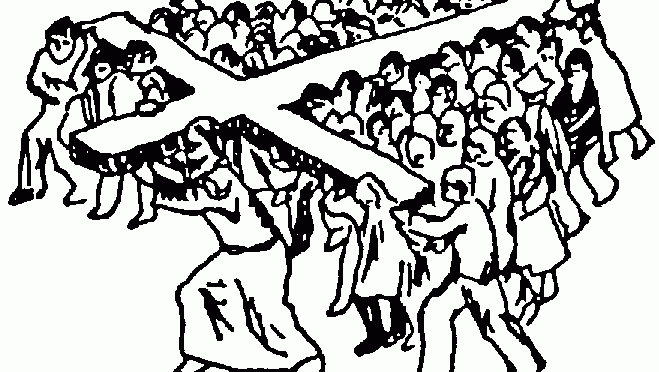
Church Membership vs. Carrying the Cross

Luke 14:25-33

“…So therefore, none of you can become my disciple if you do not give up all your possessions.” (Read the whole passage)

I remember when I was little and our family visited my grandparents. My grandparents living-room was always in perfect, pristine condition. Everything look new and unused, despite being dated with styles from decades before. Whenever we were in the living room, we had to be exceptionally careful not disrupt anything. No throw pillows could be moved, no dirt could be tracked, no signs of anyone actually being in the living room were allowed. Even as young child, I didn’t understand what the fuss was about – why was it called a living room, if there was no living allowed in it.

Now, as an adult, I understand only a slight bit more the desire to keep one’s possessions in good condition. And I also understand that nice things and children don’t really mix.

Yet, Jesus’s conditions on discipleship today, certainly poke at our materialism. We like our stuff, and Jesus knows it.

For a few weeks now, Jesus has been giving us the gears. Last week Jesus reminded us that we like to sit in the places of honour and send others down the table. Jesus continues the theme of pointing our faults, with his words on discipleship and possessions.

Today’s Gospel lesson has an unusual setting. Normally we pick up with Jesus in the gospels after he has traveled to a new place. But today, Jesus is still on the road. He is somewhere between destinations, with a crowd of people following him. You can almost picture it… Jesus and the disciples, on to their next village or town to preach in. And a large crowd following a short distance behind. From Jesus’s words to the crowds, we can guess that they were complaining. Kind of like the Israelites following Moses through the desert, the crowd is complaining about the journey. “Where are we going?” “When we will get there?” “What can we expect?” “What will we get out of it?” It sounds like the crowds are wondering whether following Jesus was a good idea, they are looking for something out of the deal. They want the benefits of being followers, but so far all they have found is a walk through the desert.

And so after hearing enough complaining, Jesus stops, turns and lays into the whiny followers behind him,

“Look, I didn’t say this would be easy. In fact, I told you that you would have to give up everything. Your homes, your families, your jobs, everything about your lives. If you are going to follow me, that means carrying MY cross.

You say you want to know what the plan is?!?! Yet, how many builders sit down and plan a whole project before beginning to build a tower? None.

You say you want assurances that we are going somewhere worth going to? Yet, how many Kings sit down with an enemy army across the field and say, “Well, looks like we won’t win. Let’s send out the white flag.” None.

If you want to be my followers, you are going to have to give up all the things tying you to your life before now.”

Jesus lays it out plainly for the crowds. They cannot hold on to their lives before and follow Jesus. Jesus knows that no builder can plan a whole project before its started. Think of all those contractors on HGTV who say things like, “Well, you don’t know how much the reno will cost before you open up the walls.” And yet the walls come down in search of show home living rooms and chef’s kitchens and dream master bedrooms. Jesus is calling out those who are grasping for the next new and shiny thing.

Think of all the wars being fought around the world for the sake of money and power. For the soldiers and civilians dying at the hands of kings and rulers who are trying to get or hold on to power. Jesus is calling out those who are clutching with all their might, and at any cost, on to power and control.

And now think of the church, and how we are like those crowds, looking for the things, the possessions that we can hold onto as well. Things like membership, with benefits like a reserved pew, or a key to the building, or eternal salvation.

But here is the thing about possessions. About the stuff we hold on to. The more we try to hold on, the more the stuff holds on to us. The more people want the next new and shiny thing, the more they become slaves to keeping up with the jones, to standing in line for that new iPhone coming out next week, or getting that new car, or having that kitchen renovated again. The more people try to hold on to power, to be in control, to call the shots,the more they must descend into darkness in order to keep power.

And here in the church, the more we see membership, faith and even God as something we have have, that we can own, that we can hold on to… the more it demands. The more weeks we have to keep making appearances to be in good standing. The more time we have to devote to keeping everything going, the traditions and duties and tasks. The more money we have to shovel into a hole that never seems to fill up. When membership and faith and God become possessions, they soon begin to own us, trapping us in a never ending cycle of keep it all afloat.

Jesus says, if you want to be a disciple, you need to give up your possession, give up all the things you are holding on to, because they will ultimately hold on to you and drag you under.

Jesus says, the thing you need to hold on to is the cross. Not your own cross, but his cross.

THE. CROSS.

And again, here is the thing about the cross.

We know that story. We know that Jesus carried the cross to Golgatha. We know that he hauled it up that mountain on Good Friday. But we also know that he stopped carrying the cross, because once he was on the mountain, the cross carried him. The cross held on to him. The cross trapped Jesus, just like all the things that we hold on to eventually do to us.

That is until Easter morning.

And all of sudden the cross that held Jesus on Good Friday, became the cross that holds all of us on Easter morning.

Jesus calls the crowds and calls us to carry the cross, because Jesus knows that we can’t carry the cross, because the cross carries us.

In world full of possessions that will hold on to us and drag us down – power, control, membership, status, new kitchens, pristine living rooms, things.

In our world full of all that, the cross is the only thing that lifts us up.

The cross is the place where the human need to hold on is met by God’s need to give up.

To give up wrath for love.

To give up judgement for mercy.

To give up sin for grace.

To give up death for life.

Jesus calls the crowds and us to give up our possessions, and not to literally empty our bank account and give away all our stuff. But to recognize that the things we hold on, keep us from seeing just what, or just who, is truly carrying us.

Our world will may never give up the quest for what is new and shiny. Our rulers may always be willing to sacrifice people for power.

Yet, God just may be calling the church to give up holding onto membership as something we own, to let faith be something that carries us. To see that the church is not a bottomless trap for energy, time and money.

But rather a community of the faithful.

A community of people who are being carried by Jesus, whose identities are being transformed by being together, who are called to work together to let the world know about this good news of giving up and letting go.

As Jesus calls out these crowds today, Jesus is reminding us of just who is doing carrying. Jesus is reminding us that the cross carries us. That Jesus’ love for the world, Jesus’ grace for sinners, Jesus triumph over death, all found on the cross, are what can truly carry us and lift us up.

Jesus tells the crowds and us today, that it is God, who was the first to give up everything. And that being a disciple, is not about what we carry, but about God who carries us.

Do Not Be Afraid… of Discipleship

Luke 12:32-40

Jesus said to his disciples, “Do not be afraid, little flock, for it is your Father’s good pleasure to give you the kingdom. Sell your possessions, and give alms. Make purses for yourselves that do not wear out, an unfailing treasure in heaven, where no thief comes near and no moth destroys. For where your treasure is, there your heart will be also.(Read the rest of the passage)


We are getting into those long summer days now, where finding a nice patio to sit on, or a shady tree to sit under with a cold drink, a good book and lots of sunlight and gentle summer breezes is about as good as life can get. As Canadians know, we like to put life on hold in the summer as much as we can, to enjoy the warm weather. School, sports, work, hobbies, and other activities are suspended as much as possible while we do whatever summery things we can fit in to life.

So when Jesus offers advice about being prepared and on guard… it is hard to get into the spirit. He gives us different images: Give away your possessions. Pull up your sleeves. Attend to your house for the coming of the Son of Man. Keep watch and wait… These aren’t normal summer activities. They don’t really fit our summer schedule of afternoon naps and long evening sunsets.

While we don’t read this today, Peter follows up Jesus’ commands with a question. He says out loud what many of us are thinking,  ‘Lord, are you telling this parable for us or for everyone?’ Like a good Canadian in summer, Peter is hoping that these commands to be diligent are not specifically for him, but more of a general warning, a take it or leave it kind of idea.

Peter makes a good point. Are these commands really for us? Is it even possible to do fulfill all of these demands? Giving away all our possessions just isn’t realistic in today’s economy. Waiting up all night for the master to return from a wedding banquet… well that image is outdated because none of us are slaves. And protecting our house from the thief is what locks, guard dogs and alarm systems are for. It is like Peter is saying, “Come on Jesus, the Olympics are on. Can we we just give the discipleship talk a rest for a few days?”

Jesus throws so many images at us that its easy to get lost in them. They are overwhelming and sorting through the meaning of each one may or may not provide answers. To figure this out we need to step back, take a breath and consider what the big picture is.

When it comes to faith and sorting out how all this God stuff applies to us, we are quick to look for the tasks that we think we need to do to make God happy. What do we need to get out of the way, so that we can get on with life, so that we can get to the real business of summer? This is at the root of Peter’s, and our question. If all these demands really do apply to us, what is the fastest and easiest way we can get them finished. How many times do we need to come to church? How many prayers do we need to pray?  How much money should we give? What else do we need to do to make Jesus happy?

We hope that completing the assigned tasks will satisfy Jesus, but that isn’t really what he is getting at today. Its not about the details, is not about breaking down faith into tasks and to do lists. The impossible demands that Jesus lists are just that — impossible. Faith is not something that can be reduced to simple instructions that we follow. Rather, faith is that relationship that finds us and grabs on to us. Faith comes from our gracious God who claims us and marks us in baptism. God pulls out of the details and our need to just complete the tasks that make God happy, and God does it with the first words that Jesus speaks today.

Do not be afraid. Words that echo throughout the bible. Words that always come before the announcement of the good news.

Do not be afraid. And we are standing with Sarah and Abraham as God calls them to be the mother and father of a nation.

Do not be afraid. And we are standing with Daniel as God promises to be with him in a foreign land and even in a den of lions.

Do not be afraid. And we are standing with Mary as she is told that she is pregnant with the Messiah, and that he will be Emmanuel — God with us.

Do not be afraid. And we are standing with the disciples in the upper room hiding in fear, and Jesus appears among us bringing peace, showing the holes in his hands and the mark in his side.

Do not be afraid. And we are standing here, and Jesus is telling St. John, that it is the Father’s pleasure to give us the Kingdom of God.

Its easy to overlook these first few words at the beginning. Its easy to get stuck with the details, stuck with trying to figure what exactly it is that Jesus is telling us to do.

Do not be afraid, these words, always accompany God’s promise. Do not be afraid. They come to us in big moments, important moments of faith. Moments when God is going to change the world. When God turns everything we know on its head. Do not be afraid, God speaks these words to us in moments that are confusing and terrifying, moments that give hope in the darkness. Moments when all seems lost and destroyed. Moments of promise that remind us first and foremost that God is doing something amazing in our world. Do not be afraid.

With these words, Jesus’ impossible demands to give ALL we have to the poor, to be ALWAYS on guard and ALWAYS watching for the return of the master, and to be CONSTANTLY alert for the unexpected coming of the Son of Man… with these words, Do not be afraid, Jesus reminds us that all those instructions coming next have less to do us and more to do with God.

And even more we hear today in this place that it is God’s good pleasure to give us the kingdom… whether we are ready or not. God gives us a treasure more valuable than any and all possessions: Grace and forgiveness… whether we are diligent or not. God comes from the heavenly banquet to bless and serve us with water, with bread and wine… whether we are watchful or not. As the Son of Man, God is breaking into our world, into our lives… whether we are waiting or not.

God pulls us out from all these impossible details. And in the midst of sunny days and olympics, Jesus says yes, these words are for you. Do not be afraid, for it is our Father’s good pleasure to give us the kingdom!

Amen.