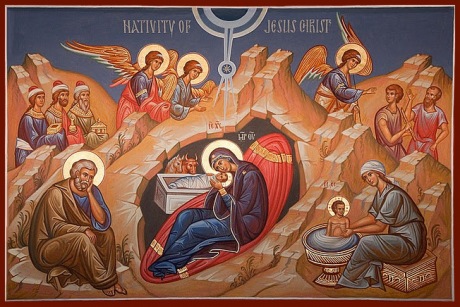
Mary’s story is our story

Luke 1:26-38

In the sixth month the angel Gabriel was sent by God to a town in Galilee called Nazareth, to a virgin engaged to a man whose name was Joseph, of the house of David. The virgin’s name was Mary. And he came to her and said, “Greetings, favored one! The Lord is with you.” But she was much perplexed by his words and pondered what sort of greeting this might be. (Read the whole passage)

Stir up your power Lord Christ and come.

Four Candles are finally lit today, and it isn’t long until that central Christ Candle is lit. Advent, as it always, starts by talking about the end, and then giving us two weeks to hear John the Baptists’s preaching about the coming of Messiah. But isn’t until Advent 4 that we get a story the feels like it belongs to the season… or least it isn’t until this Sunday that we hear a story seems to move forward our desire to roll the calendar over to Christmas.

And with the unusual experience of Advent concluding this morning and Christmas beginning this evening, we get a true mixed experience today.

But before we can bust out the carols and presents, Advent needs to give us our last reminder of what it means to wait for Messiah, a qualifier for our celebration of Christmas.

Just in case we think the Angel Gabriel’s visit to Mary is a Christmas story, we are reminded today that it is an Advent story. And quite the Advent story it is. We hear this story of Gabriel and Mary and it is easy to imagine a young grade schooler wrapped in a bath robe and shawl, woodenly reading lines as she receives the news that she is pregnant. The pageant version of this story is the one we easily imagine, but certainly unlike the moment when most women find out they are pregnant.

It is easy to imagine the young virgin, meek and mild, humbly and graciously receiving the angel’s news. It is natural to picture the made for TV Christmas movie version of the story, the version where there is no doubt that whatever tension presents itself in the story everything will turn out in the end. The idyllic nativity sets confirm this. The nostalgia laced Christmas greeting cards confirm this.

And yet, the actual story was anything but idyllic.

The story of Gabriel’s annunciation is a story in the real and messy world. A story that is less made for TV movie or Christmas pageant, and more real life stuff that usually happens in the privacy of our personal lives.

When Gabriel told the young Mary that she would conceive and bear a son, it was likely not welcome news. Mary’s life plan was certainly different than this development.

In Mary’s world, women had few options. Marriage and motherhood was the ideal, a woman’s worth was in the ability of her body to give sons to her husband. Sons to carry on their father’s lineage who would also be the retirement plan for most women, someone to care for them once their husband died.

Yet, if a woman couldn’t provide children, or couldn’t reliably provide children that belong to her husband because she wasn’t virgin before marriage… well that likely meant divorce and being tossed onto the streets. Pregnancy outside of marriage meant becoming a single mother living on the streets in the best case, execution by stoning at worst.

And so as Gabriel announces this news to Mary, she is right to be much perplexed. This just about the worst thing that could happen to a young unmarried woman. Hardly the stuff we think about during the Christmas pageant. This is messy and real life. This is the kind of stuff that many of us had to deal with – life altering changes of course,

This is kind of stuff that we know all too well in life. Things that happen to us beyond our control that change the entire course of our lives. Things like job loss, death of a loved one, separation, diagnosis of an illness or unplanned pregnancy…. The most difficult life altering parts of our lives that require all we have just to keep it together.

Mary’s story is a real life story, a story about the messiness of life.

But it also the story of God finding us in the mess, in the struggle, in the realness.

Long before the angel interrupts Mary’s life plan with news of her pregnancy, Mary lived in a world where she was less of a human and more of a piece of property or livestock, where her marriage was likely arranged by her family as they were making a business deal. And of course there was the messiness of her own people and culture that was compounded by the fact that they all lived under Roman occupation.

Yet, when the Angel first greets Mary, the Angel says, “Greetings, favoured one! The Lord is with you.”

Right from the very beginning, God does something new and unexpected with Mary. God determines her worth and value before anything else. Mary is favoured by God. Not because she is a fertile body waiting to be impregnated. Not because she will bear the Messiah. But simply because she is herself.

Greetings favoured one!

And then God gives Mary a purpose, she will be the one who will bear Messiah to the world. In a twist of irony, by choosing Mary to do the one thing that her world values her for, bear children, God takes away her cultural and social value. And instead, God imbues her with divine value. She is favoured because God has said so, and God then gives her a purpose in bearing the Messiah. God establishes her value and then gives her a purpose, opposite of the way her world works – where value is only given if one produces something considered valuable.

Right from the beginning of the story, God is at work doing something new, transforming Mary’s life in unexpected ways.

God is at work in Mary’s real story, her messy, struggled filled story.
And remarkable as Mary’s real life story is, it is not special.
Because Mary’s story is a universal story, it is our story.

God has a way of finding us in the midst of our messy, struggled filled and very real lives too.

God finds us in the middle of real life, and breaks through all the things around us that would tell us our value is based on what we can do in the world…

God breaks through all the things that would tell us we are barely more than things that can be owned and that which is less than human.
God breaks through to us, and declares that we too are favoured.
God breaks through and says that the Lord is with us.

As we gather round the font of baptism, God sends a message to us, given through divine messengers – Angels, you could say – but truly the Church, the body of Christ.

The church, through whom God speaks, to each new member among us:

You have been sealed by the Holy Spirit and marked with the cross of Christ forever.

And as we welcome the newly baptized among us we say:

We welcome you into the body of Christ and into the mission we share:
join us in giving thanks and praise to God
and bearing God’s creative and redeeming word to all the world.

Join us in bearing God’s creative and redeeming word to all the world, just as Mary, Mary the God bearer did.

Just as the Angel, the divine Messenger, tells Mary that she will bear a son, the son of God – that she will bear the Christ, the Christ who is the Word…

God tells us the same.

God declares that we are favoured, that we are marked with the cross.

And that God us will use to bear the word, Christ who is the word, to the whole world.

So you see, Mary’s story is not truly a pageant story or made for TV Christmas story.

It is a real story.

It is our story.

Today, as Advent takes us through the final parts of the story, the ones that lead us to Christmas, we are reminded that this is a real story. A messy story. A story more like our lives than the nostalgia so prevalent this time of year.

And it is real because it is the story of God’s breaking into our lives. Breaking into our mess in order to bring Messiah, the Word, the Son.

In order for Christ to come and take flesh among us.

So, stir up your power Lord Christ and come.

We are not Messiah

John 1:6-8,19-28

This is the testimony given by John when the Jews sent priests and Levites from Jerusalem to ask him, “Who are you?” He confessed and did not deny it, but confessed, “I am not the Messiah.” And they asked him, “What then? Are you Elijah?” He said, “I am not.” “Are you the prophet?” He answered, “No.” Then they said to him, “Who are you? Let us have an answer for those who sent us. What do you say about yourself?” He said, “I am the voice of one crying out in the wilderness, `Make straight the way of the Lord,'”  (Read the whole passage)

I am not.
No, not Elijah.
I am not the Messiah.

Three Advent statements on this 3rd Sunday of the season.

We are into the the third week of Advent, the third week of our period of waiting and watching. Of wondering and mystery about the coming of Messiah. Advent began by speaking of the end, speaking about our waiting for the Son of Man to return and bring about the great cosmic setting to right all of creation. Last week Mark introduced us to the coming of Messiah, first in the words of Isaiah who spoke to exiles longing to return home to God’s care and compassion, and then in the words of John the Baptist’s warning of the Messiah coming to offers us a swift kick in the pants!

Today, John is back again. Preaching this time to us from the gospel of John. And John has a curious conversation with the priests and levites – the temple authorities.

They want to know who he is, but the way John tells them seems roundabout, almost backwards.

John identifies himself by who he is not.

Imagine coming to a church for the first time, you might introduce yourself to the first person you meet,

“Hello, my name is Erik.”

“I am not the Pastor.”

“Okay, then what is your name, are you the usher?”

“I am not the usher.”

“Well, then who exactly are you?”

“I am the voice of one crying in the narthex, prepare the bulletins and hymnbooks.”

That would be a pretty weird interaction.

Yet, John isn’t being as strange as it may sound. In fact John is doing something we do often too. As Canadians we often identify ourselves as not being Americans. As Lutherans was have often identified ourselves as not Catholic.

So when John says he is not the Messiah and that he is not Elijah, it means he is identifying himself by who he is not. To know he is not Elijah means to know that he is not the return of the great prophet. To know that he is not the Messiah means he knows that his purpose is to point to the Messiah, to know who the Messiah will be and what the Messiah will do. John knows that he is not the Messiah, but that his identity and his purpose are tied closely to Messiah’s.

I am not.
No, not Elijah.
I am not the Messiah.

John tells the priests and the levites that he is not the Messiah. John hasn’t come to save the world.

What John demonstrates is that the priests and the levites, perhaps obviously, don’t know who the Messiah is. And they wouldn’t know the Messiah if they were to see the Messiah. But shouldn’t they know? As the religious leaders of the people who have been waiting for the signs of Messiah’s coming for generations, shouldn’t they know?

The same could be said of us. As Christians in a long line of people preaching about and waiting for Jesus to return, shouldn’t we be more clear on who the Messiah is?

And yet, because we wonder what God is doing with us and wonder when Messiah is coming, we have become unclear about who we are too. Are we communities of the faithful, gathered around the same core things that have given Christians meaning and purpose for centuries, the Word of God and the Sacraments? Or are we community centres? Social clubs? Culture clubs? Music appreciation societies? Social justice groups?

If we could be a little flashier, a little more attracting of the crowds, if the glory days of old could come again… if we could just go back to being the confident churches we once were, then we could be confident in knowing what God is up to in our world and up to with us.

But we have just as many questions as the priests and levites. Struggling under decline and aging, feeling out of place and irrelevant in our world, waiting for things to change… we have forgotten who we are, and we wouldn’t know if God was working in and through us, even if we saw it.

John the Baptist speaks with clarity and certainty about who he is not. He is not the Messiah, he is not Elijah, he is not the prophet.

And because John knows who he is not, he knows that he is not the one who will save God’s people, nor does he carry that burden.

He knows that he is not the return of Elijah, the embodiment of Israel’s greatest hopes, and he doesn’t have to live up to the impossible standard.

He knows that he is not the prophet, the one calling the people back to God, and he doesn’t need forge a new path for them.

And John knows this because God has given him an identity. John is the voice of one crying out in the wilderness, ‘Make straight the way of the Lord.’

John is a witness, a preacher, a disciple, a follower. He is not the one coming to save, but the first to admit that he needs saving.

John’s clarity is rooted in the identity that God has given to him. He is not the Messiah, but deeply connected to the Messiah… John is a witness to Messiah, a sinner forgiven by Messiah, the dead one raised by Messiah, the lost one saved by Messiah.

I am not.
No, not Elijah.
I am not the Messiah.

The identity that God has given to John, is the same identity that God has given to us.

Even as we forget and become unclear about who we are, and therefore who God is, the Messiah reminds us again and again where our identity is given.

In the waters of baptism, God names us as God’s own.

Forgiven yet sinners,
made whole yet broken,
reconciled yet estranged,
found yet lost
alive once dead,

God names us in the waters, and reminds us of who we are, week after week as we receive forgiveness and mercy.

God gives us an identity rooted in the stories told here week after week, as we proclaim anew the coming of Messiah into this world.

God joins us together as one, at the table of the Messiah, we become that which we eat, the body of Christ.

And this identity that God gives to us, allows us to know who we are not. Just as the identity that God gave to John, allowed him to clearly know who he was not.

We are not the ones called to fix everything, we are not Messiah.

We are not the ones called to restore the glory days, we are not Elijah.

We are not the ones called to point out everyone else’s flaws, we are not the prophet.

We are not.
No, not Elijah.
We are not the Messiah.

We are the baptized, God’s children made alive through water and the word.

And because the identity given to us in the waters of baptism tells us who we are, it also allows us to know and to see the Messiah coming amongst us.

The Messiah who is the one, coming to forge a new way and a new path for God’s people.

The Messiah who is the one who embodies our greatest hopes, but also who brings to fulfillment God’s hope for us.

And the Messiah who is the one coming to save. The one in whom children of God, the sinners and broken ones, the broken and estranged ones, the lost and dead ones… the Messiah in whom people waiting for light and life discover who God has named them to be.

Waiting to Prepare the Way

Mark 1:1-8

The beginning of the good news of Jesus Christ, the Son of God.
As it is written in the prophet Isaiah,

“See, I am sending my messenger ahead of you,
who will prepare your way;
the voice of one crying out in the wilderness:
‘Prepare the way of the Lord,
make his paths straight,’”

John the baptizer appeared in the wilderness, proclaiming a baptism of repentance for the forgiveness of sins. (Read the whole passage)

Light two candles to watch for Messiah, let the light banish darkness… or so the song goes.

We are fully half way done the season of Advent with only two weeks to go until Christmas. Just as we begin Advent each year by hearing Jesus’ proclamation about the end of the world, the second Sunday of Advent always introduces us to John the Baptist, and his preaching in the wilderness about the coming of Messiah.

As we begin making our way through Mark’s gospel this church year, it stand in contrast to the other gospels. Unlike the start of Matthew or Luke, Mark’s telling of the incarnation – of Jesus coming into the world – is a little different than what we might expect.

“The beginning of the good news of Jesus Christ, the Son of God.”

There are no angels, pregnant virgins, shepherds or mangers. There’s no Christmas pageant using Mark’s account. No shepherds in bathrobes awkwardly delivering Mark’s dialogue.

Mark gets straight to the point. Yet, there is a lot being said in the economy of Mark’s words.

The good news starts now. The good news starts with this guy named Jesus. And this guy named Jesus is the son of God.

Then to explain that statement about the good news and Jesus, Mark quotes from the prophet Isaiah. But Mark expects a lot of his readers, and when he quotes from Isaiah, he expects that the first line is enough for us to fill in the rest and get the picture. Fortunately for those of who haven’t memorized the 66 chapters of the book of Isaiah, we read the passage that Mark quotes just a few moments ago.

“Comfort, O comfort my people, says your God. Speak tenderly to her, that she has served her term, that her penalty is paid, that she has received from the Lord’s hand double for all her sins” (Isaiah 40:1-2)

This passage from Isaiah comes at key moment for the people of Israel. The first 39 chapters told of the story of the exile into the Babylon, when the religious and royal class of Israel was forcibly removed from their home and sent to live in Babylon for generations.

Yet we come into the story precisely a the moment that everything changes. The exile has ended, and Isaiah pleads with God to be gentle with God’s weary people. They have endured a lot and need the time to recover. And now begins the story of the return of God’s people to their homeland. God is no longer the wrathful who has angrily sent the exiles away because of their sins, rather God is now the gentle saviour redeeming the tired and weary people of Israel. The exiles’ experience of God is completely transformed from this moment onwards.

And Mark quotes Isaiah expecting that we know this story well, the story of exile and return from exile. Even more so Mark expects that we will see that he is connecting Jesus to this important moment when everything changes for the Israelites.

Mark is saying, “Hey remember that moment when God changed everything by bringing the exile home? Well, this Jesus guy is changing everything too.”

And then Mark takes another left turn, keeping us on our toes only a few lines into the story, by introducing us to John the Baptist.

John, the rough around the edges desert preacher and prophet, who is attracting crowds and gaining the popularity of the people while drawing the ire of those in charge. John is quite the character dressed in camel hair, eating giant desert insects and preaching from a river.

But perhaps most jarring of all in this short passage of Mark’s, is that John is quiet opposite to Isaiah. If Isaiah is pleading to God for comfort, compassion, and tenderness for God’s weary people, John is warning of the swift kick in the pants to come if they don’t repent.

So is anyone confused by all this stuff in Mark? Good, that is the point.

Not unlike the Israelites, we might know a little something about being tired… about being weary… we might know about longing and waiting for God… for Messiah to show up, to transform our lives. It is exhausting trying to keep the faith and have hope for the future.

These days it can feel like the pressures and stresses of the world are pressing in from all sides.

Maybe it is burdens of work and family, trying to juggle more than we know we can handle and watching as things are dropped, promises unkept, people forgotten.

Maybe it is small towns and rural communities struggling to keep up as government funding is being cut, business not being able to make it anymore, schools and hospitals closing.

Maybe it’s waking up every morning wondering if nuclear war broke out overnight because of some blowhard’s tweet.

Maybe it’s the slow and steady decline of churches with aging members, fewer hands to do the work, and searching for ways to provide pastoral ministry.

Take your pick.

The list of burdens on our minds and lived out in our daily lives is long. It’s no wonder we feel weary. It’s no wonder we wait for God to show up in our lives and in the lives of our family, friends and neighbours.

Here’s the thing about Advent: when waiting for Messiah becomes about things deeper than opening the little doors on advent calendars and collecting our chocolate treat, or counting the days until Christmas, it raises questions. Questions about where this Messiah that we are waiting for is in our world. Where Messiah is in our lives.

We long for the God of Isaiah to come and show us weary people some compassion and tenderness.

We know that we need the Messiah of John the Baptist to come and give us swift kick the pants to keeps from atrophy.

But it’s the waiting… the waiting is what we cannot abide.

Because waiting has no answers until its over.

This is what John and and Isaiah have in common. They are both speaking to the waiting of God’s people. Whether they are proclaiming a tender God who brings comfort or a  powerful God who comes preaching repentance… they both are speaking to people who wait. To exiles whose waiting in exile is about to end, to Israelites waiting under oppression for Messiah.

To 21st century Christians waiting for God again this advent.

The promise is and has always been that Messiah is coming soon.

As Isaiah says:

‘Prepare the way of the Lord,
    make his paths straight.
Every valley shall be filled,
    and every mountain and hill shall be made low,
and the crooked shall be made straight,
    and the rough ways made smooth;
and all flesh shall see the salvation of God.’”

Take you pick of burdens that cause us to wait,
valleys or hills and mountains,
crooked paths and rough ways,

Messiah is coming for all it.

For people who need the tender compassion of God,
for people who need the swift kick in the pants.
For people who carry the burdens of work and family,
of shrinking rural communities,
of the threat of tweet induced nuclear war,
of aging and declining churches.

Messiah is coming for all of that too.

And yes, not knowing when Messiah is coming, and having to wait is the hardest part of all.

Having to do Advent over again and again, with its questions about where God is in our world and in our lives is not easy. We want to know, how, where, when.

But the only answer is a promise, a promise that we hear every Advent again and again.

Messiah is coming.

Messiah is coming for a world in need.
Messiah is coming for people of faith who hate waiting
Messiah is coming for  you and for me.

Messiah is coming…

Soon.


  • Image credit: http://www.swordofthespirit.net/bulwark/dec08p2.htm
  • This sermon was co-written with Rev. Courtenay Reedman Parker Twitter: @ReedmanParker

The Lord Christ is coming – The Messiah has always been here

Mark 13:24-37

Jesus said, “In those days, after that suffering,
the sun will be darkened,
and the moon will not give its light,
and the stars will be falling from heaven,
and the powers in the heavens will be shaken. (Read the whole passage)


It would probably be a safe bet that no one attended a rocking new year’s eve party last night.

Advent, and the beginning of a new church year is pretty understated as far as New Years goes. Never the less, we are taking the first step of a new church year today. And as always, we begin with Advent.

Advent is the season of waiting and watching. We drape the sanctuary with blue, a colour representing hopeful anticipation. We light candles to symbolize the light of Christ coming into the world. We hear stories of the waiting of Israel for Messiah, and then Jesus’ own words about the end of the world.

And we do all of these somewhat odd things while the rest of world is frantic with Christmas fever, the lights and decorations having been out long enough to be gathering dust, and the music has gone stale on the radio and over mall speakers.

As is often the case, we find that the church tends to do the opposite of the world.

And so today, we slow down to light our lamps and watch for the signs of the coming Messiah.

As we hear Jesus begin our advent season, the thing he is talking about is the end. He gives us a prophecy, a glimpse of the end of the world. Signs found in darkened celestial bodies, and the coming of the Son of Man in glory.

And Jesus is speaking to an audience that has been waiting for Messiah for generations. The people of Israel had been waiting for a long time for God to send the one who would free them from oppression, release them from their suffering and re-establish a divine rule by one of God’s appointed kings, and not foreign occupiers like the Romans.

The Israelites had been waiting since the time that Isaiah prophesied Messiah’s coming, hundreds of years before Jesus’ day. And during that time life had not been easy. Israel had constantly been surrounded by enemy nations, there had been constant destruction and ruin. But despite this, the promise they clung to was that God was sending a promised Messiah, a saviour who would come to free them.

By Jesus’ day the Israelites were growing restless… but they could also see the signs. King Herod had killed all the children in the holy town of Bethlehem around the time of Jesus’s birth, and John the Baptist decades later had begun preaching in the desert. And now here was the one, the wandering preacher and healer, telling them of the coming Messiah.

The people could feel that it was close, that Messiah was in the air. The signs were there, and here was the one whom many thought to be Messiah, Jesus of Nazareth, and he was telling them of God’s plans to restore creation and set the world to right.

Finally, Messiah was close at hand.

2000 years down the road, we might not be living with that same kind of imminent sense of Messiah’s coming. While we hear the stories and read of Messiah’s impending coming, we do so year after year, decade after decade, lifetime after lifetime. And the stories written with such urgency take on a different meaning and we hear them in different ways.

And these days, as so many of us wonder about churches and the future of the faith in our part of the world, we feel less like the crowds listening expectantly to Jesus the Messiah in flesh announce God’s plans to restore creation, more like those who had been waiting generations before. We feel more like those who heard Isaiah’s words:

We all fade like a leaf,
and our iniquities, like the wind, take us away.
There is no one who calls on your name,
or attempts to take hold of you;
for you have hidden your face from us,
and have delivered us into the hand of our iniquity.

Isaiah has us pegged.

The grand visions of Jesus in Mark are not the clear and blinding signs for us that they were for the people of Jesus’ day. For us, they are hazy and hard to make out. The cosmic re-ordering that God is about to undertake feels more abstract and far off, than immediate and close at hand.

We faded leaves know the struggle. We know what it is to be tired and to wait, to feel thinned out and week. It is hard to keep the faith these days. Hard to keep showing up to hand out bulletins and sing God’s praises. Hard to volunteer to vacuum the church and receive forgiveness. Hard to look at budget statements and council reports AND pray without ceasing.

Jesus’ exhortation to ‘Keep Awake’ is hard enough to do during the sermon, let alone to keep vigil day after day, week after week, year after year.

But the Church has known this. Christians have known that waiting for the Messiah is both a long and a short game. Even as Mark was setting down his gospel only 30 years after Jesus rose from the dead, the early church was wondering when Jesus would return. Those first witnesses to the resurrection were getting old and beginning to die off.

And ever since, the church has lived with the sense of the now and not yet. The sense that God’s Kingdom is here NOW among us. And that God’s grand future plans to restore all creation have NOT YET come to fruition.

So we live with this dual reality. The reality that Jesus proclaims, the coming Son of Man and the reality of Isiah, that we are fading leaves waiting to be blown away in the wind.

Each Advent we begin by acknowledging this reality with the words of the collect or prayer of the day. While most begin by praising God, in Advent we begin with a petition, a request. And we direct it not to God the Father, but straight to the long awaited Messiah.

Stir up your power, Lord Christ, and come.

Stir up your power, Lord Christ, and come.

We pray knowing that we need, ever so desperately the stirring up of Messiah’s power.

And we pray knowing that the Messiah, the one sent to save us is finally now, after our long waiting is stirring up power like a pot boiling over.

Stir up your power, Lord Christ, and come.

And as the Israelites waited and waited for the coming of Messiah, even as they faded like leaves blowing in the wind.

And as the crowds heard Messiah himself preach the coming of God in power, even as they could feel Messiah in the air.

And as we grow tired waiting for something to happen among us, even as it is hard to keep up the faith.

And as the church of today sits at a moment of tremendous change, even as we don’t want to see it.

The Lord Christ is coming.
The Messiah has always been here.

The Lord Christ is coming, even when we find it hard to believe, even though it feels painfully slow. The Lord Christ is coming to bring an end to suffering, to make our upside down world right, reconcile all creation to God, to restore us all to what God intended us to be. It just has NOT YET come fully.

And the Messiah has always been here, already among us, here NOW, giving us mercy, forgiving our sins, showing us resurrection and new life.

The Messiah has always been here, present in the word of God, made manifest in the words that sound from our lips and in our midsts.

The Lord Christ is always coming to us from the waters of baptism, pulling us into a not yet future, where our sin and selfishness are no more, where we die and rise to new life.

The Messiah Lord Christ is here and yet coming to us in the bread and wine, body and blood, where God meets us, where God binds and joins us to Christ, the now risen and still coming one.

Even as we wait, even as we grow tired. Even as the story is told over and over again from the people of Israel to now…. God is bringing us from the end to the beginning.

From Advent and its promises of the great cosmic plan of God, to the beginning, to the beginning of God’s new creation born within us that first Easter.

Sure, there probably no new year’s eve parties last night.

But that is because God’s great and never ending party, starts here today.

Christ the King and the pearly gates checklist

Matthew 25:31-46

Jesus said, “When the Son of Man comes in his glory, and all the angels with him, then he will sit on the throne of his glory. All the nations will be gathered before him, and he will separate people one from another as a shepherd separates the sheep from the goats, and he will put the sheep at his right hand and the goats at the left. Then the king will say to those at his right hand, ‘Come, you that are blessed by my Father… (Read the whole passage)

The end has finally come.

Today is Christ the King Sunday, the last Sunday of the Church year. And since last Christ the King, we have waited for Jesus in Advent, sung with the Angels at Christmas, marked ourselves with ash and wandered the wilderness in Lent, walked the way of the cross in Holy Week, and been terrified by the empty tomb with the women on Easter morning. We have heard Jesus preach, and teach, and heal, and exorcize demons. We have commemorated the 500th anniversary of the Reformation, remembered the saints and all along the way we have listened for God at work through prophets and parables, psalmists and songs, the voices of young and old.

And so, finally, on this last Sunday of the church year, we celebrate Christ the King. Only Jesus is not the type of king we expect, or anticipate. Jesus does not look, or act, like any king we know. Christ the King rules in a way completely opposite what is known.

Christ the King Sunday points us to the end. To the end of time and all things when Jesus will return in order to reconcile all of creation back to God.

Jesus is wrapping up after spending time teaching the crowds and he finishes with a scene from the end times, something that sounds like the final judgment: “When the Son of Man comes in his glory, and all the angels with him, then he will sit on the throne of his glory. All the nations will be gathered before him, and he will separate people one from another… the sheep from the goats”.

For Jesus’ audience this would sound like pretty radical stuff. All these texts that we have been listening to these last weeks, in particular the parables Jesus has been telling since the triumphal entry: the parable of the ten bridesmaids, the wicked tenants, the talents, the wedding banquet, have been leading up to this moment. Jesus has been provoking the crowds and the temple authorities, who just a few days ago were shouting “Hosanna, son of David” as he rode into Jerusalem. Today, Jesus gives them the last straw: Jesus preaches this judgment scene which sounds like pretty standard fare to our modern, Christian ears: feed the hungry, clothe the naked, visit the sick, and those imprisoned. But to his audience, in particular to the religious authorities, this would not have sounded like the route that they were taught would obtain righteousness and salvation. In fact, Jesus seems to have gotten everything upside down.

According to the laws of Israel, in particular to the temple cult of Jesus’ day, righteousness and salvation were not earned in the way that Jesus describes. Righteousness was obtained by keeping the law, staying ritually clean, and making sacrifice in the temple. Whereas, what Jesus describes does the exact opposite of that.

Food was one of the primary ways you could become unclean. So sharing a drink or food with someone who is thirsty or hungry presumably  poor and unclean, is a quick way to become unclean yourself.

Naked people are unclean.

Strangers, for example foreigners or Gentiles, unclean.

The sick, unclean.

Prisoners (debtors or sinners), unclean.

Getting too involved in the affairs of your neighbours was one of the quickest ways to become unclean and therefore unacceptable to God.

That’s not to say people didn’t look after the poor. Levitical law required the giving of alms, but putting some money in the box for the poor at the temple was a little different than what Jesus was suggesting – getting down and dirty with your neighbour.

So when Jesus describes what it looks like to be righteous, what it looks like to get into heaven, his audience would not have heard it as a list of good works, but as a complete undoing of what they knew and understood about salvation.

Fast forward 2000 years. We are not that different than Jesus’ audience. We might have a different list than the people of ancient Israel, but we still have a list. It just so happens that our list of good works sounds a little but closer to the list Jesus provides.

Our sacrifices might not be animals in the temple, but we give up our Sunday mornings and money into the offering plate.

We might not worry about ritual cleanliness, but we certainly worry about looking like good Christians to the rest of the world.

We might not worry about keeping the law, but we certainly worry about whether our kids and grandkids are keeping the faith.

There is a whole list of things that we have, whether it’s praying enough, reading the bible enough, serving at the soup kitchen or knitting enough mittens for the mitten tree or quilting quilts for CLWR, or mowing the cemetery lawn.  with all of these good works that we spend a lifetime trying to pile up, one of our biggest concerns is the person who lives a fast and loose life before having a deathbed conversion and cheating their way into heaven after we did all this work. Like the people of Jesus’ day, we are still experts at making salvation into some kind of checklist or point system that we can achieve on our own.

Jesus isn’t proposing some kind of bait and switch for “things that get us into heaven” but the thing that Jesus is getting at is who it is that is working out our salvation.

As Jesus describes this scene of the end times, there are a couple of key details that would have jumped out to his audience:  The first is the whole group of people who are gathered before the king: good and bad, sheep and goats. But for Jesus’ audience, righteousness was something that was worked out here on earth, not something that was determined at the pearly gates. The second detail, was that Jesus’ criteria had everything to do with our relationship to our neighbour, but the Israelites knew that righteousness had everything to do with your relationship to God. It’s almost as though Jesus was saying everything they knew about righteousness is upside down, that God is the one working out our salvation.

Jesus’ version of the end of time is a completely new understanding of our relationship to and with God. Because if God is working out our salvation, that means we don’t have to. But it also means it’s not up to us. As freeing as it is for God to be the one doing the work, it is also terrifying that we aren’t.  And that we have no control.

Even though the religious authorities and crowds won’t respond all that well to Jesus’ suggestion that God is the one doing all the saving, God keeps at it anyway. God continues God’s work of reconciliation and redemption.

And it isn’t long after this, that Jesus will end up on the cross. The cross, which is Christ the King’s throne. And the foot of the cross is the place where all people, good and bad, sheep and goats are gathered. The judgment that Christ provides from that throne cross is neither about who’s in and who’s out, but a judgement that declares that we are forgiven and free from our sins, that we are given resurrection and new life.

And despite all of our doing and trying, our checklists and point systems, Christ the King is gathering us up too at the foot of the throne cross.

And for all the sacrifices that we think we make and offer up to God, God is the one offering God’s self to us in the body and blood of Jesus Christ.

For all our attempts at keeping the faith in this generation and the next, God’s faithfulness has already been given to us and proclaimed to us in the word from generation to generation.

For all our attempts at looking like good little Christians, God names us and claims us God’s own in the waters of baptism.

Every Sunday, God gathers us at the throne cross, we who are thirsty and hungry, we who are sick and imprisoned, strangers in need of mercy and says to us, “Come and inherit the kingdom”.

This sermon was co-written with Rev. Courtenay Reedman Parker

An iPhone Pastor for a Typewriter Church