Left Over Corners, The Sin of White Supremacy, and The Doctrine of the Trinity

GOSPEL: Matthew 28:16-20
16Now the eleven disciples went to Galilee, to the mountain to which Jesus had directed them. 17When they saw him, they worshiped him; but some doubted. 18And Jesus came and said to them, “All authority in heaven and on earth has been given to me. 19Go therefore and make disciples of all nations, baptizing them in the name of the Father and of the Son and of the Holy Spirit, 20and teaching them to obey everything that I have commanded you. And remember, I am with you always, to the end of the age.”

The high school I attended in Edmonton was one of the biggest senior high schools in Canada, with a diverse population of 2500 students. A 60s building experiment with no windows, it looked like the mixture between a shopping mall and a bunker. In the middle of the school was a large square sunken-in indoor courtyard called the rotunda. On the four sides were the main office, the cafeteria, the doors to the school theatre, and the the wall of trophies. 

With so many students, it was often crowded in the hallways. The rotunda was a place that students naturally congregated during breaks. One particular memory I have is how student separated themselves into groups. In the four corners of the rotunda, groups would gather often according to the colour of their skin. In one corner the black students, another the Asian students, another the students from southeast Asia and the other the Middle-Eastern students.

And in the hustle bustle of breaks and lunch, these groups would throw pennies and mock others students walking by. Yet whenI walked by, these corner groups left me alone. Even as every students walking in front of me had a penny thrown at them, I wouldn’t. I always passed by unbothered.

I always assumed it was because I was a football player, often wearing my jersey or football jacket. I thought was big and tough, too risky to bother. 

It wasn’t until relatively recently that it dawned on that me that this wasn’t the whole story. I was left alone because I was a white kid. A white football player. They knew that if I reacted and fought back they would get in trouble, a phone call home, a detention or a suspension. While I would only get a slap on the wrist. 

When I finally realized this truth year later, I then wondered why these students were harassing people in the first place.

To answer that question, you need to first ask where all white students were. And the answer is everywhere. The white students filled the tables and chairs in the cafeteria, they sat along the walls of the rotunda to each lunch, they were on the steps down, they were in the middle where you could sit on the ground. But the corners, the corners were the worst place to be. They were busy intersections where you couldn’t sit and eat without being tripped over, where you had to stand and hug the wall. 

The white students took up all the good space, and left the scraps to the racialized students. 

This is what white privilege looks like. This is white supremacy. My prominent memory was of the students in the corners, grouped according to their skin colour but not the fact that the white kids took up all the good spaces. For years, I conveniently overlooked the white students taking up all the good space while being annoyed and offended by students of colour occupying leftovers. 

And even though I try to be aware of my biases, this makes me I realize that I need to go back and review the ways in which I am regularly participating in the systems and structures that privilege my white body over the the bodies of people of colour.

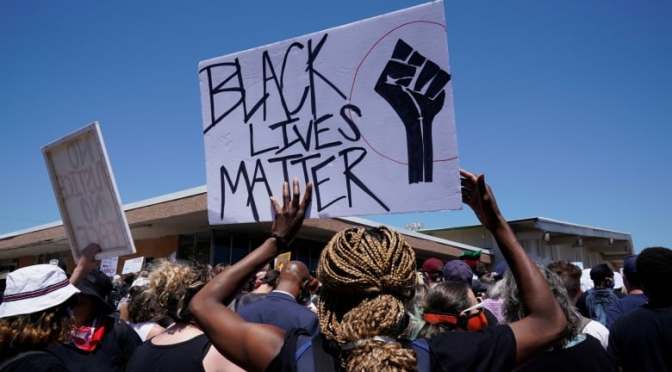
As protests in Minneapolis, across the United States, here in Canada and around the whole world continue night after night, the reality of the inequalities and suffering of black people, of indigenous people and people of colour all around us have been brought to our attention.Our blissfully oblivious world as white people has been rocked this week by the cries for justice of our sibblings of colour. We can no longer pretend like we don’t know what is really happening any more. 

And so we recognize that the systems and structures and attitudes that exist in us and around us uphold white supremacy, even as we may try ourselves, as white people, to distance ourselves from it. Even as we try to be good people who don’t hold malice towards or hatred for anyone. We recognize that we benefit from a world that privileges us because of our skin, and that even though we face struggles and hardships in our lives, one of them isn’t the daily obstacles of racism and discrimination. 

So today, we name White Supremacy as sinful. 

But not sinful in the sense that it is something that gets you on Santa’s naughty list… rather something deeper. White Supremacy is a sin in how it separates and divides us, how it is a distortion of our relationship with God, with others, with creation and with ourselves. We recognize and then confess that white supremacy is a sin because it elevates some people above other people for arbitrary reasons. It attempts to claim that some (white people) are more fully human, while others (people of colour) are less human.

Now you might be asking by this point why the pastor is talking about racism, white supremacy, and the protests for Black Lives Matter and George Floyd on Trinity Sunday. What do they have to do with the Trinity?

Well… they are in fact deeply interconnected. 

Trinity Sunday is often filled with cute, yet borderline heretical examples and descriptions of the Trinity such as: God is like an apple pie, or God is like the three states of water.  

Yet, the doctrine of the trinity is ultimately about relationships. The trinity is a doctrine of community. 

The Trinity is a community, three persons, Father, Son and Holy Spirit, one God, one Body, one Community. 

At a time when the divisions and separations, the community splitting realities of racism and white supremacy are being revealed to us daily… the Trinity both models to us  relationships and community as they ought to be. 

Relationships of mutuality and sacrifice, relationships of give and take. In the the Trinity, the 3 persons are co-equal, and yet there are times when on member steps forward while the others step back. It is the Father’s voice that speaks in creation. It is the Son that is the Word of God enfleshed. It is the Holy Spirit’s breath that blows through the disciples and into the world at Pentecost. 

And so this week, as the Pentecost spirit lifts up the voices of Black Indigenous People of Colour, it is our turn as mostly white siblings in faith to listen.  

It is our turn to step back, to make room for voices that have been relegated to the left over corners of the world. To wonder why we have been content to stand by as our brothers, sisters and siblings of colour have pushed to margins to suffer. 

And then it is our turn to follow our siblings of colour into the work of justice.  

And yet…

And yet on this Trinity Sunday, we are also reminded that our world will not be fixed by our own power. And we are reminded that it is our imperfections, our flawed humanity that got us here, and so our flawed humanity will not save us. 

But rather, this Triune God – whom has been revealed to us in the Word passed on from generation to generation – that this Triune God is already at work among us transforming us and the world in ways we could never imagine on our own. 

That on this Trinity Sunday during the middle of a pandemic, 
surrounded by protests for justice and change,
we are reminded that this triune God, 
this community God, 
this God of relationships… 
that THIS God is the One 
who will work in us the new thing 
that will bring the world to right. 

That the God, 
who died as a brown human body on a cross,
is the one who is ushering in a new creation, 
new life revealed in the same brown human body 
that walked out of the tomb 3 days later.

We are reminded today, that God will do and is already doing what we cannot, breaking hearts open for the sake of our brothers, sisters and siblings who are suffering. 

Opening our eyes to truly see our neighbour calling for justice, 
opening our ears to hear the pleas of voices so long silenced by our indifference. 

No, we cannot fix this broken world on our own. 
No we cannot bring justice and peace by our own power. 

Yet, the God who walks with those on the margins, 
the God who makes room for the other 
rather than taking up all the space, 
the God who has suffered with humanity in human flesh…. 

The Trinity will do 
in and through us 
that which we cannot do by our own power. 
The triune God, Father, Son and Holy Spirit, 
will extend the loving community 
of the divine three-in-one to all creation, 
and especially to those most forgotten and excluded. 

The Trinitarian God revealed to us again today,
will bring us to new life, 
new resurrected life, 
new resurrected life found in the One Body, 
the One Community, 
the One family of the divine one-in-three. 

And so, on this Trinity Sunday, on this day when our suffering world cries out again and again for justice… we are reminded that God the Trinity is bringing to life in us the very thing we have failed to be…

yet, the thing that the Trinity is preparing us to become – the Kingdom, Community and Body of the Father, Son and Holy Spirit.  
The Body of Christ.

Amen.
“I can’t breathe” and the Fires of Pentecost

GOSPEL: John 20:19-23
19When it was evening on that day, the first day of the week, and the doors of the house where the disciples had met were locked for fear of the Jews, Jesus came and stood among them and said, “Peace be with you.” (Read the whole passage)

“I can’t breathe”

If you have been paying attention to the news at all this week, you will know that this is a quote from George Floyd. George Floyd was killed by a police officer kneeling on his neck for 9 minutes as Mr. Floyd was being arrested by Minneapolis Police. The officers involved were fired and one has been charged with murder. 

It is another incident to add to a long list of black men and other people of colour being killed in encounters with police. While at the same time our news has also been filled with images of white protestors congregating at state capitals, in masks and brandishing assault rifles who are allowed to “protest” without police engaging. 

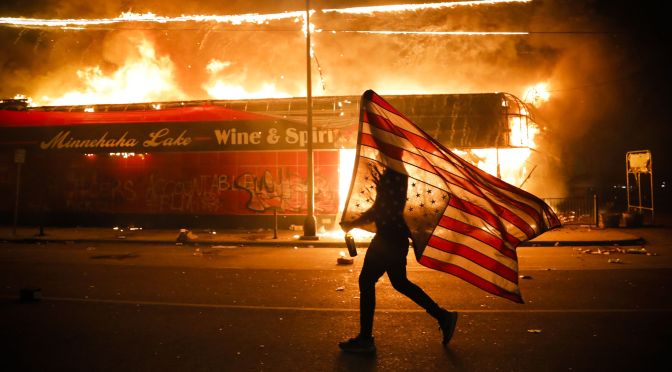
This past week protests have grown violent in Minneapolis and around the United States. Cities on fire and protesting crowds have been flooding our news feeds. 

Breath, fire and crowds. 

These are the images of Pentecost. Pentecost 2020. 

Once again, we arrive at another significant church festival, and things aren’t the way they usually are supposed to be.

Pentecost at home and social distancing is a something we never imagined as a way to mark this moment… at least not until just a few weeks ago. 

Like Lent, Holy Week and Easter this year, the Pandemic has imparted a certain authenticity to the moment. Lent required an unusual amount of sacrifice this year. Our Easter confinement to our homes was more like the original Easter than we ever imagined. And just last week, as the disciples wondered when things were going to go back to the good ol’ days, we too have been wondering when things might return to normal, or at least return and open up at all. 

Today, the Easter story is now bringing that community of disciples to an important moment. A moment of transformation and change. All the preparing that Jesus has been doing, helping his followers for what comes next, for their life as an Easter community comes to fruition as the spirit pushes them out into the streets and through them proclaims the gospel to all the nations. 

As we hear the Pentecost story each year, it is easy to get focused on the well known details of the story. It is easy to think that it is all about the disciples having tongues of fire landing on them (what is a tongue of fire anyways?), about going out into the streets and preaching in all different languages, about the accusation that they are drunk and finally the 3000 people that were baptized. Those details that lull us into thinking that Pentecost is all about the rapid expansion of the church, a model for faithful church planting and growing, a sign of the Holy Spirit’s blessing that good ministry is happening. 

Yet, this year amidst lockdowns and quarantines, we cannot even offer up our merger reproductions of that Pentecost experience by gathering for our small neighbourhood outdoor worship services and BBQs that we usually celebrate with.

All the while, just down the road from Winnipeg in Minneapolis, the images of fire and crowds, protests and anger speak to another version of pentecost this year. 

And they remind us of police involved shootings of indigenous people here in Winnipeg. We are forced to recognize that pandemic has locked down many things, but not the complicated (and often racist) relationship with police that people of colour have both in our country and just across the border to the south of us. 

And so despite the lack of tongues of fire, speaking in different languages, and 3000 baptisms… despite not having our usual pentecost celebrations and observances… and with the unmistakable pentecost images flooding our news this week… we might be wondering what is the Spirit actually up to among us? What does Pentecost mean for us today in 2020?

In John’s gospel we are given a clue. 

As the disciples are hiding out after the crucifixion, hiding in fear from the outside world, Jesus appears in their midst, speaking peace. 

Nothing else is familiar in this moment, but peace – shalom – is something they know. The greeting of the faithful, the peace of God shared between the people of Israel in the synagogue, in the street, in homes, wherever they are – Shalom Aleichem. 

And then Jesus breathes on them the spirit, the sign of life itself, the breath of God, breathed into Adam and Eve, now breathed again into them. 

Peace and breath given by the Word of God. 

The Word who was there in the beginning, speaking all of creation into existence.

The Word who became flesh and dwelt among us, full of grace and truth. 

The Word who rose from the dead on the 3rd day, transforming the life of creation itself, detaching us from death. 

And now the Word whose breath came upon the disciples, and 7 weeks later, whose breath and fire drove the disciples out into the streets to proclaim the good news to all nations.

The Good News of resurrected life found in the Word of life. 

This Word brought the disciples to the Pentecost moment. 

But Pentecost, this story central our identity as church, is not the destination. 

Pentecost was not and is not the new thing. 

Even as this community of disciples had gone from following Jesus for 3 years, to the experiences of Holy Week, and the re-orientation of Easter and resurrection, even as Jesus prepared them to be the new Easter community…

Pentecost was not the destination. Pentecost was temporary, a transitional space, a moment of disconnection. It was unlike anything they had experienced before, nothing like offering sacrifice in the temple, nothing like learning the Torah in the synagogue. 

And Pentecost, big spirit filled gatherings, full of converts hearing the good news and being baptized… is neither what this Easter community would become. 

Pentecost is a moment of disruption and disconnection. The moment that separated the disciples from the baggage they carried from before. The desire for the return of the Kingdom of Israel that they were still asking for just last week. From their desire for power and control, from their desire to shape and contort the spirit into their image. 

Pentecost instead was making them leave the old things, the old ways behind. 

And soon the early church became small communities of faith spread throughout the Empire, communities of 15 or 25 or 40 gathering around the Word and the shared meal of the Eucharist. 

And yet through all of it, the thread that connected this new Easter community to the faith that birthed them, to the ministry, crucifixion, and resurrection of Jesus, to Pentecost and then to the early church… the thread that connected them was the Word. 

The Word of God speaking from the beginning of time and still speaking to them now. 

And just as this pandemic world is unfamiliar to us and we don’t know where we are going, it is plain to see the we are living in our own Pentecost moment. The Spirit is not necessarily showing us the new thing that we are about to become, Pandemic church is not our new future. 

Instead, the spirit is stripping us of our baggage. 

Stripping us our of attachment to the old ways that we believed being faithful was all about. Of our attachment to culture and traditions that may not be helping us anymore, stripping us of our attitudes and assumptions that contribute to prejudice, racism and white supremacy that allow for a world where Black Indigenous People of Colour can be killed in broad daylight with almost no consequence, even as they cry out, “I can’t breathe.”

Stripping us of all the things that we thought we so important about being church, with the hopes that we will discern again what is essential. 

Yet, Pentecost is not our destination. 

This moment is one of transition for us too, the way are as community in this pandemic world is not the new way are going to be forever.

But as we await the new thing that we will become, Jesus is still speaking peace to us. 

Speaking peace in our homes, behind our locked doors, tying us to the thread of the Word that has been with us all along the way. 

The Word that centred the Church from before the time it was the Church.

The Word that birthed faith in us, in well-traditioned church communities that knew how to be church in their time. 

The Word whose resurrection and Easter story has been gathering us for generations, and will continue to gather us, even if it is in new ways. 

The Word who breathes the spirit in us, even in our socially distanced Easter, even in our homes at Pentecost. 

This Word is the constant all the way through, while the fires of Pentecost seem to be burning the rest of the world down around us. 

This is Pandemic of 2020 is our Pentecost moment when we know everything is changing while we still don’t know what we are changing into.

But Pentecost this year is also the reminder that the Word of God has not left us, nor sent us into this new word alone. 

Instead Jesus is coming again into our midst, speaking Peace to us, bringing us that familiar wind of the spirit, that familiar Word that gives us life.

So your church is opening up after COVID-19 closures? It won’t be what you are hoping for.

*** Guidelines and public health orders for opening up churches are sometimes hard to follow as the long lists can make your mind go numb. The following is a way of trying to put the guidelines in narrative context, to help picture what “going back to church” might look like in these COVID-19 days. ***

Sample Guidelines

It’s been months of isolation, months of mostly staying home to stop the spread of COVID-19. But active cases are going down (or maybe not), and politicians and business leaders are worried about the economic impact of social distancing. And so, for a few weeks now, things have been opening up. Playgrounds and hair salons, dentists and restaurant patios are letting people come back. 

And things seem to be going well enough, so the government announces the next phase of opening, which includes increased gathering sizes. And one of the places you have been missing the most, your church, sends out an email telling you that they are going to re-open for an in-person service on Sunday. 

You heard from a friend that your Pastor was against it, but enough folks were pressuring the council because of freedom of religion, people are getting tired of staying home and surely church should be a safe place right? Plus you are missing your friends, the folks you love to see on Sunday mornings, the other couples that you often go for brunch with following worship. 

Finally, the big day comes, you wake up excited to get back to this important part of your life, to something that feels little bit like normal, seeing familiar faces, hearing  familiar music, being in familiar community. 

You hop in the car with your spouse and make the well worn drive to church. You notice that the streets are even deader than usual for a Sunday morning. 

When you arrive at church there are few cars parked around building. You go to your normal parking spot, just down a side street, half a block from the church. 

You start walking up to the building, but before you get too close, a masked volunteer stops you. They are standing on the side walk. 

“Please stay there.” they stop you about 6 feet away from where they are standing. 

Okay… you think you know who this is, but they have a mask on their face and you aren’t totally sure. 

“Have you had any of the following symptoms recently: Cough, fever, body aches, difficulty breathing?”

“No, not that I know of,” you say.

“Are you over the age of 65 or have underlying health conditions?”

“No,” you say.

Technically, you and your spouse are 67 and you take blood pressure meds. But it’s no big deal.

“Have you been travelling recently, or spent any time with someone who has travelled recently?”

“No,” you answer again.

You don’t mention the socially distanced backyard BBQ you had with your neighbours the other night, including one neighbour who is a long haul trucker. 

“Have you been in contact with anyone who has been exposed to COVID-19, such as health-care workers?” 

“I don’t think so,” you murmur.

The babysitting you do for your son and daughter-in-law, who is a care-home nurse, doesn’t count. Family doesn’t count, right? 

“Please maintain social distance while you wait in line here.”

The volunteer gestures ahead, where you see a few dozen folks lined up – all space out according to markers along the side walk.  

Usually when you arrive at church, you come early to visit with folks before the service, but as you stand in line, people just whisper amongst households. Even though you can see many familiar faces ahead, you cannot help but feel suspicion and fear when you look at the others. You try to shake the feeling, but this pandemic world has affected you more than you want to admit.

Another couple lines up behind you and then you hear the masked volunteer turn another family away. 

“Sorry, we are at the max group size we are allowed. Maybe try again next week.”

The church stays closed right up until the time of the service. Then finally with 5 minutes to go, the door opens and households begin entering, one at a time. Another masked volunteer is letting people in. 

Slowly, you shuffle up to the door. When it gets to your turn, the volunteer waves you in. There are two surgical masks and some hand sanitizer laid out on a table.

“Please clean your hands and then put these masks on.”

You comply.

“Please follow the taped line to pew number 23 and take your seat. Please don’t stop to talk to anyone, and please remain seated for the duration of the service.”

You follow the taped line into the sanctuary, everyone is sitting down in space-out pews by household. The church is eerily quiet, kind of a like a funeral with a masked pianist playing quietly. 

Finally when everyone is inside, the doors to the church are closed. 

Instead of processing in from the back, where the pastor is usually visiting with people before church, the pastor slips in from the front of the church through a side door. The pastor then greets you from behind a mask… which makes them hard to understand. The pastor then explains that there will be no singing in worship, and no praying together or communal responses to the liturgy. You then notice there are no hymnbooks, offering envelopes or welcome cards in the pews. They are just empty. You also didn’t get a bulletin on the way in. 

Listening to the pastor, they don’t sound like their normal self… forced, stressed, tense? You can’t quite put your finger on it. 

The pastor then goes and stands in front of a phone on a tripod at the front of church and starts talking to it, welcoming all the people worshipping online. The pastor explains where the bulletin can be found on the Facebook page, how to share the peace and greet others also watching online. Then the pastor picks up the tripod turns it around and asks you to wave at the phone… which feels pretty silly and weird. 

Worship begins.

The pianist plays the hymns, but no one can sing. So you just sit and listen. It felt awkward to sing along with the hymns at home, but this feels even more strange. 

The pastor then begins worship, and every time you want to say “And also with you” or “Amen” you have to stop yourself. Instead, there is just silence while the pastor imagines how long it would take the folks watching online to give the responses. 

The first masked volunteer goes to a mic and music stand on the other side of chancel to read the lessons. You can’t say join in the psalm responsively, so again you just sit quietly and listen. 

Finally it comes time for the sermon. The pastor preaches about Pentecost and the coming of the Holy Spirit, encouraging you (but mostly the folks at home) to keep the faith. The pastor says that the time will come when the spirit will send us out into the world – but that time isn’t quite yet. And that even though we are apart, the spirit ties us together into one.

It doesn’t really feel like the pastor is preaching to you, but mostly to the those still at home.  

After listening to the hymn of the day, the creed and the prayers, it comes time for the peace.

The pastor offers the peace, but tells you that today it has to be virtual sharing only. The pastor uses their iPad to share with the folks online, and talks a bit to the phone again saying hello to people watching at home and commenting. 

Then it comes time for communion. Something you have missed for months now.  

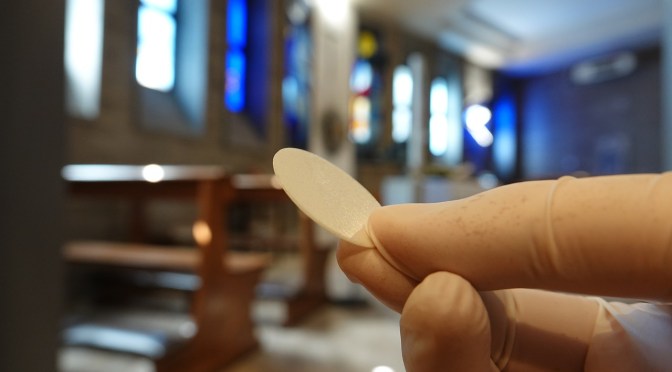
The pastor puts on a face shield and changes their mask before the Thanksgiving at the Table. You notice that they don’t lift the bread or the wine. After the Lord’s prayer, which you say along with the pastor in your head, one of the masked volunteers steps up to the mic to instruct you on how to receive communion. 

And household by household you go forward. There is only bread to receive today. You have to hand sanitize again at the front. The pastor is using a set of kitchen tongs to put the wafers in the hands of each person. 

“The bread of Christ given for you.” you hear from behind mask and shield. 

This is not like communion you have ever received before. You aren’t allowed to eat until the pastor has moved away, and then after you put the wafer in your mouth, you have to hand sanitize again (also knowing that pulling off your mask has compromised it, because your daughter-in-law gave you a lecture in mask wearing). 

The service concludes with another hymn that you listen to, a blessing and some announcements. 

And then just like you came in, you have to follow the tape straight out of the building, one household at a time. The pastor isn’t greeting people on the way out, in fact there is no one. Just the the voice of the masked volunteer in the PA system announcing pew numbers. There are signs that tell you to leave the church straight away, no lingering. 

You walk back to your car with your spouse. 

You get in for the drive home. 

You have no idea what you just experienced. You were at church, there were other people there, there were hymns and prayers, the pastor preached, you received communion (kind of)… but that wasn’t church, and it certainly wasn’t what you imagined when you thought of things opening back up again….

You drive home in silence… realizing that just maybe the world has changed more than you figured before now. 

It might take some time to get used to this. 

+++

Three days later you get a text from your neighbour, one of the ones you have had a few socially distant BBQs with. 

“You are going to get a call from the public health nurse,” it reads.

“I am so sorry.”

A few minutes later the phone rings. 

“Hi, I am calling from your local public health agency. I am calling you today as a part of COVID-19 contact tracing.”

Your heart drops and the nurse’s voice starts to sound like the teacher from Charlie Brown. You make out something about a testing appointment, the nurses gives you a time, date and address. 

Then the nurse says, “I am going to need to you to tell me all the people you might have come into contact with in the past two weeks. Especially, any groups in indoor spaces for prolonged periods of time, like doctor’s offices or someone else’s home, or maybe a church…”

There Is No Going Back To Normal Or the Glory Days – This is the Beginning

GOSPEL: John 17:1-11
1After Jesus had spoken these words [to his disciples], he looked up to heaven and said, “Father, the hour has come; glorify your Son so that the Son may glorify you… 11And now I am no longer in the world, but they are in the world, and I am coming to you. Holy Father, protect them in your name that you have given me, so that they may be one, as we are one.” (Read the whole passage)

Today, we arrive at the seventh and final Sunday in the season of Easter. Easter 2020 must be, without a doubt, the most memorable Easter in our memories. “We are living through history” has been an oft’ repeated phrase of the pandemic era. And our Easter journey as people of faith has not been that far off from our lived reality. Hiding out in locked rooms for fear of the outside world is an essential Easter experience. Having no frame of reference, no experienced story to tell that makes sense of our new world is an essential Easter experience. And being prepared as disciples of Jesus for an unknown future is an essential Easter experience. 

As we prepare to the flip the page on Easter with Pentecost Sunday next week, we slide between Easter realities. In John’s gospel we slide back to Holy Week where Jesus prays for his followers just as he is about to go the cross. In Acts, we hear Jesus and the disciples having a conversation about what happens next to this fledging Easter community. 

The disciples come to Jesus with a request to go back, to return the Kingdom of Israel.  To a specific dream of the“glory days.” A vision that requires a deep dive into the history of Israel.  A specific moment in time, after Moses, after the promise land, beginning with King David but before foreign nations began threatening their borders and before they were exiled and occupied by the Romans. And of course not during the reign of one of the bad or mediocre Kings, but one of the greats! Of course they forget that even during the best of times, God was still sending prophets into their midst telling them to repent and get their act together. 

After all the disciples had seen, from following the call of Jesus from their fishing boats to witnessing the resurrected Christ appear behind locked doors, and their burning question is “are we going back?”

Sound at all familiar?

If you have spent any time reading, watching or listening to the news, you know that the world is wondering when things are going to reopen: from sports to shopping to public spaces – including places of worship. In fact, in many cases, Christians have been at the forefront of the demand to for political and public health leaders to loosen restrictions on gatherings. 

And you would think of all the people demanding that things go back to the way they used to be, we would know better. 

Because we have been longing to go back to what we remember as the glory days, long before this pandemic hit the world. But of course, nailing down what we think we want to go back to is not as easy or straightforward as we think. It was only a matter of weeks ago that we were concerned with declining resources and aging populations and shrinking congregations. Is that what we want to return to? Or is there a more specific place we want to go backwards towards? Do we want to go back to the days of church buildings full of worshippers and bursting Sunday Schools? To a time when women, people of colour and LGBTQ2SIA+ people were prevented from holding positions of leadership in the church? To the time when many churches were homogenous cultural enclaves? To the time when pastors were paid in the chickens and made pastoral visits in order to shame members into handing over their offering?

Our desire may be to go back to the good old days, but which good old days might be hard to answer. 

It is normal to lament what was. Especially when we don’t know what is or what will be. But we have to admit it is strange to long for something that most of us can agree wasn’t that good… something that, if we’re really being honest needed change?

So when the disciples ask their question, Jesus not so gently tells the disciples that they have no clue what is coming next for them, and it isn’t their job to know. That is up to the Father. Instead they are just along for the ride, they are simply witnesses to the activity and plans of God in the world. 

The disciples had no clue that they were about to preach the gospel in all kinds of languages to all kinds of people baptizing them by the thousands. Nor did they know that most of the early church communities would small groups of 12 or 25 people spread throughout the Roman Empire and would be ministered to by a former Pharisee and murderer of Christians who liked to write letters. They did not know their little group of followers would spawn generations upon generations of faith communities proclaiming the gospel to all the ends of the earth.

They had no idea what their path would be as Jesus ascended to the Father. 

Yet as John describes to us, Jesus knows that his followers don’t have a clue what is in store for them. They are dreaming of the return of rose-coloured glory days, of going back to some imagined time of greatness that is certainly better in their imaginations than the real thing. 

They cannot help but look back with nostalgia and hope for the glory days again. 

And yet as Jesus prays, he names the ways in which his disciples belong to each other, that their life together is a reflection of Christ, peek into the Trinity, the relationship between Father, Son and Holy Spirit. All along Jesus has been stitching this rag tag group together, shaping and moulding them for the next phase, the next chapter. Transforming them into this newly birthed community of the gospel. A community defined by the life of Christ, a community tied into the very death and resurrection of the One sent to save. 

That even as they have no idea where they are about to end up, Jesus has been preparing them to be what God needs them to be. 

A community of faith, 
of imperfect and flawed people 
who may not know where they are going, 
but who proclaim that the risen Christ 
is their way, their life and their truth. 
That the cross and empty tomb have changed them 
and all creation 
for the kingdom that has God envisioned. 

And so here today, what does this mean for us? 

We who long to return to normal, even as we begin to recognize that life as we knew it will not, cannot to be the same as it was. We come to the end of Easter, in the midst of this time of global uncertainty longing for comfort of the past. 

And we too are just as clueless about what comes next for us as the disciples were. No matter our desire to go back to normal, to go back to the glory days, to restore the kingdoms of our imaginings… there is no going back. And more importantly, we aren’t the one steering the ship anyways. 

Yet, Jesus’ reminds us today, with Pentecost on the horizon, that our future is known by God. And that we too are being prepared for what comes next for us. 

That Jesus is sticking us together into One Body, 
preparing us yet again to be new communities of faith, 
birthed into the story of Christ’s death and resurrection. 
That the cross and empty tomb redefine us, 
even in a world of declining churches, 
even in a world of pandemic closures… 
God is transforming us into the very body 
that will proclaim the Good News to the world, 
through whom God will proclaim 
forgiveness of sins and salvation in the waters, 
in whom God feeds the world with God’s own Body – the Body of Christ given for us. 

And so yes on this 7th Sunday of the most memorable Easter we have known, we are reminded again that God has the regular habit of setting us off in new directions when we least expect it. And that the destination is not for us to know, nor what things will look like when we get there. But only that God is the one leading us, that we belong to one another in Christ and that the sprit goes with us. And that Christ has been preparing us for this moment long before we even had a clue.

The season of Easter may be coming to an end…

but Christ promises us that this new resurrected life in this Easter community is only beginning. 

Amen. 

Imagining The Destination and Not Knowing the Way

GOSPEL: John 14:1-14
Jesus said to the disciples:] 1“Do not let your hearts be troubled. Believe in God, believe also in me. 2In my Father’s house there are many dwelling places. If it were not so, would I have told you that I go to prepare a place for you? 3And if I go and prepare a place for you, I will come again and will take you to myself, so that where I am, there you may be also. 4And you know the way to the place where I am going.” 5Thomas said to him, “Lord, we do not know where you are going. How can we know the way?” 6Jesus said to him, “I am the way, and the truth, and the life. No one comes to the Father except through me. 7If you know me, you will know my Father also. From now on you do know him and have seen him.”

Today we enter into the second half of the season of Easter. We had been staying still, soaking in the the moment of resurrection, the stories of Easter beginning with the women at the tomb, then the disciples hiding away in the locked room, and then the two walking down the road to Emmaus. Coming back to that resurrection day because of its singular significance for us as a touchstone of faith. 

But then last Sunday we heard about the Good Shepherd, the Christ who leads us through the dark valleys, who shows us the way to the other side of the dangers that await us in this world, and it wasn’t just a comforting image to think about. Good Shepherd Sunday moved us from the immediacy of the first Easter morning and the immediacy of our pandemic lockdown, moves us onto the next step of this collective journey were are on as citizens of a pandemic world and as followers of Jesus.

This middle Sunday of the Easter Season moved us along the story, and put us into the second half of the Easter Season… to the part of the story of faith about becoming an Easter community and Easter people… it sounds great, but just like for the disciples, it is also scary for us. 

Today, we hear a familiar passage from John, “In my Father’s house there are many dwelling places…” This conversation between Jesus and his disciples comes to us from Maundy Thursday. Jesus has already raised Lazarus from the dead, and rode into Jerusalem hailed as a conquering Messiah. This conversation is first heard in moments before Jesus is eating the Last Supper with his disciples and friends. He is about to be arrested, put on trial and sentenced to death. This conversation happens in the shadow of the cross and just around the corner from the resurrection. 

And yet, Thomas (who will later demand to see the resurrected Jesus for himself) is wanting more information. He remembers following Jesus for the past 3 years, not really knowing where Jesus was going or what surprises might befall them, where the end goal might be. He is certain that he and the others won’t find their way on their own. 

Philip then comes out with it, he wants Jesus to show them the way, to fast-forward to the end and to show his followers the Father. 

The disciples, even after all they have seen of Jesus, all the miracles and healing, the exorcism and his preaching… they still have no idea where Jesus headed. They don’t know what Jesus is up to. They don’t know where they are headed, and they certainly don’t know how to get there. 

And yet the disciples seem to keep imagining the end goal, the destination, the point of arrival. They watched Jesus being greeted by hungry crowds wherever they traveled and they imagined celebrity. They watched Jesus debate and argue and put the religious authorities in their places, and they imagined power and influence. They see Jesus ride into Jerusalem like a king, and they imagine a throne room, a general commanding armies to victory. 

This whole time, the disciples have been thinking of the destination, imagining that possibilities of what this journey following Jesus bring them to, reward them with, change their fortunes to. 

This coming Friday, it will be 2 months since we last gathered in person for worship. Back then we were hopeful of being back together by Easter Sunday. How naive we were. We are now 5 Sundays on from Easter, and even with lots of conversation in the news and on social media about re-opening our world, we know that things aren’t just going back to the way they were before. The way ahead is mostly unclear with a lot of ideas and possibilities, but little certainty. Might we be still be tuning into the worship on Facebook for Canada Day? Will our Back to Church BBQ be a zoom gathering? Will will be lighting virtual candles for All Saints? Will Christmas Eve worship involve singing silent night from our respective front porches (if it isn’t too cold)?

We have come into a time where making plans is nearly impossible and every decision we took for granted before is now a calculation about risk and need, about timing and importance. Knowing what will happen and what will be possible for us next week or next month is simply beyond us. 

And so we stumble along, day to day, hour to hour, waiting for clarity and a path forward.

But more importantly, we hold onto some idea of a destination. We imagine the world as it used to be, or perhaps an even better version than that. We want to arrive at the moment when public gatherings and sharing public space are normal, unthinking activities again: Haircuts, grocery shopping, visits to the dentist, going to the movies, chats at the office water-cooler, dinner out with friends, backyard Barbecues with neighbours, airline flights where the biggest hassles are crying babies and people who insist in putting their seat back into your knees. And of course we imagine gathering together as a community of faith, greeting one another with handshakes and hugs, singing together again, sharing the peace, gathering at the table of the Lord, sharing coffee and cake after worship. 

“Jesus, we don’t know where this is going, how can we know the way?”

“Just show us the vision and we will be satisfied.” 

It isn’t surprising that this text is so often used at funerals. There is comfort in our visions of the destination. The great house where there is a room for us, the vision of our loved ones being welcomed into eternity is something to hold onto in the midst of crisis and grief. 

Yet, as Jesus speaks over the Last Supper to his disciples about the dwelling place of God with many rooms, he isn’t wanting us to imagine a giant mansion in the sky. In fact, it isn’t about the destination of our imagining at all. 

Where Jesus is going is to the cross. And the dwelling place of many rooms is not so much a mansion, but the opening up of creation itself… the opening up of us ourselves. The dwelling place of God will now be among mortals we hear at Christmas and incarnation. It fulfilled at Easter and in the resurrection. The creation that chose selfishness and therefore death in the fall, is about to be reunited with the creator who is making room within Godself. The creation that was once closed to new life will now be the home of God, and we will be welcome into the life of the Father, Son and Holy Spirit. 

And the way to get there is not to imagine the destination… But rather through the One who is the Way, the One who shows us the Father, the One who will face separation and isolation, who will go over the brink of sin and death… this One… 

This Christ is our Way. 

This Christ our Truth. 

This Christ is our Life. 

This One is where we are going, this One brings us into God’s way. 

As the disciples moved on from the day of the empty tomb, they moved into a new Easter world. A world where the Good News of Christ’s death and resurrection defined their community, defined their purpose, and defined their lives. They moved into a world where they didn’t always know what might be next for them, yet where God had opened God’s new dwelling, God’s welcome right there, wherever they were. 

And as we wonder what is next for us and when we might get to our imagined destination, Jesus reminds us that God has always been our way. 

That the place that Jesus has always been going to has been to us. 

Meeting us in the Word and showing us the Father. 

Welcoming us into the dwelling place of God in the waters of baptism. 

Showing us the way at the table of the Lord, and transforming us into the Body of Christ. 

Sure we don’t know when we will get back to work, or school, or shopping malls, or football games. And we don’t know when we might welcome our family and friends again into our homes and to our dinner tables…. 

But as the Body of Christ we have always been going to the same place… always to New Life in God. 

And how do we get here, what is our way?

Today Jesus reminds us again, “I am the way, and the truth, and the life.

An iPhone Pastor for a Typewriter Church